


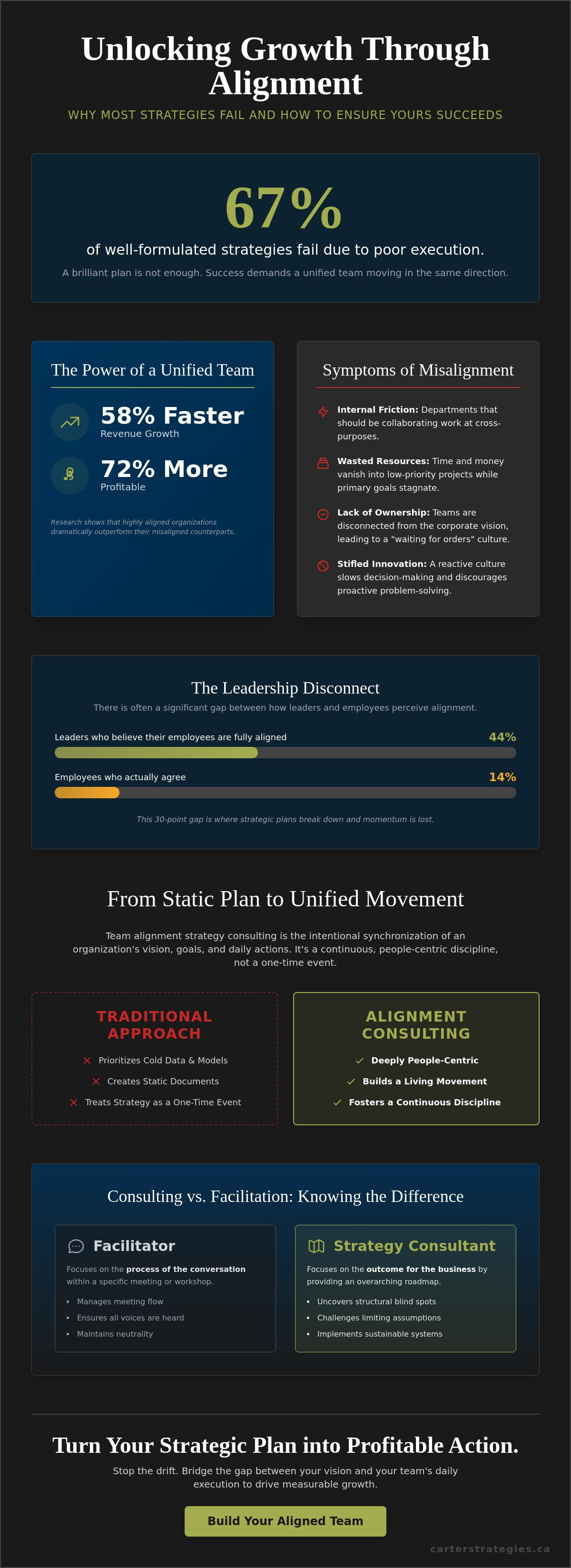
Did you know that 67 per cent of well-formulated strategies fail because of poor execution? It is a staggering figure that highlights a painful reality for many executives: a brilliant plan on paper doesn't guarantee results if the people responsible for it aren't moving in the same direction. You likely recognize the symptoms of this disconnect. Perhaps it's the internal friction between departments that should be collaborating, or the frustration of watching resources vanish into low-priority projects while your primary goals remain stagnant. It's exhausting to lead a team that lacks ownership of the corporate vision you've worked so hard to build.
Investing in team alignment strategy consulting addresses these gaps by shifting the focus from the static document to the people. Research indicates that highly aligned organizations grow revenue 58 per cent faster and are 72 per cent more profitable than their misaligned counterparts. In this article, you'll learn how to transform your strategic plan into a unified organizational movement that drives measurable growth. We will examine the methodology for building a cohesive leadership team, sharpening your strategic focus, and implementing the practical systems required to turn high-level vision into consistent, profitable action.
Key Takeaways
- Learn to synchronize your corporate vision and strategic plan with daily actions by moving beyond traditional management habits toward a people-centric approach.
- Identify the hidden financial costs of strategic drift and the psychological toll that misalignment takes on leadership and middle management.
- Discover how team alignment strategy consulting utilizes a Strategic Priorities Framework to organize company efforts and sharpen focus.
- Master a five-step process to audit your current state of alignment and simplify top priorities to ensure full stakeholder engagement.
- Explore the role of fractional Chief Strategy Officer, CMO or CRO services in bridging the gap between high-level strategic planning and revenue-driving execution.
What is Team Alignment Strategy Consulting?
Team alignment strategy consulting is not merely a series of workshops or a binder left on a shelf. It is the intentional synchronization of an organization's vision, goals, and daily actions. While traditional strategy consulting often prioritizes cold data and financial modeling, Team Alignment Strategy consulting is deeply people-centric. It recognizes that strategy fails when it lacks the heartbeat of the team. This methodology treats alignment as a continuous discipline rather than a one-time event, ensuring that every individual understands how their specific tasks contribute to the company's ultimate success.
Many mid-size companies eventually reach a complexity ceiling. This is the point where the informal communication and founder-led intuition that fueled early growth are no longer sufficient. As departments grow, silos naturally form, and internal friction begins to stall progress. Team alignment strategy consulting provides the structural buy-in, commitment and strategic action plan and roadmap needed to break through this ceiling. This strategic action plan acts as the bridge between high-level planning and boots-on-the-ground execution, turning a static document into a living, breathing movement within the company.
The Evolution of Strategic Alignment
The era of top-down mandates is over. In the current business climate, alignment has shifted toward collaborative frameworks that prioritize organizational health. For mid-market firms, scaling challenges are often tied to the human element. Leaders must realize that Strategic alignment is a revenue-driving strategy that centres on people. It's about creating a culture where accountability is shared and goals are transparent, allowing firms to pivot quickly without losing their core focus.
Consulting vs. Facilitation: Knowing the Difference
It's vital to distinguish between facilitation and true strategy consulting. Facilitation is a useful tool for managing a specific meeting or workshop. However, team alignment strategy consulting provides the overarching roadmap. A facilitator focuses on the process of the conversation; a consultant focuses on the outcome of the business.
A battle-tested expert like Jani Havunen identifies structural blind spots that are often invisible to those inside the organization. They bring a practitioner's vocabulary to the table, rooted in real-world experience rather than textbook definitions. This perspective allows them to:
- Uncover hidden departmental conflicts that drain resources.
- Challenge assumptions that lead to strategic drift.
- Implement systems that ensure long-term focus and implementation.
A consultant acts as a fractional leader who values internal buy-in as much as financial metrics. They understand that the best solutions are uncovered through collaboration, not imposed from the top down. This ensures that the path forward is both practical and sustainable for the entire team.
The High Cost of Organizational Misalignment
Strategic drift is a silent killer of corporate momentum. It happens when teams begin to prioritize secondary tasks over the primary objectives defined in the boardroom. This misalignment often results in a massive waste of resources as departments work at cross-purposes, frequently duplicating efforts without realizing it. For many leaders, the psychological toll is just as heavy as the financial one. When middle management feels disconnected from the core vision, they stop taking the initiative. This leads to a culture of "waiting for orders" that slows decision-making to a crawl and stifles innovation. Opportunity cost in this context is the cumulative value of the growth and market share you sacrifice while your organization is busy doing the wrong things well.
Why Strategic Plans Fail in Mid-Size Companies
Most strategic plans fail because they are treated as financial exercises rather than human ones. A spreadsheet can show you where you want to be, but it cannot show you how nor inspire a team to get there. There is often a significant gap in how goals are communicated from the top down. While 44 per cent of leaders believe their employees are fully aligned, a 2024 study showed that only 14 per cent of employees actually agree. This disconnect is why many mid-market leaders struggle with solving company strategy alignment problems. Without a clear path for cascading goals to the front line, the plan remains a static document rather than a catalyst for action.
The Impact on Revenue and Growth
The friction caused by misalignment is most visible in the relationship between marketing and sales. When these teams aren't strategically aligned, the customer experience becomes fragmented and inconsistent. This lack of cohesion makes it nearly impossible to scale without descending into chaos. Many executives respond to stagnant growth by demanding that their teams "do more," but increasing the volume of work on a flawed strategy only accelerates the drift. True growth requires a unified effort where every dollar spent and every hour worked moves the company toward a single, agreed-upon destination.
Engaging in team alignment strategy consulting helps identify these structural redundancies. By removing the silos that slow down decision-making, you free up your leadership to focus on high-impact growth. If you find your team is working harder but seeing fewer results, it may be time to look at your business strategy to ensure it is clear enough and your people and your plans are finally in sync. This transition from a fractured approach to a unified movement is the foundation for accelerated revenue growth.
Core Components of an Effective Alignment Framework
A robust framework for alignment moves the organization beyond the "workshop" mentality toward a continuous strategic discipline. At its core, the Strategic Priorities Framework organizes company efforts into three to five high-impact pillars. This prevents the strategic drift mentioned earlier by providing a filter for every new project or initiative. If a task doesn't serve one of these pillars, it doesn't receive resources. This level of focus requires a clear and compelling vision that resonates at every level. It's the difference between a team that works for a paycheck and a team that works for a purpose. Effective team alignment strategy consulting relies on this framework to bridge the gap between high-level planning and boots-on-the-ground execution.
Measuring success requires performance indicators that track both output and alignment. Standard financial metrics tell you what happened; alignment metrics tell you why. Research shows that high-trust organizations experience 50 per cent greater productivity, a metric that directly correlates with how well the team understands the overarching strategy. When comparing organizational health, the data is clear:
- Aligned Organizations: Experience 58 per cent faster revenue growth and are 72 per cent more profitable.
- Misaligned Organizations: Face a 67 per cent strategy failure rate and 21 per cent higher turnover in high-turnover industries.
Leadership Alignment: The Foundation
The executive team must be the first to realize and model the strategy. If the leadership group is fractured, the rest of the organization will be as well. Securing buy-in among diverse leadership personalities requires moving past individual agendas to focus on collective outcomes. This involves candid discussions to uncover hidden resistances and personality conflicts to ensure every executive is a vocal advocate for the unified path forward. For a deeper dive into this process, see our guide on leadership alignment for business growth.
Connecting People to Strategy
Connecting people to strategy involves translating boardroom goals into meaningful daily tasks. This requires a model for strategic alignment that links individual employee goals and behaviours to the company's broader objectives. Transparent communication builds a culture of shared accountability where everyone knows their role in the bigger picture. Use active verbs in internal messaging—words like "implement," "drive," and "realize"—to encourage movement and prevent the plan from becoming a static document.
5 Steps to Realize Alignment Across Your Organization
Moving from a fractured team to a unified force requires a deliberate, phased approach. While many leaders attempt to force alignment through decree, true synchronization happens when the team understands the "why" behind the "what." This process transforms strategy from a high-level concept into a shared operational reality. Team alignment strategy consulting provides the structure needed to navigate these transitions without losing momentum or morale.
Step 1: The Alignment Audit
The first step is to uncover the blind spots that exist within your current structure. Perceived alignment is often a mirage; executives may believe the path is clear while front-line staff feel lost in the weeds. To bridge this gap, you must engage stakeholders at every level to understand their reality. A leader should directly ask their team: "What are our top three priorities this quarter, and how does your specific work directly impact them?" If the answers vary significantly across departments, you have identified a critical gap in your strategic communication.
Step 2: Define and simplify. Complexity is the primary enemy of execution. Once the audit is complete, narrow your focus to the three to five strategic priorities that will move the needle. If everything is a priority, nothing is. Step 3: Cascade goals. Use a structured framework like Objectives and Key Results (OKRs) or Balanced Scorecards to ensure these priorities reach the front line. Research indicates that when employees clearly understand business objectives, 63 per cent report higher productivity and 59 per cent have more motivation. This ensures that every individual contributor can see the direct line between their daily output and the company's long-term success.
Step 4: Maintaining Momentum
Alignment is a living, breathing execution model, not a one-off project. Establishing a rhythm of accountability through regular strategic check-ins ensures that the plan remains relevant as market conditions shift. Strategic friction is inevitable when priorities change mid-year; however, a unified team can pivot without losing focus because the underlying vision remains stable. Celebrate small wins along the way to maintain employee buy-in. These milestones prove that the unified effort is working, which reinforces the culture of shared accountability.
Step 5: Continuously refine. Strategy is never truly finished. Use real-world execution data to refine your approach, ensuring your tactics remain aligned with your evolving goals. If your firm is ready to move beyond static planning, consider how growth strategies and planning can help you build a more resilient and responsive organization. This methodical path ensures that your team remains focused on measurable growth rather than just busy work.
Scaling with Purpose: The Carter Strategies Approach
Carter Strategies partners with mid-size firms that have reached the complexity ceiling where informal communication no longer sustains growth. We provide a practical, pragmatic perspective, grounded in the realities of cross-functional matrixed corporate environments. Our team alignment strategy consulting doesn't just deliver a plan; it delivers the implementation framework required for sustainable expansion. We help you cut through the noise to focus on the core activities that drive results. This approach ensures your strategic plan moves from a static document to an energetic organizational movement.
Our methodology focuses on shared accountability and the human element of corporate growth. We act as a strategic guide or fractional leader who values internal buy-in as much as financial metrics. By uncovering the best solutions through collaboration rather than top-down imposition, we help you build a actionable plan and identify practices that translate and embed the plan throughout the organization. This transition from organizational confusion to unified execution is what allows companies to realize their full potential without the friction that typically slows down scaling efforts.
Your Path to Strategic Clarity
The journey from organizational confusion to unified execution requires a shift in how your team perceives their roles. It involves moving away from traditional, ineffective habits toward a more integrated alternative. We remain committed to pragmatic, action-oriented consulting that prioritizes measurable outcomes over theoretical models. This steady rhythm of assessment, planning, and implementation brings order and clarity to complex transitions.
Alignment is a necessity for any firm aiming to scale without chaos. By choosing a partner who understands the "trenches" of business, you ensure your growth is both focused and profitable. Schedule a consultation with Carter Strategies to align your team and realize your organization's full potential. We help you bridge the gap between where your business is and where your vision says it should be.
Realize Your Organization's Full Potential
Strategic alignment is not an HR initiative; it's a revenue-driving strategy that centres on people to realize growth. You've seen how organizations that synchronize vision with daily action grow 58 per cent faster and achieve significantly higher profitability. By implementing a Strategic Priorities Framework and establishing a rhythm of accountability, you transform your plan from a static document into a unified movement. Success requires moving beyond traditional, fragmented habits toward a more integrated and inclusive alternative that prioritizes organizational health.
Frequently Asked Questions
What is the difference between team building and team alignment?
Team building focuses on strengthening interpersonal relationships and trust, whereas team alignment focuses on strategic synchronization. While team building creates a positive social environment, alignment ensures that every individual understands the corporate vision and their specific role in executing it. You need both to succeed, but building trust is only the foundation for the unified action required to drive growth.
How long does it typically take to see results from alignment strategy consulting?
Structural clarity often emerges within 30 to 90 days, though full cultural shifts take longer. The initial audit identifies immediate gaps in communication and focus, allowing leaders to implement a Strategic Priorities Framework quickly. Most organizations begin to see improvements in productivity and decision-making speed within the first full quarter of implementation.
Can a small or mid-size company benefit from alignment consulting as much as a large enterprise?
Mid-size companies often realize the greatest benefits because they are at the complexity ceiling where informal communication no longer works. Team alignment strategy consulting helps these firms build the structural integrity needed to scale without the bureaucratic bloat of a massive corporation. It ensures that a growing team remains agile and focused on high-impact revenue activities.
What are the signs that my leadership team is misaligned?
Common signs include strategic drift, where departments prioritize secondary tasks, and a recurring lack of shared accountability for missed targets. If your marketing and sales teams are operating with different metrics, or if departmental silos cause redundant work, your leadership is likely misaligned. This friction usually results in slowed decision-making and visible frustration among middle management.
How do you measure the ROI of team alignment strategy?
ROI is measured through accelerated revenue growth, improved profit margins, and lower employee turnover rates. Research indicates that highly aligned organizations grow revenue 58 per cent faster than their misaligned counterparts. You can also quantify the reduction in wasted resources by tracking the percentage of projects that directly serve your top strategic priorities versus those that don't.
What role does technology play in maintaining organizational alignment?
Technology serves as a visibility tool that ensures cascading goals remain transparent and measurable across the entire organization. Shared dashboards and project management systems allow teams to track their progress in real time, which reinforces a culture of accountability. However, technology is only effective if the underlying strategy and human buy-in are established through team alignment strategy consulting first. When implementing new systems, working with a Business With AI Strategist can ensure that advanced tools like artificial intelligence are deployed in a way that supports your overall alignment strategy.
How often should a strategic alignment audit be conducted?
Perform a comprehensive audit at least once a year to ensure your people and plans remain in sync. High-growth firms often benefit from quarterly strategic check-ins to address strategic friction and refine tactics based on execution data. This regular rhythm prevents the strategic plan from becoming a static document and keeps the organization focused on measurable growth.


