

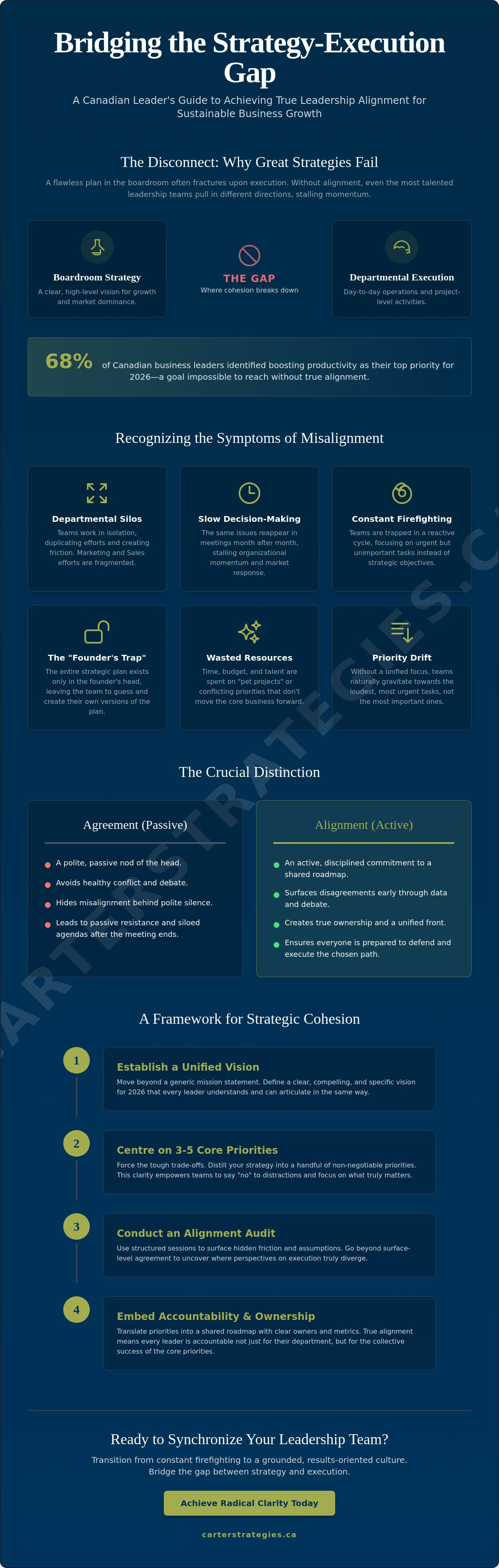
Why does a strategic plan that looks flawless in the boardroom so often fracture once it reaches the departmental level? Many Canadian mid-market leaders find themselves presiding over talented executive teams that, despite their best intentions, are pulling in different directions. This lack of cohesion often results in siloed departments and resources wasted on low-priority projects that don't move the needle. You've likely felt the weight of slow decision-making and the friction that arises when your leadership isn't on the same page. It's a common struggle, especially as 68% of Canadian business leaders in 2026 identify boosting productivity as their top priority, a goal that is impossible to reach without leadership alignment for business growth.
We believe that a plan is only as effective as the people who believe in it. This guide shows you how to achieve genuine alignment by synchronizing your executive team to bridge the gap between strategy and execution. You'll discover how to unify your leaders around 3-5 core priorities, allowing for faster execution of your roadmap and sustainable revenue growth. We'll outline a pragmatic path to transition from constant firefighting to a grounded, results-oriented culture where everyone is accountable for the same shared vision. By focusing on the human element of corporate growth, you can ensure your strategic investments actually deliver the results your organization deserves.
Key Takeaways
- Distinguish between simple agreement and true ownership to ensure your executive team is actually committed to the same execution path.
- Recognize the symptoms of the strategy-execution gap, such as the "Founder's Trap," before they stall your organizational momentum.
- Apply a structured framework for leadership alignment for business growth that centres your team on a unified vision for 2026.
- Master practical techniques like the Alignment Audit and Radical Clarity sessions to surface and resolve hidden internal friction.
- Explore how fractional leaders can act as objective catalysts to bridge the distance between high-level planning and daily operations.
What is Leadership Alignment and Why is it Critical for Growth?
Leadership alignment is the bedrock of any successful scale-up strategy. It isn't just about executive harmony or a lack of shouting matches in the boardroom; it's the shared ownership of a company's vision, its immediate priorities, and the specific execution path required to get there. For Canadian mid-market firms, this becomes particularly vital during the transition from a founder-led "hero" model to a professional executive-led structure. When a founder has the entire plan in their head, the team is often left guessing. True alignment ensures that the strategy is realized through every layer of the organization, starting with a unified front at the very top.
Realizing What is Strategic Alignment? involves more than just reading a mission statement. It requires a deep, pragmatic look at how your executive team functions as a single unit. Without this foundation, even the most brilliant marketing strategy or business plan will eventually stall. Leadership alignment for business growth isn't a one-time event; it's a continuous process of ensuring that every resource, dollar, and hour spent is moving the company toward the same destination.
Alignment vs. Agreement: The Crucial Distinction
Agreement is a passive nod of the head, whereas alignment is an active, disciplined commitment to a shared roadmap. In many Canadian boardrooms, leaders mistake "polite agreement" for actual buy-in. While everyone might agree that "growth is good," they often misalign on which specific trade-offs are necessary to achieve it. This polite silence often transforms into passive resistance once the meeting ends, with department heads returning to their silos to focus on their own agendas. To reach true alignment, your team must engage in healthy conflict. You need to surface disagreements early and resolve them with data and debate so that the final path is one everyone is prepared to defend and execute.
The Role of Alignment in Accelerating Scalable Growth
Alignment acts as the primary engine for leadership alignment for business growth by drastically reducing internal friction. Friction is the internal energy your company wastes on redundant work, conflicting priorities, or "pet projects" that don't align with the core strategy. When your executive team is synchronized, you create a powerful multiplier effect. Your teams move faster and with significantly more autonomy because they understand the 3-5 priorities that actually matter. In a business environment where certainty of execution is becoming more valuable than sheer transaction speed, this internal clarity is a massive competitive advantage. It allows your organization to pivot quickly and capitalize on market opportunities before they vanish, ensuring that your growth remains both sustainable and intentional.
The Strategy-Execution Gap: Recognizing the Symptoms of Misalignment
Many Canadian mid-market firms suffer from a disconnect where the executive suite believes they are moving forward, but the departments are actually standing still. This is the strategy-execution gap. It often begins with the "Founder's Trap." You might have a clear vision in your head, but if your team is left to fill in the blanks, they will inevitably create their own versions of the plan. This lack of leadership alignment for business growth creates a vacuum where priority drift becomes the norm. Instead of focusing on long-term strategic objectives, teams naturally gravitate toward the loudest, most urgent tasks. It's a cycle of constant firefighting that prevents true scaling.
Misalignment isn't always loud or confrontational. Often, it's a quiet drift that results in a leadership team that is out of sync with the actual business strategy. You might notice that decisions take longer than they used to, or that the same issues keep appearing in executive meetings month after month. Identifying these indicators early is essential. When your leaders aren't synchronized, the rest of the organization loses its sense of direction, leading to wasted resources and missed market opportunities.
Silos and the Failure of Integrated Marketing Strategy
Fragmented efforts between Marketing and Sales are a hallmark of this misalignment. Without a cohesive business strategy development process that precedes tactical execution, these departments often end up working at cross-purposes. Marketing might be chasing lead volume while Sales is looking for high-value enterprise accounts. This disconnect creates a significant revenue leak, as marketing spend is wasted on prospects that the sales team cannot or will not close. Professional growth strategies and planning can help bridge this divide by establishing shared KPIs and a unified message that resonates across all channels.
The High Cost of "Busy-ness" Without Progress
High activity is often mistaken for progress. In mid-size firms, you'll see teams working late and checking off endless tasks, yet the needle on sustainable revenue growth barely moves. This "busy-ness" without progress leads to profound fatigue. When employees feel like they're rowing in different directions, burnout is inevitable. In fact, early 2026 data shows that 62% of Canadian leaders are prioritizing employee wellbeing, yet they often overlook the fact that misalignment is a primary driver of workplace stress. Adopting a proven framework for leadership alignment allows you to audit where your team's focus has broken down and redirect that energy toward high-impact work that drives leadership alignment for business growth.
Building a Framework: The Three Pillars of Strategic Cohesion
For a mid-market firm in Canada, scaling beyond the founder's initial success requires a shift from individual intuition to collective discipline. While global consulting firms often push complex, academic models, a pragmatic framework for leadership alignment for business growth focuses on three foundational pillars. These pillars act as the structural support for your organization as it matures, ensuring that your executive team remains a cohesive unit rather than a collection of high-performing individuals. Without this structure, growth often becomes chaotic and unsustainable.
- Pillar 1: Shared Vision. This is the non-negotiable destination. By the time we reach 2026, every member of your C-suite must be able to describe the company's future state with identical clarity. If there is even a five-degree variance at the top, that gap becomes a chasm by the time it reaches the front lines.
- Pillar 2: Strategic Priorities. This is the "how" of your journey. It involves identifying the "Vital Few" initiatives that will move the needle, rather than drowning the organization in the "Trivial Many" that merely create noise.
- Pillar 3: Accountability Systems. Alignment without accountability is just a nice conversation. You need clear systems to measure progress, celebrate wins, and, most importantly, address deviations from the plan before they become systemic failures.
This framework is specifically designed to help leaders navigate the messy middle of scaling. It provides the stability needed to transition from a reactive posture to an intentional, strategic one. When these three pillars are in place, the entire organization gains a sense of calm and focus that is often missing in rapidly growing companies.
Establishing the 'Vital Few' Strategic Priorities
The hardest part of leadership is not choosing what to do; it's choosing what not to do. Most mid-market leaders are surrounded by good ideas, but a surplus of "good" often kills the "great." We recommend narrowing your focus to 3-5 key objectives that directly drive growth. Saying "no" to a profitable but distracting project requires significant executive courage. Often, engaging a strategic management consultant provides the external perspective needed to facilitate these difficult conversations. An objective third party can help your team navigate the internal politics and emotional attachments that often cloud strategic decision-making, ensuring that the final list of priorities is one everyone can fully support.
Connecting People to Strategy Through Shared Values
Values are not just words on a lobby wall; they are the "operating system" that guides your team when you aren't in the room. In the executive suite, this means fostering a culture of empathy and a collaborative spirit. When leaders trust each other, they are more likely to share resources and support cross-departmental initiatives. This focus on organizational health ensures that leadership alignment for business growth is built on a foundation of mutual respect rather than just financial metrics. A plan is only as strong as the people who believe in it, and people believe in a plan when they feel seen, heard, and valued by their peers. This human-centric approach is what transforms a dry strategic roadmap into a living, breathing culture of execution.
Five Steps to Synchronize Your Executive Team for Scalable Growth
Many leaders mistakenly treat alignment as a one-time event, perhaps a seasonal retreat or a single boardroom session. To achieve leadership alignment for business growth, you must instead view it as a recurring operational discipline. Synchronization doesn't happen by accident; it's the result of a methodical process that identifies friction and resolves it before it stalls your momentum. We recommend a five-step approach to bring your executive team into lockstep.
Start with an Alignment Audit. Ask your leadership team the same three questions in isolation: What is our primary goal for the next 12 months? Who is our most valuable customer? What is the single biggest hurdle to our growth? You'll often find that even the most seasoned teams provide wildly different answers. Once these gaps are surfaced, facilitate a Radical Clarity Session. This isn't a time for polite agreement; it's a space to get the friction out in the open and resolve it through data-backed debate. From there, document your Strategic Roadmap, ensuring you clearly articulate the "why" behind every priority. This leads to Cascading the Message, where high-level goals are translated into departmental objectives. Finally, establish a Rhythm of Review. Regular alignment checks, whether weekly or monthly, are essential to prevent the natural drift that occurs in a fast-paced business environment.
Overcoming Common Strategy Alignment Problems
The most frequent failure point in this process is the "Middle Management Gap." You might achieve perfect clarity in the C-suite, but if that vision isn't communicated effectively, your managers will continue to focus on tactical "busy-ness." For a deeper dive into these hurdles, see our guide on solving company strategy alignment problems. To keep your momentum, use this checklist during your monthly reviews:
- Are we still focused on the same 3-5 "Vital Few" priorities?
- Have any "pet projects" or distracting "good ideas" crept into our workflow?
- Is there any departmental friction that hasn't been voiced or resolved?
- Do our current resource allocations actually reflect our stated strategic goals?
Securing Employee Buy-in for Long-Term Success
Top-down mandates rarely produce the same results as a collaborative alignment process. When your team members understand the logic behind the strategy, they're more likely to take ownership of their specific roles. You must translate high-level growth goals into daily tasks that resonate with each department. If you're ready to move beyond theoretical planning and into active execution, our Growth Strategies and Planning services provide the hands-on guidance required to make this transition. Transparent communication and celebrating "alignment wins" will help solidify this new way of working, ensuring that leadership alignment for business growth becomes a permanent part of your corporate DNA.
Leveraging Fractional Expertise to Drive Leadership Alignment
Many Canadian mid-market leaders reach a point where they realize they cannot scale alone. The internal friction and "Founder's Trap" discussed earlier often require more than just an internal reshuffle. This is where Fractional CMO and CRO services provide a pragmatic, structural solution. Unlike large-scale management consulting that often leaves behind a thick binder of advice, a fractional leader joins your team to bridge the gap between high-level planning and boots-on-the-ground execution. They act as a stabilizing force, bringing the seasoned authority needed to drive leadership alignment for business growth without the overhead of a permanent executive hire.
The Fractional CMO as an Alignment Catalyst
A Fractional CMO does more than manage campaigns; they ensure your marketing strategy is a direct extension of your business objectives. In many firms, marketing becomes an island, focused on metrics that don't translate to revenue. By integrating a fractional leader, you align your marketing priorities with the overall growth roadmap. This role helps organize your efforts for maximum impact, ensuring that every dollar spent is supporting the "Vital Few" priorities we identified earlier. It's a way to gain senior-level expertise that understands the unique pressures of the Canadian market while maintaining the flexibility your balance sheet requires.
Why an Outside Perspective is Essential for Strategic Focus
It's difficult to read the label from inside the jar. Internal teams often struggle to identify their own alignment gaps because they're too immersed in the company culture and daily "firefighting." An external fractional leader brings an objective, third-party perspective that can surface uncomfortable truths without being entangled in internal politics. This battle-tested expert persona is essential for building trust with your existing executive team. They don't come in to replace current leaders, but to act as a strategic guide who has been in the trenches and understands that a plan is only as good as the team's buy-in.
Achieving leadership alignment for business growth is an ongoing operational discipline, not a one-time retreat. It requires a partner who values shared accountability as much as financial metrics. If you're ready to synchronize your executive team and bridge the strategy-execution gap, it's time to bring in a practitioner who has successfully navigated these transitions before. Contact Carter Strategies to align your leadership team for growth.
Realizing Your Growth Potential Through Unified Action
Scaling a mid-market firm in Canada requires a shift from individual intuition to collective discipline. We've explored how identifying the symptoms of misalignment, such as the "Founder's Trap" and departmental silos, is the first step toward reclaiming your strategic momentum. By implementing a framework built on a shared vision and the "Vital Few" priorities, you can ensure that every hour spent in your organization contributes to measurable progress rather than just high-activity "busy-ness." Achieving leadership alignment for business growth isn't about perfect harmony; it's about fostering the healthy conflict and radical clarity necessary to move forward as a single unit.
Our pragmatic, practitioner-led approach is specifically designed for the unique challenges of the Canadian mid-market. We provide the fractional leadership and specialized expertise needed to convert high-level plans into daily execution. If you're ready to stop the internal friction and start scaling with intention, book a consultation with Carter Strategies to bridge your strategy-execution gap. You don't have to navigate the complexities of organizational growth alone. With the right guidance and a commitment to shared accountability, your team can realize the sustainable results your vision deserves.
Frequently Asked Questions
What is the difference between leadership alignment and team building?
Leadership alignment focuses on shared strategic ownership and execution, whereas team building centres on interpersonal rapport and relationship dynamics. While team building helps people work together more harmoniously, alignment ensures they are actually working toward the same 3-5 priorities. It's the difference between liking your colleagues and being fully committed to the same execution roadmap for the business.
How long does it typically take to achieve leadership alignment in a mid-size company?
Initial synchronization usually takes between three and six months of focused operational effort. While a strategic retreat can identify immediate gaps, it takes a full business cycle to embed new review rhythms and accountability systems. This period allows the executive team to move past "polite agreement" and establish a permanent habit of unified action.
Can we achieve alignment without hiring an outside consultant?
It's possible to start the process internally, but internal leaders often struggle to see their own alignment gaps. An objective third party acts as a catalyst to surface "undiscussables" and resolve friction that internal teams might avoid to maintain harmony. A practitioner-led approach provides the external perspective needed to bridge the strategy-execution gap without getting caught in company politics.
How do I know if my executive team is misaligned?
Look for symptoms like slow decision-making, siloed departments, and "priority drift" where teams focus on urgent tasks instead of strategic goals. A simple test is to ask each leader to list the company's top three priorities separately. If their answers don't match exactly, you have a clear case of misalignment that will eventually stall your growth.
What are the most common reasons leadership alignment fails during growth?
Failure usually stems from a lack of clear accountability systems or "polite agreement" that masks passive resistance. Alignment also fails when the vision isn't cascaded to middle management, leaving the front lines to guess at the actual strategy. Without a regular rhythm of review, teams naturally drift back into their departmental silos as the pace of growth accelerates.
How does leadership alignment impact the bottom line?
Leadership alignment for business growth reduces "friction," which is the wasted energy and capital spent on redundant or low-priority work. By ensuring every dollar of marketing and operational spend is focused on the same objectives, you eliminate revenue leaks and execute your roadmap faster. This synchronization allows mid-market firms to capitalize on market opportunities with much greater certainty and speed.
Is leadership alignment a one-time project or an ongoing process?
It is a continuous operational discipline rather than a one-off project or an annual retreat. As market conditions and team dynamics evolve, you must maintain a steady rhythm of alignment checks to prevent drift. Treating it as an ongoing process ensures your executive team remains synchronized through every stage of the business lifecycle, from founder-led to executive-led growth.