


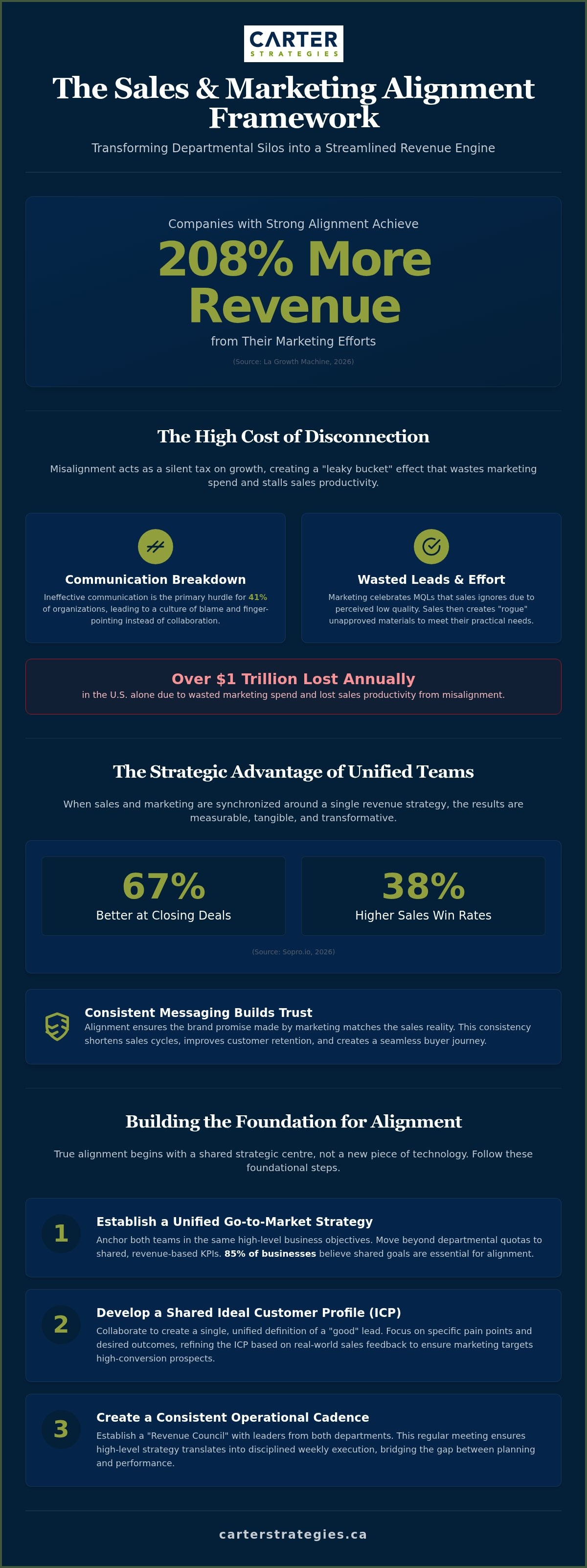
Did you know that companies with strong sales and marketing alignment achieve 208% more revenue from their marketing efforts? (La Growth Machine, 2026). Most leaders recognize the daily friction of this divide. You've likely seen marketing teams produce leads that sales ignores, while sales reps complain that those leads lack quality. It's exhausting to manage a business where no single source of truth exists for revenue data. We understand that this disconnect isn't just a technical glitch; it's a strategic hurdle that impacts your bottom line.
By adopting a pragmatic sales and marketing alignment framework, you can transform these silos into a streamlined revenue engine. This guide provides the roadmap to bridge the gap between your teams and unify them around a single revenue strategy. You'll learn how to foster a collaborative culture that prioritizes shared accountability and predictable growth, moving your organization from internal conflict to strategic execution.
Key Takeaways
- Identify how misaligned silos create a "leaky bucket" effect that wastes marketing spend and stalls sales productivity.
- Implement a pragmatic sales and marketing alignment framework built on a shared business strategy and a unified definition of the ideal customer.
- Move beyond misleading vanity metrics by establishing shared revenue-based KPIs that foster mutual accountability for growth.
- Establish a consistent operational cadence through a Revenue Council to ensure high-level strategy translates into disciplined weekly execution.
- Leverage fractional leadership to provide the neutral perspective and seasoned expertise required to bridge the gap between planning and performance.
The Cost of Disconnection: Why Traditional Sales and Marketing Silos Fail
Misalignment acts as a silent tax on your organization's growth. In the United States, research indicates that this disconnect causes over $1 trillion in annual losses through wasted marketing spend and lost sales productivity. For Canadian leaders, this often manifests as the "leaky bucket" effect. Marketing invests heavily in lead generation, yet those leads frequently spill out of the funnel because sales lacks the context or the confidence to pursue them. This isn't just a breakdown in communication; it's a fundamental failure of your go-to-market strategy.
Effective sales and marketing alignment and integration requires moving past the traditional hand-off model. The old "relay race" approach, where marketing passes a lead to sales and walks away, is obsolete. Modern B2B buyers now navigate around ten touchpoints before engaging with a representative. If your teams aren't synchronized, the customer experiences a disjointed journey that erodes trust before the first pitch begins. Beyond the financial cost, these silos take an emotional toll. Internal friction breeds a culture of blame, where teams prioritize defending their own departments over achieving collective revenue goals. Without a shared sales and marketing alignment framework, even the most talented professionals will struggle to stay focused on the same priorities.
Symptoms of a Misaligned Revenue Engine
You can identify a fractured engine by observing your internal dynamics. Ineffective communication is the primary hurdle for 41% of organizations, often surfacing as finger-pointing during quarterly planning sessions. You might see marketing teams celebrating a high volume of Marketing Qualified Leads (MQLs) that never actually correlate with closed-won revenue. Out of necessity, sales teams often begin creating "rogue" marketing materials, such as custom pitch decks or unapproved brochures, because they feel the official assets don't address the practical needs of the prospect. These symptoms suggest that your current sales and marketing alignment framework lacks the necessary integration to drive predictable growth.
The Strategic Advantage of Unified Teams
When you implement a pragmatic strategy, the results are measurable. Aligned companies are 67% better at closing deals and see 38% higher win rates (Sopro.io, 2026). This success stems from consistent messaging that ensures the brand promise matches the sales reality. When both departments speak the same language, sales cycles shorten and customer retention improves. Alignment is the synchronization of goals, metrics, and culture.
The Foundation of an Alignment Framework: Unified Strategy and ICP
Alignment doesn't begin with a CRM integration or a shared Slack channel. It starts with a fundamental agreement on the organization's trajectory. If your sales and marketing teams aren't working toward the same business objectives, no amount of tactical coordination will fix the underlying friction. This foundational step is often overlooked in the rush to generate leads, yet it's the core of a sustainable sales and marketing alignment framework. Without this strategic centre of gravity, departments naturally drift toward their own localized goals, often at the expense of the company's broader mission.
Research shows that 85% of businesses believe shared goals and KPIs are essential for achieving true alignment (WebSocial, 2026). This shared vision is the antidote to the cultural friction described in the seminal article Ending the War Between Sales and Marketing. Instead of focusing on departmental quotas, leaders must anchor both teams in a unified go-to-market strategy. This approach prioritizes strategic growth over tactical volume. It's a shift from counting leads to measuring the progress of your overall revenue engine. When 88% of businesses prioritize lead quality as their primary success metric, it's clear that the focus must remain on the right customers, not just more customers. This mindset shift ensures that every dollar spent on marketing directly fuels the sales pipeline.
Developing a Shared Ideal Customer Profile
A common point of failure is the lack of a shared definition of a "good" lead. Creating a shared Ideal Customer Profile (ICP) requires both teams to collaborate beyond basic demographics. You must identify specific pain points and desired outcomes that resonate with your best buyers. Successful teams refine their ICP based on real-world sales feedback to ensure marketing stays focused on high-conversion prospects.
Bridging the Vision and Execution Gap
Mapping the buyer's journey from the customer's perspective prevents "random acts of marketing" that fail to drive results. Every campaign must support the sales team's top priorities. By utilizing business strategy development, you create a roadmap that synchronizes high-level planning with execution. This structure ensures your revenue engine moves in one direction. If silos persist, you might need to review your strategic alignment.
Bridging the Accountability Gap: Shared Metrics and Revenue Ownership
Strategic alignment remains a theory until it's anchored by shared financial responsibility. For too long, organizations have allowed marketing and sales to operate under separate scorecards, creating a culture where marketing celebrates success while sales struggles to hit revenue targets. This disconnect is often fueled by vanity metrics, such as raw lead volume or social media impressions, which do not correlate with closed-won revenue. When teams rely on a disjointed sales and marketing alignment framework, they inadvertently incentivize volume over value, leading to the friction and rogue behaviours mentioned earlier.
Transitioning to revenue-based Key Performance Indicators (KPIs) changes the conversation from "How many leads did we get?" to "How much revenue did we generate together?" This shift requires a commitment to shared ownership of the entire funnel. Aligned teams are 3.5 times more likely to have strong cross-functional data sharing (WebSocial, 2026), which allows them to track the journey of a prospect from the first touchpoint to the final signature. By focusing on the health of the revenue engine rather than departmental quotas, you foster a collaborative environment where both teams share the burden and the rewards of growth.
Defining Revenue-Centric KPIs
To move beyond surface-level data, leaders must prioritize metrics that reflect actual business impact. Focus on these core indicators:
- Pipeline Velocity: Measuring how quickly a prospect moves from an initial lead to a closed deal.
- Sales-Accepted Leads (SAL): Tracking the percentage of leads that sales actually agrees to pursue, which serves as a definitive measure of lead quality.
- Marketing Contribution to Revenue: Calculating the specific percentage of closed-won revenue that originated from marketing-driven initiatives.
These metrics ensure that marketing is accountable for the quality of the pipeline, while sales is accountable for the conversion of those opportunities.
The Role of the Service Level Agreement (SLA)
An SLA acts as a formal contract between departments, providing a neutral framework for performance reviews. It eliminates ambiguity by defining exactly what each team owes the other. Marketing commits to delivering a specific volume of leads that meet the agreed-upon ICP, while sales commits to a defined timeframe for follow-up. This mutual commitment ensures that no lead is ignored and no marketing dollar is wasted. When disputes arise, the SLA serves as a pragmatic tool to identify bottlenecks without resorting to finger-pointing or defensive posturing. It's the operational glue of a robust sales and marketing alignment framework. If you find your teams are still struggling to define these shared goals, exploring business strategy development can help clarify the path forward.
Implementing an Operational Cadence: Moving from Strategy to Execution
A strategy without a heartbeat quickly becomes a document that gathers dust. For Canadian mid-market leaders, the challenge isn't usually a lack of vision; it's the absence of a disciplined rhythm to keep that vision alive. While enterprise-level software promises to solve these issues, real alignment happens in the rooms where teams actually talk to one another. Establishing a "Revenue Council" consisting of leaders from both departments creates the necessary structure to oversee your sales and marketing alignment framework. This council ensures that high-level priorities don't get buried by the noise of daily tactical execution.
Operationalizing this framework requires two distinct rhythms. First, the Weekly Sync focuses on the immediate pipeline. Teams identify bottlenecks, discuss lead quality, and ensure the Service Level Agreement (SLA) mentioned earlier is being met. Second, the Quarterly Strategic Review allows leaders to step back and adjust the framework based on market shifts or internal performance data. Since 87% of sales and marketing leaders believe collaboration is a key driver of growth (protocol 80, Inc.), these meetings provide the platform to turn that belief into measurable action.
Structuring the Alignment Meeting
To prevent these sessions from devolving into finger-pointing or anecdotal complaint sessions, you must anchor them in data. Use a "Start, Stop, Continue" framework to evaluate current initiatives. This approach forces teams to identify what's working and what's wasting resources. Document every action item and assign clear ownership to ensure accountability. If you need help establishing this disciplined rhythm, you can explore our growth strategies and planning services to build a custom roadmap for your team.
The Feedback Loop: Sales as Marketing’s Best Resource
Your sales team spends their days in the trenches hearing exactly why prospects buy or walk away. This continuous feedback loop acts as the nervous system of a healthy revenue engine. Encourage marketers to join sales calls to hear customer objections first-hand rather than relying on second-hand reports. This direct exposure ensures your sales and marketing alignment framework remains grounded in reality rather than theory. When marketing content reflects the actual conversations happening in the field, the entire organization moves with greater confidence and speed.
Fractional Leadership: The Catalyst for Sustainable Organizational Alignment
Achieving this unity requires more than just a new set of rules; it requires a shift in culture. When teams operate in silos, they naturally develop defensive postures to protect their own metrics. A Fractional CMO or CRO bridges this gap by facilitating shared accountability. They don't just hand over a plan and walk away. Instead, they work alongside your teams to ensure everyone understands their role in the broader revenue strategy. This hands-on approach builds the trust necessary for long-term buy-in, ensuring the framework remains resilient even as your market evolves.
When to Consider a Fractional CMO or CRO
Internal politics often blind leaders to the reality of their operations. Research shows a significant gap in perception: 69% of executives report strong alignment, while only 47% of non-executives agree. This disconnect suggests that what looks like a unified front from the top often feels like a fractured process to the people executing the work. You should consider external leadership when internal friction stalls growth or when you need senior expertise without the commitment of a full-time hire. Leveraging marketing and revenue alignment as a growth lever allows you to fix the "leaky bucket" before investing more in lead generation.
A Practitioner’s Approach to Alignment
Pragmatic solutions always outperform textbook definitions. A practitioner's approach focuses on implementing a sales and marketing alignment framework that your people actually believe in. This means moving beyond theoretical models to create a strategic plan that is owned by the people who execute it every day. We focus on the human element of corporate growth, ensuring that your teams feel supported rather than scrutinized during the transition. Discover how fractional leadership can unify your revenue teams and accelerate growth by bringing order and clarity to your organizational transitions.
Turn Strategy Into a Unified Revenue Engine
Moving from departmental silos to a shared go-to-market strategy requires more than just better communication. It demands a disciplined sales and marketing alignment framework that anchors both teams in revenue-based KPIs and a shared definition of the ideal customer. When you replace finger-pointing with shared accountability, your organization transforms from a collection of competing interests into a streamlined engine for growth.
Carter Strategies specializes in helping mid-size Canadian companies bridge the gap between high-level vision and daily execution. Through our fractional CMO and CRO services, we provide the seasoned expertise and neutral perspective necessary to unify your leadership and stabilize your revenue operations. We don't rely on corporate buzzwords; we focus on pragmatic, execution-focused strategies that prioritize your team's health and long-term success. Align your teams for growth with Carter Strategies.
You don't have to navigate this transition alone. With a clear roadmap and a commitment to collaboration, you can build a culture where every team member is focused on the same strategic priorities. The path to predictable growth is within your reach.
Frequently Asked Questions
What is the first step in a sales and marketing alignment framework?
The first step is aligning both teams with the overarching business strategy and a shared Ideal Customer Profile (ICP). This agreement ensures everyone understands who the target customer is and what the primary growth objectives are for the year. Without this strategic foundation, any tactical efforts to coordinate will eventually drift back into siloed behaviours.
How does sales and marketing alignment impact revenue growth?
Alignment accelerates growth by ensuring that marketing spend targets high-value prospects that sales can actually close. When teams work together, they see 36% higher customer retention rates and 38% higher win rates (Sopro.io, 2026). This unified approach eliminates the "leaky bucket" effect, where leads are lost due to poor follow-up or mismatched expectations.
What is a Sales and Marketing Service Level Agreement (SLA)?
A Sales and Marketing SLA is a formal agreement that defines the specific responsibilities of each department in the revenue process. Marketing commits to delivering a specific volume and quality of leads, while sales commits to a defined timeframe for following up on those leads. It serves as a neutral tool for performance reviews and ensures mutual accountability.
How do you measure the success of an alignment framework?
You measure success by tracking revenue-centric metrics like pipeline velocity, average deal size, and the percentage of sales-accepted leads (SALs). A successful sales and marketing alignment framework shifts the focus away from vanity metrics like lead volume toward marketing's actual contribution to closed-won revenue. These indicators provide a clear picture of the revenue engine's health.
Can a mid-size company achieve alignment without expensive software?
Yes, mid-size companies can achieve alignment through disciplined processes and clear communication rather than expensive technology. While tools can help, alignment is primarily a leadership commitment to shared goals and accountability. Focusing on a pragmatic sales and marketing alignment framework allows smaller teams to outperform larger competitors who rely solely on software without strategic integration.
What is the role of a Fractional CMO in sales and marketing alignment?
A Fractional CMO acts as a neutral leader who bridges the gap between high-level strategy and tactical execution. They provide the seasoned authority needed to resolve internal friction and establish shared metrics without the bias of internal politics. This role ensures that the alignment process remains focused on organizational health and measurable growth.
How often should sales and marketing teams meet for alignment?
Teams should establish a consistent cadence consisting of weekly tactical syncs and quarterly strategic reviews. The weekly meetings centre on identifying immediate pipeline bottlenecks and lead quality issues. Quarterly reviews allow leadership to step back and adjust the strategy based on market changes or performance data gathered over the previous three months.
What are the most common barriers to sales and marketing alignment?
The most common barriers include conflicting goals, ineffective communication, and a lack of a single source of truth for revenue data. When marketing is measured on lead quantity while sales is measured on revenue, friction is inevitable. Overcoming these hurdles requires a commitment to shared accountability and a unified vision of success.


