


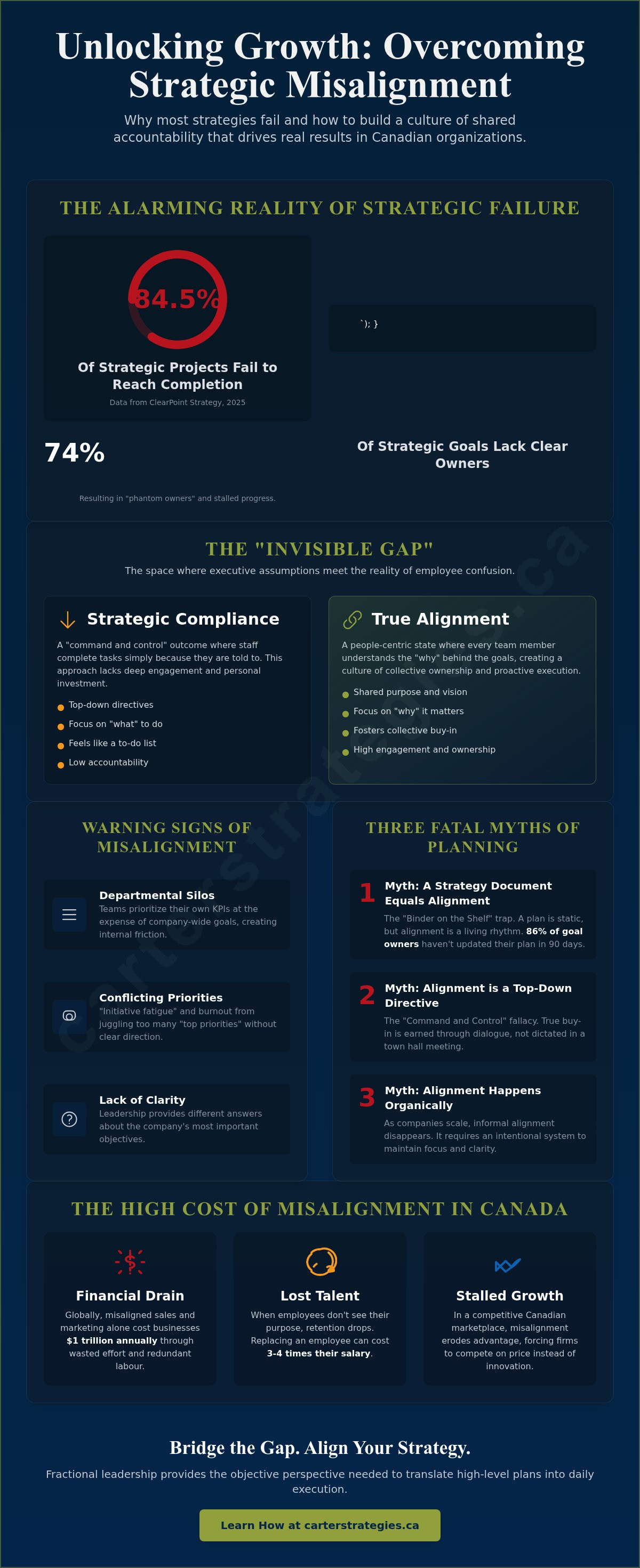
Did you know that 84.5% of strategic projects fail to reach completion? According to data from ClearPoint Strategy in late 2025, the vast majority of mid-market organizations struggle to cross the finish line, often leaving their most ambitious goals to wither on the vine. This isn't just a failure of planning; it's a symptom of deep-seated company strategy alignment problems that create friction between departments and fuel the perception of an "Ivory Tower" leadership team disconnected from the daily grind. When 74% of strategic goals lack clear owners, execution inevitably feels like an uphill battle.
You've likely felt this tension yourself when quarterly growth targets slip or when your best-laid plans are met with confusion rather than commitment from your staff. It's frustrating to watch a well-crafted vision lose momentum because the people responsible for executing it don't see how they fit into the bigger picture. This guide will show you why traditional strategic planning often fails and how to build a culture of shared accountability that drives real growth. We'll explore practical ways to unify your leadership team, clarify your priorities, and turn "phantom owners" into engaged leaders who deliver measurable results.
Key Takeaways
- Learn to distinguish between simple "strategic compliance" and true organizational alignment to ensure every team member understands the purpose behind your growth goals.
- Uncover why a static strategy document often fails and how to move past the "command and control" mindset to foster a culture of collective buy-in.
- Use a targeted alignment audit to expose hidden company strategy alignment problems and resolve friction between your marketing, sales, and operations departments.
- Understand how fractional leadership provides the seasoned authority and objective perspective required to bridge the gap between high-level planning and daily execution.
- Discover the practical steps to establish a shared language across your leadership team, turning abstract priorities into measurable and realized progress.
What Are Company Strategy Alignment Problems and Why Do They Occur?
At its core, Strategic alignment functions as the vital bridge between a high-level corporate vision and the daily execution carried out by every employee. It isn't merely a technical integration of goals; it's the shared understanding that ensures every action taken at the desk level moves the needle toward a collective destination. When this bridge collapses, we see company strategy alignment problems manifest as a persistent drag on momentum, where leadership assumes the path is clear while the workforce remains lost in the fog of tactical busywork.
There's a fundamental difference between strategic compliance and true strategic alignment. Compliance is a "command and control" outcome where staff do what they're told because it's on their to-do list. Alignment, however, is a people-centric state where individuals understand the "why" behind the "what." Without this understanding, an "Invisible Gap" forms. This gap is the space where executive assumptions meet the stark reality of employee confusion. Leaders often believe that a single town hall or a circulated PDF is enough to create unity, yet research shows that only 8% of companies report their sales and marketing teams are truly aligned. This disconnect isn't just a communication glitch; it's a failure to translate abstract goals into a shared language of accountability.
Mid-market companies are particularly vulnerable to these issues during rapid scaling phases. As a business grows from a tight-knit group into a complex organization, the informal alignment that once happened over coffee disappears. Without intentional systems to maintain focus, the organization begins to drift, and the human element of growth is often sacrificed for rigid, ineffective processes.
The Symptoms of a Misaligned Organization
Misalignment doesn't always look like chaos; often, it looks like a group of talented people working very hard in the wrong directions. You can spot these company strategy alignment problems through several distinct warning signs:
- Departmental Silos: Marketing, sales, and operations prioritize their own specific KPIs, often at the direct expense of company-wide growth.
- Conflicting Priorities: Teams face "initiative fatigue" as they try to juggle twenty "top priorities" at once, leading to widespread burnout.
- Lack of Clarity: When asked, different members of the leadership team provide different answers regarding the company's "top three" objectives for the quarter.
The High Cost of Misalignment in Canada
The financial impact of these gaps is staggering. Globally, organizations lose an estimated $1 trillion annually due to misaligned sales and marketing efforts alone. In Canada, this translates to significant wasted effort and redundant labour costs that eat into already tight margins. When employees don't see how their work contributes to a larger purpose, organizational health declines and retention rates drop. The cost of hiring a new employee can reach three to four times their salary, making the preservation of your current talent through clear alignment a financial necessity. Misalignment within a Canadian context erodes competitive advantage by forcing firms to compete on price rather than innovation, effectively stalling growth in an increasingly crowded global marketplace.
The Three Fatal Myths of Strategic Planning
Many mid-market leaders fall into the trap of thinking that a polished slide deck or a detailed annual plan is the same as organizational unity. In reality, documentation represents only about 10% of the effort required for success. If your team is failing to execute, it's likely because your approach is built on three fatal myths that exacerbate company strategy alignment problems and stall your growth momentum.
Myth 1: A Strategy Document Equals Alignment. This is the "Binder on the Shelf" trap. A plan is a static snapshot; alignment is a living rhythm. Research involving over 20,000 strategic plans revealed that 86% of assigned owners for strategic goals are "phantom owners" who haven't made an update in over 90 days. A document doesn't change behaviour; shared ownership does.
Myth 2: Alignment is a Top-Down Directive. This "Command and Control" fallacy assumes that if leadership speaks, the organization moves in unison. In modern Canadian workplaces, this approach fails because it ignores the human element of buy-in. You cannot dictate belief. When leadership tries to impose a vision without collaboration, they often find that employees appear to comply while quietly maintaining the status quo.
Myth 3: Financial Metrics are the Best Measure of Success. Revenue and profit are lagging indicators that tell you where you've been, not where you're going. If you only focus on the C$ values, you miss the leading indicators of organizational health, such as team clarity and departmental trust. A plan is only as good as the people who believe in it, and ignoring the human element leads to missed quarterly targets and internal friction.
Why Documentation Does Not Drive Behaviour
Reading a plan is a passive act; owning a result is an active commitment. When strategy is developed in "Ivory Tower" sessions, it often feels alien to the boots-on-the-ground team who must actually do the work. Passive agreement is the silent killer of growth in many firms. Employees might nod in meetings, but without a personal connection to the goals, they return to their desks and continue as they were before. To move from passive agreement to active accountability, leaders must stop treating strategy as a one-time event and start treating it as a collaborative conversation where every team member sees their own contributions reflected in the company's success.
The Fallacy of Top-Down Implementation
Effective execution requires leaders to understand how strategy shapes structure and team dynamics. Empathy is a critical leadership tool here. Modern Canadian teams value collaboration over dictation, and leaders must recognize that resistance is usually a sign of a lack of clarity rather than a lack of effort. By fostering an environment where feedback is encouraged, you turn potential resistors into strategic partners. Forced alignment creates a veneer of unity that masks deep-seated departmental friction and quietly erodes the culture from within. If you're struggling to bridge this gap, professional business strategy development can provide the external perspective needed to align your people with your goals permanently.
Strategic Compliance vs. True Team Buy-in
A compliant team follows orders; an aligned team pursues a purpose. While compliance is easily mandated through KPIs and performance reviews, it rarely survives the pressure of a shifting market or an internal crisis. True team buy-in, conversely, creates a resilient organization where individuals don't just complete tasks; they solve problems. Many leaders worry that seeking buy-in takes too much time, yet the long-term ROI is undeniable. Organizations with aligned sales and marketing teams see 36% higher customer retention rates and can achieve a 208% potential revenue increase. Investing in alignment upfront prevents the costly rework and friction that define most company strategy alignment problems.
Success hinges on creating a "Shared Language." When executives use abstract strategic terms and staff use tactical jargon, a translation gap emerges. Bridging this requires a move away from complex terminology toward simple, outcome-focused language that everyone understands. Middle management acts as the critical "Alignment Centre" here. They are the practitioners who translate high-level vision into daily reality. If they don't believe in the plan, the rest of the organization won't either.
Building a Culture of Shared Accountability
Ownership at every level means that a junior analyst understands how their data entry impacts the three-year growth target. This sense of belonging is nurtured by rewarding alignment rather than just isolated department performance. If your sales team hits their numbers but compromises the long-term marketing strategy, that's a failure of alignment, not a success. Radical transparency is also essential. Leaders must be willing to share not just the wins, but the missed measures and the "friction points" that need collective solving. When people see that their contribution is valued beyond a simple labour metric, they're more likely to realize their potential as strategic partners.
The Power of Integrated Communication
Monthly town halls are insufficient for maintaining momentum. Instead, leaders must establish daily and weekly strategic rhythms that keep priorities top-of-mind. Centring the customer in every conversation simplifies complex decisions; if a project doesn't improve the revenue experience, it likely isn't a priority. You cannot under-communicate your strategy. To ensure it sticks, you must repeat the core priorities until they become part of the organizational DNA. This persistent, integrated approach ensures that the "why" behind every task remains visible, even during the busiest periods of growth, turning a static plan into a living, breathing guide for every employee.
The Alignment Audit: How to Identify and Fix Gaps
Moving from a state of friction to one of flow requires more than just a renewed commitment to your goals; it demands a rigorous, objective assessment of your current operations. An alignment audit serves as a diagnostic mirror, reflecting the reality of how work actually gets done versus how leadership imagines it. For mid-market firms scaling from 50 to 500 employees, the informal "gut-feel" alignment of the early days is no longer sufficient. You need a methodical approach to expose and resolve company strategy alignment problems before they bake inefficiency into your corporate DNA.
- Step 1: Conduct a Priority Check. Ask every member of your leadership team to list the company's top three priorities for the next six months. If the lists don't match, you've identified the primary source of organizational drift.
- Step 2: Map the Friction Points. Identify exactly where projects stall. Most often, these bottlenecks occur at the hand-off points between marketing, sales, and operations.
- Step 3: Audit the Information Flow. Trace a strategic directive from the executive suite to the front line. If the message loses its "why" by the time it reaches the practitioner, your communication loop is broken.
- Step 4: Evaluate Task Relevance. Pick five random daily tasks from different departments. If you cannot directly link those tasks to a core strategic pillar, your team is likely busy but not productive.
- Step 5: Apply the Stop-Start-Continue Framework. Use the audit findings to prune "zombie projects" that no longer serve the vision. This regains the focus necessary for high-impact growth.
Diagnosing Leadership Disconnect
Alignment begins at the top, yet this is often where the most significant gaps hide. To diagnose a disconnect, ask your VPs: "What is the one thing we must stop doing to ensure we hit our North Star?" Their answers will reveal "Shadow Strategies," which are unspoken agendas that pull resources away from the official plan. Often, personal egos mask as expertise, leading leaders to protect their own departmental turf rather than the organization's health. Identifying these hidden biases is the first step toward restoring a unified front.
Bridging Marketing and Sales Silos
Revenue alignment is the most frequent failure point in Canadian mid-market firms. When marketing focuses on lead volume and sales focuses on closing at any cost, the resulting friction creates a disjointed customer experience. Organizations with strong sales and marketing alignment see an average annual revenue growth rate of 20%, according to March 2026 data from Sopro.io. True "Smarketing" alignment exists when both teams share a single revenue target and a unified definition of a qualified customer, ensuring they work as two halves of the same growth engine. If your audit reveals deep-seated gaps in your revenue engine, engaging fractional CMO and CRO services can provide the objective leadership needed to bridge them permanently.
How Fractional Leadership Resolves Strategic Friction
Identifying company strategy alignment problems through an audit is a vital first step, but the actual work of repair often requires a level of objectivity that is difficult to achieve from within. When internal leaders are already stretched thin by daily operations, they rarely have the capacity to overhaul the very systems they are operating. This is where fractional leadership becomes a powerful catalyst for organizational health. A Fractional CMO or CRO brings the seasoned authority of a veteran executive to your team, acting as a strategic guide who bridges the gaps between high-level planning and boots-on-the-ground execution.
These external practitioners offer a pragmatic, results-oriented approach that prioritizes shared accountability. Because a fractional leader is not a permanent fixture of the corporate hierarchy, they are uniquely positioned to navigate internal politics without being compromised by them. They can identify "Shadow Strategies" and address friction points with a level of directness that internal hires might find difficult. This persona acts as a mentor who has been in the trenches and understands that a plan is only as good as the people who believe in it, ensuring that the human element of corporate growth is never sidelined by financial metrics alone.
This focus on the individual is just as vital for the executives themselves; high-performers who need to maintain their edge during intense organizational transitions often turn to specialized health partners like 5280 Restorative Medicine to reclaim their vitality and sustain peak leadership performance.
The Practicality of Fractional Executive Support
For mid-market firms, the cost of a full-time, C-suite executive can be prohibitive, yet the need for high-level expertise is constant. Fractional leaders deliver this expertise without the full-time overhead, providing a flexible solution for companies in rapid scaling phases. A Fractional CRO, for instance, focuses specifically on aligning revenue streams and sales processes to ensure that marketing and sales operate as a single, unified engine. This outside perspective is often the only way to see deep-seated company strategy alignment problems that have become "invisible" to the internal team over time. By integrating into the leadership team as a peer, they provide the stabilizing force necessary to bring order to complex organizational transitions.
Beyond strategic leadership, providing your team with a professional base of operations is equally important for maintaining focus; for those seeking flexible workspace solutions, you can visit Citizens Business Center to explore executive suites designed to support business scaling and professional productivity.
Moving Forward with Confidence
Transitioning from a cold, data-driven exercise to a people-centric strategy is the hallmark of a successful alignment engagement. It requires moving steadily from identifying challenges to outlining a clear, cumulative path toward a solution. In the first 90 days of an alignment-focused engagement, the focus shifts from diagnosis to the implementation of daily strategic rhythms and shared accountability frameworks. This methodical approach ensures that the "North Star" remains visible to every employee, turning abstract goals into measurable progress.
Carter Strategies acts as a strategic partner for mid-market leaders who are ready to move beyond "strategic compliance" and build a culture of true team buy-in. Our Fractional CMO and CRO services are designed to resolve strategic friction and drive sustainable growth through integrated business strategy development. We believe the best solutions are uncovered through collaboration rather than imposed from the top down. If you're ready to align your leadership team and realize your growth potential, contact Carter Strategies for a consultation today.
Unifying Your Team for Sustainable Growth
True strategic alignment is never a final destination; it's a collaborative rhythm that requires constant attention and intentional communication. We've explored how moving beyond the "binder on the shelf" and fostering deep team buy-in can turn stalled projects into measurable momentum. By centring your people in every decision and conducting a rigorous audit, you can effectively bridge the gap between your vision and your team's daily reality.
Addressing persistent company strategy alignment problems is the most critical step a mid-market leader can take to ensure long-term organizational health. Carter Strategies brings seasoned fractional leadership expertise to help you navigate these complex transitions. We specialize in Canadian mid-market growth, focusing on building shared accountability rather than just hitting financial metrics. If you're ready to transform your strategy from a static plan into a living engine for growth, book a Strategic Alignment Consultation with Carter Strategies today. You don't have to navigate the path to alignment alone; the right guide can turn your most ambitious goals into your company's new reality.
Frequently Asked Questions
What are the most common company strategy alignment problems?
The most frequent issues include departmental silos where teams prioritize local KPIs over corporate growth and the "phantom owner" problem where goals lack active accountability. Misalignment often stems from a lack of shared language, leading to conflicting priorities and initiative fatigue. When leadership assumptions don't match the front-line reality, the organization drifts, resulting in missed quarterly targets and persistent internal friction.
How do you measure if a team is truly aligned with the strategy?
You can measure alignment by conducting a "Priority Check" to see if leadership and staff can identify the same top three objectives. High-performing organizations also track the completion rate of strategic projects; research shows only 5.7% of organizations complete more than 75% of their plans. True alignment is visible when daily tasks directly link to strategic pillars and team members can explain the "why" behind their work.
Can a small leadership team still have alignment issues?
Yes, small teams often suffer from "assumed alignment" where informal conversations replace documented, rigorous strategic rhythms. While communication might feel frequent, it often lacks the clarity needed to prevent personal egos or "Shadow Strategies" from pulling the team in different directions. Without a shared framework for accountability, even a group of three can struggle with conflicting priorities that stall growth and create unnecessary internal friction.
Is strategy alignment the same as organizational culture?
Strategy alignment and organizational culture are distinct but deeply interconnected. Culture is the set of shared values and behaviours that define how work gets done, while alignment is the bridge that connects those behaviours to a specific strategic vision. An organization is over three times more likely to shape a strong culture when its HR roadmap and talent strategy are aligned with the business objectives.
How long does it take to fix deep-seated alignment gaps?
While initial clarity can be achieved through an audit in a few weeks, fixing deep-seated gaps typically requires a 90-day focused engagement to establish new rhythms. This period allows for the transition from "strategic compliance" to true buy-in. Permanent change involves shifting the organizational mindset, which often takes several quarters of consistent over-communication and shared accountability to ensure the new strategic direction becomes part of the company's DNA.
What is the role of a Fractional CMO in strategic alignment?
A Fractional CMO acts as a strategic catalyst by providing an objective, outside perspective that internal leaders often lack. They bridge the gap between high-level vision and tactical execution, specifically focusing on marketing strategy and revenue alignment. By operating as a peer to the leadership team, they can address company strategy alignment problems without being hindered by internal politics, helping to unify the revenue engine and drive measurable growth.
Why do employees often resist new company strategies?
Resistance usually occurs because employees feel disconnected from the decision-making process or don't understand the purpose behind the change. When a strategy feels like an "Ivory Tower" directive, it creates fear and uncertainty rather than commitment. People don't resist the strategy itself; they resist the lack of clarity and the perceived threat to their daily workflows. Empathy and radical transparency are essential to turning resistance into active buy-in.
How can I align my marketing and sales teams more effectively?
Effective alignment requires both teams to share a unified revenue target and a common definition of a qualified lead. This "Smarketing" approach eliminates internal competition for resources and centres the customer journey in every conversation. Utilizing a shared CRM and establishing a collaborative rhythm for feedback ensures that both departments work toward the same growth goals. Organizations that achieve this level of integration see 36% higher customer retention rates.


