

If your marketing tactics feel like a series of expensive experiments that never quite move the revenue needle, you're likely facing a leadership gap rather than a talent problem. Why commit to a C$300,000 annual salary for a full-time executive when your current hurdle is strategic alignment, not daily management? Many Canadian mid-market leaders find themselves overwhelmed by the complexity of modern growth, watching as sales and marketing drift into separate silos while competitors gain ground. Engaging a fractional cmo allows you to bridge this gap by bringing seasoned, executive-level authority into your organization on a flexible, pragmatic basis.
It's frustrating to see potential go unrealized because your internal teams aren't pulling in the same direction. We understand the friction that comes with scaling a business in an increasingly complex regulatory environment, especially with the June 2025 amendments to the Competition Act introducing new risks for deceptive marketing. This guide will show you how to secure the strategic leadership necessary to unify your departments and accelerate growth without the overhead of a permanent hire. You'll discover how this model provides a clear strategic roadmap, ensures compliance with Canadian standards, and builds a foundation for scalable, predictable revenue growth.
Key Takeaways
- Understand why a fractional cmo serves as a strategic architect rather than a tactical manager, focusing on revenue architecture and long-term organizational health.
- Learn to distinguish between high-level leadership and tactical execution to ensure your marketing efforts drive measurable revenue rather than just activity.
- Evaluate the speed and cost-efficiency of fractional leadership compared to the significant compensation and onboarding time required for a full-time Canadian executive.
- Follow a practical framework to identify your internal friction points and select a peer-level advisor who understands the nuances of the mid-market landscape.
- Discover how to unify sales and marketing teams through a collaborative roadmap that ensures shared accountability for your company’s growth.
What is a Fractional CMO? Defining Strategic Leadership
A fractional cmo is a seasoned marketing executive who provides high-level leadership on a part-time or contract basis. Unlike a traditional consultant who might offer a list of recommendations and then exit the room, these leaders embed themselves within your leadership team. They take active accountability for strategic outcomes. This model is part of a broader trend toward the Fractional executive, allowing mid-size Canadian firms to access sophisticated revenue architecture that was once reserved for global enterprises with massive budgets.
For a mid-market leader, the value isn't just in the title. It's in the ability to organize complex growth plans into actionable steps. These professionals don't just "do" marketing; they design the engine that makes marketing work. They focus on organizational health, team dynamics, and the practicalities of leadership, ensuring that every dollar spent in the Canadian market is tied to a specific business objective. It is a pragmatic solution for companies that have outgrown their current marketing structure but aren't yet ready for the C$300,000 plus annual commitment of a full-time executive.
The Role of a Fractional Leader in the Mid-Market
Mid-market companies often face a specific kind of internal friction. The CEO has a clear vision for growth, but the marketing team's output feels disconnected or purely tactical. A fractional leader bridges this gap. They identify strategic priorities so that your team isn't just busy, but productive. By providing an objective, external perspective, they can spot the bottlenecks in your sales and marketing alignment that internal teams are often too close to see. They bring a practitioner’s vocabulary to the table, focusing on implementation rather than abstract theory.
Fractional CMO vs. Marketing Agency
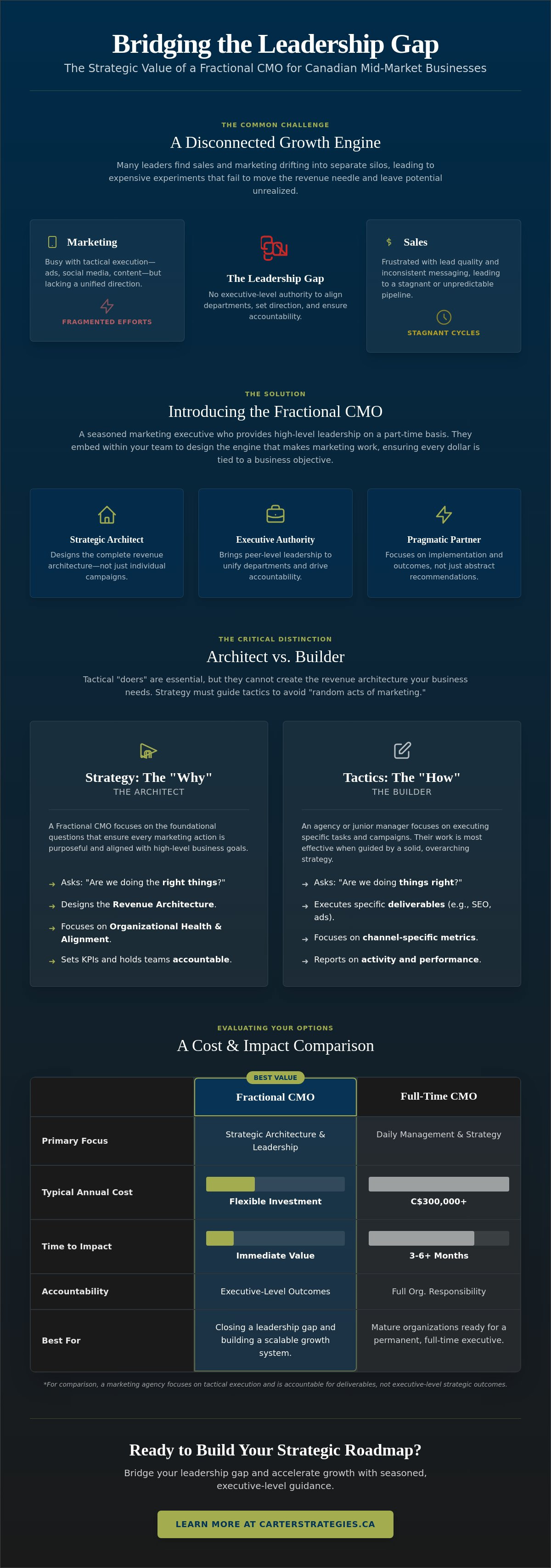
It's common for leaders to mistake a marketing agency for a strategic partner. While agencies are excellent at execution, they are built to be builders, not architects. An agency focuses on the tactics, such as SEO, social media, or paid ads. A fractional cmo focuses on the "why" behind those tactics.
Hiring an agency without a strategic leader often leads to wasted spend because there is no overarching plan to unify the efforts. Consider these distinctions:
- The CMO designs the strategy and sets the KPIs.
- The agency executes the specific deliverables.
- The CMO holds the agency accountable for results.
This distinction is critical. Without an architect, you're essentially asking a carpenter to design your entire house while they're already swinging the hammer. A fractional leader ensures the foundation is solid before the first nail is driven, protecting your budget from the common trap of "tactic-first" thinking.
Strategic Leadership vs. Tactical Execution: The Critical Distinction
Many Canadian mid-market firms fall into a predictable, expensive pattern. They hire a junior manager or a specialized freelancer to "run ads" or "manage social" before they have a cohesive plan. This is a fundamental error. Tactical "doers" are essential for implementation, but they cannot create the revenue architecture your business needs to scale. Engaging a fractional cmo provides the strategic oversight required to ensure your tactical investments actually yield a return. Without this head-level leadership, you're essentially paying for activity rather than progress.
The distinction lies in where the focus is placed. Tactics are about the "how," while strategy is about the "who," "where," and "why." A practitioner’s approach goes beyond spreadsheets to look at organizational health. It examines how your teams interact, where the handoff between sales and marketing is failing, and how your brand is perceived in a competitive Canadian landscape. It's about moving from "random acts of marketing" to a unified growth engine.
The Danger of the Tactical Trap
You are likely stuck in the tactical trap if your marketing team is constantly busy, yet your sales cycle remains stagnant or unpredictable. Signs of this friction include high lead volumes that sales ignores, fragmented messaging across different channels, and a general feeling of being overwhelmed by new platforms. The cost of these misaligned efforts is significant, often resulting in thousands of dollars in wasted media spend and missed market opportunities. True strategic focus is the disciplined elimination of non-essential activities.
Building a Robust Strategic Framework
A robust strategic framework moves the conversation beyond mere lead generation. It encompasses your entire revenue model, brand positioning, and long-term business goals. A fractional leader identifies the top priorities that will actually move the needle, ensuring that every initiative is tied to a measurable outcome. This isn't just about data; it's about the human element of corporate growth.
For a strategy to succeed, you need internal team alignment. We prioritize building buy-in from the people on the ground, ensuring they understand the "why" behind the roadmap. When your team sees how their daily work contributes to the larger vision, productivity increases and friction decreases. If you're tired of fragmented efforts and want to unify your growth strategy, exploring fractional CMO and CRO services can provide the clarity and stability your leadership team deserves.
Evaluating the Impact: Fractional CMO vs. Full-Time Hire
Choosing between a permanent executive and a fractional partner is a high-stakes decision for any mid-market leader. In Canada, the average base salary for a full-time CMO sits around C$150,000, but total compensation packages involving bonuses, benefits, and equity often climb toward C$300,000 or C$500,000. For many growing firms, this represents a massive fixed overhead that can strain cash flow. In contrast, a fractional cmo provides the same level of seasoned expertise without the long-term liability of a permanent C-suite contract. This model allows you to redirect those resources into media spend or team development while still benefiting from top-tier revenue architecture.
Speed is another critical factor. Recruiting a high-calibre executive often takes six months or more, followed by a lengthy onboarding period. Research indicates that businesses using a fractional model can see results 40% to 60% faster than those waiting for a full-time hire. This agility is vital in a shifting market. If a fractional leader isn't the right fit, the professional separation is straightforward and pragmatic, whereas a failed C-suite hire can cost a company hundreds of thousands of dollars in severance and lost momentum. It's about mitigating risk while maximizing impact.
When to Hire a Fractional CMO
There is usually an inflection point where a founder or CEO can no longer oversee marketing effectively. You'll recognize this stage when growth plateaus despite increased activity, or when sales and marketing teams operate in separate worlds. If you are preparing for a major scale-up or an organizational transition, you need an architect who has been in the trenches before. These transition periods are high-risk; having a battle-tested guide ensures your strategy remains grounded in reality rather than hope. It allows the CEO to focus on broader business health while the marketing engine is professionally managed.
The ROI of Strategic Alignment
A direct fractional CMO vs full-time CMO comparison often reveals hidden savings beyond just the salary line. The true value lies in revenue efficiency. By aligning your internal teams and eliminating non-essential tactics, a strategic leader ensures that every marketing dollar is focused on high-impact objectives. Avoiding a single failed strategic plan can save more than the entire cost of the engagement, making it a stabilizing force for your company’s financial health. Success is measured not just in lead volume, but in organizational clarity and the speed at which you can realize your growth goals.
How to Select the Right Strategic Marketing Partner
Selecting a fractional cmo is not like hiring a tactical freelancer; it's about finding a peer who can challenge your assumptions and bring order to organizational complexity. The first step is to identify your primary business challenge. Are you struggling with stagnant growth, a misalignment between sales and marketing, or an execution gap where high-level plans simply stall? Once you clarify the problem, you can look for an advisor with battle-tested executive experience who prioritizes a proven strategic methodology over the latest tactical "hacks."
A successful partnership also requires a leader who knows how to secure employee ownership of the growth plan. If your internal team doesn't believe in the roadmap, implementation will fail regardless of the strategy's quality. Finally, define clear performance indicators for the first 90 days. This ensures shared accountability and provides a stabilizing rhythm for the organization during the transition. It moves the engagement from a vague consultancy to a results-oriented leadership role.
Vetting for Strategic Depth
To separate tactical managers from true strategic leaders, ask questions that probe their framework for bridging strategy and execution. Instead of asking which software tools they prefer, ask how they align marketing spend with long-term business goals and organizational health. Effective fractional CMO services mid-size business require a deep focus on people-centric growth. You need a partner who understands that a plan is only as good as the people who believe in it, requiring a practitioner’s vocabulary rather than academic jargon.
Cultural Fit and Team Buy-in
Cultural fit is often overlooked in favour of technical skills, yet it's the primary reason executive engagements fail. A fractional leader must act as a mentor and guide, utilizing professional pragmatism and empathy to navigate internal friction. They should feel like a natural extension of your leadership team, capable of collaborating with your existing staff rather than imposing solutions from the top down. This collaborative spirit ensures that the strategy remains sustainable and that your team feels empowered to execute the vision.
If you're ready to move beyond tactical experiments and build a unified growth engine, our fractional CMO and CRO services offer the seasoned, hands-on leadership your organization needs to scale effectively in the Canadian market.
Accelerating Growth with Carter Strategies’ Fractional Leadership
The transition from fragmented marketing tactics to a unified growth engine requires more than just a plan; it demands a leader who understands the human element of corporate growth. At Carter Strategies, our approach to the fractional cmo role blends seasoned executive authority with a deeply collaborative spirit. We focus specifically on Canadian mid-market businesses, where internal friction often stalls even the most well-funded initiatives. By positioning ourselves as peers to your leadership team, we help you navigate the complexities of modern growth while ensuring that your strategy is rooted in pragmatic, real-world execution.
Leslie Carter’s practitioner’s vocabulary simplifies transitions that often feel overwhelming to internal teams. We move the conversation beyond mere financial exercises or abstract spreadsheets. Instead, we focus on securing true employee ownership of the growth roadmap. A strategy is only as effective as the people who believe in it, and our methodology ensures that your team isn't just following orders, but actively driving the vision forward. This creates a stabilizing force within your organization, allowing for steady, intentional movement toward your revenue goals.
Our Methodology for Strategic Priorities
We help you realize long-term success by ruthlessly focusing on what matters most. Our process integrates business strategy development with active fractional leadership to bridge the gap between high-level planning and daily implementation. By identifying a few critical priorities, we eliminate the noise of non-essential activities that often drain Canadian marketing budgets. This methodology fosters a culture of shared accountability, where every department understands its role in the overarching growth architecture. It's about building a foundation that remains resilient even as market conditions shift.
Next Steps: Aligning Your Team for 2026
With major regulatory changes like the Competition Act amendments and new industry standards taking full effect by 2026, the window for reactive marketing is closing. Now is the time to bridge the gap between your vision and your team’s execution. If you feel your current marketing efforts are disconnected from your revenue goals, it’s time to introduce a strategic guide who has been in the trenches. Starting a conversation about fractional leadership is the first step toward bringing order and clarity to your organizational transition. We invite you to contact Carter Strategies for a strategic consultation to explore how we can align your strategy and accelerate your growth without the overhead of a full-time executive hire.
Unifying Your Path to Sustainable Growth
The gap between a CEO’s vision and tangible market results is rarely caused by a lack of effort. More often, it’s the result of a missing strategic architect. By engaging a fractional cmo, you move beyond the cycle of reactive, tactical experiments and begin building a robust revenue engine. You've seen that the right leadership isn't just about managing budgets; it's about fostering organizational health and ensuring that every member of your team understands their role in the broader growth roadmap. This shift from activity to impact is what defines a truly scalable business.
At Carter Strategies, we bring seasoned executive leadership to mid-market firms through a pragmatic, people-centric approach. Our battle-tested framework is designed to bridge the gap between high-level strategy and daily execution, creating a culture of shared accountability. We don't just hand over a plan; we work alongside you to ensure it's implemented effectively and embraced by your people. If you're ready to bring clarity and stability to your marketing efforts, book a strategic consultation with Carter Strategies to align your growth plan. Your company’s next phase of growth depends on a foundation of alignment and focus. We're here to help you build it.
Frequently Asked Questions
What exactly does a fractional CMO do on a daily basis?
A fractional cmo focuses on high-level revenue architecture and mentoring your internal team rather than managing daily social media posts. They spend their time auditing marketing performance, identifying strategic priorities, and ensuring that every initiative aligns with your broader business goals. This role involves bridging the gap between the executive vision and the tactical execution performed by your staff or agencies.
How many hours a week does a fractional CMO typically work?
Most engagements range from five to fifteen hours per week, though this varies based on the complexity of your growth goals. This flexible schedule allows a seasoned leader to provide executive oversight and strategic direction without the administrative burden of a full-time role. It's a pragmatic way to secure senior leadership while keeping your overhead manageable as you scale.
Is a fractional CMO the same as a marketing consultant?
No, the primary distinction lies in accountability and implementation. While a consultant often provides a list of recommendations and then exits the room, a fractional leader embeds themselves within your leadership team. They take active responsibility for the outcomes of the strategy and stay to guide the team through the practicalities of execution and organizational change.
Can a fractional CMO help with sales and marketing alignment?
Yes, resolving internal friction between these two departments is a core function of the role. They act as a stabilizing force to create shared KPIs and clear handoff processes between sales and marketing. This alignment ensures that marketing efforts actually drive revenue and that your sales team receives high-quality leads they can actually close.
What is the typical cost of a fractional CMO in Canada?
The investment for a fractional leader is typically structured as a monthly retainer that scales based on the seniority of the expert and the scope of work required. This model provides a predictable cost for your business while avoiding the significant expenses associated with a full-time executive salary, benefits, and equity. It allows you to redirect those savings into media spend or other growth initiatives.
How long do fractional CMO engagements usually last?
These partnerships typically last between six and eighteen months, providing enough time to overhaul a strategy and establish a sustainable growth engine. Some firms choose to keep a fractional leader on a long-term basis to provide ongoing mentorship and strategic oversight. The duration is flexible and can be scaled up or down as your company moves through different growth phases.
Do I need a fractional CMO if I already have a marketing manager?
Yes, because a marketing manager typically focuses on the "how" of tactical execution while a CMO focuses on the "why" of the overall strategy. A fractional leader acts as a mentor to your manager, helping them elevate their output and align their daily tasks with your long-term business objectives. This combination ensures that your tactical efforts are backed by professional, executive-level planning.
What results should I expect in the first 90 days?
In the first three months, you should realize a comprehensive strategic roadmap and the beginning of cultural alignment within your teams. You'll see identified "quick wins" for revenue efficiency and a clear framework for how marketing will contribute to your 2026 goals. This period is about bringing order to your marketing function and setting a foundation for predictable, scalable growth.


