


Most mid-size business leaders mistake an ambitious financial forecast for a growth strategy, yet a spreadsheet has never once inspired a team to execute a vision or plan. Many executives watch their strategic plans gather dust while their days remain consumed by urgent firefighting. It's a common frustration to realize that while your revenue goals are clear, the path to achieving them remains obscured by a lack of internal alignment and shared purpose.
We understand that the friction between within and across various departments isn't just a communication issue; it's a structural failure that often leads to organizational burnout. This article shows you how to move beyond static projections to build a framework that synchronizes your people and ensures predictable execution. We will outline a pragmatic roadmap for scaling your operations, improving team accountability, and securing sustainable revenue growth that actually lasts without compromising your company culture.
Key Takeaways
- Distinguish between a financial target and a true growth strategy that guides resource allocation and execution.
- Identify the most effective pathways for scaling, from maximizing existing markets to entering entirely new customer segments.
- Close the strategy-execution gap by establishing clear lines of ownership and consistent communication across all departments.
- Align individual daily tasks with high-level organizational goals to improve team buy-in and prevent executive burnout.
- Leverage fractional leadership to integrate specialized marketing and revenue expertise into your senior management team.
Understanding Growth Strategy: Beyond the Financial Forecast
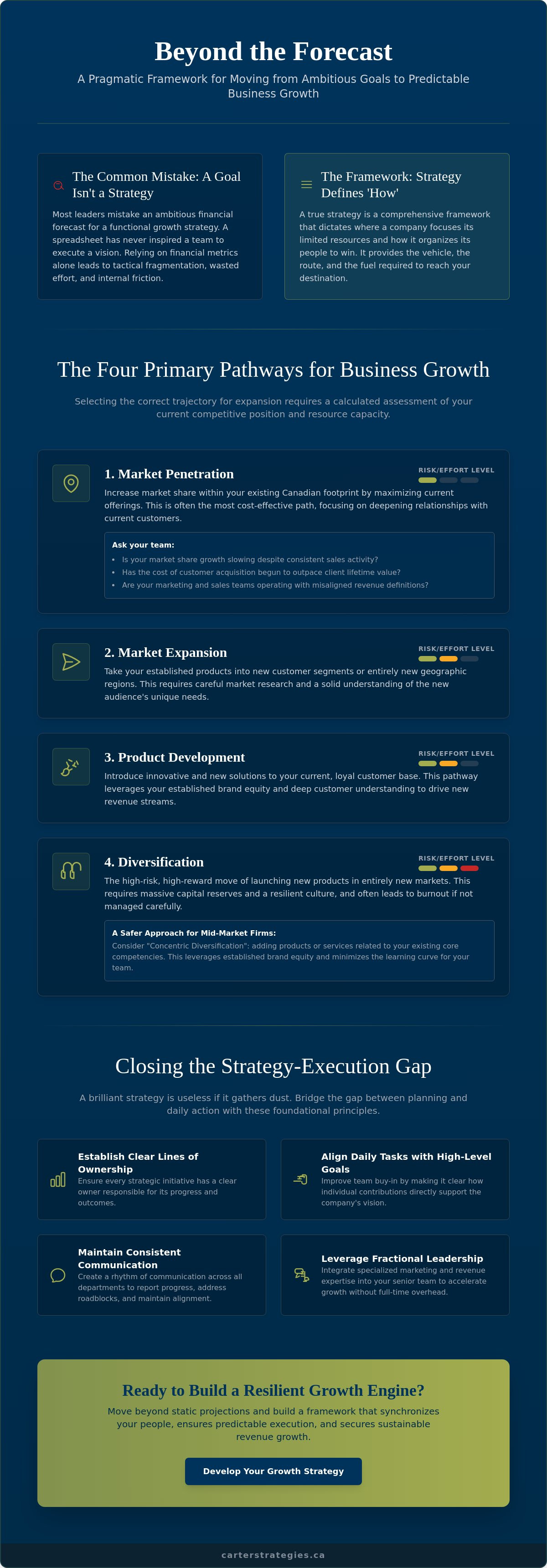
A true growth strategy is not a list of aspirations or a spreadsheet filled with aggressive revenue targets. It is a comprehensive framework that dictates where a company focuses its limited resources and how it organizes its people to win. While many leaders point to a 20 per cent revenue increase as their strategy, that number is merely a goal. It defines the destination but says nothing about the vehicle, the route, or the fuel required to get there. Relying on financial forecasts alone creates a vacuum where tactical execution happens in silos, often leading to wasted effort and internal friction.
The Difference Between Growth Goals and Growth Strategy
The distinction between goals and strategy is fundamental to organizational health. Goals define the where while strategy defines the how. When companies lead with financial metrics alone, they often suffer from tactical fragmentation. Marketing chases leads, sales chases volume, and operations struggles to keep up, all without a shared understanding of the core objective. Effective growth planning requires a Strategic Priorities Framework that guides daily decision-making. This practitioner-led approach values internal buy-in as much as data. It ensures that the plan remains implementable rather than just theoretically sound.
Why Mid-Market Companies Need a Unique Approach
Mid-market firms often fall into a specific trap. They outgrow the entrepreneurial systems that fueled their early success but aren't yet large enough to justify the heavy bureaucracy of global consulting firms. In the first quarter of 2026, business fixed investment grew at an annual rate of 10.1 per cent, indicating that companies are actively pouring capital into expansion. However, scaling without a clear growth strategy often leads to overwhelming internal teams and diminishing returns. These businesses need leadership that remains agile and connected to the front lines.
This is where Business Strategy Development becomes a necessity rather than a luxury. By focusing on strategic priorities, leaders can move away from constant firefighting and toward proactive growth. The objective is to build a roadmap that balances expansion with the human element of the business. This ensures that revenue growth does not come at the cost of organizational burnout or cultural decay. Success requires a bridge between high-level planning and the practicalities of daily execution.
The Four Primary Pathways for Business Growth
Selecting the correct trajectory for expansion requires more than ambition; it requires a calculated assessment of your current competitive position. To Develop Business Growth Strategies that yield consistent results, mid-market leaders typically navigate four distinct pathways. Market penetration focuses on increasing share within your existing geographic an footprint by maximizing current offerings. Market expansion involves taking those established products into new customer segments or geographic regions. Product development introduces innovative solutions to your current loyal base, while diversification involves the high-risk move of launching new products in entirely new markets.
Market Penetration vs. Market Expansion
For many mid-size firms, the most sustainable growth strategy often begins with market penetration. It is generally more cost-effective to deepen relationships with existing customers than to fund the high cost of acquisition in a new territory. Before pivoting to a new region, use this checklist to determine if your current market is truly saturated:
- Is your market share growth slowing despite consistent sales activity?
- Has the cost of customer acquisition begun to outpace the lifetime value of those clients?
- Are your marketing and sales teams operating with misaligned revenue definitions?
Often, significant growth is realized simply by improving internal alignment. When teams share accountability for the same outcomes, execution becomes more predictable and less prone to friction. If you find your current market still holds untapped potential, refining your Growth Strategies and Planning can unlock revenue without the overhead of geographic expansion.
When to Diversify Your Offering
Diversification is often viewed as the ultimate sign of success, but it requires incremental capital reserves and a resilient culture. For mid-market companies, the "Concentric Diversification" model is a safer bet. This involves adding products or services that are related to your existing core competencies. This approach leverages your established brand equity and technical expertise—often supported by specialized partners like CNC Cut to Size—while minimizing the learning curve for your team.
In contrast, conglomerate diversification, or entering entirely unrelated fields, frequently leads to organizational burnout. Mid-size firms rarely possess the surplus leadership capacity to manage fundamentally different business models simultaneously. Before launching into a new category, organize your resources to ensure your core business remains stable. Success in new markets depends entirely on the strength of the foundation you have already built. A disciplined approach ensures that expansion strengthens the company rather than diluting its focus.
Strategic Planning vs. Growth Execution: Why Most Plans Stall
The most common compliant I hear from leaders is: "We have a plan, but nothing changes." This frustration stems from the Strategy-Execution Gap, a disconnect where high-level vision fails to translate into daily action. Many leaders treat planning as a seasonal financial exercise, resulting in a document that sits in a drawer while the team returns to firefighting. A living growth strategy, however, functions as a filter for every decision made on the shop floor or in the sales bullpen. It bridges the gap between the executive suite and boots-on-the-ground reality.
Common Reasons Why Strategic Plans Fail
Stagnation usually traces back to a lack of employee understanding or buy-in. When a team does not understand how their specific role contributes to the larger objective, they default to safe, status-quo behaviours. Over-complication is another frequent trap. Plans that are too dense or rely on impenetrable jargon become impossible for teams to realize in a fast-paced environment. For a deeper look at these pitfalls, explore our analysis of 5 Common Reasons Why Strategic Plans Fail. Execution requires simplicity and a shared language that everyone in the organization can speak fluently.
Moving from Strategic Plan to Execution
Success requires narrowing your focus to what actually drives results. Research published by Forbes indicates that effective mid-size company growth strategies prioritize operational efficiency and talent adaptability. Instead of chasing a dozen different goals, centre your organization around three to five key priorities. These Strategic Priorities provide the clarity needed to say "no" to distractions that don't align with your long-term roadmap.
To maintain momentum, leaders must establish a rhythm of accountability. This involves regular check-ins that focus on progress toward strategic priorities and initiatives rather than just reviewing past financial data. Using a structured Leader’s Checklist helps ensure that execution remains a consistent priority rather than a one-time event. By treating strategy as a continuous process of alignment and adjustment, you create a resilient organization capable of predictable growth. This shift from a static plan to a dynamic execution model is what separates market leaders from those who are merely surviving.
Organizational Alignment: The Missing Link in Growth Strategy
A strategy is not a technical puzzle to be solved; it is a human one. A plan only succeeds if the people tasked with executing it actually believe in its purpose and feasibility. Without this belief, even the most sophisticated growth strategy becomes a collection of ignored instructions. True alignment happens when every individual in the organization understands how their specific daily tasks contribute to the company's broader objectives. This requires a transition from top-down imposition to a collaborative model where shared accountability is the standard for everyone from the boardroom to the front lines.
Connecting People to the Business Strategy
Communicating the "Why" behind a strategic shift is just as important as the "What." When leaders explain the rationale behind new initiatives, they reduce the friction caused by uncertainty and resistance to change. Securing employee buy-in early in the planning phase ensures that the team feels a sense of ownership over the eventual results. A collaborative approach allows frontline workers to identify potential execution hurdles that executives might miss. This level of empathy and transparency transforms a static document into a shared mission that the entire organization can rally behind.
Marketing and Revenue Alignment
One of the most persistent points of friction in mid-size firms is the disconnect between marketing and sales departments. Marketing often focuses on top of the funnel brand building and lead volume in B2B businesses, while sales focuses on the bottom of the funnel; revenue opportunities, creating a culture of finger-pointing when targets are missed. Unifying these functions under a single growth roadmap is essential for long-term organizational health. When departments operate in silos, they compete for resources rather than working toward a common goal.
Scalable growth is only possible when the executive team models the accountability they expect from their staff. This means breaking down the barriers between departments to ensure that everyone is moving at the same pace and toward the same destination. If you are struggling to bridge these internal gaps, refining your Marketing Strategy can help align your revenue-generating teams around a consistent message and purpose. A healthy organization is the prerequisite for any successful expansion. By prioritizing alignment, you ensure that your growth is both sustainable and predictable without causing organizational burnout.
Scaling with Precision: The Role of Fractional Leadership
Mid-market companies often reach a point where their existing leadership structure can no longer support the complexity of their expansion. This is the stage where a growth strategy often becomes a list of missed opportunities rather than a roadmap for success. A Fractional CMO or CRO serves as a catalyst for firms that need executive-level expertise but don't require a full-time, permanent hire. These leaders bridge the gap between high-level strategy and boots-on-the-ground implementation, ensuring that revenue goals are met with precision.
Integrating a fractional leader allows a business to access specialized marketing and revenue expertise without the heavy overhead of a traditional executive search and salary. For SMEs and non-profit organizations, this expertise is often complemented by digital agencies like Web Words Intl, which help translate strategic growth objectives into measurable online results. These practitioners don't just provide advice; they take ownership of the outcomes, working alongside your existing team to refine processes, unify marketing and sales, and drive sustainable growth. This approach provides the stability needed to navigate complex organizational transitions while keeping the focus on long-term health.
When to Bring in a Fractional CMO or CRO
The decision to seek outside leadership usually follows several recognizable signs. You might notice that revenue has plateaued despite increased sales activity, or perhaps your marketing efforts feel purely tactical rather than strategic. Persistent misalignment between your sales and marketing teams is another indicator that a fresh perspective is required. A fractional leader brings battle-tested experience from high-stakes corporate environments to your specific challenges. To understand how this model fits within your organization, review The Fractional CMO Guide for Canadian Mid-Market Leaders. This external viewpoint often uncovers the internal friction that internal teams have become accustomed to over time.
Building a Sustainable Growth Engine
Building a scalable business requires a methodical approach that moves from planning to action. The path involves identifying your strategic priorities, aligning your people around those goals, and executing with expert guidance to maintain momentum. Carter Strategies acts as a pragmatic advisor for mid-size firms ready to accelerate their progress. We prioritize the human element of corporate growth, ensuring that your plan is executable because your people believe in it.
Success is not found in a static document; it is found in the daily habits and shared accountability of your team. By focusing on organizational health, you ensure that your revenue growth is sustainable and predictable. If you are ready to move beyond financial forecasts and build a functional roadmap for your future, book a consultation with Carter Strategies to align your growth strategy today. A clear plan, supported by the right leadership, is the most effective way to secure your company's long-term success.
Building Your Roadmap for Sustainable Scaling
Sustainable expansion requires a fundamental shift in perspective. You must move away from viewing a growth strategy as a static financial forecast and start treating it as a dynamic framework for organizational alignment. By narrowing your focus to a few strategic priorities, you empower your team to execute with clarity and purpose. True success isn't found in aggressive revenue targets alone; it lives in the shared accountability and health of your internal culture.
Bridging the gap between high-level planning and daily revenue generation often requires specialized expertise. Carter Strategies provides seasoned executive leadership with real-world practitioner experience to help you navigate these transitions. Our fractional CMO and CRO services ensure that your marketing and sales functions operate as a unified engine rather than competing silos. We focus on mid-market organizational alignment to turn your vision into predictable results.
If you are ready to move past the cycle of firefighting and lead with precision, we are here to guide you. Align your leadership and accelerate your growth with Carter Strategies today. Your team is your greatest asset. Let's build a plan they can actually realize.
Frequently Asked Questions
What is the first step in developing a growth strategy?
The first step in developing a functional growth strategy is conducting a thorough assessment of your current organizational health to identify your true strategic priorities. You must understand your internal capacity and resource constraints before committing to an expansion path. This internal audit ensures your foundation can support the weight of new initiatives. Starting here prevents the common mistake of chasing revenue targets that your team isn't structurally prepared to handle.
How is growth strategy different from a business plan?
A business plan outlines the broad operational and financial goals of a company, whereas a growth strategy is a specific framework designed to scale revenue and market presence. While the business plan provides the "what," the growth strategy focuses on the "how" of expansion. It dictates resource allocation and organizational focus to move the needle on specific, high-impact priorities that drive long-term value.
Why do most growth strategies fail to deliver results?
Most plans fail because of the Strategy-Execution Gap, where high-level vision doesn't translate into daily action. When employees don't understand their role in the plan, they default to status-quo behaviours. Failure often stems from a lack of internal alignment and shared accountability across the executive team. Without a living strategy that guides every decision, the plan remains a static document rather than a functional tool.
What are the 4 main types of growth strategies?
The four primary pathways include market penetration, market expansion, product development, and diversification. Market penetration focuses on existing customers, while market expansion takes current offerings to new segments. Product development introduces new solutions to your loyal base, and diversification involves new products for new markets. Choosing the right path depends on your current market share, competitive landscape, and available capital reserves for the 2026 fiscal year.
How do I know if my company is ready for a fractional CMO?
You are likely ready for a fractional CMO if your revenue has plateaued despite consistent sales activity or if your marketing team feels purely tactical. Mid-size firms often need executive-level strategy without the overhead of a full-time hire. If you lack a unified revenue roadmap or struggle with marketing and sales alignment, bringing in specialized leadership can bridge that gap and accelerate your progress toward scaling.
How do you align employees with a new company strategy?
Aligning employees requires connecting their daily tasks to the broader "Why" behind the company's direction. Use a collaborative approach during the planning phase to secure buy-in early rather than imposing a top-down mandate. When individuals see how their specific contributions drive the organizational mission, they feel a sense of ownership. Clear communication and transparency are the most effective tools for overcoming internal friction and driving collective success.
What are the key performance indicators for a growth strategy?
Key indicators for a successful growth strategy include Customer Acquisition Cost (CAC), Customer Lifetime Value (LTV), and revenue growth rate. Beyond financial metrics, you should track organizational health through employee alignment scores and the percentage of strategic initiatives completed on time. These KPIs provide a balanced view of both financial performance and the internal capacity required to sustain that growth over the long term without burnout.
Can a mid-size company use the same growth strategies as a startup?
No, mid-size companies should not use the same high-risk, "move fast and break things" approach typical of early-stage startups. While startups focus on finding product-market fit, mid-market firms must focus on professionalizing their systems and scaling with precision. Your strategy should prioritize sustainable revenue and organizational stability. The complexity of a mid-size team requires more robust alignment and sophisticated leadership models than a smaller entrepreneurial venture.


