


What if your team is missing a growth target not because people aren’t working hard, but because their efforts aren’t connected? Business performance alignment bridges that gap by linking strategic priorities to the decisions and work happening every day.
When departments pursue different goals, employees can lose sight of why their work matters, and even a well-developed plan can stall during execution. The answer isn’t simply to set more targets or send another strategy update. Teams need a shared understanding of a focused set of priorities, a meaningful role in shaping the work and a clear connection between their contributions and business results.
In this article, you’ll learn how to build that connection, involve employees in turning strategy into action and keep the management team focused on the priorities that matter most. We’ll explore practical ways to align teams around three to five goals, connect individual work to company performance and improve operational focus so your business can grow with greater consistency.
Key Takeaways
- Business performance alignment connects company direction with the choices teams make each day, helping close the gap between planning and execution.
- Performance management tracks activity and results; alignment helps teams direct their effort towards future priorities and meaningful outcomes.
- Use an alignment audit to find where silos slow progress, then turn strategic priorities into clear roadmaps for each department.
- Build alignment around strategic clarity and leadership cohesion so teams understand which priorities matter and hear a consistent message.
- Fractional CMO or CRO leadership can help connect marketing, sales and revenue goals when roles, priorities and ownership are clear.
What is Business Performance Alignment?
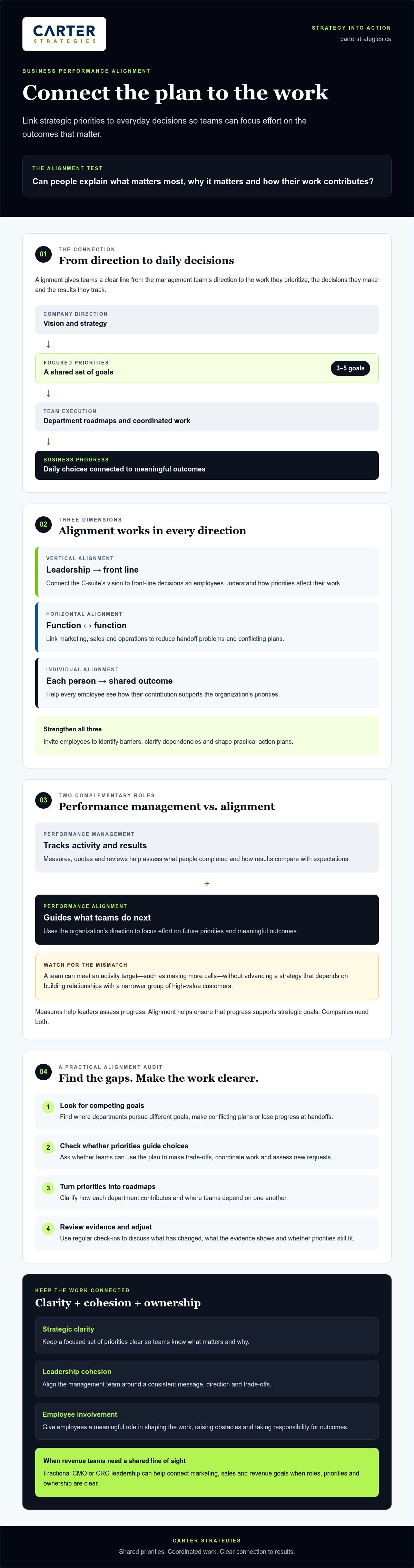
Business performance alignment connects an organization’s vision, strategy and daily execution. It gives teams a clear line from the direction set by the management team to the work they prioritize, the decisions they make and the results they track. The goal isn’t to keep everyone busy. It’s to focus effort on work that advances the organization’s most important priorities.
The execution gap often appears when leaders agree on a strategy but teams interpret it differently, pursue competing goals or lack the authority and resources to act. The result can be plenty of activity without enough progress on the outcomes that matter. The practical risk is clear: if a plan doesn’t guide daily choices, teams can’t reliably use it to make trade-offs or coordinate their work.
Strategic alignment provides a useful foundation: an organization’s structure, resources and culture need to support its direction. Business performance alignment extends that idea into execution by making priorities relevant to teams and connecting their actions to business results.
The Three Dimensions of Alignment
Alignment needs to work in three directions. Vertical alignment connects the C-suite’s vision to front-line decisions, so employees know how priorities affect their work. Horizontal alignment links functions such as marketing, sales and operations, reducing handoff problems and conflicting plans. Individual alignment helps each employee understand how their contribution supports a shared outcome. Leaders can strengthen all three by inviting employees to identify barriers, clarify dependencies and shape practical action plans.
Why Mid-Market Companies Struggle Most
As a company grows, the founder can no longer guide every decision directly. This “muddle in the middle” can leave managers translating strategy in different ways, while teams wait for clarity or move ahead on separate assumptions.
Limited capacity makes that disconnect harder to absorb. If a team spends time on work that doesn’t support a priority, it may delay more valuable work or stretch already-busy people. Canadian businesses may also serve customers with different needs, making it important to test strategic assumptions against customer and industry insights rather than expect one approach to fit every situation.
Strategic priorities act as a North Star. A short, clearly communicated set of priorities helps teams assess new requests, make trade-offs and coordinate their efforts. The test is simple: can people explain what matters most, why it matters and how their work contributes?
Performance Management vs. Performance Alignment
Performance management and performance alignment serve different purposes. Management systems track activity and results, often looking back at what people completed. Alignment uses the organization’s direction to guide what teams should do next. Companies need both: measures help leaders assess progress, while alignment helps ensure that progress supports strategic goals.
The distinction matters when a team meets its targets but the business still misses its growth objectives. For example, a sales team might be measured on the number of calls made, while the strategy depends on building relationships with a narrower group of high-value customers. The activity metric may improve, but it doesn’t necessarily show whether the strategy is moving forward.
Traditional Management: The “What” and “How”
Annual reviews, quotas and output measures can clarify expectations, but they can also narrow attention to tasks and short-term results. If a KPI rewards volume over value, employees may meet the target without improving the outcome the organization needs. In mid-size teams, this mismatch can create friction: people work hard, managers press for numbers, and neither group can see a clear connection to growth.
That’s where “malicious compliance” can emerge. Employees follow a measure exactly, even when it no longer serves the broader goal. The behaviour may look like resistance, but it can point to a system that rewards the wrong actions. Leaders should ask whether each measure helps teams make better decisions or simply records activity.
Strategic Alignment: The “Why” and “Where”
Alignment starts with a shared purpose and a clear direction. Strategic priorities can help employees weigh daily choices: does this request support a core objective, or should time and resources go elsewhere? When people understand the reason behind a priority, they can take responsibility for outcomes instead of waiting for instructions on every task.
This shifts leadership from supervising each step to agreeing on the result, boundaries and measures of progress. Teams gain room to decide how to deliver, while leaders stay accountable for direction and trade-offs. Autonomy doesn’t mean working without oversight. It means people have enough clarity to act, raise obstacles and adjust without constant approval.
Regular feedback keeps that autonomy connected to the plan. In check-ins, discuss what has changed, what the evidence shows and whether priorities still fit. This helps leaders course-correct before a small issue becomes a missed objective. It also gives employees a way to surface practical insight that may not appear in a dashboard.
For Canadian companies refining their strategy or connecting revenue teams around shared outcomes, Carter Strategies’ business strategy development and fractional CMO and CRO services can provide a path to explore.
The 5 Pillars of Organizational Alignment
Business performance alignment depends on more than clear targets. Strategy moves into daily work when leaders set a focused direction, teams have the ability and authority to act, and progress measures reward the right outcomes. These five pillars work together: a gap in one can weaken the others.
Pillar 1: Achieving Strategic Clarity
Define the organization’s “must-win” priorities for the next 12 to 18 months. A one-page strategy can make the direction easier to understand by summarizing the goals, choices and measures that will guide decisions. It isn’t a substitute for discussion; it gives teams a shared reference point. Remove or defer competing priorities that stretch capacity without advancing the main goals. For practical guidance on shaping a strategy, read Business Strategy Development.
Pillar 2: Building Leadership Cohesion and Employee Ownership
Executives need to explain priorities consistently and resolve disagreements before conflicting messages reach teams. But alignment isn’t created by leaders speaking at employees. Involve people in identifying barriers and shaping action plans. Explain what a shift means for each team: what will change, what will stop and how their work contributes. When employees resist, ask what they’re concerned about. Their response may reveal unclear expectations, competing incentives or practical risks the plan hasn’t addressed.
Pillar 3: Matching Capabilities to the Strategy
Check whether teams have the skills, time and decision-making support the plan requires. If growth depends on stronger customer insight, for example, identify who will gather it and how the findings will inform choices. Where a capability is missing, decide how to develop it, assign responsibility or adjust the plan. A strategy must fit the organization’s capacity to act.
Pillar 4: Reinforcing the Right Culture
Everyday decisions signal which behaviours the organization values. Recognize collaboration, knowledge-sharing and thoughtful problem-solving when they support strategic priorities. If employees are rewarded only for individual volume, they may protect their own targets at the expense of shared results. Make expectations clear, then reinforce them through leadership actions and team practices.
Pillar 5: Measuring Progress, Not Just Activity
Choose measures that show whether the strategy is gaining ground, not only how much work teams complete. Pair activity measures with outcome indicators, and review them together. For instance, track sales activity alongside evidence that the team is reaching the intended customers. When results fall short, use the data to ask what needs to change, not simply who should be held responsible. This keeps measurement useful and gives teams a reason to adjust course together.
Implementation: How to Align Your Team with Strategy
Business performance alignment takes shape through practical decisions: what to prioritize, where to assign people and resources, and how teams will check progress. For a mid-size company, the process should help leaders see where work gets stuck without adding layers of administration. Use these four steps to turn strategy into coordinated action.
Step 1: Conduct an Alignment Audit
Start by asking employees a direct question: “What are the company’s top three priorities?” Compare responses across the management team and departments. Differences can reveal where the strategy hasn’t reached people or where teams have interpreted it in conflicting ways.
Then map budgets, staff time and leadership attention against each priority. Are resources going to the work the strategy says matters most? List ongoing projects and identify “strategic drifters,” work that consumes capacity but no longer supports a clear objective. Discuss what to pause, change or stop with the people closest to that work. They can often explain its purpose and the consequences of changing course.
Step 2: Build Departmental Roadmaps
Translate each company priority into a small set of department-level outcomes. A roadmap should show how a team contributes, who owns each action, what dependencies need attention and which milestones will indicate progress. For example, a sales roadmap might identify a customer group to focus on, while marketing clarifies how it will support that focus. Agree on early milestones that show whether work is moving forward and help teams maintain momentum.
A roadmap also needs a “stop-doing” list. Name lower-priority projects or routines to pause so the organization can make room for strategic work. For more on connecting the plan to practical action, read Bridging the Gap Between Vision and Execution.
Step 3: Set a Rhythm for Strategic Progress
Establish regular check-ins that focus on progress against priorities, not a round-up of every task. Ask what has moved forward, what evidence supports that view, where teams are blocked and which decision is needed next. Keep the discussion frequent enough to allow course correction, while matching the pace of the work.
Step 4: Carry the Message Through Every Level
Communication needs to travel beyond a leadership announcement. Managers should explain what a priority means for their teams, invite questions and share updates in plain language. Give them consistent context, then make room for feedback from employees. That two-way flow helps leaders catch confusion early and keeps the strategy connected to day-to-day decisions.
If your team needs support turning strategic priorities into executable action plans, explore Carter Strategies’ business strategy development.
The Role of Fractional Leadership in Driving Alignment
Misalignment can be hard to see from inside an organization. Leaders may work from different assumptions, marketing may measure success by activity while sales focuses on revenue, and teams may not raise concerns if they believe priorities are already settled. An experienced external leader can ask direct questions, compare plans with day-to-day decisions and help the management team identify where work is pulling in different directions.
That perspective matters because alignment is not an HR initiative separate from growth. It shapes how the company attracts customers, supports sales and follows through on its value proposition. Fractional leadership can bring senior marketing or revenue expertise into that work without adding a full-time executive role. The contribution is strategic: clarify the shared goal, involve the people responsible for delivery and keep decisions connected to the organization’s priorities.
Bridging Marketing and Revenue Silos
A fractional CMO or CRO can help marketing and sales work from the same view of the customer and the company’s growth priorities. Marketing plans should reflect what sales teams hear from prospects, while sales conversations should reinforce the value proposition that marketing communicates. If marketing is generating interest that sales can’t convert, the teams can examine the customer journey together, from first contact through to a decision, and identify where their assumptions or handoffs differ.
This work needs to connect customer-facing activity with the internal strategic framework, not just produce more campaigns or reports. A fractional leader can bring teams together around shared outcomes, clarify ownership and use customer and industry insights to inform adjustments. For a closer look at the role, see The Fractional CMO Guide for Canadian Mid-Market Leaders.
Accelerating Growth Through Expert Guidance
Specialized leadership can help a company test assumptions against evidence and make informed decisions before it commits more effort to an approach that isn’t working. It doesn’t remove uncertainty or replace the knowledge of employees. It gives the team a guide who can frame the questions, connect functions and help leaders decide what to adjust. Learn how this work supports a growth strategy.
The value of this guidance is in helping leaders turn priorities into decisions, review progress and address barriers when teams drift. Alignment still depends on shared ownership. Leaders and employees need to understand the goal and take responsibility for their part in moving it forward.
To discuss how fractional CMO or CRO leadership could support your organization’s priorities, partner with Carter Strategies to align your team.
Turn Shared Priorities into Measurable Growth
Business performance alignment turns strategy into a shared way of making decisions. It connects company priorities with team roadmaps, gives employees a clear role in progress and helps leaders focus measures on outcomes, not activity alone. The five pillars provide a practical check: clarify the direction, bring leaders and employees into the work, match capabilities to the plan, reinforce the right behaviours and track meaningful progress.
For mid-market companies, alignment also helps connect revenue goals across marketing and sales. Fractional CMO or CRO leadership can add experienced guidance, while a pragmatic, implementation-focused approach keeps strategy grounded in the choices teams need to make.
If your organization is ready to connect its priorities with daily execution, Accelerate your growth with Carter Strategies' alignment expertise. With focused leadership and shared ownership, your team can move forward with greater clarity and confidence.
Frequently Asked Questions
What is the first sign that my business is misaligned?
A common first sign is that leaders and employees give different answers when asked to name the company’s top priorities. You may also see teams pursuing conflicting targets, repeated delays at department handoffs or projects that consume time without supporting a clear business goal. Ask employees across functions what matters most and how their work contributes. Differences in their answers can reveal where business performance alignment needs attention.
How long does it typically take to achieve full performance alignment?
There’s no standard timeline for achieving alignment, and it isn’t a one-time milestone. The pace depends on how clearly leaders agree on priorities, how many teams need to coordinate and whether people have the capacity to act. A company can clarify priorities and responsibilities as an initial step, then review progress regularly. Keep checking understanding and adjusting plans as conditions change, rather than treating alignment as a project with a fixed end date.
How can a mid-size company build organizational alignment?
A mid-size company can build alignment by agreeing on a focused set of priorities, involving employees in action planning and reviewing progress together. Start by asking teams what they understand the priorities to be, then identify gaps in communication, resources or decision-making. Leaders should clarify responsibilities, invite feedback and follow through on agreed actions. This keeps the work practical and helps people across the organization take ownership of shared goals.
How do I measure the ROI of business performance alignment?
Start with a baseline tied to the strategic goals you want alignment to support. Depending on the goal, track measures such as qualified sales opportunities, conversion rates, time to complete priority work or progress against key milestones. Compare results over time and consider other factors that may affect them. Also gather employee feedback on priority clarity and barriers. This helps connect business performance alignment to business outcomes without attributing every change to one initiative.
What is the difference between organizational alignment and team building?
Organizational alignment connects company priorities, decisions, resources and day-to-day work. Team building focuses on how people communicate, build trust and work together. Both matter, but they solve different problems. A team may have strong relationships and still lack agreement on which goals come first. Alignment gives teams a shared direction; team-building practices can help them collaborate more effectively as they pursue it.
Why do strategic plans often fail during the execution phase?
Plans often stall when employees don’t understand the priorities, departments interpret goals differently or teams lack the capacity and authority to act. A plan developed by leaders in isolation can also miss practical barriers that employees see in daily work. To improve execution, translate priorities into clear responsibilities and measures, involve teams in shaping action plans, and create regular opportunities to raise obstacles and adjust the work.
How can a Fractional CMO help with internal team alignment?
A Fractional CMO can connect marketing priorities with the company’s wider growth strategy and sales goals. They can help clarify the intended customer, align marketing plans with sales feedback, set shared measures and establish regular discussions about progress and obstacles. The role brings senior marketing expertise while working with the existing team. Alignment still depends on leaders and employees agreeing on priorities and taking responsibility for their part in delivery.


