

What if the revenue gap isn’t caused by too few leads, but by commercial priorities that don’t match what customers value or what teams can deliver? A revenue optimization consultant can help identify where strategy, customer experience and day-to-day ownership fall out of step. The work should look beyond reported outcomes to examine the decisions and assumptions behind them.
Leaders often know marketing and sales need to work more closely, yet still face unclear priorities, competing views of the customer and uncertainty about the support they need. A consultant can guide strategic decisions, while a fractional executive can take on an ongoing leadership role. Neither should be confused with tactical marketing delivery. The right fit depends on the business challenge, the decisions to be made and the work your team will own.
This article explains what a revenue optimization consultant can help address and what to assess before engaging one. You’ll find questions to ask about scope, collaboration and accountability, plus ways to connect customer and industry insights to focused priorities and an executable business strategy. The aim is not just to improve revenue outcomes, but to give your people a clear direction they can act on together.
Key Takeaways
- A revenue optimization consultant helps leaders examine growth opportunities, commercial priorities and the decisions behind revenue goals.
- Assess growth by testing company goals and assumptions against customer and industry insights before setting priorities.
- Choose between strategic advice, fractional executive leadership and tactical support by clarifying the role, decision-making authority and expected outputs.
- Before engaging a consultant, ask how they’ll learn the business, involve employees and define a scope your team can act on.
- Consider whether Carter Strategies’ business strategy development, marketing strategy or fractional CMO and CRO services fit the support your company needs.
What Does a Revenue Optimization Consultant Do for a Mid-Size Company?
Revenue goals can outpace alignment. A company may expect growth while marketing, sales and other teams work from different assumptions about which customers to prioritize, what the business should offer or how to support the plan. This can lead to activity without shared direction, and revenue discussions that focus on results without examining what is driving them.
A revenue optimization consultant provides strategic guidance to help leaders examine growth opportunities, commercial decisions and organizational priorities. The role is to clarify what the business is trying to achieve, test whether its priorities support that direction and help shape an executable business strategy. This is not a promise of guaranteed results or a universal method. Recommendations depend on the company’s goals, customer and industry insights, core capabilities and agreed engagement scope.
The work may include reviewing the company’s go-to-market strategy, or plan for reaching target customers and bringing an offering to market. Wikipedia’s overview of go-to-market strategy outlines areas such as target markets, pricing and distribution channels. For leaders, the practical test is whether choices across these areas reinforce the company’s value proposition and strategic direction.
Which business questions can a revenue optimization consultant help address?
Start with questions that connect market understanding to business choices: What do customers value, and where is demand changing? Do marketing and sales decisions support the company’s stated direction? Are the outcomes leaders want realistic in light of the team’s core capabilities and priorities? Employees who work with customers and deliver the offering can help surface gaps that summary reports may not show.
For example, a company may aim to grow a particular customer segment while its sales team spends most of its time pursuing another one. The useful discussion is not simply how to increase activity. It is whether the target, value proposition, resources and team priorities fit together.
How does strategic revenue advice differ from execution work?
Strategic advice helps leaders decide what to focus on, why it matters and how priorities should connect. Tactical execution carries out activities such as developing campaign materials or managing day-to-day marketing tasks. These are distinct responsibilities. Clarify what the consultant will recommend, what your team will own and what falls outside the engagement.
A consultant’s remit depends on the agreed scope. It may centre on strategic questions, priorities and action plans, with implementation left to internal employees or another provider. Clear boundaries help prevent a strategy engagement from being mistaken for an execution service, and give leaders and employees a shared understanding of how the work will move forward.
How Does a Revenue Optimization Consultant Assess Growth Opportunities?
A useful assessment starts with the decisions the business needs to make, not a preselected solution. Before recommending priorities, a revenue optimization consultant should understand what the company aims to achieve, which assumptions shape its plans and what decisions leaders need to address. That context keeps the review focused on the business rather than a generic list of sales or marketing tactics.
Leaders can frame the assessment around a sequence of questions:
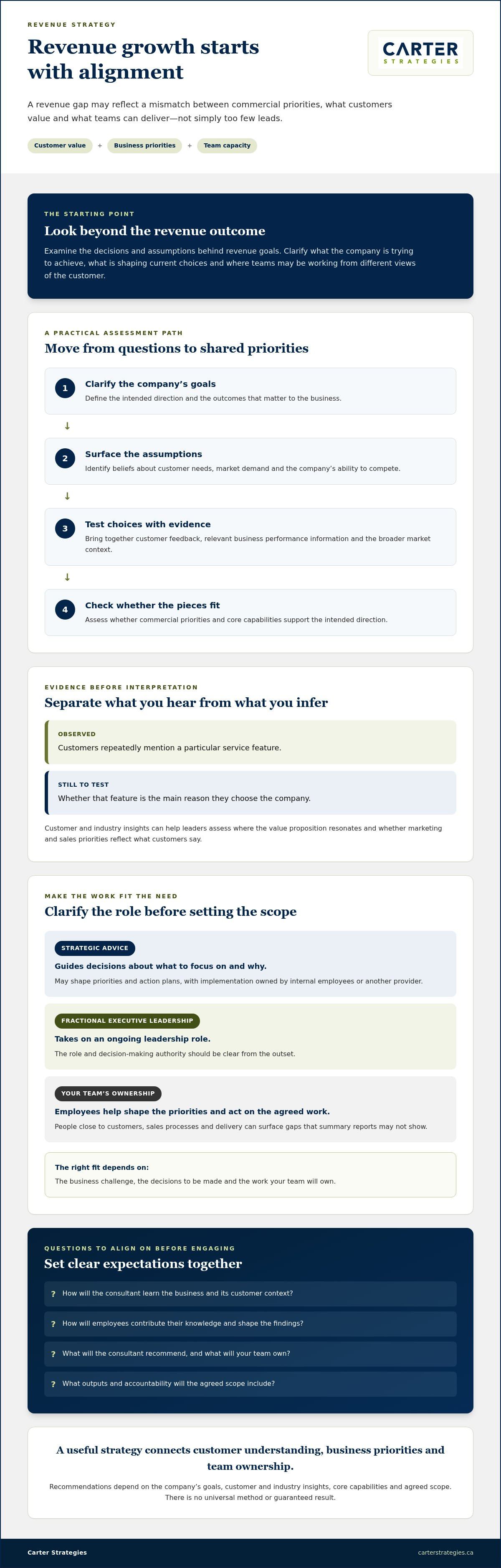
- What are the company’s goals? Clarify the intended direction and the outcomes that matter to the business.
- Which assumptions are guiding current choices? Identify beliefs about customer needs, market demand and the company’s ability to compete.
- What decisions need evidence? Pinpoint choices about target customers, the value proposition, commercial priorities or resource focus.
- What could prevent progress? Examine whether current priorities and core capabilities support the intended direction.
What evidence should inform revenue decisions?
Use customer feedback, relevant business performance information and the broader market context to test assumptions. Customer conversations may reveal what people value, how they distinguish the company’s offering from alternatives, or what makes them hesitate. Performance information can show where results match expectations and where further investigation is needed.
Keep observed evidence separate from interpretation. For example, customers may repeatedly mention a particular service feature. The belief that this feature is the main reason they choose the company still needs to be tested. This distinction helps leaders assess where the value proposition resonates and whether marketing and sales priorities reflect what customers actually say. If the assessment draws on external research, cite the original, credible source and be clear about what the finding does, and does not, establish for the company.
How should assessment findings become shared priorities?
Findings are more useful when the people responsible for acting on them can question and shape them. Invite employees who work with customers, sales processes and delivery to identify practical constraints and internal friction. Their input can reveal why a proposed priority may be difficult to carry out, or which existing capability could help the company act on an opportunity.
Compare potential priorities with the company’s strategic direction and core capabilities. A long list of opportunities can dilute attention if the team cannot support each one. Translate selected priorities into action plans that state the activity, the owner and the intended outcome. This gives the team a practical basis for discussing progress and clarifies accountability, while making planning a shared process rather than a decision made by leaders alone.
For an outside perspective on aligning strategic direction and team priorities, explore business strategy development from Carter Strategies.
Consultant, Fractional CRO, or Tactical Provider: Which Fit Makes Sense?
The right support depends on the gap you need to address. A revenue optimization consultant can advise on strategic questions and priorities, while a fractional chief revenue officer (CRO) provides part-time executive leadership. A tactical provider carries out specified activities. These roles may contribute to the same business goals, but their responsibilities and expected outputs differ. Agree on scope before work begins.
| Support model | Remit | Decision-making role | Continuity | Typical outputs |
|---|---|---|---|---|
| Strategic consultant | Examine growth opportunities, business choices and priorities | Advises leaders; decision rights remain as agreed with the company | Often defined around a project or an agreed retainer | Strategic recommendations, priorities and action plans |
| Fractional CRO | Provide part-time executive leadership for revenue-related priorities | Leadership responsibilities and authority should be clearly defined | Ongoing for the agreed period and scope | Executive guidance and leadership aligned with the agreed remit |
| Tactical provider | Carry out specified delivery activities | Implements work within agreed direction and approvals | Depends on the work and arrangement | Completed activities or materials defined in the scope |
When is strategic consulting a better fit than fractional leadership?
A defined strategy project may fit when leaders need to examine a specific challenge, make decisions and set priorities, and the management team can lead implementation. Fractional leadership may be a better fit when the company needs continuing executive-level guidance to lead revenue priorities over time. Neither model guarantees growth. Results depend on the company’s decisions and follow-through.
Before choosing a model, clarify who makes decisions, how the consultant or executive will work with employees, and what deliverables the engagement includes. Ask whether the management team has the time and authority to carry the work forward after recommendations are made. If not, strategic advice alone may leave an ownership gap.
What belongs outside a strategic consulting engagement?
Strategic business planning sets direction and priorities; it does not automatically include day-to-day campaign delivery or other tactical work. Confirm whether the engagement covers strategic guidance, fractional executive leadership, or both, and identify who will handle work outside that scope. A dedicated guide to fractional CRO services can also help leaders assess what executive revenue leadership involves.
For example, a consultant may help determine which customer groups and commercial priorities deserve focus, while an internal team or separately engaged provider handles delivery. Clear boundaries support collaboration and accountability without confusing advice with execution.
How Can Leaders Evaluate a Revenue Optimization Consultant Before Engaging One?
Choose a revenue optimization consultant based on the business problem, not just a polished proposal or an impressive list of credentials. Leaders need to understand how the adviser will learn about the company, work with its people and turn findings into decisions the organization can carry forward. A good fit connects relevant experience with a defined scope and a practical way of working.
Use this checklist to guide early conversations:
- Relevant experience: Ask about work with companies facing comparable strategic challenges. Request examples of the questions addressed and the work produced, without asking for confidential client information.
- Problem fit: Explain the challenge you need to resolve. Ask what the consultant would need to understand before recommending priorities, and how they would distinguish evidence from assumptions.
- Customer and employee input: Ask how customer and industry insights, employee knowledge and management team perspectives would inform the work.
- Scope and outputs: Confirm what the engagement includes, what it doesn’t, and whether it centres on strategic advice, leadership support or both.
- Progress and accountability: Discuss how recommendations will connect to measurable business progress and action plans, and who will be responsible for decisions and follow-through.
What questions should CEOs and boards ask a prospective consultant?
Ask, “How would you learn our business before recommending priorities?” A useful answer should explain what information and perspectives the consultant would seek, rather than jump straight to a preferred solution. Also ask for relevant examples, how recommendations will connect to business goals and action plans, and how the adviser supports alignment without replacing internal leadership.
How can leaders test collaboration and accountability?
Discuss how employees and leaders will contribute to strategic planning. Ask who owns decisions, who coordinates action plans and how the management team will review progress. A consultant should be able to explain how the working relationship supports shared understanding and ownership, while keeping decision rights clear. If expectations for employee involvement or accountability remain vague, resolve them before agreeing to the scope.
These questions help you assess whether the adviser’s experience, working style and scope match the decisions your company needs to make. For broader context on connecting strategic choices to priorities and action plans, review business strategy development guidance from Carter Strategies.
How Carter Strategies Connects Revenue Priorities with Team Ownership
Once you have clarified the challenge, scope and working style your company needs, consider whether the adviser can connect strategic direction with the people responsible for carrying it forward. Carter Strategies advises mid-size companies on business strategy development, marketing strategy, growth strategies and planning, and fractional CMO and CRO services. These offerings are for leaders seeking strategic guidance or executive-level support, rather than tactical marketing delivery.
Leslie Carter brings more than 25 years of business strategy and brand management experience. For leaders evaluating a revenue optimization consultant, that background can inform work on growth priorities, marketing direction and team alignment. The right scope still depends on your company’s needs and the decisions you want to address.
What makes the advisory approach collaborative?
Strategic planning is stronger when employees can contribute ideas and practical knowledge, rather than receive a plan developed in isolation. Carter Strategies’ stated approach involves employees in the process to help uncover ideas and build alignment and ownership of strategic priorities. Their perspectives can help connect leadership’s direction with customer and industry insights, as well as the realities of carrying out action plans.
The aim is to connect priorities with action plans and accountability while keeping decisions grounded in the company’s goals and capabilities. Employee involvement does not replace leadership responsibility; it helps leaders develop priorities that people understand and can work towards together. Discuss and agree on the specific scope and outputs before an engagement begins.
What is a practical next step for interested leaders?
Bring a clear business question to an initial discussion, along with relevant context about your goals, current priorities and the decisions you need to make. Consider who should contribute from the management team and across the organization. Then clarify the desired outcomes, scope, leadership involvement and whether a project or retainer arrangement best fits the work.
If your company needs strategic direction, marketing strategy or fractional executive leadership, discuss how the work could fit your priorities and team. Discuss your strategic priorities with Carter Strategies.
Move Forward with Clear Priorities and Shared Ownership
The right revenue optimization consultant helps leaders connect growth goals with customer and industry insights, clear commercial priorities and the team’s ability to act. Before engaging support, define the decisions you need to make, the scope you expect and how employees will contribute. Strategic advice and fractional executive leadership serve different needs, so choose the arrangement that matches the work ahead.
At Carter Strategies, Leslie Carter brings more than 25 years of business strategy and brand management experience. Advisory support is available on a project or retainer basis, with collaborative strategic planning that involves employees and builds ownership of priorities. The aim is to connect direction with action, not hand down a plan in isolation.
Start with the business question your team needs to resolve. Discuss your strategic priorities and explore whether the scope and working arrangement fit. With focused priorities and people involved in shaping the work, your organization can move forward with greater clarity and shared purpose.
Frequently Asked Questions
What does a revenue optimization consultant do?
A revenue optimization consultant helps leaders examine the business decisions, customer understanding and organizational priorities connected to revenue performance. Depending on the agreed scope, the work may include assessing growth opportunities, clarifying strategic priorities and advising on action plans. For example, a consultant might help determine whether marketing and sales priorities reflect the company’s direction and customer needs. The role does not automatically include tactical marketing execution or guarantee a particular business result.
When should a company hire a revenue optimization consultant?
Consider outside advice when leaders need to clarify growth priorities, improve alignment between marketing and sales, or connect customer needs with the company’s direction. First identify which decisions are proving difficult to resolve internally. A consultant can help examine the relevant evidence and options, but the management team needs to be ready to involve employees, make decisions and take ownership of agreed actions. Without that commitment, recommendations may not translate into progress.
How is a revenue optimization consultant different from a fractional CRO?
A consultant typically advises on strategic questions within an agreed scope, while a fractional chief revenue officer (CRO) provides part-time executive-level revenue leadership. A company seeking recommendations on priorities may need consulting; one that needs ongoing senior leadership to guide revenue priorities may consider fractional support. Responsibilities vary by engagement, so clarify decision rights, continuity, collaboration expectations and outputs before choosing either model.
Can a revenue optimization consultant help align marketing and sales?
Yes. A consultant can help leaders assess whether marketing and sales priorities support the company’s direction and reflect customer and industry insights. The engagement should clarify how each team will contribute, which decisions leaders will make and who owns follow-through. Alignment takes participation and continued effort from the people involved. Recommendations alone cannot ensure that teams share priorities or put agreed actions into practice.
What should I ask a revenue optimization consultant before starting?
Ask how the consultant will learn about your business and what evidence will inform recommendations. Clarify how employees and the management team will contribute, what the agreed scope includes, who makes decisions and what outputs to expect. Discuss how you’ll review progress and who owns each action plan. You can also ask for relevant examples of past work without requesting confidential details about other clients. These answers help you assess fit before committing.
Does revenue optimization consulting include marketing execution?
Not necessarily. Strategic consulting may focus on assessing opportunities, setting priorities and advising on action plans, while tactical marketing execution is a separate scope of work. Confirm what the consultant will and won’t do before an engagement begins, including who will carry out delivery work. Carter Strategies focuses on business strategy, marketing strategy and organizational alignment rather than tactical marketing execution, so clarify the support your company needs.


