


More marketing activity won’t fix a problem the company hasn’t correctly diagnosed. If campaigns are running but business progress remains unclear, a marketing turnaround consultant should help leaders find the cause before recommending a reset. The issue may be strategy, team alignment, or execution priorities, and each calls for different support.
It’s reasonable to expect a consultant to bring senior expertise and a clear path forward, but advisers don’t all do the same work. Some focus on strategic recovery and leadership; others concentrate on carrying out defined activities. Choosing without understanding that distinction can leave the underlying issue unresolved.
This article explains how to assess a consultant’s experience, approach, and fit with your company. You’ll learn how to distinguish a strategic gap from an organizational or execution issue, what questions can clarify how a consultant works with your management team and employees, and how to set priorities with measures of progress. The goal is a business strategy your team can understand, own, and act on.
Key Takeaways
- Check whether the marketing challenge relates to strategy, positioning, team alignment, or execution priorities.
- Review business goals, customer and industry insights, brand positioning, and available performance evidence before writing a consultant brief.
- Compare each marketing turnaround consultant on relevant experience, diagnostic approach, collaboration, scope, and follow-through.
- Connect strategic priorities to clear owners, measures, and coordinated action plans your team can carry forward.
- Consider whether Carter Strategies’ marketing strategy and fractional CMO/CRO services match your need for senior strategic direction and alignment.
What a Marketing Turnaround Consultant Does: And When to Consider One
Marketing continues, but leaders can’t explain how it is moving the business forward. Teams may disagree about priorities, customers may not see a clear reason to choose the company, or leaders may struggle to connect marketing decisions to business goals. Before changing direction, the company needs to understand what is holding progress back.
A marketing turnaround consultant advises on the strategic issues behind unclear or stalled marketing progress. The work can include examining marketing strategy, brand positioning, customer understanding, business priorities, and gaps in senior leadership. A useful diagnosis connects these areas to the company’s direction and includes input from people who understand the customers and the work.
This differs from a broader corporate turnaround. Turnaround management refers to the wider renewal of a troubled company, which may involve financial or operational matters beyond marketing. A marketing advisory engagement focuses on strategic marketing questions and leadership needs. If a company is facing financial distress or insolvency concerns, leaders should identify the appropriate qualified expertise rather than assume a marketing adviser covers those matters.
What problems can a marketing turnaround consultant address?
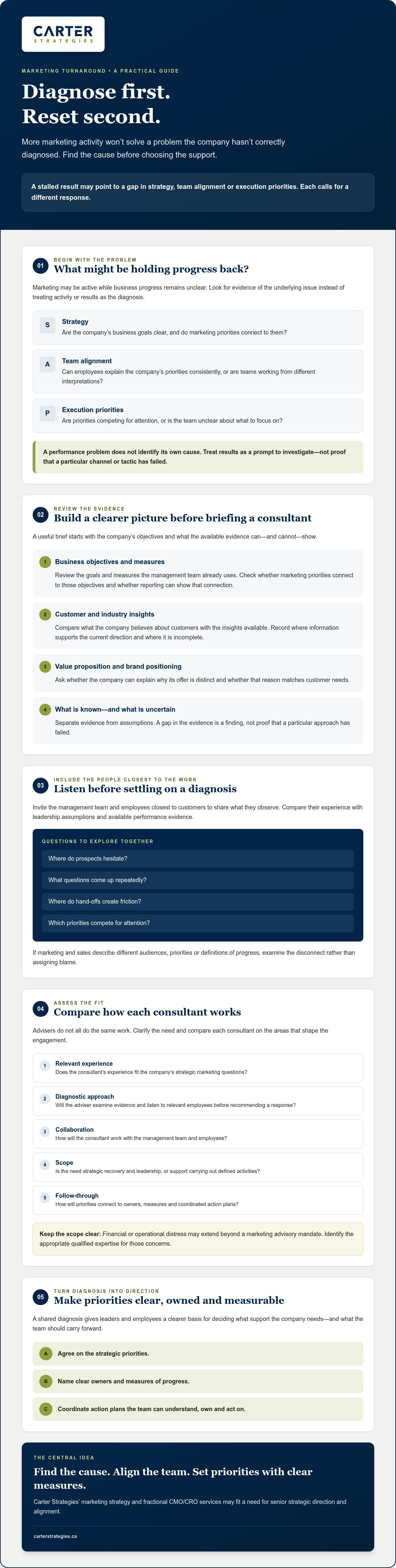
Start with questions, not assumptions. Are the company’s business goals clear? Do leaders have useful customer and industry insights? Does the brand’s value proposition give customers a clear reason to choose it? Can employees explain the company’s priorities consistently, or are teams working from different interpretations?
A performance problem doesn’t identify its own cause. Results may prompt leaders to review positioning or priorities, but they may also point to unclear goals, limited customer understanding, or conflicting direction between marketing and sales. A consultant should examine the evidence and listen to relevant employees before recommending a strategic response.
The right support depends on the gap. If the company needs clearer marketing strategy or differentiated brand positioning, look for an adviser whose experience fits those questions. If leaders need senior marketing or revenue leadership, fractional CMO/CRO support may address that expertise gap.
When does a marketing challenge require broader turnaround support?
Financial or operational distress may extend beyond a marketing advisory mandate. If the company faces urgent concerns in those areas, leaders should identify the expertise required rather than assume a marketing specialist can address every part of the situation. Clarify the immediate business issue, the decisions that need attention, and which advisers are qualified to support them.
A shared diagnosis gives leaders and employees a clearer basis for deciding what support the company needs. It also helps the organization focus on strategic priorities that fit its circumstances and direction.
How to Diagnose the Marketing Problem Before Hiring a Consultant
Before you write a brief for a marketing turnaround consultant, establish what the company is trying to achieve and what the available evidence can tell you. A disciplined review helps leaders distinguish a genuine strategy gap from unclear measures, inconsistent direction, or missing information. It also gives a prospective adviser a more useful starting point than a broad request to “fix marketing.”
Symptoms can show where progress is stalled, but they can’t establish the root marketing issue. Treat that as a working principle: investigate the evidence, compare interpretations, and make room for the team’s perspective before settling on a diagnosis.
Which evidence helps explain stalled marketing progress?
Start with the company’s business objectives and the measures the management team already uses to assess progress. Check whether marketing priorities connect to those objectives, and whether current reporting can show that connection. Avoid imposing outside benchmarks when the company lacks comparable evidence. Instead, record what is known, what is uncertain, and what needs to be measured or clarified.
Then compare customer and industry insights with the company’s stated value proposition and brand positioning. Do customer needs match the assumptions behind the current approach? Can the business explain why its offer is distinct? Note where evidence supports the current direction and where it is incomplete. A gap in the evidence is a finding, not proof that a particular tactic or channel has failed.
How do teams contribute to a credible diagnosis?
Invite the management team and employees closest to customers to describe what they observe. Ask where prospects hesitate, what questions recur, where hand-offs create friction, and which priorities compete for attention. Compare those observations with leadership assumptions before deciding what the problem is. Employees can surface practical constraints and customer signals that performance reports alone may not explain.
If marketing and sales describe different audiences, priorities, or definitions of progress, examine the disconnect rather than assigning blame. The guide to marketing and revenue alignment offers a relevant next step for leaders exploring those cross-functional gaps. A shared view of the issue can help the company define the expertise and scope it needs.
Once the diagnosis is clearer, use it to shape the consultant brief. General selection advice, including these essentials of choosing a consultant, can help leaders assess fit alongside the specific marketing challenge. If you’re defining that challenge in relation to business strategy, Carter Strategies’ business strategy and marketing strategy advisory is one option to review.
How to Compare Marketing Turnaround Consultants and Their Approach
Once you’ve clarified the challenge, compare advisers on how they think and work, not just on titles or presentations. A marketing turnaround consultant should connect marketing decisions to business strategy and, where relevant, revenue leadership. Ask how they’ll test assumptions, involve your team, and turn findings into priorities people can own.
Use this framework to compare candidates:
| Area | What to assess | Questions to ask |
|---|---|---|
| Diagnosis | Whether recommendations follow evidence and inquiry. | How will you assess our goals, customer insights, positioning, and performance evidence? |
| Relevant experience | Experience with a similar business model or strategic challenge. | What comparable challenges have you advised on, and what did you learn? |
| Collaboration | How the adviser brings the management team and employees into the process. | Whose perspectives will inform priorities, and how will you build ownership? |
| Scope | Whether the work covers strategy, leadership, or specialized marketing services. | What is included, and what expertise should our team add? |
| Follow-through | How recommendations connect to owners, measures, and action plans. | How will we review progress and adjust priorities? |
What experience and working approach should leaders assess?
Look for experience relevant to your business model and the problem you’ve identified, not a list of unrelated credentials. A strong adviser explains how evidence informs their reasoning, identifies what remains uncertain, and translates recommendations into practical action planning. Assess their ability to work with people as well: the process depends on frank discussion, shared accountability, and aligning people with different views. General guidance on the essentials of choosing a consultant can complement your marketing-specific criteria.
Should you hire a consultant, fractional CMO, or marketing agency?
Match the role to the gap. A consultant can provide focused strategic advice; a fractional CMO adds senior marketing leadership; a marketing agency may offer a distinct set of specialist capabilities. These roles aren’t interchangeable. Fractional CMO support provides leadership and direction, not a promise to cover every marketing need. Clarify responsibilities, decision authority, and how sales and marketing will work together before agreeing on scope. For a closer look at the leadership role, see this fractional CMO guide.
What a Marketing Turnaround Engagement Should Deliver
A well-scoped engagement should move from understanding the business question to agreeing on priorities the company can act on. The marketing turnaround consultant should explain how discovery, diagnosis, priority-setting, action planning, and progress reviews fit together. The work isn’t complete when a strategy document is delivered. Leaders and employees need to understand the choices, their roles, and how the company will assess progress.
What should the consultant clarify at the outset?
Before work begins, agree on the question the engagement must answer, its scope, who will make decisions, and what evidence is needed. Clarify how the management team and employees will contribute, when they’ll review findings, and how differing views will be resolved. Set expectations for strategic outputs without accepting promises of results or timelines that haven’t been substantiated.
Discovery should build a shared view of the situation. Diagnosis should explain what the evidence suggests and where uncertainty remains. From there, priority-setting narrows the focus, while action plans translate the agreed direction into practical steps. Each priority should connect to:
- An owner: the person or team accountable for moving the work forward.
- A measure: an indicator tied to the business priority and supported by available evidence.
- Coordinated action: the activities and decisions required across relevant teams.
Ask how the adviser will keep employees involved as priorities take shape, not just consult them during discovery. Ongoing participation can surface practical barriers and build ownership. For related guidance on turning direction into action, read about bridging vision and execution.
How can leaders assess progress without relying on vague claims?
Agree on measures that reflect the chosen priorities, using existing business objectives and reliable information where possible. If the evidence is incomplete, identify that gap and decide how to address it rather than presenting an unsupported benchmark as proof of progress.
Set regular review points to examine the measures, test assumptions, surface barriers, and adjust action plans. Use those conversations to confirm who owns each next step and what support is needed. A strategy should guide ongoing decisions, not sit untouched as a finished document.
If your company needs support connecting strategic direction with practical priorities, explore Carter Strategies’ business strategy and marketing strategy advisory.
Is Carter Strategies the Right Marketing Turnaround Consultant for Your Company?
Carter Strategies may suit mid-sized companies seeking clearer marketing priorities, differentiated brand positioning, or senior strategic guidance. The firm advises on marketing strategy, business strategy, and fractional CMO/CRO leadership, with a focus on strategic direction and organizational alignment. Its approach connects marketing decisions to broader business goals and helps leaders identify priorities the team can put into action.
Principal Leslie Carter brings more than 25 years of business strategy and brand management experience. For companies seeking a marketing turnaround consultant, that experience can inform work on customer and industry insights, brand choices, and growth priorities.
Which companies are most likely to benefit from Carter Strategies’ approach?
This approach may fit leaders who need to clarify which marketing priorities support business progress, strengthen their value proposition, or access senior marketing leadership. Fractional CMO/CRO services may address a leadership gap; the right scope depends on the company’s challenge and the decisions it needs to make.
Strategic priorities gain strength when employees help shape them. Their perspectives bring practical experience into the discussion and support shared understanding and ownership. If the marketing challenge connects to wider questions about company direction, review this guide to business strategy development.
Carter Strategies’ advisory work is available on a project or retainer basis. Discuss the challenge and the support required to determine which engagement structure may fit your company.
What should leaders bring to an initial conversation?
Bring a clear business goal, the concerns prompting the discussion, available evidence, and unresolved leadership questions. Identify who should contribute to the diagnosis and who will make decisions about strategic priorities. Including employees who understand customers and day-to-day work can help leaders see where assumptions differ from experience.
A focused conversation can clarify whether your company needs marketing strategy, fractional CMO/CRO leadership, or broader business strategy support. Discuss your strategic priorities with Carter Strategies to explore the challenge and whether project or retainer advisory support fits.
Choose a Partner Who Can Turn Diagnosis Into Direction
The right marketing turnaround consultant won’t prescribe a reset before understanding the problem. Start with business goals, customer and industry insights, and team perspectives. Then compare advisers on relevant experience, collaboration, scope, and their ability to connect strategic priorities with clear ownership and measures.
A useful engagement should leave your management team and employees aligned on what matters and equipped with coordinated action plans. Strategy gains traction when the people responsible for moving it forward help shape and own it.
Carter Strategies advises mid-sized companies on marketing strategy, business strategy, and fractional CMO/CRO leadership. Principal Leslie Carter brings more than 25 years of business strategy and brand management experience, supported by collaborative strategic planning and brand positioning expertise. Advisory support is available on a project or retainer basis, depending on your needs.
If you’re ready to clarify your priorities and determine what support fits, discuss your marketing and business strategy priorities. A clear diagnosis is a practical first step toward aligned action and measurable progress.
Frequently Asked Questions
What does a marketing turnaround consultant do?
A marketing turnaround consultant diagnoses why marketing isn’t clearly advancing business priorities and helps leaders set a focused strategic direction. The work may examine business goals, customer and industry insights, brand positioning, team alignment, and available performance evidence. The adviser should explain what the findings support, identify evidence gaps, and help shape priorities and action plans with the people responsible for carrying them forward.
When should a company hire a marketing turnaround consultant?
Consider hiring one when marketing activity continues but leaders can’t connect it to clear business progress, or when teams disagree about priorities and the reasons behind stalled results. First, review business goals, customer understanding, positioning, and available measures. If the main need is senior strategic direction or alignment, an adviser may help. If the company faces broader financial or operational distress, identify the additional expertise that situation requires.
How do you choose the right marketing turnaround consultant?
Choose a marketing turnaround consultant whose experience and working approach fit the challenge you’ve identified. Ask how they’ll diagnose the issue, what evidence they’ll review, how they’ll connect marketing decisions to business strategy, and how they’ll involve leaders and employees. Clarify scope, decision-making responsibilities, and expected outputs. Look for clear reasoning and practical action planning, not just confident claims or recommendations made before the adviser understands your company.
Can a fractional CMO help turn around marketing performance?
Yes, a fractional CMO can provide senior marketing leadership when a company needs strategic guidance but doesn’t have that expertise in place. The role can help align marketing priorities with business direction and bring greater clarity to decisions. It doesn’t promise a particular performance result or mean the executive will carry out every campaign task. Confirm the leadership scope, decision authority, and how progress will be assessed.
What should a marketing turnaround consultant deliver?
A marketing turnaround consultant should clarify the business question, review relevant evidence, diagnose the challenge, and help the company agree on practical priorities. The resulting action plans should connect each priority to an owner, a measure, and coordinated work across relevant teams. A sound engagement also defines how employees and the management team will contribute, review findings, address barriers, and adjust priorities as the work progresses.
How is a marketing turnaround consultant different from a marketing agency?
A marketing turnaround consultant typically focuses on diagnosis, strategic direction, priorities, and leadership needs. A marketing agency may focus on delivering defined marketing activities, though its scope depends on the agreement. These roles aren’t interchangeable. Before engaging either, decide whether the company needs strategic advice, senior marketing leadership, campaign delivery, or a combination of distinct forms of support, then confirm responsibilities and deliverables in writing.
Does a marketing turnaround consultant implement campaigns?
Not necessarily. The title alone doesn’t confirm whether a consultant delivers campaign work, so ask directly what the engagement includes. Carter Strategies focuses on business strategy, marketing strategy, fractional CMO/CRO services, and growth strategies and planning, rather than tactical marketing execution. Companies seeking campaign production or channel management should clarify who will handle that work and how it will connect to the agreed strategic priorities.


