


What if revenue growth is being held back not by a lack of effort, but by teams working toward different priorities? If you’re asking what does a fractional CRO do, the role starts with bringing those priorities together. A fractional Chief Revenue Officer provides part-time executive leadership to connect revenue goals with business decisions, team responsibilities, and strategic direction.
When sales, marketing, and leadership each have a different view of what is driving growth, it can be hard to agree on what to focus on next. You may need senior revenue guidance, but still have questions about what the role covers, how it differs from a sales leader, and where it fits with your management team.
This guide explains a fractional CRO’s responsibilities and boundaries, how the role works with the CEO, management team, sales, and marketing, and when fractional leadership may suit your company. It also covers practical ways to clarify priorities and build shared ownership, rather than treating strategy as a plan handed down from the top.
Key Takeaways
- To understand what a fractional CRO does, look at how part-time revenue leadership connects company priorities with executive decisions and team responsibilities.
- Assess revenue priorities using customer and industry insights alongside relevant business information, then identify where teams need clearer alignment.
- Distinguish the CRO’s revenue focus from the responsibilities of sales leaders, fractional CMOs, and CFOs.
- Use a collaborative process to review evidence, align leaders, set priorities, and build employee ownership of action plans.
- Consider whether disconnected priorities or unclear ownership call for an outside perspective, while recognizing that employees and leaders remain responsible for decisions and execution.
What does a fractional CRO do? Start with the revenue leadership role
A fractional Chief Revenue Officer provides part-time executive leadership for revenue strategy. The role helps connect revenue priorities to an executable business strategy, so decisions and action plans support the same direction. If you’re asking what does a fractional CRO do, start with this distinction: the work is about revenue leadership, not simply overseeing sales activity.
The scope depends on the company’s priorities, operating context, and agreed responsibilities. A CRO might help leaders identify revenue opportunities or obstacles, then align relevant teams around a practical response. The role can connect functions such as marketing and sales, but that doesn’t mean the CRO automatically manages every team or function. The Chief Revenue Officer (CRO) title describes a senior revenue role; the specific remit still needs to be defined for each company.
A sales leader typically concentrates on sales operations and team performance. A fractional CRO works at the executive level to consider how revenue priorities relate to broader business decisions. That could mean checking whether sales goals reflect the company’s direction, whether teams share clear priorities, and which decisions need leadership attention. The title alone doesn’t create alignment. Clear responsibilities, decision rights, and shared ownership do.
How is a fractional CRO different from a full-time CRO?
The central difference is the time commitment and the context in which the executive works. A full-time CRO is part of the company’s ongoing leadership structure. A fractional CRO provides executive leadership on a part-time basis, with the arrangement shaped around the company’s needs. Part-time doesn’t mean disconnected: the CRO needs access to decision-makers and relevant information to understand the business. The company retains responsibility for its internal decisions and follow-through.
What does “fractional” mean in an executive role?
“Fractional” means senior expertise on a part-time basis, not an outsourced department or a temporary title. The executive works with company leaders on agreed priorities while employees continue to own their work and decisions. For Carter Strategies, advisory offerings are available on a project or retainer basis. The right scope depends on what the company needs to address and which responsibilities both sides agree to.
Before engaging a fractional CRO, clarify the challenge the role should address, which decisions it can inform, and who inside the company will carry the work forward. For example, specify whether the priority is clarifying revenue direction, aligning sales and marketing, or helping leaders agree on the next strategic priorities. This creates a useful boundary: the CRO can bring focus to revenue leadership, but progress depends on leaders and employees having the information, alignment, and ownership to act.
What does a fractional CRO oversee across the revenue system?
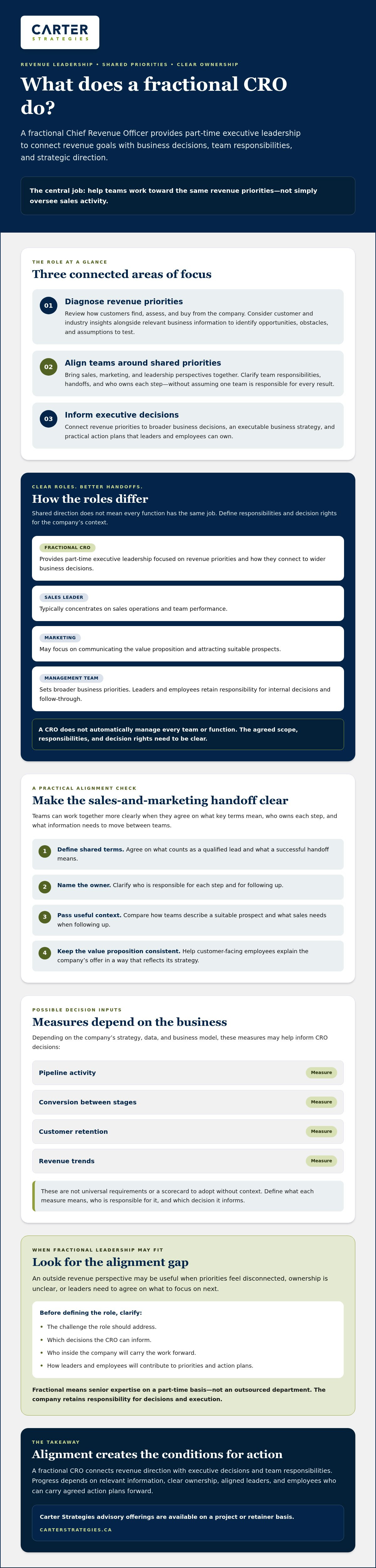
To understand what does a fractional CRO do in practice, look at how the role connects three areas: diagnosing revenue priorities, aligning teams, and informing executive decisions. The CRO can review how customers find, assess, and buy from the company, then work with leaders to identify where the revenue strategy needs greater focus. The goal isn’t to assume one team is responsible for every result. It’s to clarify how decisions, handoffs, and responsibilities connect.
That assessment should draw on customer and industry insights, along with relevant business information. For example, customer feedback may point to a gap between what a company promises and what buyers experience during a sales conversation. Sales, marketing, and company leadership each bring different context to that issue. A CRO can help bring those perspectives together, test assumptions, and support a decision about what to address first.
Shared direction doesn’t erase distinct responsibilities. Marketing may focus on communicating the value proposition and attracting suitable prospects. Sales may guide prospective customers through decisions. The management team sets broader business priorities. A CRO can help these groups agree on priorities and handoffs without automatically taking over their functions. A useful first check is to ask where work crosses team boundaries and whether each handoff has a clear owner.
How does a fractional CRO connect sales and marketing?
Alignment starts with clear definitions. Teams need a shared understanding of terms such as a qualified lead, an agreement to follow up, or a successful handoff. They can then identify who owns each step and what information needs to move between teams. For instance, marketing and sales can compare how they describe a suitable prospect and what context sales needs when following up. A consistent value proposition also helps customer-facing employees explain the company’s offer in a way that reflects its strategy. For more on the connection, explore the topic of business strategy development.
Which revenue measures can inform CRO decisions?
Depending on the company’s strategy, data, and business model, useful measures may include pipeline activity, conversion between stages, customer retention, and revenue trends. These aren’t universal requirements or a scorecard to adopt without context. Before using a measure, define what it means, who is responsible for it, and which decision it should inform. If teams calculate the same measure differently, comparisons may not help leaders decide what to change.
Selected revenue measures show where progress or friction may affect business decisions. For instance, a change in conversion may prompt leaders to examine customer feedback, sales practices, or the fit between the offer and the intended market before deciding on a response. The measure informs the discussion; it doesn’t make the decision on its own.
Reporting should serve the agreed priorities, not become a separate exercise. A fractional CRO can help leaders decide what information they need, how teams will review it, and which decisions should follow. Companies exploring how to connect revenue priorities with an executable business strategy can learn more about Carter Strategies’ approach.
Fractional CRO vs. sales leader, fractional CMO, and CFO: who does what?
These roles can work toward the same company goals, but they bring different perspectives and areas of responsibility. A fractional CRO focuses on revenue priorities across the business. That doesn’t mean they automatically manage sales, marketing, or every function connected to revenue. The management team should agree on boundaries, decision rights, and how the roles will work together.
| Role | Primary focus | Decisions supported | Typical internal partners |
|---|---|---|---|
| Fractional CRO | Revenue strategy and alignment across relevant functions | Which revenue priorities to pursue and how teams coordinate around them | CEO, management team, sales and marketing leaders |
| Sales leader | Sales team leadership, pipeline, and sales performance | How the team manages opportunities, customer conversations, and sales priorities | Sales employees, CRO, marketing |
| Fractional CMO | Marketing leadership, including brand positioning and demand generation | How marketing supports the company’s goals and reaches intended customers | CEO, management team, sales, marketing employees |
| CFO | Financial planning, reporting, and oversight | How financial information informs plans, resource decisions, and monitoring | CEO, management team, finance, CRO |
When does a fractional CRO differ from a sales leader?
A sales leader usually concentrates on the sales team’s priorities and day-to-day view of opportunities. A fractional CRO considers how those priorities fit the company’s broader revenue direction. The roles can collaborate on pipeline visibility and accountability: the sales leader brings direct knowledge of team activity, while the CRO helps connect that view to wider business decisions. One role doesn’t automatically replace the other.
How does a fractional CRO complement a CMO or CFO?
A CMO leads marketing strategy; a CRO focuses on revenue decisions that may involve marketing and sales, according to the agreed scope. For more on marketing leadership, see fractional CMO services. A CFO brings financial planning and oversight, helping leaders assess business performance and financial implications. These perspectives can inform one another, but their responsibilities aren’t interchangeable.
For example, marketing may recommend a change in how the company presents its value proposition, sales may share what customers ask during buying conversations, and finance may provide relevant performance information. The CRO can help the management team consider these inputs together and clarify the revenue priority, while each function retains its distinct responsibilities.
Titles alone won’t settle the boundaries. Agree with the management team on the CRO’s remit, who owns each decision, and how leaders will share information. That clarity helps answer what does a fractional CRO do in your company, rather than relying on a generic job description.
How does a fractional CRO work with a company’s leadership team?
A productive engagement starts with questions, not a pre-set plan. The fractional CRO works with the CEO and management team to understand the challenge, review available evidence, hear from employees closest to the work, and agree on priorities. This sequence helps leaders connect strategic choices to the company’s operating realities.
A practical process may include these steps:
- Clarify the challenge: Define the business question and the decisions leaders need to make.
- Review evidence: Consider relevant performance information, customer and industry insights, and employee perspectives.
- Align leaders: Discuss what the evidence means, where leaders agree, and which differences need to be resolved.
- Set priorities: Choose the actions that best support the company’s direction and available capabilities.
- Review progress: Check what is moving forward, where obstacles have emerged, and whether priorities need to change.
Leadership alignment and clear ownership help turn strategy into action. That means involving employees before decisions are finalized, not simply presenting a plan after the fact. People doing the work can identify operational constraints and customer needs that may not be visible in an executive discussion alone.
What should leaders clarify before the engagement begins?
Start by naming the business question, the decisions the CRO will help inform, and which teams should contribute. Agree on role boundaries, access to relevant information, and who inside the company owns each decision. It also helps to establish how leaders will review progress and raise obstacles. These conversations create a workable mandate without assuming a fixed timeline or promising a particular result.
How can a CRO build alignment without imposing a plan?
A CRO can invite functional leaders and employees to discuss customer and industry insights, test assumptions, and identify practical options. Once priorities are agreed, action plans translate them into specific responsibilities, owners, and follow-up. This creates a bridge between the company’s direction and the work required to advance it. For more on fractional CRO services, explore how Carter Strategies supports strategic alignment and accountable action planning.
The answer to what does a fractional CRO do depends on the company’s challenge and the agreed scope. The CRO can guide discussion and help leaders organize priorities, but the company remains responsible for decisions and follow-through. Clear owners and regular review keep action plans connected to the strategy as conditions change.
When should a company consider a fractional CRO: and what should happen next?
A fractional CRO may be worth considering when revenue priorities are disconnected across teams, no one has clear ownership of shared challenges, or the CEO and management team need an outside perspective to inform decisions. For example, marketing may be pursuing one growth priority while sales is responding to different customer needs. Before adding activity or changing team structures, leaders can ask whether the underlying issue is unclear direction, competing priorities, or a handoff that lacks ownership. The gap may call for clearer revenue leadership.
Fractional support has limits. A CRO can help leaders examine priorities and agree on a direction, but can’t replace internal decisions or employee ownership. The people responsible for the work need a voice in shaping action plans, and leaders must make decisions and follow through. Before starting, assess whether the company is ready to share relevant information, involve the right employees, and assign owners to agreed actions.
What questions should a CEO ask before engaging a fractional CRO?
Use these questions to define the role and set workable expectations:
- Which revenue priorities and strategic decisions would this role support?
- How would the CRO work with the management team and employees who understand day-to-day operations?
- What information would the CRO need, and who would provide access?
- Which decisions remain with company leaders, and who owns follow-through?
- How will the team review progress, and what evidence will inform those discussions?
Clear answers help distinguish a focused leadership need from a general desire for growth. They also establish how the company will assess progress without assuming a particular outcome.
How can strategic support connect revenue priorities to broader business goals?
Revenue priorities are more useful when they support the company’s wider direction. In strategic business planning, leaders can weigh customer and industry insights against business goals, then agree which priorities deserve attention. Action plans can translate those choices into responsibilities, owners, and follow-up, connecting executive decisions with work across the organization. For related guidance, explore business strategy development.
If the central question is what does a fractional CRO do, the answer depends on the company’s needs and the responsibilities agreed with its leaders. Carter Strategies provides fractional CRO services and business strategy development for mid-size companies, with a focus on executive-level strategy, alignment, and practical priorities. If those needs match your current challenge, explore Carter Strategies’ advisory approach.
Bring revenue priorities into focus
So, what does a fractional CRO do? This executive helps connect revenue priorities with company strategy, leadership decisions, and team responsibilities. The scope depends on the company’s needs, and clear role boundaries matter. A CRO can guide alignment, but leaders and employees still own decisions and follow-through.
For a company considering this model, the key question is whether revenue priorities are clear, connected, and owned across the organization. An outside perspective can help the management team assess the challenge, agree on practical priorities, and shape action plans with employee input. Progress depends on turning those choices into shared responsibilities, not simply assigning a title.
Carter Strategies brings more than 25 years of business strategy and brand management experience. Its advisory offerings are available on a project or retainer basis. If you’re considering how fractional leadership could support your company’s growth priorities, explore Carter Strategies’ business strategy and fractional leadership approach.
With clear priorities and shared ownership, your team can take its next steps with greater focus and confidence.
Frequently Asked Questions
What does a fractional CRO do on a day-to-day basis?
A fractional CRO works with company leaders to clarify revenue priorities and support decisions about how teams contribute to them. Depending on the agreed scope, this may involve reviewing business information, discussing customer and industry insights, meeting with the management team, and checking progress on action plans. The focus is executive-level revenue strategy and organizational alignment. The exact activities vary with company priorities, operating context, and the responsibilities established at the outset.
Is a fractional CRO the same as a sales consultant?
No. A sales consultant generally advises on sales-related challenges, while a fractional CRO provides part-time executive leadership for revenue strategy. The CRO considers how revenue priorities connect with company goals and relevant teams, including sales and marketing. The roles may overlap in areas such as pipeline visibility, but they aren’t interchangeable by default. A company should define with its management team which decisions and responsibilities the CRO will support.
How does a fractional CRO work with a fractional CMO?
A fractional CRO and fractional CMO can collaborate while retaining distinct areas of focus. The CMO leads marketing strategy, which may include brand positioning and demand generation. The CRO focuses on revenue strategy and how relevant teams contribute to shared priorities. They may work together on customer insights, the value proposition, or how marketing and sales coordinate. Their responsibilities depend on the company’s needs and the scope agreed with its leaders.
When should a company consider a fractional CRO?
A company may consider a fractional CRO when revenue priorities are disconnected across teams, ownership is unclear, or leaders need an outside perspective to inform decisions. Before engaging one, identify the business question the role should address and which employees need to contribute. A CRO can help leaders set direction and clarify priorities, but can’t replace internal decisions or employee follow-through. The company remains accountable for acting on agreed plans.
Can a fractional CRO help align sales and marketing?
Yes, a fractional CRO can help sales and marketing leaders agree on shared priorities, definitions, and handoffs. For example, teams can clarify what information passes from marketing to sales and how both groups describe the company’s value proposition to customers. Alignment doesn’t require one function to take over the other. Each team retains its responsibilities while contributing to revenue priorities set with the company’s leadership.
What is the difference between a fractional CRO and a fractional CFO?
A fractional CRO provides part-time executive leadership focused on revenue strategy and alignment across relevant teams. A fractional CFO focuses on financial planning, reporting, and oversight. Their work can inform the same company decisions from different perspectives: the CRO considers revenue priorities, while the CFO brings financial information to planning and oversight. Neither role automatically owns the other’s responsibilities. The company should clarify decision rights and how the executives will work together.
Does a fractional CRO execute sales and marketing work?
A fractional CRO’s role centres on executive-level revenue strategy, not automatically carrying out sales or marketing tasks. The agreed scope may include helping leaders clarify priorities, align teams, and connect decisions to action plans. Employees remain responsible for their work, and company leaders retain decision-making accountability. Before the engagement begins, clarify which responsibilities belong to the CRO, which remain with internal teams, and how progress will be reviewed.


