


A strategy can look ambitious on paper and still leave a business moving in the wrong direction. The common business strategy mistakes to avoid often start with reasonable intentions: acting on assumptions instead of customer and industry insights, adding priorities without making trade-offs, or handing employees a plan they had no part in shaping.
If your team is working hard but struggling to agree on what matters most, strategic planning may have lost its connection between evidence, priorities, and people. A plan needs clear leadership, but it also needs employee involvement so teams understand the direction and can take ownership of the work.
This article explains how to recognize strategy mistakes early, what can cause them, and how to make clearer choices before committing resources. You’ll learn how to connect insights to focused, measurable action plans, narrow competing priorities, and involve employees in building an executable business strategy. The goal is to connect where the business intends to go with the decisions people make each day.
Key Takeaways
- Distinguish a list of goals from strategic choices about direction, customers, and where the business will focus.
- Recognize common business strategy mistakes to avoid, including relying on assumptions, spreading priorities too thin, and planning without employee input.
- Separate a short-term setback from recurring signs that priorities, resources, and decisions are out of step.
- Use focused questions to test evidence, clarify priorities, and shape action plans before committing resources.
- Give employees a meaningful role in developing priorities so teams can understand and support the strategy.
Common business strategy mistakes to avoid begin with unclear choices
Most businesses face more opportunities and demands than they can pursue at once. Customers may ask for different things, teams may see several paths to growth, and leaders must decide where to direct limited time and attention. The challenge isn’t a lack of ambition. It’s choosing what the business will prioritize and what it will set aside.
Business strategy sets an organization’s direction through choices about which customers to serve, how to meet their needs, which core capabilities to build or rely on, and where to focus. An overview of the field is available in Strategic management. In practice, strategy connects customer and industry insights to decisions that guide the business and its teams.
Business strategy turns evidence-based choices about direction, customers, capabilities, and focus into coordinated action across an organization. Strategy is not simply a statement of ambition or a list of tasks. It gives people a shared basis for deciding what to do, where to direct effort, and how to respond when demands compete.
How strategy differs from goals and action plans
Goals describe intended outcomes, such as serving a new customer segment or improving customer retention. Strategy explains the choices that support those outcomes: which segment to prioritize, what customer need to address, and how the business will distinguish its offering. Budgets assign resources to those choices, while action plans specify the activities, responsibilities, and measures needed to put them into practice.
Each element has a role, but they aren’t interchangeable. A business can have ambitious goals, a detailed budget, and a long task list without deciding which customers matter most or how its value proposition will meet their needs. Activity alone does not provide direction.
Why well-intended strategy mistakes take hold
Competing priorities, incomplete evidence, and time pressure can make it tempting to approve familiar ideas without testing whether they fit. A management team may agree on a goal such as growth, yet interpret it differently: one leader may favour entering a new market, while another expects the business to deepen relationships with existing customers. Without clear choices, teams receive mixed signals about where to focus.
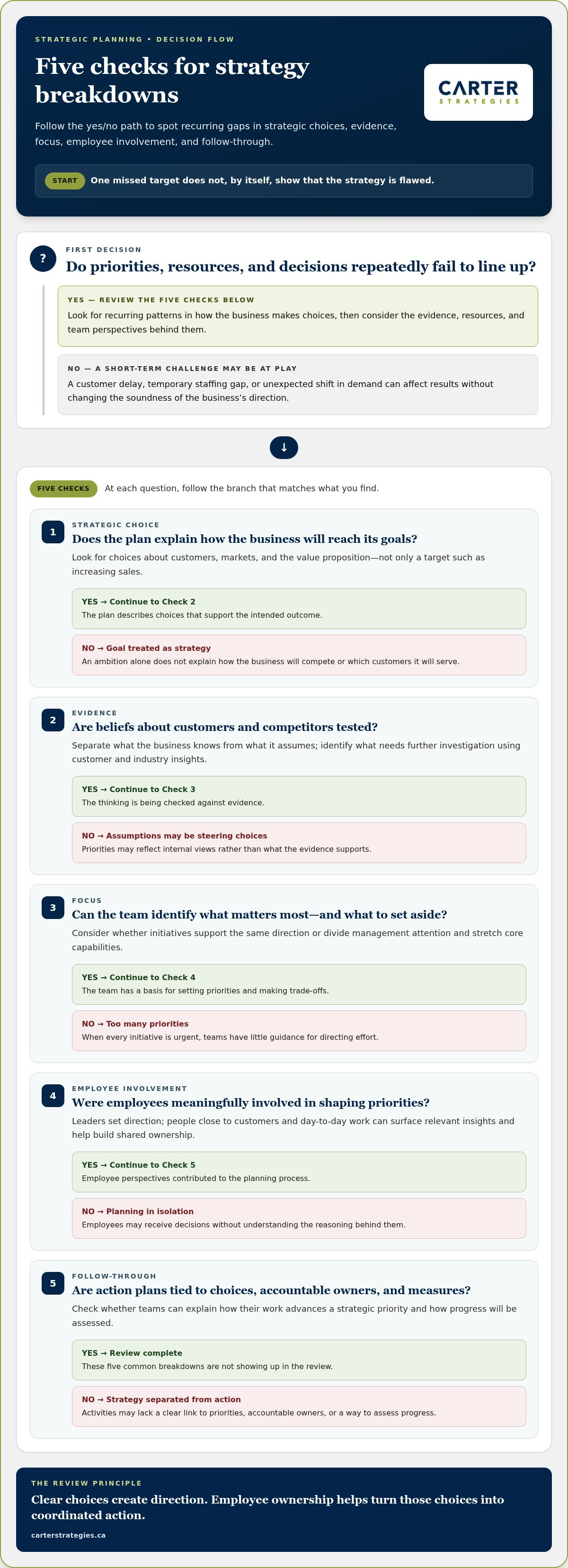
These conditions can create strategy gaps, but no single mistake explains every missed target or business outcome. Use the following review as a way to spot patterns in how choices are made, then investigate the evidence, resources, and team perspectives behind them.
Five common business strategy mistakes to avoid in strategic planning
Once leaders recognize the need to make clear choices, the next challenge is to see where those choices break down. These common business strategy mistakes to avoid often arise from familiar decision patterns, not a lack of effort. Each can make it harder for teams to understand what matters and direct their work accordingly.
Mistakes that weaken strategic choices
- Treating goals as strategy. A target such as increasing sales describes an outcome, not how the business will achieve it. Without a clear value proposition and decisions about which customers and markets to serve, teams may pursue growth in different directions. Harvard Business School’s discussion of the most common strategy mistakes reinforces the distinction between setting an ambition and deciding how a business will compete.
- Relying on assumptions. Leaders may assume they know what customers value or why competitors win, then make decisions without testing those beliefs against customer and industry insights. Priorities can end up reflecting internal views rather than what the evidence supports. Ask what the business knows, what it is assuming, and what needs further investigation.
- Choosing too many priorities. A long list of initiatives can seem like a way to address every opportunity. In practice, it can divide management attention and stretch core capabilities across work that does not support the same direction. If every initiative is urgent, teams have little guidance for making trade-offs.
Mistakes that weaken ownership and follow-through
- Planning in isolation. When the management team develops priorities without meaningful employee involvement, employees may receive decisions without understanding the reasoning behind them. Leaders set direction, while people close to customers and day-to-day work can surface relevant insights and help build shared ownership.
- Separating strategy from action. Strategic objectives lose practical value when action plans aren’t connected to them or activities lack accountable owners. Teams may complete tasks without being able to explain how the work advances a priority. Link each action to a strategic choice, a responsible owner, and a way to assess progress.
A strategy creates direction through clear choices, and employee ownership helps turn those choices into coordinated action. No single mistake explains every business outcome, but spotting these patterns can help leaders ask better questions before committing time and resources. Our guide to business strategy development for mid-market leaders provides a practical framework for the planning process.
How to tell a strategy mistake from a short-term business challenge
A missed target deserves attention, but it doesn’t automatically point to a flawed strategy. A customer delay, temporary staffing gap, or unexpected shift in demand may affect results without changing the soundness of the business’s direction. A stronger signal is a recurring pattern: priorities, resources, and decisions repeatedly fail to line up.
Use evidence to guide questions rather than jump to conclusions. A drop in sales alongside a new market initiative doesn’t prove the initiative caused the decline. Check timing, customer feedback, team capacity, and other relevant factors. Then discuss what you find with employees and leaders who understand the work and customer relationships.
Signals that priorities may be unclear or overloaded
Look for recurring competition for the same people, time, or core capabilities. Ask teams what takes precedence when two urgent initiatives need the same resources. If employees give different answers, leaders may not have made the trade-offs clear. A short capacity constraint may explain a temporary delay; recurring conflicts across projects may point to a broader focus problem.
Signals that evidence or ownership may be missing
Check whether key assumptions reflect current customer and industry insights. Ask employees how they would describe the business’s direction, then compare their answers with leadership’s stated priorities. Differences don’t prove the strategy is wrong, but they can reveal gaps in evidence, communication, or shared understanding. Harvard Business School’s discussion of common strategy mistakes offers context on the role of clear strategic choices.
The table below turns these signals into questions for investigation. Treat possible causes as hypotheses to test with relevant stakeholders, not as automatic diagnoses.
| Warning sign | Possible strategic cause | Question to investigate |
|---|---|---|
| The same initiatives repeatedly compete for staff or time. | Too many priorities may be drawing on the same capabilities. | Which work takes precedence when teams must choose? |
| Teams describe the business direction differently. | Priorities or the reasoning behind them may not be clear or shared. | Can employees explain what the business is focusing on and why? |
| Decisions rely on familiar beliefs about customer needs. | Assumptions may have replaced fresh customer and industry insights. | What evidence supports this view, and whose perspective is missing? |
| A target is missed once, despite aligned decisions and resources. | A short-term challenge, rather than a strategic flaw, may be affecting results. | Is this an isolated event, or part of a recurring pattern? |
| Action continues, but progress against strategic objectives is hard to assess. | Activities, ownership, or measures may not connect clearly to priorities. | Who owns the work, and how will the team assess its contribution? |
Use this diagnostic approach to assess the common business strategy mistakes to avoid without treating every setback as proof that the strategy needs to change. Repeated misalignment calls for a closer review; a single result calls for context, evidence, and discussion before leaders act.
How to avoid common business strategy mistakes with practical questions
A disciplined review helps management teams test choices before strategic business planning is finalized. Use these questions to check whether priorities rest on evidence, fit the organization’s direction, and can be carried out by the people responsible for the work.
Test assumptions before committing to priorities
For each proposed choice, identify the customer, industry, and organizational assumptions that could change the decision. Separate verified findings from beliefs that need further investigation. Invite employees who work with customers or deliver the work to share relevant evidence and practical constraints.
- 1. Test the evidence. What customer and industry insights support this choice? Which claims are confirmed, and which still need to be tested?
- 2. Clarify the choice. Which customers and needs will the business focus on, and what value proposition will guide that decision?
- 3. Narrow the priorities. Which initiatives matter most, given the organization’s core capabilities and available attention? What will the business defer?
- 4. Involve employees. What do employees see in customer needs, delivery demands, and obstacles? Can they explain the reasoning behind the priorities?
- 5. Assign action plans. Who will own each activity, what measure will show progress, and when will the management team review it?
Turn focused priorities into owned action plans
Keep priorities to those the organization can explain and actively support. Leadership remains responsible for setting direction, while employee involvement strengthens the evidence behind choices and builds understanding of how the work contributes. Make trade-offs explicit so teams know what takes precedence when demands compete.
Apply a simple test to every proposed action: Does this action advance a stated strategic choice? If the connection is unclear, revisit the action’s purpose before assigning resources. For each action plan, name an accountable owner, select a meaningful measure, and set a review point. These details connect strategic objectives to day-to-day decisions without mistaking activity for progress.
For more on shaping priorities into a growth plan, see growth strategy and planning for mid-size businesses. Details about business strategy development support can help management teams connect evidence, priorities, and ownership.
Build an executable business strategy through shared ownership
A strategy becomes executable when people can connect its direction to the decisions and work they manage. Leadership sets the direction and makes the key choices. Employee involvement adds knowledge of customers, daily work, and practical constraints, helping the management team test those choices and build shared understanding.
This doesn’t mean every decision is made by consensus. It means leaders involve employees in planning so the strategy reflects relevant perspectives and the people responsible for action understand why priorities matter. This approach can help address common business strategy mistakes while maintaining clarity and accountability.
What collaborative strategic planning should connect
Strategic planning should link customer and industry insights to clear priorities, the organization’s core capabilities, and action plans. Each action plan needs an accountable owner and measures that show whether the work is advancing a strategic objective. Regular review helps the team learn from progress and adjust activities when evidence or business conditions change.
For example, if the management team chooses to focus on a particular customer group, employees who serve those customers can help identify needs, delivery considerations, and gaps in the current value proposition. Their input informs the plan, while leadership remains accountable for the choice. Read more about aligning teams with company strategy.
When an outside strategic perspective can help
An outside advisor can help when leaders need to clarify competing choices, bring different views into alignment, or connect broad goals with focused action plans. Leslie Carter brings more than 25 years of business strategy and brand management experience. Carter Strategies involves employees in developing strategic priorities and action plans, supporting clearer understanding and ownership without promising a particular business result.
Different planning needs may suit project-based or retainer advisory support. The right focus depends on the challenge, whether that’s testing strategic assumptions, aligning teams on priorities, or strengthening the connection between direction and action. Related guidance on growth strategy and planning can help clarify what your organization needs to address next.
For support with a specific strategy challenge, explore collaborative business strategy support.
Make your next strategic choices count
Spotting common business strategy mistakes to avoid starts with checking whether decisions are grounded in customer and industry insights, focused on clear priorities, and connected to action. A missed target may call for investigation, while recurring gaps between priorities, resources, and decisions may signal a need to revisit the strategy.
Plans gain strength when leaders set direction and employees help shape strategic priorities and action plans. Their involvement brings practical knowledge into the process and supports understanding and ownership across teams. Leslie Carter brings more than 25 years of business strategy and brand management experience to this collaborative work.
If your organization needs to clarify its direction, align teams, or turn priorities into actionable plans, explore collaborative business strategy support. Clear choices and shared ownership give your team a focused basis for moving forward.
Frequently Asked Questions
What are the most common business strategy mistakes?
Common mistakes include treating goals as strategy, relying on assumptions instead of customer and industry insights, and taking on too many priorities. Planning without employee input can leave teams unclear about the reasoning behind decisions. Another risk is separating strategic objectives from action plans, owners, and measures. These patterns can weaken focus and alignment, though their effects depend on the organization and circumstances.
Why do business strategies fail to deliver results?
Strategies may struggle to deliver results when choices aren’t grounded in evidence, priorities compete for the same resources, or teams don’t understand how their work supports the direction. Action plans can also lose momentum if they lack clear owners or measures. These are possible causes, not automatic explanations. Leaders should review results, decisions, resources, and employee perspectives before deciding whether the strategy or its implementation needs attention.
How can a company avoid choosing too many strategic priorities?
Assess each proposed priority against the organization’s direction, customer and industry insights, and core capabilities. Ask what choice it supports, what resources it requires, and what the business will defer to make room for it. If leaders can’t explain how an initiative advances a stated strategic choice, reconsider its place in the plan. Focus means making trade-offs, not simply adding work to existing commitments.
Can employees be involved in strategic planning?
Yes. Leadership remains responsible for setting direction, while employee involvement brings practical knowledge of customers, work, and constraints into planning. Invite employees to share evidence, test assumptions, and help shape strategic priorities and action plans. Their input can build understanding and ownership without requiring every decision to be made by consensus. Teams are better positioned to act when they understand both the priority and the reasoning behind it.
What happens if a business strategy has too many goals?
Too many goals can make it harder for people to see what matters most. Teams may divide their attention across competing initiatives, making it difficult to direct resources toward the choices that support the business’s direction. Review each goal against the strategy and identify which ones need to take precedence. Then make clear what will wait, so employees can make consistent decisions when priorities compete.
How often should a business review its strategy?
Review the strategy regularly enough to assess progress and respond to meaningful changes in customer needs, industry conditions, or organizational capabilities. The review should examine whether priorities remain relevant, action plans are advancing, and teams have the resources and understanding they need. A single missed target doesn’t necessarily require a strategic shift. Look for recurring misalignment and investigate its causes before changing direction.
What is the difference between a business strategy and an action plan?
A business strategy sets direction and makes choices about customers, value, capabilities, and focus. An action plan translates those choices into specific activities, responsibilities, measures, and review points. For example, choosing to focus on a customer segment is strategic; assigning an owner to research that segment’s needs is an action. Action plans should support the strategy rather than become a disconnected list of tasks.


