


What if the problem isn’t that your marketing team needs to do more, but that the strategy no longer reflects the business you’re building? The signs your company has outgrown its marketing strategy can be easy to miss: activity continues, yet its contribution to business priorities is unclear. Your customers, value proposition or growth direction may have changed, while marketing still follows the old plan.
That disconnect can leave leaders and employees working hard without agreeing on what marketing should accomplish or how to measure progress. It doesn’t always mean the whole strategy needs replacing. The gap may sit in the strategy itself, its execution, measurement or the alignment between the people responsible for moving it forward.
Use this practical checklist to identify where your marketing strategy no longer fits, distinguish the type of gap you’re facing and choose a next step tied to your growth priorities. Consider what has changed in the business and your understanding of customers, which results matter now, and who needs to help shape the action plans. Clear priorities and shared ownership give your next move a stronger foundation.
Key Takeaways
- Identify signs your company has outgrown its marketing strategy by looking for recurring patterns, not reacting to one weaker result.
- Assess whether changes in business direction, customer understanding or value proposition have left marketing priorities out of step.
- Decide whether a focused refresh is enough or whether the company’s direction and assumptions need a broader rethink.
- Involve employees who understand customer needs and delivery constraints to build shared ownership of next steps.
- Consider when strategic support, including fractional CMO or CRO leadership, could help connect marketing priorities with business goals.
Signs Your Company Has Outgrown Its Marketing Strategy: The Diagnostic Checklist
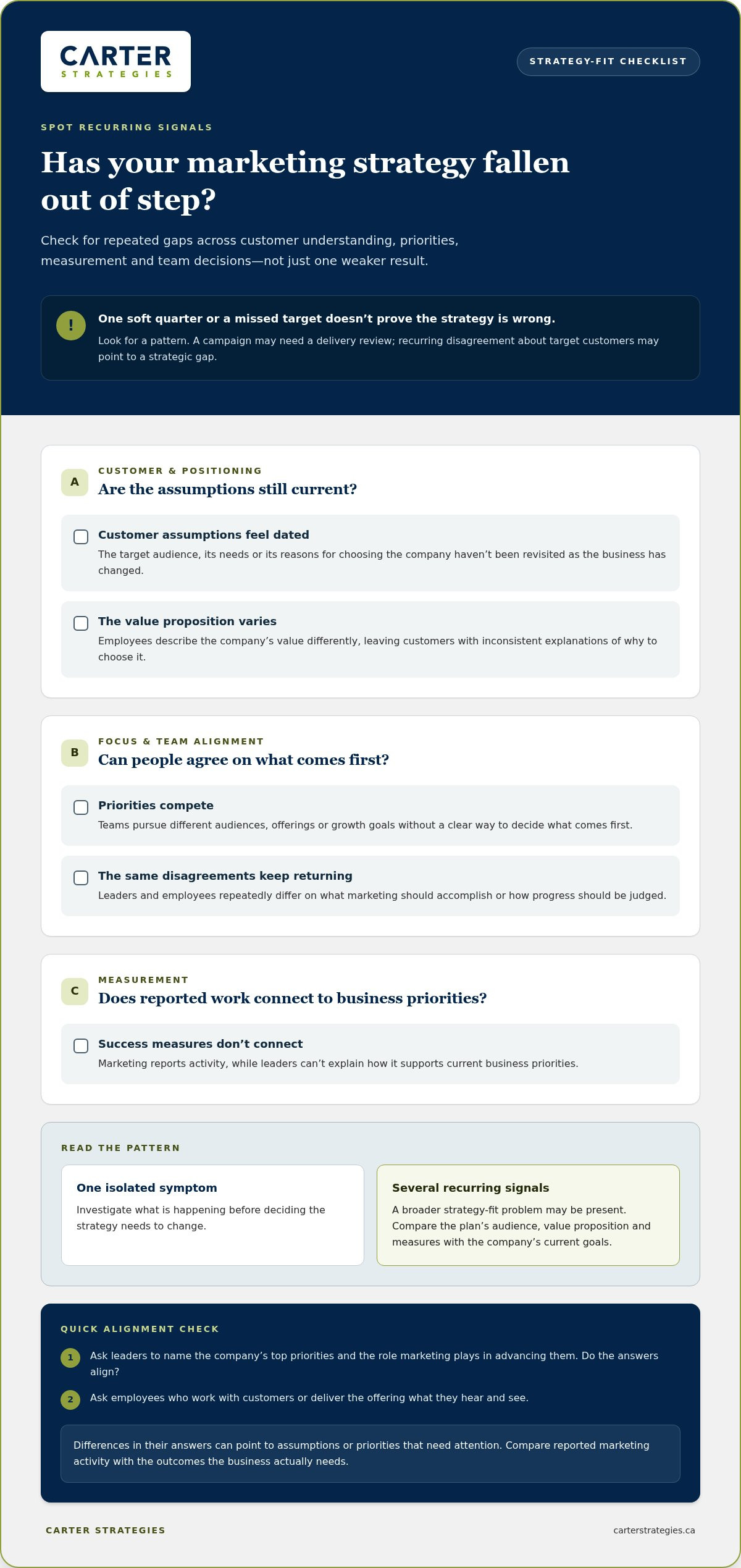
Weaker results can prompt a fair question: has the strategy stopped fitting, or is a campaign simply underperforming? One soft quarter or a missed target doesn’t prove the strategy is wrong. Look for a pattern across business priorities, customer understanding, measurement and team decisions. For example, a dip in campaign results may call for a delivery review, while recurring disagreement about target customers may point to a strategic gap.
An outgrown marketing strategy is a plan built on assumptions that no longer match the company’s direction, customers or value proposition. A marketing strategy guides how a business reaches customers and pursues its goals. The diagnostic question is whether that direction still reflects the business today.
Which changes in the business can make the old strategy stop fitting?
Compare the choices behind the current strategy with the company’s present priorities. Has the business entered a new market, changed its offerings, shifted its target customers or set different growth ambitions? Each change can affect whom marketing needs to reach, what the company should communicate and which opportunities deserve attention.
A change in campaign performance is different from a change in business direction. A campaign may need adjustment while the company’s priorities and customer assumptions remain sound. But if the business itself has moved on, improving individual campaigns may not address the underlying gap. Check whether the plan’s audience, value proposition and measures still match the company’s current goals.
What recurring signals should leaders look for?
Use this checklist to spot signs your company has outgrown its marketing strategy:
- Customer assumptions feel dated: The target audience, its needs or its reasons for choosing the company haven’t been revisited as the business has changed.
- Priorities compete: Teams pursue different audiences, offerings or growth goals without a clear way to decide what comes first.
- Success measures don’t connect: Marketing reports activity, while leaders can’t explain how it supports current business priorities.
- The value proposition varies: Employees describe the company’s value differently, leaving customers with inconsistent explanations of why to choose it.
- The same disagreements keep returning: Leaders and employees repeatedly differ on what marketing should accomplish or how progress should be judged.
Marketing activity can continue in all these situations. The warning sign is that people can’t connect the work to shared priorities or explain what success means. Compare what marketing reports with the outcomes the business actually needs, rather than treating a list of completed activities as evidence of progress.
Try a quick check: ask leaders to name the company’s top priorities and the role marketing plays in advancing them. Do the answers align? Then ask employees who work with customers or deliver the offering what they hear and see. Differences in their answers can point to assumptions or priorities that need attention. One isolated symptom calls for investigation; several recurring signals suggest a broader strategy-fit problem.
Why a Growing Company’s Marketing Strategy Can Fall Out of Step
A marketing strategy connects the company’s direction to its customer and industry insights, brand positioning and marketing priorities. If one part changes while the others stay fixed, the plan can lose relevance. For example, a company may add an offering or pursue a different type of customer, while its messages and priorities still reflect the business it used to be.
Strategy fit depends on whether marketing priorities support the company’s current direction, not on how much marketing activity is underway. More campaigns or content can’t resolve a gap between what the business is trying to achieve and whom it is trying to serve. First identify which assumptions have changed, then decide whether the strategy or its delivery needs attention.
How can changed customer needs or market conditions affect strategy fit?
Review the customer and industry insights behind the existing strategy. Compare them with what the company now hears from customers, sees in sales conversations and learns through its work in the market. The goal isn’t to react to every new comment. It’s to test whether the assumptions guiding audience choices and priorities still hold. Look for repeated feedback and patterns across conversations, rather than allowing one anecdote to dictate a change.
A value proposition that once set the business apart may need review if customer expectations have shifted or the company’s offerings have changed. The business may still have strong core capabilities, but customers may value a different benefit, or the company may now be serving a different need. Record the evidence behind the review, including documented market research and customer analytics, so the reasoning is clear to the people shaping decisions.
How can internal misalignment make a sound strategy hard to use?
A strategy can still point in the right direction and be difficult to act on if people interpret it differently. Leaders may agree on a goal such as growth, while teams disagree about which customers to prioritize, what the value proposition means in practice or how to recognize progress. Employees who serve customers or deliver the offering can see constraints that aren’t visible in a leadership discussion. Their input helps test whether priorities can guide day-to-day choices.
Without clear ownership, broad goals don’t become coordinated action plans. Teams may duplicate effort, wait for decisions or judge results by different measures. That’s a gap between direction and delivery, not automatic proof that the strategy itself is wrong. For a closer look at connecting intent to action, explore Carter Strategies and how business strategy development can support shared priorities and accountability.
Several signs your company has outgrown its marketing strategy may reflect this wider disconnect: business direction, customer understanding and team ownership have shifted out of step. Before adding activity, determine which link needs attention and involve the people responsible for carrying the priorities forward.
Should You Refresh Your Marketing Strategy or Rethink It?
Once you’ve identified a possible fit problem, the next decision is how much of the strategy needs to change. A refresh can address specific gaps while preserving a sound direction. A broader rethink is worth assessing when the foundations themselves may no longer hold. Use the criteria below to structure the discussion, not as an automatic recommendation to discard existing work.
When might a focused strategy refresh be enough?
A refresh can make sense when the company’s direction and customer understanding remain sound, but selected priorities, measures or assumptions need updating. For example, leaders might agree on the target market and value proposition yet need to clarify which objectives marketing should support first. Preserve the research and decisions that still hold; document what needs revision and why.
Changing a campaign or choosing a different channel may address an execution issue, but it doesn’t replace a strategic decision about customers, priorities or the value proposition. Keep the review focused on those decisions, and use evidence to explain each proposed adjustment. Make clear which parts of the current strategy remain in place so teams know what to continue as well as what to change.
When should the management team reconsider the broader direction?
Reassess the wider strategy when business goals, offerings, target customers or brand positioning have changed enough to challenge its underlying assumptions. Repeated disagreement about priorities can also point to a deeper issue: the management team may not share a clear view of what the company is trying to achieve. Include employees who understand customer needs and delivery constraints as you test what should guide the next plan.
This comparison is a starting point, not a fixed rule. Keep the evidence behind your assessment together with this strategy reference for review. If the discussion points beyond marketing, business strategy development can help connect company direction with practical priorities and action plans.
A Collaborative Checklist for Assessing Your Marketing Strategy
A useful assessment turns broad concerns into questions the team can answer together. Start with the company’s direction, then test the assumptions behind marketing priorities and decide what evidence or alignment is still needed. Include the management team and employees who hear customer feedback, explain the offering or see what makes delivery possible. Their perspectives can help separate customer evidence from internal assumptions.
- Step 1: Restate business priorities. Write down the company’s current goals and intended customer groups. Ask: Do our marketing priorities support this direction? Are we focusing on the customers and offerings that matter to the business now? If leaders describe the priorities differently, record the differences instead of settling them by assumption.
- Step 2: Revisit customer and industry insights. Identify the evidence behind current beliefs about customer needs, preferences and reasons for choosing the company. Ask which assumptions still have support, which need fresh customer and industry insights, and who can help gather or interpret them. Include employees with direct customer knowledge, not only senior decision-makers.
- Step 3: Test strategic assumptions. Examine whether the value proposition still reflects what the company offers and what intended customers value. Ask employees how they explain that value and whether the same priorities guide their work. Different answers can point to a need for clearer direction, better shared understanding or further validation.
- Step 4: Connect priorities to outcomes and owners. For each marketing priority, state the business outcome it is intended to support and name the person accountable for moving it forward. Agree on measures that suit the outcome and the information available. Avoid adding targets before the team has clarified what it is trying to achieve.
How can a team turn findings into clear next steps?
Keep a working record with three categories: assumptions to validate, priorities to retain and decisions that need leadership alignment. For each item, note the evidence, the open question, who will help resolve it and what decision is needed. This makes uncertainty visible without treating every concern as proof that the strategy has failed.
Then translate agreed decisions into focused action plans. Assign an owner, identify the intended outcome and choose an appropriate way to review progress. Employees responsible for delivery should help shape these actions so the plan reflects both customer needs and practical constraints. If leaders can’t agree on a priority, resolve that issue before asking teams to act on competing instructions.
If this assessment reveals a need to clarify direction and build shared ownership, explore collaborative strategic planning support to help turn priorities into action plans.
When Strategic Support Can Help Bring Marketing Back into Alignment
An outside strategic perspective can help when leaders see the symptoms but can’t agree on their cause. Perhaps marketing priorities no longer connect clearly to business goals, teams are working from different customer assumptions, or discussions about what to focus on keep circling without a decision. A strategic advisor can help the management team test those assumptions, clarify choices and involve employees who understand customer needs and delivery constraints.
What should effective strategic support contribute?
Strategic support should connect marketing priorities with the company’s business direction and revenue goals. It should help leaders make clear choices about what matters, what evidence supports those choices and who will own the next steps. The result should be an executable business strategy shaped with the people responsible for carrying it forward, not a set of isolated recommendations handed down for others to implement.
At Carter Strategies, business strategy development and fractional CMO and CRO services help companies bring business priorities, marketing direction and revenue goals into closer alignment. Leslie Carter brings more than 25 years of business strategy and brand management experience. The work centres on direction, shared understanding and accountability, giving teams a clear basis for coordinated action.
How can leaders make the next step practical?
Come to the discussion prepared to describe the priorities the company is pursuing, the assumptions behind its current marketing strategy and the questions leaders haven’t resolved. Include perspectives from employees who speak with customers or deliver the company’s offerings. Their experience can reveal where the stated value proposition, customer expectations and everyday practice diverge.
Not every situation calls for the same form of support. Advisory work can be structured on a project or retainer basis, depending on the company’s needs. The aim is to clarify the work required, establish ownership and help the team move from discussion to focused action plans. Fractional CMO or CRO support can provide senior marketing or revenue leadership that connects priorities across the business. The scope should reflect the questions and goals the company needs to address.
If you’re ready to discuss your strategic priorities and determine a practical next step, explore strategic advisory support.
Make Your Next Marketing Decision with Clarity
The signs your company has outgrown its marketing strategy are worth investigating, but they don’t automatically mean you need to start over. Look for patterns, test whether customer assumptions and business priorities still hold, then decide whether a focused refresh or a broader rethink fits the evidence.
Most of all, involve the people responsible for understanding customers and carrying decisions forward. Shared ownership helps turn strategic choices into practical action plans, with clear priorities and accountability.
Leslie Carter brings more than 25 years of business strategy and brand management experience to collaborative strategic planning that includes employee involvement. Advisory support is available on a project or retainer basis, shaped around the company’s needs.
Ready to clarify your priorities and determine a practical next step? Explore strategic advisory support. With a clear direction and a team aligned around it, your marketing can better support the business you’re building.
Frequently Asked Questions
What are the signs your company has outgrown its marketing strategy?
Common signs include customer assumptions that no longer match what the company hears in sales conversations, competing marketing priorities, inconsistent measures of success and decisions that don’t reflect current business direction. These signs your company has outgrown its marketing strategy are more meaningful as a recurring pattern than as isolated problems. One weak campaign alone isn’t proof; assess whether the strategy, its delivery, measurement or team alignment explains the results.
How do you know whether your marketing strategy needs an update?
Compare current business priorities, customer and industry insights, and employees’ understanding of the strategy with the assumptions behind the existing plan. Ask whether marketing still supports the company’s direction and intended customers. Involve employees who work closely with customers and deliver the offering, since they can surface practical evidence and unanswered questions. Document what you know and what needs validation before deciding which parts of the strategy to update.
Can a company outgrow its marketing strategy even when marketing results are strong?
Yes. Strong results show that marketing is producing value now, but they don’t prove the strategy fits future priorities or changed customer needs. Assess results alongside business direction, customer and industry insights, and team alignment. For example, marketing may perform well with an established audience while the company’s growth plans call for reaching a different group. Success alone doesn’t mean the strategy is outdated; use it as one part of the assessment.
What is the difference between a marketing strategy problem and an execution problem?
A strategy problem may involve a mismatch between business direction, customer understanding and the priorities marketing has chosen. An execution problem arises when the direction and priorities are agreed, but the team struggles to deliver them consistently. The two can overlap: unclear priorities can make delivery harder, while delivery challenges can obscure whether the strategy fits. Clarify the direction and assumptions first, then identify the action needed.
Should a growing company refresh its marketing strategy or start over?
A focused refresh may be enough if the company’s core direction and customer understanding still hold, but specific priorities, measures or assumptions need attention. Consider a broader reassessment if business goals, target customers, offerings or brand positioning have changed. Neither approach is automatic. Compare the existing strategy with current evidence, discuss the findings with leaders and employees, and preserve useful work while deciding what should change.
How can a management team assess whether its marketing strategy is still aligned?
Restate the company’s business priorities, review customer and industry insights, and test the assumptions behind current marketing choices. Ask employees how their work supports the value proposition and shared priorities. Document the evidence, decisions and unresolved questions, then assign an owner to each agreed action plan. Agreement can support coordination, but it doesn’t prove performance; select measures that connect each marketing priority to its intended business outcome.
When should a company consider fractional marketing leadership?
Consider fractional marketing leadership when the company needs senior marketing or revenue perspective to clarify priorities and connect them with business strategy. A fractional CMO or CRO can provide executive-level guidance on marketing and revenue strategy, helping leaders align decisions across the business. Before exploring support, identify which decisions remain unresolved, where alignment is breaking down and what outcomes leadership needs the role to help advance.


