


What if your long term business growth plan gave your company a clear direction without looking into choices that no longer fit? Leaders need to focus limited time and resources on the right opportunities, while employees need to see how their daily work supports company priorities. A plan that sits untouched can quickly lose that connection as customer needs and market conditions shift.
A useful plan sets priorities, then adapts as new evidence emerges. This article explains how to shape a long-term business growth plan that connects strategic direction with team ownership and measurable progress. You’ll learn how to choose a manageable set of priorities, involve employees in turning those priorities into action plans, and use progress measures to guide decisions. The result is a practical approach to growth that keeps leaders and teams aligned while leaving room to adjust when circumstances change.
Key Takeaways
- Build a long term business growth plan around shared direction, clear priorities and action plans, not just targets or disconnected initiatives.
- Use customer and industry insights, your value proposition and core capabilities to guide growth choices.
- Keep long-term direction steady while reviewing assumptions and adapting action plans as conditions change.
- Involve employees in gathering insight and shaping priorities so teams understand their role in putting the plan into action.
- Track useful measures to review progress, support accountability and guide decisions about what to adjust.
What a long-term business growth plan should do for your company
A long-term business growth plan gives a company a shared direction, a focused set of priorities and action plans to guide decisions over time. It connects what leaders aim to achieve with the work teams can own and advance. Unlike a list of disconnected initiatives, it explains why the company is pursuing certain opportunities and what it will prioritize.
A long-term business growth plan is a shared direction and set of priorities for guiding decisions over time, with assumptions and action plans that can change as the company learns. The direction provides continuity; choices about how to move forward remain open to review.
This distinction matters because a plan is not an annual budget, a sales target or a promise of a particular result. A budget allocates resources for a defined period. A sales target describes an intended outcome. A growth plan helps leaders and employees decide where to focus, what capabilities to build and which opportunities to defer. Growth planning also means looking beyond immediate activity to the choices that support a company’s development.
How a growth plan differs from a forecast or annual plan
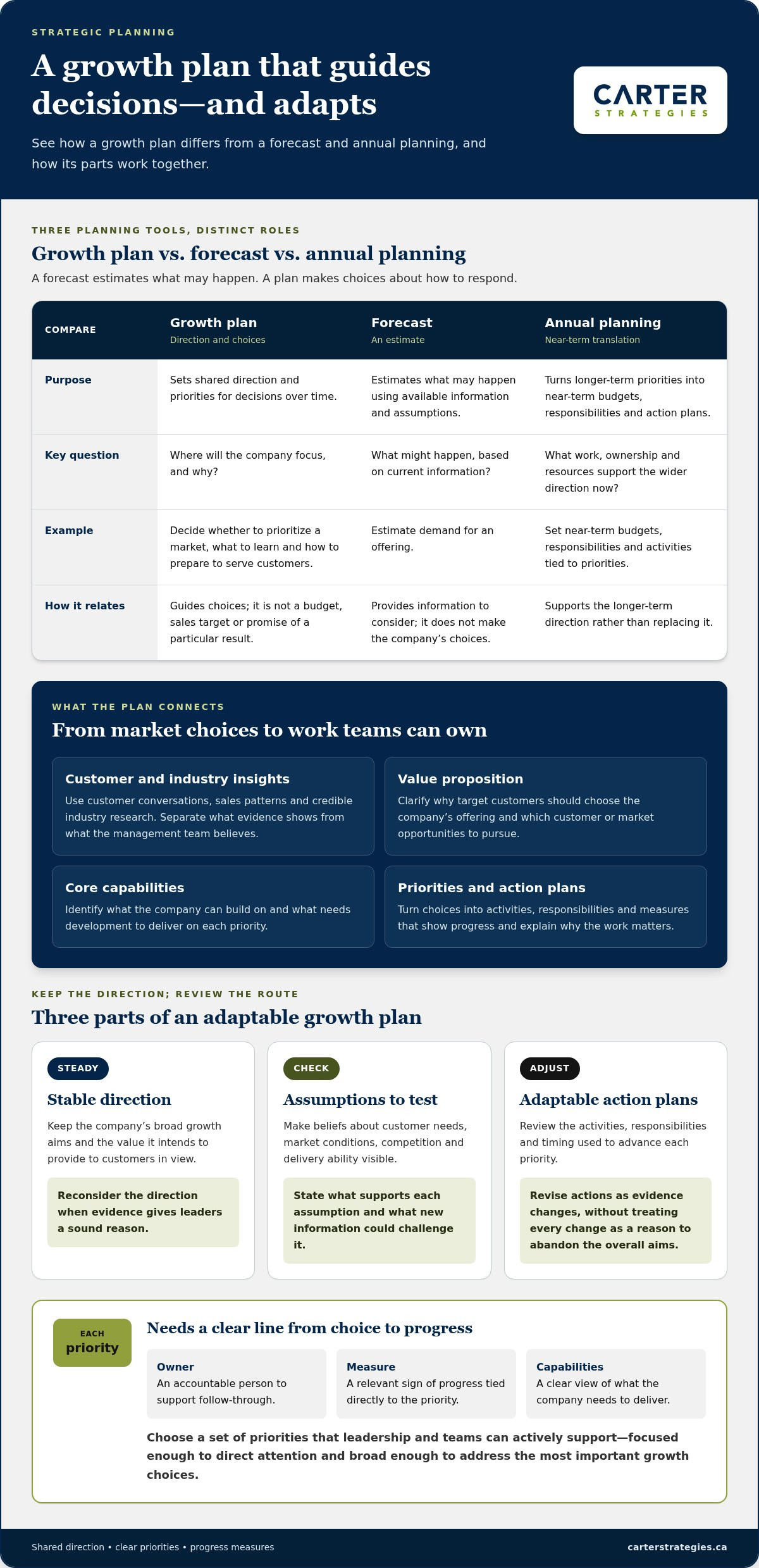
A forecast estimates what may happen based on available information and assumptions. A plan makes choices about how the company will respond and where it will direct its attention. For example, a forecast may estimate demand for an offering, while the growth plan sets out whether the company will prioritize that offering, what it needs to learn and how it will prepare to serve customers.
Annual planning translates longer-term priorities into near-term budgets, responsibilities and action plans. It supports the wider direction rather than replacing it. Leaders can review progress and revise assumptions without treating every change as a reason to abandon the company’s overall aims. A plan guides decisions; it cannot guarantee outcomes.
When a company may need a longer-term view
A longer-term view can help when opportunities compete for leadership attention, growth choices are made quarter by quarter, or employees can’t see how their work connects to company priorities. These challenges often arise in mid-size entrepreneurial companies managing several possible paths with limited capacity. Without an agreed direction, teams may take on work that competes for the same people and resources.
Look for recurring decisions without a shared basis: which customer groups to serve, which offerings to develop, or which capabilities to strengthen. A growth plan gives the management team a consistent way to weigh those choices and explain them across the organization. For broader context on strategic planning, see this business strategy development guide.
What belongs in a long-term business growth plan
A useful plan brings together the choices that shape growth: where the company wants to go, which customers and markets it will focus on, why they should choose its offering, and what the business needs to deliver. It should draw on customer and industry insights, a clear value proposition, the company’s core capabilities, a manageable set of priorities and action plans that turn those priorities into work.
A growth plan connects the company’s market choices with its ability to deliver, linking customer needs and opportunities to the capabilities, ownership and actions required to pursue them.
Each priority needs an accountable owner, a relevant progress measure and a clear view of the capabilities required. Choose only as many priorities as leadership and teams can actively support. There’s no universal ideal number: the right set is small enough to focus attention and broad enough to address the company’s most important growth choices.
Use customer and industry insights to ground growth choices
Customer needs, competitor activity and industry changes can challenge assumptions about where growth will come from. Gather evidence from sources such as customer conversations, sales patterns and credible industry research. Then distinguish what the evidence shows from what the management team believes. Identify unanswered questions, too. If a source is dated or limited in scope, say so, so people can judge how much weight to give its findings.
Connect priorities with capabilities and action plans
For each priority, identify the core capabilities the company can build on and any that need development. For example, a decision to serve a new customer group may depend on stronger customer knowledge, delivery capacity or sales expertise. Identify what’s needed before committing teams to action.
Action plans should name activities, responsibilities and measures that show progress. A measure might track customer response, delivery readiness or another outcome tied directly to the priority. This connection helps teams see not only what they’re doing, but why it matters. For related guidance, consider how your growth choices connect to near-term actions, owners and measures. If your management team needs support connecting those choices to an executable business strategy, explore business strategy development.
How to balance long-term direction with changing business conditions
A long-term plan doesn’t require treating every forecast as certain. It gives the company a direction to work towards while making room to test the assumptions behind that direction and revise actions as evidence changes. A long term business growth plan is useful when it helps leaders make informed choices, not when it asks teams to follow outdated steps.
Separate three parts of the plan:
Stable direction: The company’s broad growth aims and the value it intends to provide to customers. Reconsider this direction when evidence gives leaders a sound reason to do so.
Assumptions to test: Beliefs about customer needs, market conditions, competition or the company’s ability to deliver. State what evidence supports each assumption and what new information might challenge it.
Adaptable action plans: The activities, responsibilities and timing used to advance a priority. Adjust these as teams learn, capacity changes or conditions shift.
Change the tactics when the evidence calls for it; change the strategic direction only when the evidence challenges the choices that support it.
Separate enduring priorities from assumptions to test
For each priority, ask what needs to be true for it to succeed. A company aiming to grow with a particular customer group might be relying on assumptions about unmet needs, demand or its ability to serve that group. Identify signals that could strengthen or weaken each assumption, such as customer feedback, changing purchase patterns or new delivery constraints.
Scenario planning helps leaders consider plausible conditions without claiming to predict which one will occur. For example, consider how the company would respond if demand grew more slowly than expected or if a key capability took longer to develop. These scenarios can reveal which choices remain sound across different conditions and where the action plan needs options. The aim isn’t to map every possible future. It’s to prepare for meaningful changes while keeping the company’s value proposition clear.
Set a review rhythm that supports adaptation
At regular leadership reviews, assess progress against relevant measures, revisit assumptions and risks, and decide whether to continue, change or pause an action. Keep the discussion focused on decisions, not just reporting. Employees close to customers and daily work can identify emerging issues and practical ideas that may not be visible in a leadership summary.
Record what changed, why the decision was made, who owns the next steps and what evidence will be reviewed next. Share that reasoning with affected teams. Clear communication helps employees understand how the plan is adapting, rather than mistaking a revised action for a sudden shift in company direction.
How to turn a long-term growth plan into shared priorities and progress
A plan becomes useful when people can connect its direction to choices, responsibilities and regular decisions. The management team remains accountable for setting priorities and making trade-offs, but it shouldn’t do that work in isolation. Employees can contribute customer knowledge, operational insight and ideas that help shape plans teams can carry forward.
Use a clear sequence to move from direction to action:
- Clarify direction: Agree on the growth aims and the choices that will guide decisions.
- Gather input: Invite perspectives from employees who understand customers, processes and day-to-day constraints.
- Choose priorities: The management team weighs the evidence, capacity and trade-offs, then explains what the company will focus on.
- Build action plans: Define activities, owners, dependencies and measures for each priority.
- Review progress: Discuss what the measures and employee feedback reveal, then decide whether to continue, adjust or address a barrier.
Build employee involvement into strategic planning
Facilitated discussions can bring forward information a leadership-only process may miss, such as recurring customer concerns, process bottlenecks or practical growth ideas. Involve people across relevant teams early enough for their input to inform the choices, rather than presenting a finished plan and asking them to carry it out.
Leaders should close the loop. Explain which insights shaped the priorities, which suggestions weren’t adopted and why, and which decisions remain the management team’s responsibility. This clarity respects employee contributions while keeping accountability for strategic choices where it belongs. It also gives teams a shared understanding of the direction and their role in advancing it. Connect direction to follow-through by making owners, next steps and review points clear to everyone involved.
Use measures and action plans to guide decisions
Choose a few measures that show whether each priority is advancing and whether its underlying assumptions still hold. Assign an owner to every action, clarify dependencies between teams, and agree on how people can raise barriers before they stall progress. Measures should prompt useful questions, not add reporting for its own sake.
If results differ from expectations, examine what the evidence says. Is an assumption wrong, has a dependency delayed the work, or does the action need adjusting? Treat the gap as information for a decision, not a reason to assign blame. To turn planning into shared action, explore collaborative business strategy development.
How Carter Strategies can help shape an executable business strategy
A long term business growth plan needs more than sound analysis. It needs choices leaders can stand behind, priorities employees understand and action plans people can carry forward. Carter Strategies advises mid-size companies on business strategy development, growth planning and strategic alignment, helping leaders connect direction with practical decisions and shared ownership.
Leslie Carter brings more than 25 years of experience in business strategy and brand management. That experience informs a collaborative approach: the management team remains accountable for setting direction and making decisions, while employee involvement brings customer knowledge, operational realities and ideas into the planning process. This connects leadership choices with the work required to advance them.
When outside strategic perspective can help
An outside perspective can be useful when growth opportunities compete for attention, leaders disagree about which path to pursue, or a plan lacks clear ownership. An advisor can facilitate discussion, test assumptions and help the management team weigh trade-offs. The advisor supports the decision process; responsibility for the company’s choices stays with its leaders.
This work can help turn broad aims into an executable business strategy by clarifying what the company will prioritize, what it will defer and how teams can contribute. Employee insight is part of the planning, not a hand-off after decisions have already been made.
Connect strategy with marketing and revenue leadership
Some growth priorities depend on senior marketing or revenue perspective. When that expertise connects directly to the plan, fractional CMO or CRO leadership can help inform strategic choices, such as how the company positions its offering or approaches revenue growth. The focus is executive-level leadership that supports the strategy, not a promise of a particular outcome.
Advisory work is available on a project or retainer basis, depending on the company’s planning needs. Whether leaders are shaping priorities or need ongoing strategic perspective, the work should connect the company’s direction to clear decisions and accountable action plans.
An executable business strategy depends on clear choices, aligned people and action plans with ownership. To explore business strategy development and discuss your company’s planning priorities, visit Carter Strategies.
Give your growth strategy a clear next step
A long term business growth plan should set a clear direction without becoming fixed. Ground priorities in customer and industry insights, connect them to the capabilities needed to deliver, and translate them into action plans with owners and useful measures. Review progress and adapt actions as conditions change, while keeping employees involved in the work.
Carter Strategies brings more than 25 years of business strategy and brand management experience to help companies build alignment, ownership and accountability for business strategy results. The planning process connects management team decisions with employee insight, so priorities are understood and teams can contribute to putting them into action.
Ready to clarify your company’s priorities and shape an executable business strategy? Explore business strategy development and take a practical next step towards aligned growth.
Frequently Asked Questions
What is a long-term business growth plan?
A long term business growth plan sets a company’s direction, priorities and action plans over time. It connects customer and industry insights with the company’s value proposition and core capabilities, helping leaders decide where to focus and what the business needs to deliver. Unlike a forecast, it doesn’t promise a particular outcome. It guides decisions, aligns teams and allows leaders to adapt actions as evidence changes.
How far ahead should a business growth plan look?
The right planning horizon depends on the company, its industry and the decisions leaders need to make. Look far enough ahead to clarify strategic direction and the capabilities the company may need, but keep assumptions open to review. There’s no single timeframe that suits every business. Connect the longer-term direction to nearer-term action plans, then review progress so teams can adjust their work as they learn.
Can a long-term growth plan change as the business grows?
Yes. A useful growth plan keeps the company’s strategic direction clear while allowing assumptions and action plans to change as evidence develops. Leaders can review customer and industry insights, progress measures and new constraints, then communicate what they’re changing and why. Adaptation should improve decisions, not shift the company’s direction every time it faces a challenge. Keep the underlying priorities steady unless new evidence gives leaders a reason to reconsider them.
What should a long-term business growth plan include?
A long-term business growth plan should connect the company’s direction and growth priorities with customer and industry insights, its value proposition and the core capabilities needed to deliver. It should also identify action plans, accountable owners, useful progress measures and assumptions to review. These elements help leaders and employees make consistent decisions and understand how work supports priorities. Keep the plan practical, with enough detail to guide action without making it difficult to use.
How do you get employees involved in strategic planning?
Involve employees in gathering customer and operational insights, identifying barriers and discussing possible priorities. Their knowledge can help leaders understand what customers need and what teams can realistically deliver. The management team remains accountable for strategic choices, but should explain how employee input informed the decisions. Clear priorities, action plans, responsibilities and review points help employees see how their work contributes to the company’s direction and where they can take ownership.
How often should a business review its growth plan?
Review the plan often enough to spot changes in progress, assumptions and business conditions before they disrupt action plans. The right rhythm depends on the company’s decisions and operating context. At each review, ask what’s working, what has changed and whether priorities still fit. Use evidence to guide adjustments rather than reacting to every short-term fluctuation. Record decisions and explain changes so teams understand what shifted and how it affects their work.
What is the difference between a growth plan and a strategic business plan?
The terms can overlap. A growth plan tends to focus on choices and action plans intended to support business growth, while strategic business planning may address the organization’s broader direction and priorities. Either plan should connect evidence, people, capabilities and action. Rather than focus on the label, consider which decisions the plan helps the company make, how it guides teams and whether it gives leaders a practical basis for setting priorities.


