


Agreement in the boardroom doesn’t guarantee consistent action across a growing company. One executive may prioritize a new market while another redirects people and resources to a different goal. Teams receive conflicting direction, and decisions made after the meeting can undermine the priorities leaders agreed to pursue. Executive alignment means turning strategic choices into consistent decisions and shared accountability, not simply reaching consensus in the room.
Aligning a management team doesn’t require every leader to agree on every detail. It does require open discussion, clear decisions and a shared commitment to what comes next. Disagreement can strengthen a strategy when leaders address it directly and leave with clarity about the decision and their role in carrying it forward.
This article explains how to clarify strategic priorities, work through disagreement constructively and connect leadership decisions to action plans. You’ll also learn how to assign ownership and involve employees in translating strategy into daily work, so teams can move forward with consistent direction.
Key Takeaways
- Executive alignment requires shared priorities, decision principles and clear accountability, not agreement on every detail.
- Spot leadership drift by checking whether executives make consistent decisions, communicate the same priorities and take ownership of commitments.
- Distinguish productive disagreement from misalignment by looking at what leaders do after a decision is made.
- Build alignment through a practical strategic planning process that surfaces perspectives, sets priorities, assigns owners and involves employees.
- Collaborative strategic advisory support can help connect leadership choices to an executable business strategy.
What Executive Alignment Means for Business Strategy
Executive alignment means more than agreeing that growth matters. Leaders need a shared view of where the company is going, which priorities deserve attention to get them there, how they’ll make decisions and who owns the work. Without that clarity, each executive can act on a different interpretation of the strategy, even when everyone supports the same broad ambition.
Executive alignment turns shared priorities into consistent leadership decisions, clear ownership and coordinated action. It doesn’t require identical opinions, unanimous votes or agreement on every detail. Leaders should challenge assumptions and debate trade-offs openly. Alignment comes when they understand the decision, support the direction that follows and communicate it consistently to their teams.
Strategic leadership involves aligning an organization's systems, culture, and structure with its strategy. In practical terms, leaders need to connect their choices with how the company assigns work, makes decisions and communicates expectations. A strategy has limited value if everyday leadership behaviour points employees elsewhere.
What does an aligned management team agree on?
An aligned management team shares context about the intended direction, the priorities that matter most and the outcomes those priorities should support. Leaders also clarify decision rights: who recommends, who decides and who carries out the work. Each executive can then explain their ownership, how it connects to other leaders’ responsibilities and what teams should do when priorities compete.
Shared context helps leaders give teams consistent direction without requiring identical wording or management styles.
Why alignment matters as a company grows
As a company adds teams, customers and responsibilities, informal coordination becomes harder to sustain. If executives set different priorities, departments may duplicate work, redirect people midstream or measure progress against conflicting expectations. Employees are left to interpret which direction takes precedence, and managers may spend time reconciling decisions instead of moving work forward.
Alignment helps leaders focus action plans on agreed priorities and make trade-offs visible when time, people or resources are limited. It doesn’t guarantee results, but it gives teams a clearer basis for deciding what to do, what to defer and how to track progress. Inclusive business strategy development connects leadership choices with employee perspectives and the work required to put them into practice. This helps turn strategic direction into an executable business strategy with ownership across the company.
Why Executive Teams Lose Alignment
Leadership drift often starts with small differences that stay unspoken. One executive believes the company should protect its existing customer base; another assumes growth depends on entering a new market. Both may support the stated strategy, but their separate assumptions shape different choices about staffing, investment and timing. Without discussion, those choices accumulate until the company’s direction shifts in practice.
Unclear priorities make this more likely. If leaders haven’t agreed what takes precedence when goals compete, each function may treat its own work as urgent. Measures can deepen the divide: one team focuses on near-term revenue, while another is accountable for long-term customer retention. Executive alignment weakens when executives are measured against outcomes that pull them towards conflicting decisions.
Common signals that executive alignment is slipping
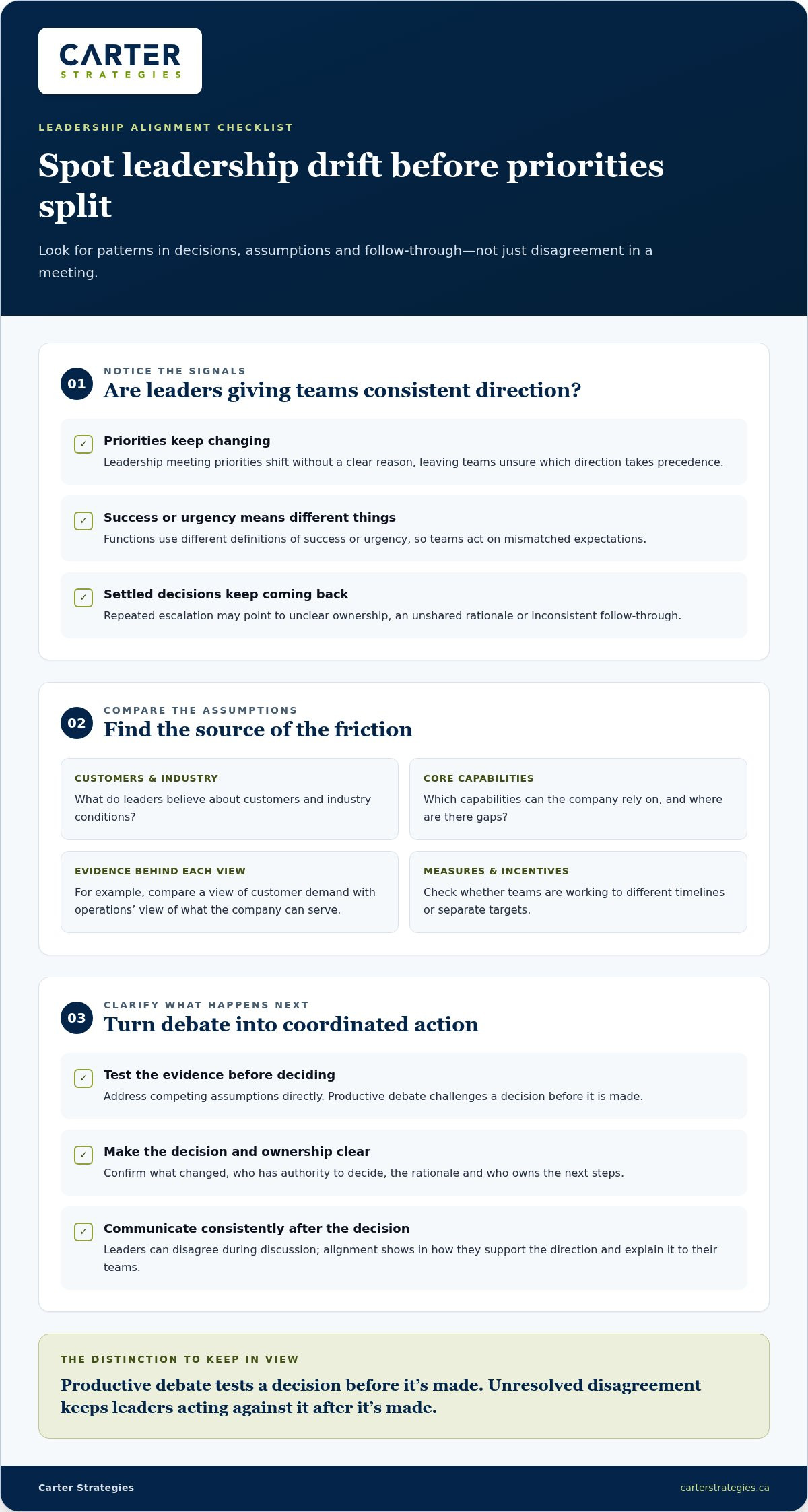
Look for patterns, not just a difficult meeting. Priorities that change from one executive team meeting to the next without a clear reason can signal that leaders haven’t settled the trade-offs. Functions may also use different definitions of success or urgency, causing teams to act on mismatched expectations.
Repeated escalation of decisions executives thought they had settled is another signal. If managers keep returning to the same question, the decision may lack clear ownership, a shared rationale or consistent follow-through. Ask what changed, who has authority to decide, and what the teams involved have been told. These questions help distinguish a change prompted by new information from a decision that was never understood in the same way.
How competing assumptions create friction
Before treating disagreement as a personality issue, compare the assumptions behind each position. What do leaders believe about customers and industry conditions? Which core capabilities can the company rely on, and where are there gaps? A sales leader may see demand in a customer segment that operations believes the company cannot yet serve. Testing the evidence behind both views can make the real choice clearer.
Measures and incentives also shape behaviour. If marketing is asked to build awareness while sales is judged mainly on immediate conversions, each function may favour a different timeline or audience. Cross-functional priorities need shared definitions of progress, so marketing and revenue leaders can coordinate their choices rather than optimize for separate targets. This matters in marketing and revenue strategy, where teams need a common view of the customer, the offer and the path to growth.
Productive debate tests a decision before it’s made; unresolved disagreement keeps leaders acting against it after it’s made. Leaders don’t need to suppress dissent. They do need to make room for evidence and challenge, then clarify the decision, its rationale and who owns the next steps. When assumptions remain difficult to reconcile, a neutral strategic perspective can help the management team examine them and refocus on shared priorities.
How to Assess Executive Alignment Without Requiring Consensus
Assess alignment through what leaders say and do, not a show of hands at the end of a meeting. A practical diagnostic compares each executive’s understanding of the company’s priorities with the decisions they make, the work they own and the direction they communicate. The aim isn’t to produce an alignment score. It’s to identify where shared understanding holds and where leaders need to resolve a gap.
Use the company’s stated priorities as the reference point, then test them against customer and industry insights. If the evidence has changed, leaders may need to revisit a priority. If the evidence is consistent but leaders interpret the priority differently, the issue is clarity or ownership.
Questions to test shared direction
Ask each executive to write down the company’s most important strategic priorities independently, before comparing answers. Then ask each person to describe the outcomes those priorities should produce and the contribution they own. Differences in wording may be harmless; differences in priority, definitions of success or accountability deserve discussion. For each gap, ask what evidence could resolve it.
Review the answers across four practical areas:
- Priorities: Do leaders identify the same strategic choices and explain why they matter now?
- Decisions: Do recent choices reflect those priorities, or do leaders apply different rules when trade-offs arise?
- Ownership: Can each executive name the decisions and action plans they’re accountable for?
- Communication: Do leaders give their teams a consistent explanation of the direction and expected outcomes?
Look for specific examples, such as a resource decision, a customer commitment or a project that was paused. Concrete cases help the management team distinguish a real pattern from a difference in phrasing.
Alignment is not the same as consensus
Executives can question a proposal, raise risks and argue for alternatives without undermining alignment. The key test is whether the final decision is understood, its owner is clear, and leaders communicate it honestly, even if they preferred another option. By contrast, unresolved disagreement persists when executives keep acting on opposing interpretations or treat ownership as unsettled.
| Healthy disagreement | Unresolved misalignment |
|---|---|
| Leaders test assumptions with evidence before a decision. | Leaders repeat competing positions after the decision. |
| The decision, rationale and owner are recorded and understood. | Teams receive different direction or escalate the same choice again. |
| Executives raise new evidence through an agreed review process. | Executives quietly redirect work without revisiting the decision together. |
This distinction matters during follow-through. A shared direction needs to reach the work itself, with owners, next steps and a way to review progress. Business strategy development can help leaders turn discussion into action plans while keeping employee perspectives and delivery realities in view.
How to Build Executive Alignment into Strategic Planning
Executive alignment takes shape through the planning process, not through a statement of intent at its end. Leaders need to examine what they know, make choices together and connect each priority to people and work. A clear sequence helps the management team move from discussion to action while leaving room to revisit assumptions when evidence changes.
Keep the process focused. Work through these steps in order:
- Surface perspectives. Invite leaders to bring forward relevant customer and industry insights, assumptions, constraints and opportunities. Ask employees closer to customers and delivery to share what they see, too.
- Clarify the choices. Name the trade-offs. Discuss what the company will prioritize, what it will defer and what evidence supports those choices.
- Set priorities. State the intended outcomes in plain language, then confirm that leaders understand how the priorities connect.
- Assign ownership. Identify who has authority to make decisions and who is accountable for coordinating each priority’s work.
- Review progress. Check results against agreed indicators and revisit assumptions when new information calls for a decision.
Facilitate an inclusive strategic planning discussion
Start by asking each executive to distinguish evidence from assumption. One leader may cite customer feedback, while another raises a delivery constraint. Both belong in the discussion. Invite employees to contribute observations and ideas before choices are finalized; their proximity to customer needs and day-to-day work can reveal implications leaders might otherwise miss. Record decisions, rationale and unresolved questions in accessible language so teams can understand what was decided and what remains open.
Employee involvement doesn’t mean asking everyone to decide everything. It means gathering relevant perspectives early, showing how input informed the choices and making the resulting priorities clear to the people who will carry them forward.
Turn shared priorities into accountable action
For each priority, document a decision owner, an accountable lead, the intended outcome and the action plans needed to advance it. Keep measures to a small set of relevant indicators that show whether work is progressing towards the intended outcome. For example, if a priority is improving the customer experience, choose indicators connected to that outcome rather than a long list of activity counts. Make dependencies visible, especially where one team’s progress relies on another’s contribution.
Set a review rhythm that fits the work. Use existing management meetings where possible, and reserve discussion for progress, changed assumptions, obstacles and decisions that need attention. A review should clarify the next action, owner and timing, not create reporting for its own sake. If conditions change, revisit the choice openly rather than letting teams quietly work to different priorities.
Carter Strategies’ approach to strategic planning connects inclusive planning with action plans and clear priorities.
How Strategic Advisory Support Can Strengthen Executive Alignment
An outside strategic perspective can help when leaders are circling the same choices without resolving them, pursuing competing priorities or interpreting the company’s direction in different ways. A strategic advisor creates space to examine the assumptions behind those positions, test them against available evidence and make the trade-offs visible. The goal isn’t to impose an answer. It’s to help the management team reach decisions it understands and can own.
This can be especially useful during growth, when customer needs, resources and responsibilities are changing. An advisor can ask what the company is prioritizing, what it will set aside and how leaders will know whether their choices are moving the business towards its intended outcomes. Executive alignment remains the executives’ responsibility; outside support can help keep discussion focused, candid and connected to strategic planning.
When an external strategic perspective may help
Consider support when important decisions stall, leaders bring disconnected views of the business to planning, or employees receive direction that shifts without explanation. An advisor can help the team distinguish evidence from assumption, surface unanswered questions and structure a discussion around choices rather than positions. This supports the process without replacing executive judgement, decision rights or ownership.
The work centres on business strategy development and planning. It doesn’t mean handing strategic responsibility to an outsider or asking an advisor to take over operational delivery. When the alignment challenge centres on marketing or revenue leadership, fractional CMO or CRO support can help clarify strategic direction and leadership accountability in that area.
Connect executive alignment to executable business strategy
Shared priorities become more actionable when employees help inform them, leaders make clear choices and the company connects those choices to owned action plans. Employee perspectives can surface customer needs, delivery constraints and opportunities that may not appear in executive discussions alone. Leaders can use those insights to shape an executable business strategy, explain its direction to teams and review progress against agreed outcomes.
Leslie Carter brings more than 25 years of business strategy and brand management experience to this work. Carter Strategies supports companies through collaborative business strategy development and growth planning, with an emphasis on employee involvement, ownership and accountability. Strategic advisory support can help keep the strategy connected to what the company can deliver, while the management team remains responsible for decisions and results.
Make Your Next Strategic Choice a Test of Alignment
The next time a priority competes with another demand, treat the decision as a practical test: can executives explain the choice, make decisions that support it and help teams see what should happen next? If answers differ across the broadroom table, use that gap as a starting point for a candid conversation, not a reason to force agreement for its own sake.
Executive alignment develops through repeated choices and follow-through. Each decision gives the management team a chance to clarify what matters, consider new information and reinforce shared accountability. Start with one decision that affects multiple teams, then agree how you’ll communicate it and review its effects. That steady practice can bring strategy closer to the work people do every day.
The goal isn’t to remove every disagreement. It’s to make sure debate helps leaders make clear choices and that teams can act on those choices with confidence. Progress begins when leaders identify the next decision that needs shared attention.
To discuss your leadership team’s strategic priorities and planning needs, connect with Carter Strategies.
Frequently Asked Questions
Is executive alignment the same as executive consensus?
No. Executive alignment means leaders understand the direction and can carry out decisions consistently; consensus means everyone supports the same choice. A CEO may decide to delay a product launch after hearing different views. Leaders can still align by explaining the decision accurately, following through on their responsibilities and raising new evidence through an agreed process rather than quietly reversing course.
Can executives stay aligned when they disagree about a strategic choice?
Yes. Disagreement can help leaders examine risks and alternatives before making a decision. Afterward, they can stay aligned by stating what was decided, what would prompt the team to revisit it and who will monitor those conditions. For example, executives who favour different growth channels can support a chosen pilot while tracking the agreed customer response measures before recommending a change.
How often should a management team review its strategic alignment?
Review alignment as part of the management team’s existing operating rhythm, rather than adding meetings by default. A short check-in can surface changed assumptions or unclear decisions, while a deeper review can fit with regular strategic planning milestones. Revisit priorities sooner if customer needs, delivery capacity or other material conditions shift. The right rhythm catches drift early without turning every update into a strategy debate.
What should a new executive do to understand existing leadership priorities?
Start by reviewing the current strategy, recent decisions and the measures leaders use to track progress. Then meet executives and relevant employees to hear how priorities affect their work and where they see unresolved questions. Compare those perspectives with the stated direction. Before proposing changes, ask which commitments are fixed, which assumptions are being tested and how the organization will decide whether a priority needs to change.
Can executive alignment work in a hybrid or distributed team?
Yes, if leaders make decisions and context accessible to everyone, not only those present in a room. Use a shared written record for priorities, decision owners and changes, and circulate materials before discussions so remote participants can prepare. Close meetings by checking for questions across locations and time zones. Follow up directly with anyone whose role or schedule made it harder to contribute, then share the same decision summary with all teams.
How can a board support executive alignment without taking over management decisions?
A board can reinforce alignment by asking the CEO and management team to explain strategic priorities, key risks and how progress will be assessed. It can test whether the reasoning is clear and whether leaders have surfaced important differences, while leaving operational choices and execution with management. Consistent questions from directors help keep attention on agreed objectives without creating a second decision-making path for employees.
What is the difference between executive alignment and employee alignment?
Executive alignment concerns whether senior leaders share an understanding of direction and act consistently. Employee alignment concerns whether people across the organization understand how their work contributes and can act on that direction. The two connect, but one doesn’t automatically create the other. For instance, a leadership team may agree on customer retention while employees still need clear guidance on which customer issues to escalate and how teams should coordinate.


