


The board should assess a fractional executive by the business need they will own, not by title alone. In Canada, evaluating whether fractional leadership fits the board’s business need means linking the role to a defined priority, clear accountability and measurable outcomes. Comparing the role with a full-time position is useful only when the comparison reflects the scope and responsibility the business actually needs.
It is reasonable for directors to ask whether fractional leadership can provide enough continuity and authority to advance a priority. Fractional executives work part-time, offering ongoing leadership while integrating with a company’s team. This article explains what they do, how to assess whether the approach fits a company’s growth, transition or fundraising needs, and how to align the role with the board’s priorities.
Key Takeaways
- Clarify how part-time executive leadership can address a defined business need without committing to a permanent role.
- Make a fair comparison with full-time compensation by aligning the role’s scope, time commitment and accountability.
- Define responsibilities, decision-making authority and expected outcomes so the board can assess the mandate clearly.
- Consider fractional leadership when growth, a transition or fundraising calls for focused expertise.
- Connect executive support to shared priorities and measurable progress, with the management team and employees aligned on delivery.
What is a Fractional Executive?
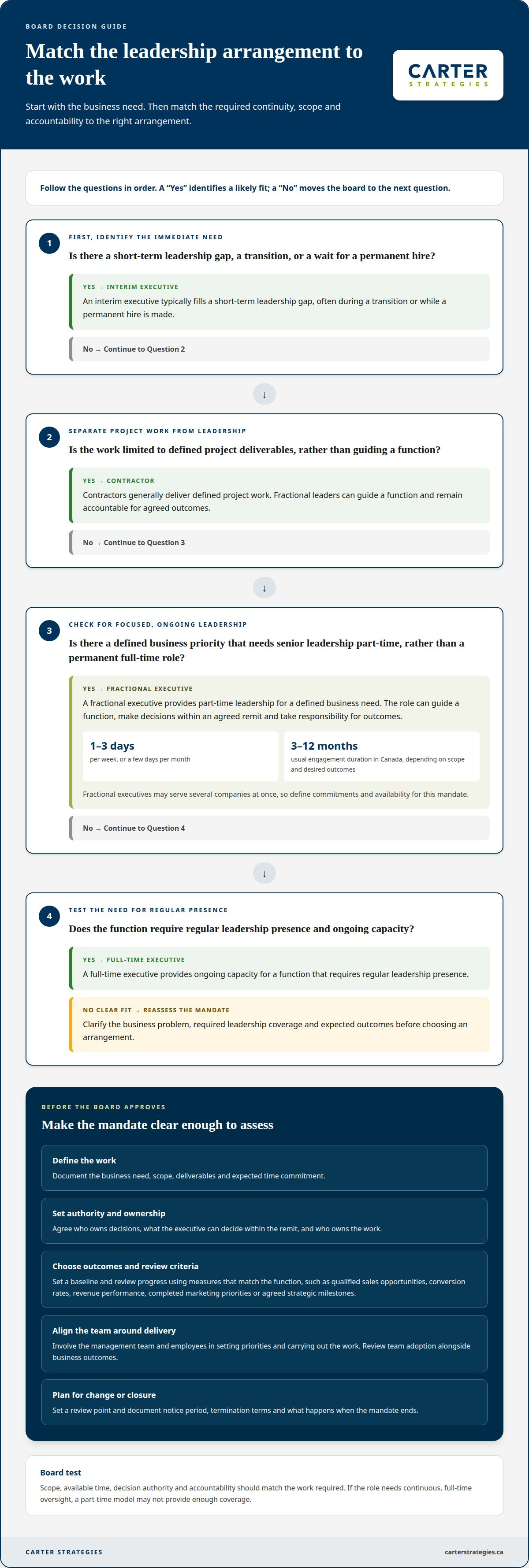
A fractional executive provides senior leadership part-time, often for a defined business need. In Canada, these engagements usually last three to twelve months, depending on scope and desired outcomes.
Flexible Part-Time Leadership
Fractional leaders bring executive-level strategy and management to a company without taking a permanent, full-time position. They commonly work 1 to 3 days per week, or a few days per month, and may serve several companies at once. This model lets a business match leadership time to a priority, such as strengthening its marketing function, while limiting a long-term commitment.
Part-time does not mean arm’s-length. A fractional leader can join leadership discussions, guide a function, make decisions within an agreed remit and take responsibility for outcomes. For example, an executive may combine strategic advice with functional leadership while the management team retains responsibility for broader company decisions. Scope, authority and ownership need to align so there is no gap between advice and delivery.
Common Misconceptions
One misconception is that fractional leaders simply deliver a report and leave. Unlike project-based contractors, they can provide ongoing leadership and integrate with teams. Another is that fewer days automatically mean less accountability. The board should assess agreed responsibilities, decision-making authority and results instead. A fractional executive may work with several organizations, but their role and commitments should be clearly defined for each.
Outcomes from a fractional executive engagement depend on the mandate, the company’s starting point and the results it needs. Boards can assess progress against specific business outcomes, rather than assuming executive experience alone will produce results.
Boards can assess measurable outcomes such as qualified sales opportunities, conversion rates, revenue performance, completed marketing priorities or progress against agreed strategic milestones. Choose measures that match the executive’s function and establish a baseline before work begins. Review results alongside team adoption, because a plan advances only when employees can act on it.
To set up the engagement, define the business problem, the executive’s scope, expected deliverables and engagement period. Specify how success will be reviewed, who owns decisions and what happens when the mandate ends. Involve the management team and employees in setting priorities and carrying out the work. This gives directors a clear basis for approval.
Risks include assigning broad responsibilities without enough time, expecting accountability without decision-making authority, or relying on external leadership without internal ownership. Commitments to several companies can also limit availability. Boards can reduce these risks by documenting scope, deliverables, notice period and work ownership, then involving the management team and employees in implementation.
A fractional arrangement may fit when the mandate calls for focused or staged expertise and the scope, authority and expected outcomes are clear. If the role requires continuous, full-time oversight, a part-time model may not provide enough coverage. Boards should confirm that the executive’s availability and responsibilities match the work required.
Assessing the scope of executive leadership
Compare the commitment required for part-time leadership with the full scope of a permanent role. A fair assessment accounts for more than time alone.
Comparing Leadership Arrangements
A fractional arrangement can suit a company that needs senior expertise for a defined scope rather than continuous leadership. A fully loaded full-time role can involve a broader mandate, ongoing availability and responsibility across a function. The board should compare those expectations with the fractional mandate, then consider whether the company needs a full-time executive’s entire capacity.
For example, a business seeking stronger sales direction may need executive guidance and team alignment, not a full-time position. The case for focused support is stronger when the mandate connects that support to business priorities and makes responsibility for outcomes clear. The company still needs enough leadership capacity to meet its objectives.
Fractional, Interim, and Full-Time Arrangements
Fractional, interim and full-time arrangements differ in duration, continuity and purpose. A fractional executive provides part-time leadership that can continue as priorities evolve. An interim executive typically fills a short-term leadership gap, often during a transition or while a permanent hire is made. A full-time executive provides ongoing capacity for a function that requires regular leadership presence.
Contractors differ as well: they generally deliver defined project work, while fractional leaders can guide a function and remain accountable for agreed outcomes. The board’s choice should follow the work. A temporary vacancy calls for continuity during transition; a defined growth priority may suit a fractional partner; an enduring need for daily executive oversight may point to a permanent position.
Evaluating Scope and Time Commitment
Compare proposals by matching scope, time commitment and accountability. One proposal might cover strategy and leadership-team alignment; another might include functional management and responsibility for delivery. Those are different mandates, even if both use the same executive title.
Before approval, the board should review the written scope, deliverables, expected time commitment, decision authority, work ownership and termination terms. It should also set a review point for the engagement. These boundaries help directors assess progress and adjust the mandate if business priorities shift.
To evaluate and approve an engagement, directors should connect the business need to defined outcomes, review scope and authority, and agree on review criteria. This keeps the decision grounded in the company’s priorities and available capacity.
For a marketing or revenue leadership need, fractional executive strategy support can help connect the mandate with business priorities and team accountability.
Comparing Fractional and Permanent Executive Roles
The distinction between fractional and permanent leadership is clearest when the board examines capacity, decision rights and continuity. Rather than compare titles, define what the organization needs the executive to own and how that work connects with the management team’s responsibilities.
Match Capacity and Decision Rights to the Role
A permanent executive role provides ongoing leadership across a function; a fractional mandate assigns senior responsibility for a more focused need. For example, a company refining its market position may need an experienced leader to guide choices, align the team and set priorities. The mandate should identify which decisions the executive owns, which require board or management-team approval, and how employees contribute.
This clarity matters when work crosses departments. A marketing leader may guide customer priorities while sales and operations teams share relevant insights and carry out agreed actions. If the board expects the executive to direct a broader function, the mandate should specify that authority rather than leave it implied. Scope should reflect the work the organization expects the role to lead.
Fractional, Interim and Permanent Roles
A fractional executive provides part-time leadership for an ongoing or defined business need. An interim executive generally fills a temporary leadership gap, such as maintaining direction during a departure or transition. A permanent executive leads an ongoing position with full-time responsibility. This distinction helps directors match the arrangement to the need rather than treating every leadership gap as a permanent vacancy.
During a transition, an interim leader can maintain decision-making and team direction while the board considers the future structure. A fractional leader may instead guide a specific priority that continues beyond an immediate handover. A permanent role fits when a function requires sustained, day-to-day executive attention. Each option calls for a different approach to continuity, authority and internal ownership.
Advisor, Board Member or Functional Leader?
An advisor offers perspective, while a board member contributes governance and oversight through board participation. Neither role automatically carries responsibility for running a business function. A fractional executive can take on that operational leadership when the mandate assigns decision rights and accountability. The board should distinguish these roles before approving a mandate, especially when directors expect advice to translate into action.
For instance, an advisor might recommend changes to a company’s revenue approach, while a fractional executive could lead the function’s agreed priorities with the team. A board member would assess direction and progress through governance discussions. Keeping these responsibilities distinct helps employees understand who sets priorities, who makes operating decisions and where oversight sits.
In a board discussion, state the role’s purpose, authority, expected contribution and relationship to existing leaders. A shared definition gives directors a sound basis for evaluating fit and helps the executive and employees work from the same expectations.
Fractional executive responsibilities and role definition
A fractional executive’s responsibilities depend on the function, agreed scope and authority. A clear role connects senior direction with operational work, so teams know who decides, who delivers and how progress will be assessed.
Separate Leadership, Advice and Delivery
A fractional leader may run a business function, but the agreement determines their decision-making authority. For example, a marketing executive might set priorities, guide the team and own agreed outcomes while employees carry out day-to-day activities. If the role also includes advice on wider strategy, allow enough time and authority for that responsibility. Advice and delivery need clear ownership, not a gap between recommendations and execution.
Before work begins, define the function’s boundaries in writing. Specify deliverables, work ownership and notice period, then identify which decisions the executive can make independently. For example, a leader could recommend a change in customer focus while the management team approves its broader business implications. This division preserves accountability without treating the executive as an arm’s-length advisor.
Make Implementation Part of the Mandate
A strategy does not become operational simply because an executive presents it. The mandate should identify how the leader will involve employees, assign responsibilities and connect action plans to organizational priorities. During the first month, a fractional executive can assess current conditions, design a response and pilot it in one area. That sequence gives the team a practical starting point and helps reveal barriers before wider implementation.
Boards can expect regular progress updates tied to agreed deliverables. For example, a report can distinguish completed decisions, work underway and items blocked by dependencies. The executive should explain the next action and who owns it. Linking updates to the business need and agreed outcomes gives directors a clear basis for assessing progress.
Examples: Fractional CFO Responsibilities
A fractional CFO can assess an organization’s financial and operational position, then use its numbers to develop projections that guide business decisions. Depending on the mandate, the role may include upgrading accounting systems, preparing for a merger or acquisition, addressing complex financial issues, or improving cash management through technology. Each task needs a named owner and a defined outcome.
For a company preparing for an acquisition, the CFO may lead financial assessment and projections while internal finance staff maintain routine records. The written role should state who coordinates information, makes recommendations and approves decisions. Clarifying responsibilities helps directors see how specialized leadership supports a defined business objective and gives employees a clear role in the work.
Role definition is strongest when the board, executive and team agree on the same priorities. A written mandate linking authority, delivery and employee involvement helps turn senior expertise into work the organization can carry forward.
Using fractional executives during growth, transitions, and fundraising
Fractional leadership can match executive capacity to a defined business stage. A strong mandate ties a milestone, such as growth, a leadership transition or fundraising, to clear ownership, a timeframe and measurable results. This helps directors assess whether the role fits current priorities and gives the executive a practical focus.
During growth, responsibilities can expand as new demands emerge, then narrow after operations stabilize. For example, a fractional executive might contribute more days per week during a scaling period and fewer once operations settle. The company can adjust the leadership commitment while retaining continuity. An ongoing working relationship also helps the executive understand how decisions affect employees, customers and business priorities.
Transitions create a different need. A company facing an executive departure may need an interim leader to maintain direction while the board considers its longer-term structure. A two-week overlap between outgoing and incoming leaders can support knowledge transfer, clarify responsibilities and reduce disruption. Fractional support may suit a defined transition when the organization needs senior guidance without establishing a permanent position.
Fundraising calls for preparation before a funding round begins. Companies often engage a fractional CFO six to twelve months before fundraising, giving the finance function time to strengthen projections and address information needs. Directors can link the mandate to milestones such as financial readiness, internal coordination and timely decisions. This positions executive involvement as part of the company’s preparation, rather than a last-minute response.
Some priorities have a defined endpoint. A company could engage a fractional executive for six months to rebuild a technology roadmap and guide the team through the work. The board can review progress against the roadmap, team ownership and agreed milestones. Clear measures help directors see whether the mandate is advancing the intended business priority and whether employees are equipped to carry the work forward.
Across these situations, the key question is whether the business need can be staged. A focused mandate with a visible milestone may suit fractional leadership; continuous oversight across a growing function may call for a different arrangement. Boards can connect the timeframe to business outcomes and employee ownership, then adapt the role as conditions change. The executive’s direction should reinforce work the team can sustain beyond the immediate milestone.
Build growth priorities into an executable plan with Growth Strategies and Planning, connecting leadership direction with team action.
Carter Strategies: Fractional CMO and CRO services
Carter Strategies helps companies connect fractional marketing or revenue leadership with clear growth priorities. Its Fractional CMO and CRO services support boards and management teams that need senior direction for a defined business challenge while keeping internal teams involved in the work.
Turn to this support when the company needs to sharpen its Marketing Strategy, set business direction or align growth priorities with practical action plans. Business Strategy Development and Growth Strategies and Planning can connect those priorities to an executable plan, rather than treating leadership as a title without clear ownership.
If your board is weighing a fractional marketing or revenue leadership mandate, contact Carter Strategies to discuss the business priorities and the support they call for.
Set the Next Leadership Priority
A practical approach to justifying the cost of a fractional executive to the board starts with the next decision the company needs to make. Keep the discussion centred on the priority, the ownership required to advance it, and how the leadership team will stay aligned as conditions change. This shifts the conversation from defending a title to deciding what capability the business needs now.
Before the next board discussion, frame the mandate around the choices ahead: what needs to change, who must be involved, and what evidence will show progress. Bring employees into the conversation early so the plan reflects operational realities and builds ownership beyond the boardroom. A clear, shared direction gives the mandate a stronger foundation and helps the organization turn decisions into action. Agree on the intended outcome before settling on the role.
If your board is considering its next leadership priority, contact Carter Strategies to discuss fractional leadership. A focused conversation can help clarify the business challenge and the support needed to move forward with confidence.
Frequently Asked Questions
What is fractional hiring?
Fractional hiring engages a senior executive on a part-time or fixed-term basis to meet a specific business need. For example, a company may bring in a fractional marketing leader to guide its existing team through a repositioning effort without creating a permanent executive position. The arrangement works best when the business can identify the function requiring leadership and clarify how the executive will work with current staff.
How should a board define the scope of a fractional executive’s role?
Start by identifying the business need, the executive’s responsibilities and the expected outcomes. A focused mandate requiring periodic strategic input differs from one involving ongoing leadership of a business function. For board planning, define the work and period first, then agree on the executive’s time commitment, how they will work with the team and how progress will be assessed.
How can a board set accountability for a fractional executive?
The agreement should make clear what the role covers, such as leadership meetings, preparation, team guidance and agreed deliverables. Define the responsibilities, expected outcomes and review process before work begins. The board should assess accountability alongside scope and the executive’s time commitment, not as a standalone measure.
How should a board assess a fractional executive role against a full-time position?
Compare the role requirements and expected period of support. For example, a company needing leadership for a market repositioning can define a fractional mandate around that work and assess the capacity required. If the need later becomes continuous, the board can reassess whether the workload supports a full-time position.
What measures can a board use to assess a fractional executive’s work?
Choose measures that connect the executive’s work to the business need. A revenue-focused mandate might track qualified opportunities, conversion and revenue performance; a marketing mandate might assess campaign contribution, customer acquisition and progress against approved priorities. Establish a baseline and review results alongside delivery milestones. For a board, the strongest case links these measures to a clear business objective and shows how the executive’s work contributes to it.


