


A fractional executive’s value is measured by what changes, not by hours on a calendar. Whether a fractional executive is worth the investment depends on whether their expertise addresses a clear business need and helps the team advance priorities that have stalled.
It’s reasonable to weigh the commitment against the results you expect. The case is strongest when an experienced leader can focus attention on a pressing challenge, align people around a workable direction, and help turn strategy into action, without creating a full-time leadership role the business doesn’t need.
This article explains how to assess a fractional executive’s contribution and evaluate return on investment alongside lasting improvements in decision-making and team alignment. You’ll also learn when fractional CMO or CRO services may fit a company’s needs, and when another approach may be more appropriate.
Key Takeaways
- Judge the engagement by the business need it addresses and the progress it enables, not by leadership hours alone.
- Assess ROI through measurable business outcomes as well as clearer priorities, stronger decisions, and team alignment.
- Look beyond the engagement period: new processes, capabilities, and shared ownership can continue to support the business afterward.
- Include employee involvement and management team alignment when evaluating whether the work is taking hold.
- Fractional leadership is most useful when the business needs focused executive expertise without a full-time role.
Avoided costs and opportunity costs
A fractional executive can address a leadership gap without making a permanent appointment the only option. The comparison is not simply one role against another. It includes recruiting time, work left waiting, and the internal capacity needed to support a new leader. For example, a company preparing to enter a new market may need senior revenue direction before it needs a permanent executive role.
Consider what a full-time search involves. The CEO and management team must define the role, assess candidates, and make time for onboarding. Those demands can draw attention from decisions already affecting customers and employees. A fractional leader can focus on a defined business priority while the company determines the leadership structure it needs over the long term. That distinction matters when the need is urgent but the role’s lasting scope is still unclear.
Opportunity cost is the value of work the business delays or gives up while people focus elsewhere. If a sales team is waiting for clearer priorities, the delay can affect its ability to pursue suitable opportunities. If marketing lacks a shared direction, activity may continue without agreement on the target customer or value proposition. A senior leader can connect these decisions, clarify ownership, and give the team a direction it can act on.
Assess the trade-off through a specific business example. A company entering a new market might need an executive to align customer insights, sales priorities, and marketing strategy. Without that leadership, the CEO may have to manage the work alongside other responsibilities, while employees make decisions without enough direction. With fractional support, the leader can structure the priority and involve the people responsible for carrying it forward.
There are still demands to account for. Internal leaders need to share relevant information, make decisions, and support the agreed work. A fractional executive cannot build momentum if the management team withholds context or leaves priorities unresolved. The relevant comparison is not “fractional or no effort.” It is whether focused leadership makes better use of existing company capacity than leaving the gap unaddressed.
Before weighing the alternatives, identify the business constraint. Is the main issue delayed decisions, unclear ownership, or a missing strategic perspective? Then consider what would remain stalled without senior support. This sequence helps distinguish an urgent leadership need from a desire to add another title. It also makes opportunity cost visible: the business can identify which priorities are waiting, who is affected, and what progress the engagement should enable.
Assessing the ROI of hiring a fractional executive
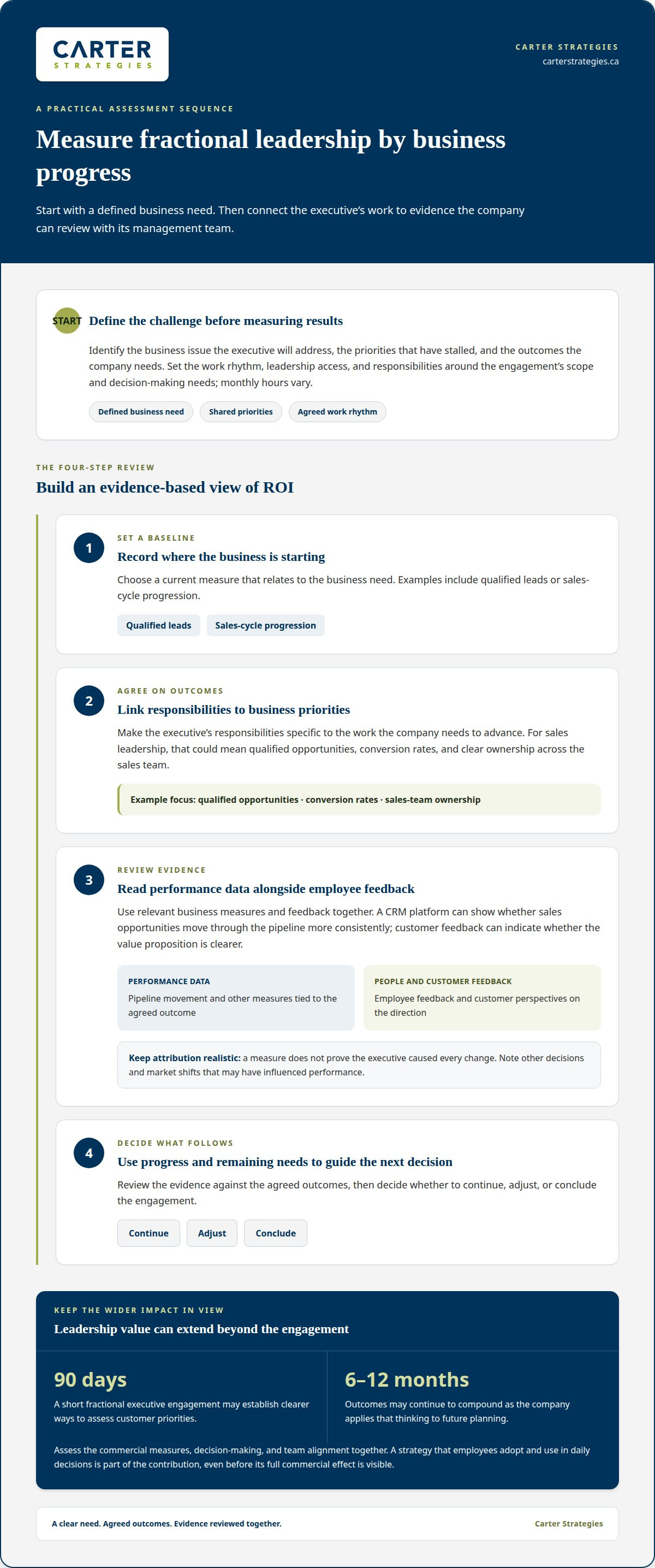
A sound ROI assessment starts with a business outcome, not a calendar entry. Define the issue the executive will address, then connect their work to measures the company already tracks. For example, a sales leadership engagement might focus on qualified opportunities, conversion rates, and clear ownership across the sales team.
A fractional executive provides senior-level direction for a defined business need while working with the existing management team. Common roles include chief marketing officer, chief revenue officer, chief financial officer, chief operating officer, and chief technology officer. Their contribution may include setting priorities, guiding decisions, and aligning employees around the work needed to advance a goal.
Early-stage and mid-sized companies can benefit when growth creates leadership demands they cannot support with a full-time executive role. A company entering a new market, repositioning its brand, or seeking more coordinated sales and marketing decisions may need focused executive experience. The best fit is a business with a defined challenge and a management team ready to act on shared priorities.
Monthly hours vary with the engagement’s scope, responsibilities, and decision-making needs. Rather than assume a fixed monthly allocation, define the outcomes, access to leadership, and work rhythm required. A market-entry plan, for example, may call for regular leadership discussions and coordination with employees responsible for customer research and sales priorities.
Separate direct results from the conditions that enable them. A CRM platform can show whether sales opportunities move through the pipeline more consistently, while customer feedback can reveal whether the value proposition is clearer. Neither measure proves the executive caused every change. Compare the starting position with later results, and document other decisions or market shifts that influenced performance.
Use a simple assessment sequence:
- Set a baseline: Record the current measure, such as qualified leads or sales-cycle progression.
- Agree on outcomes: Connect the executive’s responsibilities to specific business priorities.
- Review evidence: Look at performance data and employee feedback together.
- Decide what follows: Continue, adjust, or conclude the engagement based on progress and remaining needs.
This approach keeps ROI grounded in evidence without reducing leadership to a single financial metric. For example, a marketing leader may clarify priorities and improve coordination between marketing and sales. If the teams adopt the direction and use it in daily decisions, that alignment is part of the value created, even before its full commercial effect is visible.
For companies assessing growth priorities alongside executive outcomes, business strategy development can help connect leadership decisions with an executable direction.
Long-term effects of short engagements
A short engagement can leave value behind when it changes how the organization makes decisions and carries work forward. A 90-day fractional executive engagement may produce outcomes that compound over the following six to twelve months. For example, a company may retain a clearer way to assess customer priorities after the executive’s direct involvement ends, then apply that thinking to future planning.
Some effects take time to show. Reviewing results at the six-week mark may understate progress because some engagements take two to three months for their full impact to become visible. A new direction may first require employee input, clearer responsibilities, and changes to existing routines. For instance, a sales team may need time to apply a revised approach in customer conversations before its effects become evident.
The lasting contribution depends partly on what the team can carry forward independently. A useful handover can explain the reasoning behind key choices, the information used to make them, and the internal roles responsible for ongoing work. If a fractional leader helps refine a company’s value proposition, employees should understand how customer and industry insights shaped it. That context helps them apply the positioning consistently as conditions change.
Risks include losing important context when the executive leaves, leaving ongoing work without an internal owner, or treating recommendations as a finished result. A strategy document alone cannot sustain progress if employees do not know how to use it. For example, a growth priority may stall when the team understands the goal but lacks clarity about which decisions they can make independently.
Knowledge transfer works best through participation, not a final presentation. When employees contribute to working sessions, test assumptions, and help shape action plans, they gain experience applying the thinking behind decisions. A marketing team involved in refining customer segments, for example, can use those criteria in future campaign planning without relying on the fractional leader to interpret them.
Long-term effects can also appear in the quality of future choices. A management team that has learned to connect customer evidence with strategic priorities can apply that discipline beyond the original assignment. The executive’s contribution then extends beyond an immediate deliverable: the organization has a clearer way to frame decisions, assign ownership, and adapt plans as circumstances shift.
Evaluate the lasting impact by looking at what remains useful after the engagement: shared decision criteria, employee capability, and work with an internal owner. These are practical signs that a short engagement has strengthened how the organization operates, rather than simply producing advice that leaves with the executive.
Qualitative indicators of success
A Canadian business should look for relevant executive experience, clear communication, sound judgement, and the ability to work with its existing team. The right fractional executive listens before recommending changes, explains trade-offs, and connects decisions to the company’s priorities.
Qualitative progress shows up in how people work together, not just in a spreadsheet. For example, if marketing and sales teams previously disagreed about their target customer, a fractional leader can help clarify the audience and the handoffs between teams. Employees should be able to explain the priority and their role in advancing it.
Look for stronger decision-making. Before the engagement, a management team might revisit the same market-entry question in several meetings without assigning ownership. After focused executive input, a useful sign of progress is a documented decision, a named owner, and a clear next action. The quality of the reasoning matters as much as the speed of the decision.
Team involvement is another practical indicator. A leader who develops plans in isolation may leave employees unsure about what is changing or why. In contrast, a leader who gathers employee perspectives can surface operational barriers early. For example, frontline sales staff may explain why a proposed message does not address customer concerns, helping refine the company’s value proposition before rollout.
Assess fit through observable working habits as well as credentials. In early discussions, notice whether the executive asks about the company’s customers, core capabilities, and internal decision-making process. During the work, assess whether they make complex choices understandable and invite relevant voices into discussions. A strong fit respectfully challenges assumptions while keeping the management team accountable for decisions.
These indicators can be reviewed alongside business measures, using specific evidence rather than general impressions. Useful questions include:
- Clarity: Can employees describe the agreed priority and how their work supports it?
- Ownership: Are responsibilities understood by the people expected to carry out the action plans?
- Alignment: Do marketing, sales, and leadership teams make decisions from the same customer and industry insights?
- Decision quality: Are choices tied to stated goals, evidence, and clear accountability?
Use regular review conversations to identify where these signs appear and where friction remains. For example, if employees understand the strategy but teams still make conflicting decisions, the next discussion should focus on decision rights or coordination. That distinction helps separate a communication gap from a lack of shared commitment.
Qualitative indicators do not replace financial analysis. They show whether the work is taking hold inside the organization and whether employees can carry priorities into daily decisions. When people understand the direction, contribute relevant insight, and take ownership, the engagement is building organizational capacity alongside business results.
True employment and engagement considerations
Compare the full commitment, not just the executive’s stated fee. A permanent role may involve recruiting, onboarding, compensation, benefits, equipment, and management time. A fractional engagement also requires leadership time and internal coordination. The balance depends on the role’s scope and the company’s priorities.
Canadian contract, tax, and employment considerations depend on the agreement and the actual working relationship. A written contract should define responsibilities, decision authority, confidentiality, intellectual property, and how either party can end the engagement. Tax treatment and worker classification depend on the specific arrangement and applicable jurisdiction, so the contract should reflect how the work will operate in practice.
There is no single typical Canadian rate that applies across hourly, daily, and monthly engagements. The amount depends on the executive’s experience, the work’s complexity, expected availability, decision-making responsibility, and engagement structure. A defined strategic project and ongoing leadership support can require different levels of involvement, so comparing rates without comparing scope can be misleading.
For a fair comparison, set out what each arrangement includes. An hourly structure ties the work to recorded time, while a daily structure centres on agreed workdays. A monthly retainer generally defines ongoing access and responsibilities over a set period. In each case, clarify what work is included, how additional requests are handled, and what outcomes the executive is expected to guide.
Internal capacity also affects the commitment. A fractional leader needs timely access to business information, relevant employees, and decision-makers. If the CEO must resolve every question or employees cannot make time for working sessions, progress may slow even when the engagement scope is clear. Account for the management team’s role in supporting decisions and coordinating follow-through.
Before agreeing to terms, align the engagement with the strategy and specify how both parties will review it. Record responsibilities, expected outputs, meeting rhythm, and the renewal or exit process. This gives the executive and management team a shared basis for discussing scope changes, unresolved decisions, and whether the work still matches the business need.
For organizations defining priorities alongside executive support, align executive support with business strategy so responsibilities connect to the work the team needs to advance.
When comparing executives, weigh the commitment against the work required, rather than treating salary and fees as equivalent measures.
These examples show why the payment figure alone may not capture the employer’s full commitment. They do not establish which arrangement is more suitable: compare the responsibilities, availability, decision authority, and expected outputs in each proposal. Also consider whether the business needs ongoing leadership capacity or a defined period of support, and account for the internal time required to work with the executive. A comparison built around the same business priorities makes it easier to identify what the organization is paying for and whether the proposed commitment fits its needs.
Carter Strategies: Fractional CMO and CRO services
Carter Strategies provides Fractional CMO/CRO Services to help companies address marketing and revenue leadership needs. This support can fit when growth priorities need executive direction, but the business does not need a full-time leader for every part of the work.
For example, a company facing unclear market positioning or disconnected sales and marketing priorities may need help aligning its teams around practical goals. Carter Strategies also offers Business Strategy Development, Marketing Strategy, and Growth Strategies and Planning, connecting leadership decisions with an executable direction and clear ownership.
If your business is weighing fractional leadership against its current needs, contact Carter Strategies to discuss the priorities you want to address.
Make your next leadership decision with purpose
Whether a fractional executive is worth the investment depends on the business need you want addressed and the progress your team can carry forward. Before deciding, identify the leadership gap, the outcomes that matter, and how employees will take part in the work. A clear mandate gives the executive and management team a shared basis for action.
Carter Strategies offers Strategic Business Planning, Go‑To‑Market Strategy, and Fractional CMO/CRO Services. These offerings can help companies connect leadership direction with practical priorities when growth, marketing, or revenue decisions need greater focus. Start a conversation about your goals, the challenges facing your team, and the support that fits your needs.
Discuss your needs with Carter Strategies, and take a considered step towards clearer priorities and aligned action.
Frequently Asked Questions
How much does a fractional executive cost in Canada?
Engagement fees vary with the executive’s responsibilities, experience, time commitment, and the complexity of the work. A focused strategic assignment differs from ongoing leadership across several functions, so a single figure would not describe every engagement. Define the outcomes, scope, and expected availability first. Those details shape the engagement terms and help you compare the commitment with the leadership capacity your business needs.
How does the cost of a fractional executive compare with hiring a full-time executive or consultant?
A fractional executive provides part-time leadership, while a full-time hire assumes an ongoing role and its associated employment commitments. A consultant may deliver advice or a defined project, but responsibilities vary by agreement. Compare scope and accountability, not just the title: who guides decisions, works with employees, and helps move priorities forward? A company needing sustained executive direction may value a different arrangement than one seeking a specific recommendation.
What measurable ROI and business outcomes can fractional executives deliver?
Outcomes depend on the role and business challenge, so assess the measures tied to the work rather than relying on a promised return. A revenue leader might track the quality of sales opportunities or movement between pipeline stages. A marketing leader might assess customer retention, campaign response, or the strength of the company’s market position. Pair these measures with employee feedback to understand whether the work is improving coordination and decision quality.
How can a fractional executive help a business assess whether the investment is worthwhile?
To decide whether a fractional executive is worth the investment, have the leader define the business problem, the expected contribution, and the evidence that would indicate progress. For example, if a company’s sales and marketing teams pursue different customer groups, the executive can help clarify the shared target and agree on relevant measures. Reviewing those measures alongside customer feedback helps distinguish meaningful progress from activity that hasn’t addressed the original need.
How many hours or days per month do fractional executives typically work?
Fractional executives typically work 10 to 20 hours per week; their monthly schedule varies with the engagement’s scope, responsibilities, and decision-making needs.


