


An outside perspective can reveal assumptions that are difficult to see from within a business. Understanding the value of an outside business perspective means recognizing how an independent adviser can question familiar norms, identify blind spots and broaden the options considered.
Outside advice can bring useful expertise. The more important question is whether it will help your team make better decisions or simply reinforce established habits. That depends in part on whether the adviser listens, understands your people and priorities, and challenges ideas constructively.
This article explains how an outside viewpoint can reduce decision bias, surface issues in your strategy and connect business choices to practical action. It also considers when external advice is useful and how to choose someone whose approach and values fit your organization, so new ideas can earn the team’s trust and move into execution.
Key Takeaways
- An outside viewpoint can reveal blind spots across finance, marketing, sales, innovation, organizational structure and team dynamics.
- Question familiar business norms to see whether they still support your goals, customers and employees.
- Use constructive challenge to surface assumptions and reduce the influence of internal bias on important decisions.
- Bring in a mentor, strategist or experienced peer when a decision calls for expertise or perspective your team does not have internally.
- Choose an adviser whose values and working approach fit your organization, and involve employees so new priorities can gain alignment and ownership.
So what exactly are the benefits of getting an outside perspective for your business?
An external viewpoint can help leaders identify blind spots, test assumptions and connect operational realities with business priorities. Its value lies in asking questions the team may have missed and grounding discussion in evidence, customer needs and employee experience.
Spotting blind spots across business functions
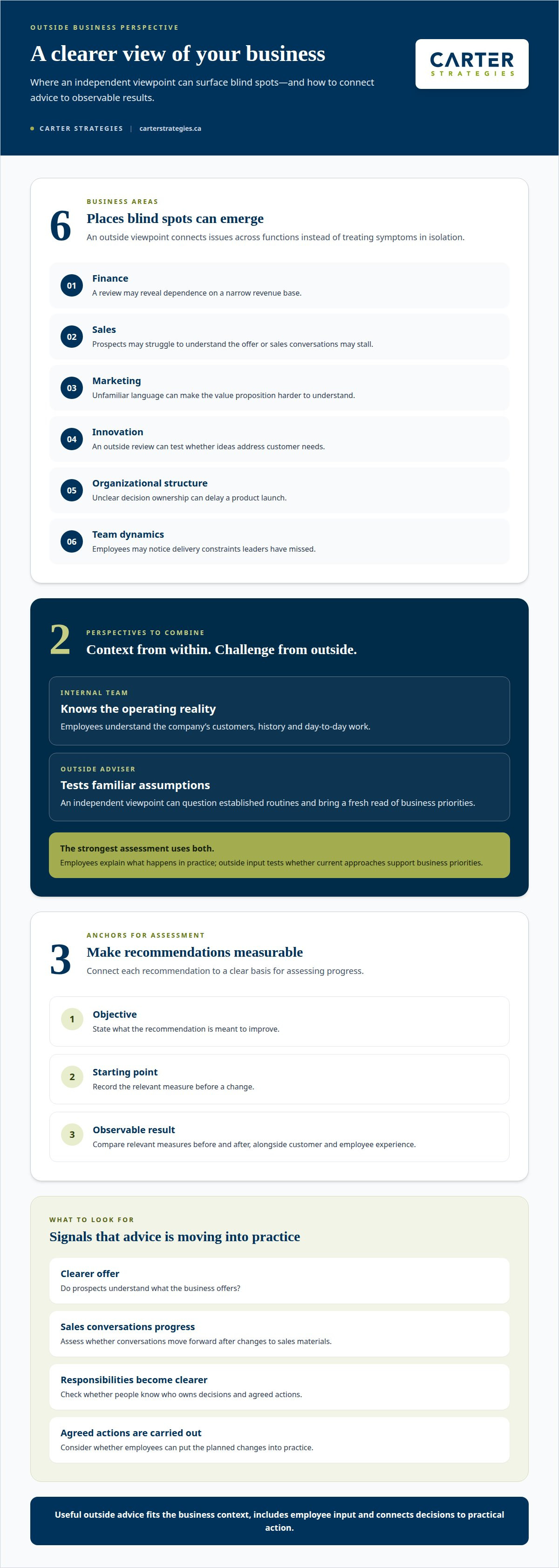
An outside perspective considers how decisions in one function affect the wider business. A finance review may reveal dependence on a narrow revenue base; sales conversations may show that prospects struggle to understand the offer. In marketing, unfamiliar language can obscure a value proposition, while an innovation review can test whether ideas address customer needs.
Organizational structure and team dynamics matter, too. Unclear decision ownership, for example, can delay a product launch, while employees may notice delivery constraints leaders have missed. Connecting these observations helps management identify which issue to address first instead of treating symptoms in isolation.
Comparing outside advice with internal expertise
Internal teams understand the company’s customers, history and operating realities. An outside adviser can question assumptions without being shaped by established routines. The strongest assessment combines both perspectives: employees explain what happens in practice, while external input tests whether current approaches support business priorities.
Advice needs context, too. An adviser may misunderstand a customer commitment or the capabilities needed to deliver a recommendation. Leaders can reduce this risk by sharing relevant information, inviting employee input and assessing recommendations against the business’s actual objectives.
For a Canadian business, the right scope depends on the decision, the analysis required and the adviser’s role. Defining deliverables and responsibilities helps keep the work focused on its purpose.
Measuring the impact of outside advice
Connect each recommendation to an objective, a starting point and an observable result. If advice leads to changes in sales materials, assess whether prospects understand the offer and whether sales conversations progress. For operational changes, consider whether responsibilities become clearer and employees can carry out agreed actions.
Financial indicators can help assess progress, too. Compare relevant measures before and after a change, such as operating expenses, retention or sales conversion. Interpret results alongside service quality and employee experience, so improvement in one measure does not conceal a problem elsewhere.
During a business transition, an outside assessment can clarify how earnings, customer concentration, reliance on key people and investment needs affect the business’s position. Owners can use that perspective to consider transition timing alongside personal goals, such as retirement income, family support and legacy plans. Reviewing these factors early leaves more room to weigh adjustments before deciding.
Interpret the results alongside the owner’s broader financial picture to help align business decisions with personal goals. An early valuation can inform sale timing, strategic improvements and transition planning in light of those goals.
Questioning established business norms
Established routines can keep work moving, but they can also shield assumptions from scrutiny. An outside perspective helps leaders ask whether a familiar practice still serves customers, employees and business priorities, rather than preserving it simply because it is familiar.
Start with decisions that shape everyday work: how the company sets priorities, approves spending, responds to customer feedback and shares information. A rule requiring several approvals, for example, may have been introduced to manage risk. If it now delays routine decisions without improving oversight, it may need to change. The point is not to dismiss experience, but to test whether past reasoning still fits current conditions.
This test can reveal how norms affect customer relationships. A company might assume buyers understand its technical language because employees use it every day. An adviser unfamiliar with that shorthand can review a proposal from a customer’s perspective and identify where the message becomes unclear. Leaders can then compare the wording with sales conversations and customer feedback before revising the value proposition.
Norms also shape whose views carry weight. If planning sessions routinely include only management, employees closest to customers or delivery may have little influence on priorities. Invite people from different functions to describe what slows execution, what customers ask for and which processes create unnecessary friction. Compare their examples with the assumptions behind the current plan. This makes constructive challenge part of the work, rather than criticism imposed from outside.
Consider how the company handles new ideas. An established norm might favour familiar products or markets, even when customer and industry insights point to another opportunity. An external adviser can ask what evidence supports the current choice, which alternatives the team has considered and what capabilities each option requires. These questions help leaders distinguish a deliberate strategic choice from an untested habit.
Change takes more than identifying a better approach. Courtney Intersimone said she spent 20 years believing her closed, internal network was a competitive advantage. That example illustrates how a norm can feel beneficial while limiting exposure to different approaches. An outside viewpoint can widen the discussion, but employees still need context, a chance to contribute and clear ownership of resulting action plans.
To question a norm without creating defensiveness, examine one decision at a time. State the assumption, identify the evidence behind it, consider an alternative and assess the consequences for customers and employees. This sequence keeps debate practical. Leaders who want to connect that challenge to strategic business planning can use the findings to clarify priorities and build alignment before decisions move into execution.
Reducing bias in business decisions
Familiarity can make business owners less likely to notice bias or consider alternatives. A decision that once worked, such as keeping a long-standing product line, may feel safer than testing a new direction. For leaders, understanding the value of an outside business perspective means recognizing how independent challenge can expose preferences before they shape investment, staffing or customer priorities.
Confirmation bias can lead a management team to favour evidence that supports its existing view. Suppose leaders believe a product’s sales decline reflects weak promotion. They may focus on campaign results and overlook customer feedback about product fit. An adviser can ask what evidence would challenge that explanation, then compare sales patterns, customer comments and purchasing behaviour.
Past investment can influence future choices, too. If a company has devoted time and resources to developing a service, leaders may continue funding it because stopping feels like admitting failure. A more useful question is whether the service can meet current objectives from this point forward. That means weighing customer demand, delivery requirements and alternative uses for those resources.
Meeting dynamics can introduce bias, too. If the most senior person speaks first, others may hold back or align with that view. An outside facilitator can invite independent input before discussion, including from employees who work directly with customers or deliver the service. This helps distinguish agreement based on evidence from agreement based on hierarchy.
For a major decision, use a short sequence that makes assumptions visible:
- State the decision clearly, such as expanding into a new Canadian market.
- Record the evidence supporting the preferred option and the evidence that challenges it.
- Identify who benefits from the choice and who carries its risks.
- Compare at least one alternative against the same customer, capability and resource criteria.
- Set a review point and define what result would prompt a change in direction.
A decision log can strengthen this process. Record the date, objective, assumptions, evidence, alternatives and accountable owner. If a forecast later misses its target, the team can identify whether the cause was an unsupported assumption, changing market conditions or an execution gap. That distinction improves future decisions and keeps review focused on learning, not blame.
An outside adviser can sharpen leadership judgment without taking responsibility away from decision-makers. Before approving a new sales channel, for example, invite the adviser and employees to assess customer demand, operational readiness and the conditions that would justify further investment. Leaders can then make a clearer choice and explain their reasoning.
For strategic planning, an outside adviser can help leaders and employees examine whether proposed priorities align with customer and industry insights, core capabilities and available resources. The adviser can ask questions, compare alternatives and help the management team clarify what evidence supports each choice. Employees can contribute practical knowledge about customers and delivery, while leaders remain accountable for decisions. Record the agreed priorities, assumptions and action plans so the team has a shared basis for putting its executable business strategy into practice.
When should a business seek advice from external consultants or mentors?
External advice is most useful when a decision exceeds the experience or capacity available within the business. A company considering expansion into a new region, for example, may need a strategist to test assumptions about customers, operations and growth priorities. The right adviser depends on the question, not simply on seniority.
A mentor can help an owner think through leadership challenges, while a business strategist can bring structure to choices about direction and priorities. A peer from another industry may offer a useful comparison when familiar practices are difficult to question. Someone with general business knowledge but limited familiarity with the company can also raise basic questions that insiders have stopped asking.
Consider an outside view when the management team keeps revisiting a choice without resolving it. A company debating whether to refresh its brand or enter a new market, for instance, may be combining two separate decisions. An adviser can clarify the objective, identify the evidence each option requires and bring customer and industry insights into the discussion.
External support can also help when a business changes faster than its internal structure. If sales growth creates unclear responsibilities across marketing, sales and operations, an independent perspective can help leaders define priorities and decision ownership. Employee involvement remains essential: people responsible for delivery can explain where a proposed change meets practical constraints.
Before engaging an adviser, define the decision that needs attention and the outcome the team wants to inform. A board preparing for succession, for example, may need to understand how leadership responsibilities affect continuity. A company facing inconsistent sales performance may need to examine its strategy, customer segments or value proposition. A clear scope keeps the discussion focused on the business need.
The adviser’s role should match the work. A mentor may offer a sounding board over time; a strategist may guide a defined planning process; a peer may share a contrasting experience. None replaces the management team’s responsibility for decisions. External input should strengthen the team’s ability to weigh options and explain its reasoning.
Timing matters. Waiting until a launch stalls or a key leader leaves can limit the options available. Bringing in an adviser while choices remain open gives the business time to assess trade-offs, involve employees and align action plans with available capabilities.
Outside advice is not the right response to every operational issue. If the business already has the expertise it needs and a clear decision process, internal action may be enough. Seek a fresh perspective when a consequential choice lacks alignment, relevant expertise or a clear path from discussion to execution.
How does an outside business perspective compare with internal expertise?
Internal expertise comes from doing the work and understanding the company’s history; outside expertise brings a different vantage point. Understanding the value of an outside business perspective means seeing how these sources can play complementary roles in a decision. Employees can describe how a proposed change affects delivery, while an adviser can help assess whether it supports the business’s broader direction.
Employees often hold practical knowledge that reports cannot fully capture. A customer service representative may hear recurring concerns, while a production lead may know which changes could disrupt delivery. These details give leaders a grounded view of how current systems work. Without them, even a sound strategic idea can falter during execution.
An outside adviser contributes by framing questions, comparing options and identifying assumptions that merit closer examination. A mentor might help an owner think through a leadership choice; a strategist might help a management team assess competing growth priorities. The role should fit the decision, and advice should be tested against the business’s evidence and capabilities.
External distance has limits. An adviser unfamiliar with the organization may not know about a customer commitment, a technical constraint or the reason a process exists. A recommendation to simplify a service, for example, could overlook a feature a major customer relies on. Internal employees can provide that context before leaders decide whether the proposal fits.
Understanding the value of an outside business perspective also means avoiding a false choice between internal and external expertise. The adviser does not need to know more about the company than its employees. Their role is to help the team examine a question from a different angle, while people inside the business assess the practical implications.
Clear roles make the exchange productive. Employees explain what they observe and what a change would require. The adviser asks questions, tests the reasoning and helps compare alternatives. The management team remains accountable for its decision, how it explains the rationale and how it assigns responsibility for follow-through.
When considering entry into a new customer segment, internal teams can describe existing customer relationships and delivery capacity. An outside adviser can help assess whether the opportunity fits the business’s direction and identify assumptions that need evidence. Together, they can determine what information is still needed and what would make the opportunity worth pursuing.
This combined approach works best when discussion includes the people affected by the decision. Give employees space to raise operational concerns and explain customer needs before leaders settle on a direction. The result is a decision informed by internal knowledge and external challenge, with clearer ownership of the work that follows.
Carter Strategies: Business Strategy Development
Carter Strategies supports leadership teams seeking an independent perspective to turn strategic questions into clear priorities and action plans. Its Business Strategy Development work can help when growth options are unclear, internal views are divided or plans lack employee alignment and ownership.
For a focused challenge, Marketing Strategy can clarify how market priorities connect to business direction. Growth Strategies and Planning can help teams assess opportunities and organize practical next steps. Carter Strategies’ advisory work is available on a project or retainer basis, depending on the work required.
If your team is ready to connect outside insight with decisions people can act on, contact Carter Strategies to discuss your business strategy needs.
Turn outside insight into your next decision
Understanding the value of an outside business perspective starts with deciding which business choice needs clearer evidence, broader input or stronger alignment. Before seeking advice, write down the decision, why it matters now and what would help your team move forward. Include the people affected and the practical constraints they see.
This preparation gives an adviser a useful starting point without prescribing an answer. It also helps your leadership team distinguish a request for fresh ideas from a need to resolve competing priorities. The goal is not to hand responsibility for a decision to someone outside the business. It is to improve the discussion, so the people responsible can make a considered choice and carry it into action.
If a strategic decision would benefit from an independent, collaborative discussion, contact Carter Strategies to discuss your needs. A clear next step can help your team move from uncertainty toward shared direction and practical progress.
Frequently Asked Questions
Why bother bringing in a new perspective?
A new perspective can help a leadership team see how its decisions appear to people outside the organization. An adviser, for example, can review a proposed customer onboarding process without assuming its steps are self-explanatory. That fresh read may identify friction before it affects the customer experience. It also lets leaders test whether their reasoning is clear enough for employees to act on consistently.
What are the benefits of an external perspective for a business?
An external perspective can help a business compare its priorities with the needs of customers, employees and the market. A company preparing a new service, for example, might ask an adviser to challenge its assumptions about who will buy it and why. The discussion can help leaders distinguish evidence from expectation, identify what needs further attention and decide whether the proposal fits the organization’s direction.
How can outside perspectives improve business strategy and decision-making?
Outside perspectives can improve decision-making by helping leaders examine options before committing resources. A useful discussion might compare a proposed partnership with building capability internally, considering customer impact, fit with existing strengths and demands on employees. Leaders can then document why they chose an option and what would prompt a review. That record helps the team learn from results and adjust its direction deliberately.
How can businesses assess the credibility of an external advisor?
Assess whether the adviser listens, understands your people and priorities, and challenges ideas constructively. Share relevant context, invite employee input and test recommendations against your objectives and the business’s actual capabilities.


