


A strategic plan doesn’t need a preset budget figure to be useful. To decide how much to budget for strategic planning, start with your current-year budget and year-to-date spending, then identify which strategic initiatives need resources beyond ongoing operations. The right baseline depends on your priorities, capacity and the work required to put the plan into action.
Budgeting can feel difficult when day-to-day demands already claim much of the available funding, or when leaders have different views of the risks involved. A practical approach links each initiative to a strategic priority, estimates the resources it needs and tests how the plan holds up under changing conditions. This article explains how to set a budget baseline, assess initiatives individually and together, compare scenarios and establish spending limits. The aim is to balance financial discipline with team ownership, so leaders can make clear choices and employees understand what the priorities require.
Key Takeaways
- Build a realistic starting point from current spending, separating ongoing operations from proposed strategic change.
- Account for direct expenses, tools, specialist support.
- Assess initiatives on their own and together to see how competing priorities affect available resources.
- Use base-case, best-case and worst-case scenarios to prepare for changing revenue and business conditions.
- Set spending limits and review actual results against the plan so leaders can adjust priorities as circumstances shift.
Budgeting resources for strategic initiatives
Plan strategic initiatives around the resources needed to turn priorities into action, not just the planning sessions themselves. Include internal capacity, supporting tools and possible revenue trade-offs.
Resources for strategic planning
A strategic planning budget allocates staff capacity to act on a few key priorities. Scope, participants and implementation work all shape the resources required. This matters because a plan that funds discussion but not delivery can leave departments without the resources to achieve agreed outcomes.
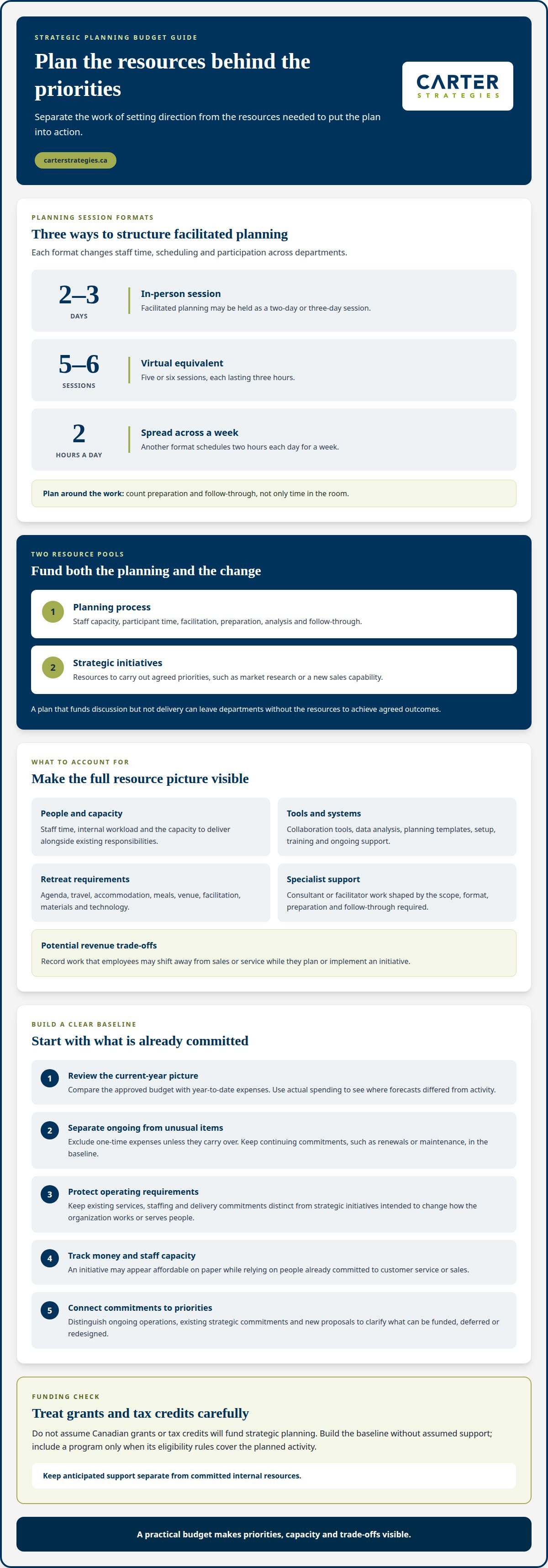
Separate the planning process from the initiatives it produces. For example, a company may need to allocate staff time, then separately plan for market research or a new sales capability. This distinction helps decision-makers see what supports planning and what enables action.
Consultant and facilitator support
Consultant and facilitator support is one part of the overall planning process, and the work varies with the scope and format. Build the plan around the work required rather than an assumed daily fee. This distinction matters when comparing an intensive workshop with support that includes preparation, analysis and follow-through.
Facilitated planning may use two-day or three-day sessions. The virtual equivalent may use five or six 3-hour sessions, while another format schedules two hours each day for a week. Each format affects staff time, scheduling and participation across departments. Count preparation and post-session work as well as time in the room.
Retreats, tools and funding considerations
A one-day or multi-day retreat requires resources for the agenda, participant travel, accommodation, meals, venue, facilitation and any materials or technology. A local one-day meeting and a multi-day gathering involving staff from several locations require different resources. List each item separately so the retreat does not obscure the initiatives that follow.
Strategic planning software and tools also require resources. The work depends on whether the organization needs basic collaboration tools, data analysis, planning templates or systems that connect priorities to departmental action plans. Include setup, training and ongoing support when needed. Existing tools may cover some requirements, but staff time to configure and maintain them still belongs in the plan.
Do not treat Canadian grants or tax credits as automatic funding for strategic planning. Build the baseline without assumed support, then include a program only when its eligibility rules cover the planned activity. Keep anticipated support separate from committed internal resources.
Finally, record tools, specialist services and potential lost revenue for each initiative. Lost revenue can arise when employees shift time from sales or service work to planning or implementation. A clear line-item view helps leaders weigh trade-offs and set practical priorities before approving action.
Establishing a budget baseline
A budget baseline is the starting financial picture for assessing what an organization can fund. Establish it before adding new initiatives, so leadership can distinguish existing commitments from resources available for development and change.
Begin with the current year’s approved budget and year-to-date expenses. Use actual spending, not just planned amounts, to see where forecasts differed from activity. If a budgeted project did not proceed, separate its allocation from recurring costs. If an expense was higher than expected, determine whether the cause will continue into the next year.
Next, exclude unusual expenses unless they will carry over. A one-time system replacement, for example, may not belong in the next baseline if the purchase is complete. A contract renewal or ongoing maintenance commitment does belong if it continues. This distinction prevents an exceptional past expense from distorting the resources available for future priorities.
Keep operating requirements separate from strategic change. In municipal budgets, ongoing work such as keeping pools open, removing snow and mowing parks needs continued funding. Those services differ from strategic initiatives intended to change how an organization operates or serves residents. Separating ongoing services from strategic initiatives helps decision-makers see which funding is committed before they consider new priorities.
The same principle applies in companies, even when expenses differ by sector. A business may need to preserve funding for existing service, staffing and delivery commitments before allocating resources to growth initiatives. Separating these categories helps management see whether an initiative requires new funding, a change to existing allocations or a realistic adjustment to timing.
A useful baseline shows both money and capacity. An initiative may look affordable in a spreadsheet but depend on staff already committed to customer service or sales. Record the internal time required alongside direct expenses. This makes trade-offs visible and helps departments assess whether the work can proceed without disrupting existing responsibilities.
Finally, connect the baseline to the organization’s strategic priorities. Identify which current expenses support ongoing operations and which support existing strategic commitments. Then distinguish those commitments from new proposals. This gives leadership a clear starting point for deciding what can be funded, deferred or redesigned, while helping employees understand how decisions affect their work and culture.
For organizations aligning available resources with growth priorities, strategic business planning can connect financial choices with direction and action.
One budgeting approach is to start with the current year’s budget and year-to-date expenses, then exclude unusual expenses unless they will carry over. This sequence provides a consistent starting point for evaluating proposed priorities. It keeps the baseline focused on the budget picture and distinguishes exceptional costs from those expected to continue. With that distinction clear, decision-makers can assess new proposals against the resources already represented in the baseline, rather than assuming every past expense will recur or overlooking continuing costs.
Identifying initiatives and projecting finances
Initiative planning connects each priority to the people, resources and timing needed to put it into action. The scope of the work, required skills, capital needs and expected effect on revenue all shape its financial requirements. To determine how much to budget for strategic planning, leaders need to understand what each initiative asks of the organization and what it can deliver.
Define each initiative before estimating its cost. For example, improving customer retention could involve customer research, revised service processes or new account-management capabilities. Each option calls for different skills, tools and timelines. Document the intended outcome, accountable owner, main activities and assumptions, so estimates reflect the work itself rather than a broad goal.
Project each initiative’s financial effects across the annual planning period. Separate one-time expenses from continuing requirements, such as software support or additional staffing. Note when resources will be needed and when the initiative may affect revenue. A delayed launch, for example, may require staff and preparation well before new sales begin.
Use historical results and current trends to inform projections, then account for relevant risks and opportunities. Review supplier agreements, planned changes and each department’s resource needs. A technology project may require specialist skills the organization hasn’t needed before. Reflect that difference in the forecast rather than hiding it in a broad operating assumption.
Consider effects that don’t appear as direct expenses. A new service could shift employees’ attention from existing customers, reducing the time available for other work. Changes to product quality or service delivery may affect customer satisfaction and reputation. An initiative can also affect company culture if it changes responsibilities or places sustained demands on particular teams. Record these effects alongside the financial estimates.
Assess proposals individually and as a portfolio. Separate estimates may seem manageable, but several initiatives could rely on the same specialists, creating delays or capacity gaps. A combined view can reveal shared resources, dependencies and duplicated work. Deciding how much to budget for strategic planning also means weighing competing demands against the organization’s ability to deliver.
For capital-constrained projects, compare financial prospects with strategic impact. Net present value and internal rate of return can help assess financial returns, while strategic impact shows how a project supports organizational priorities. No single measure captures every benefit. A project that strengthens core capabilities may still advance the plan when its immediate financial return is limited.
Document the assumptions, expected revenue, expenses, risks and evidence behind each estimate. As actual results and new information emerge, revise projections and action plans. This keeps annual planning connected to implementation and gives leadership a clear basis for deciding which initiatives can proceed.
Scenario analysis and spending limits
Scenario analysis tests how strategic priorities hold up when business conditions change. For Canadian companies facing uncertain revenue, it helps leaders decide what to fund, pause or adjust while protecting cash and accountability.
Build three forecasts: a base case, a best case and a worst case. The base case reflects current expectations; the other scenarios test stronger or weaker conditions. For example, a company planning a market expansion can model slower customer uptake, expected demand and stronger-than-expected demand. Each version should show how revenue, expenses and available resources change.
Link every scenario to a decision, not just a revised forecast. In a weaker case, leaders might delay a launch, reduce its scope or protect funding for essential operations. In a stronger case, they could invest in added capacity or accelerate an initiative. Set out these possible responses in advance, so teams know what changes when assumptions shift.
Base cash planning on the worst-case scenario, while stretch goals can reflect the best case. This separates commitments the organization can sustain from opportunities that depend on favourable conditions. For instance, a company could protect the resources needed to serve existing customers, then make expansion spending conditional on demand. This approach balances growth objectives with risk management.
Set spending limits at both the initiative and organization levels. An initiative limit can define the approved amount, the people responsible and the conditions that require leadership review. An overall limit helps prevent individually reasonable proposals from exceeding available resources when combined. Assign a decision owner for each limit, then document who can approve changes.
- Approval point: identify the spending level or changed assumption that requires review.
- Accountability: assign an owner to track commitments and report variances.
- Response: define whether the team will pause, rescope or continue the work.
Forecasting tools, including AI-driven systems, can compare scenarios and stress-test assumptions about demand, pricing or supply conditions. They support analysis, but leadership still needs to decide which assumptions are credible and which priorities matter most. For example, a forecast can show the effect of reduced demand; managers decide whether to defer a project or protect its strategic role.
Review the forecast against actual results as conditions evolve. If customer demand, supplier capacity or expected revenue changes, update the relevant scenario and spending authority. A fixed annual budget may no longer reflect operating conditions, so clear review points help leaders act without abandoning agreed priorities. Record changes and reasons, keeping teams aligned on what remains funded and what must wait.
Scenario analysis works best when leaders and affected employees understand the assumptions behind each choice. That shared view makes spending limits practical: teams can see how resources connect to objectives and the decisions needed to sustain progress.
Strategic budgeting methods
Strategic budgeting connects a strategic plan to the resources and decisions needed to carry it out. The budgeting process should establish which priorities receive funding, who owns the work and how leaders will respond when results differ from expectations.
In-house planning and consultant-supported planning involve different contributions. In-house work uses employee time, leadership attention and internal capacity that could support other responsibilities. A consultant brings additional expertise, while internal leaders and employees still contribute context, decisions and implementation knowledge. Compare the full scope of work, including the time and involvement required from your team.
A participative approach brings managers from multiple organizational levels into budgeting. Their input can strengthen engagement and ownership because teams help shape the assumptions behind proposed initiatives. It also calls for clear expectations: bottom-up estimates may overstate revenue or inflate resource requests. Leaders can address this by asking each department to explain its assumptions and connect requests to strategic objectives.
Top-down budgeting can align spending with corporate direction, but a process developed in isolation may limit initiative or feel imposed on frontline managers. A balanced approach sets organization-wide priorities, then invites employees and managers to identify practical requirements and risks. For example, a sales team may identify customer needs that affect the resources required for a planned market expansion.
To keep planning focused without sacrificing quality, concentrate on decisions the organization must make. Reuse reliable internal data, limit duplicate analysis and involve the people responsible for implementation early. Avoid cutting work that clarifies ownership, assumptions or trade-offs. A shorter planning exercise that skips these elements can leave departments with priorities they cannot act on.
A master budget coordinates production, marketing, human resources and finance. This shared view helps leaders identify conflicts before approving separate departmental requests. If a strategic initiative depends on both marketing resources and added staff capacity, the master budget can show whether those needs fit together or compete with existing commitments.
Budgeting should continue after approval. Organizations can update rolling forecasts monthly or quarterly, compare actual results with planned figures and adjust action plans as conditions change. Reviewing results monthly or weekly helps managers spot variances and take corrective action. A formal revised budget each quarter can also be compared with the original forecast and current results.
Strategic planning and budgeting work as an iterative cycle: results inform future priorities, forecasts and resource decisions. Linking the plan to regular financial reviews gives leaders a practical basis for adjusting expectations without losing accountability. Align strategic priorities with business planning when your team needs a clearer connection between direction, resources and action.
Carter Strategies: Growth Strategies and Planning
Carter Strategies helps leadership teams connect growth priorities with clear strategic choices and action plans. Its Growth Strategies and Planning and Business Strategy Development services can help leaders align their teams, assess competing priorities and turn planning decisions into work the organization can pursue.
This support is useful when a budgeting exercise surfaces unresolved questions about direction, ownership or the resources needed to move forward. Carter Strategies’ inclusive, employee-involved planning approach brings practical insight into decisions and helps build shared accountability for the priorities that emerge.
If your organization is ready to align its growth priorities and planning, contact Carter Strategies.
Make your next planning decision count
Deciding how much to budget for strategic planning is part of a larger leadership choice: which capabilities should your organisation build next, and what will it stop doing to make room? Treat the budget as an active decision tool, not just an annual approval. As market conditions and team capacity shift, revisit whether resources still support the direction leaders and employees have agreed to pursue.
When that direction needs sharper definition, Carter Strategies’ Business Strategy Development and Marketing Strategy services can connect organisational priorities with growth choices. Dedicated executive advisory and revenue leadership services add senior oversight to support those decisions. The next step is a clear conversation about your priorities, the decisions ahead and the support that would help your team move forward.
Discuss your budget with Carter Strategies and take the next step towards a plan your team can own.
Frequently Asked Questions
What resources should small businesses account for in strategic planning?
Small businesses should identify the decisions they need to make and the capacity available to act on them. A plan focused on clarifying market priorities differs from one involving new offerings or major organizational change. For example, a small firm can scope planning around a specific growth decision, then account for the staff time and follow-up analysis needed to make that decision actionable.
What resources should nonprofits account for in strategic planning in Canada?
Canadian nonprofits should base their planning resources on the scope, available funding and the capacity needed to carry out their mission priorities. A nonprofit considering a new community program, for example, may need to account for staff participation, board input and the work required to assess service demand. Keep planning resources distinct from program delivery funds, so decision-makers can see what each allocation supports.
What should a strategic planning budget account for besides consultant fees?
Include internal staff time, research, meeting logistics, digital tools and the work required to communicate decisions after planning. For example, gathering input from customers or program participants may require dedicated staff hours and organized data collection. Also account for the time employees spend away from routine responsibilities. These items reveal the full organizational commitment, not just external services or direct expenses.


