


What if the best opportunity for revenue growth isn’t the one with the biggest forecast, but the one your company can deliver well? A mid-size company revenue strategy connects customer needs with your value proposition and core capabilities. Without that connection, promising ideas can compete for attention and resources, leaving teams without a clear way to choose.
That tension is familiar to leaders. Customer and industry insights shift, growth plans need to adapt, and marketing, sales, and operations may interpret priorities differently. The answer isn’t to pursue every opportunity or leave strategy to the management team alone. It’s to make informed choices together and give people a practical role in turning them into action.
This article offers a framework for assessing revenue opportunities against customer fit, business strengths, and the capacity to execute. You’ll learn how to align leaders and employees around a manageable set of priorities, translate those choices into action plans and measures, and recognize when strategic leadership, including fractional CMO or CRO support, could help. The aim is an executable business strategy grounded in what your company can deliver.
Key Takeaways
- A mid-size company revenue strategy should guide connected choices about how the business creates and grows revenue, not simply set a target.
- Use customer and industry insights, your value proposition, and core capabilities to assess which growth opportunities fit.
- Compare growth options against customer evidence, execution needs, and clear ownership before committing resources.
- Involve employees in shaping priorities so their ideas inform the strategy and teams understand how to act on it.
- Consider strategic advisory or fractional CMO/CRO leadership when competing priorities or gaps in internal expertise make it harder to move forward.
Why Mid-Size Company Revenue Strategy Needs More Than a Growth Target
A growth target says what the company hopes to achieve. It doesn’t explain which customers to serve, why they’ll choose the business, or how teams will deliver the value that earns revenue. A mid-size company revenue strategy connects those choices, giving leaders a shared basis for deciding where to focus and what the organization can execute.
A revenue strategy is the connected set of choices that guides how a company creates, earns, and grows revenue by serving selected customers with an offer it can deliver. It is not a target on its own, a sales plan, or a list of marketing activities. Those tools can support the strategy, but they don’t replace the decisions that give them direction. A revenue model, for example, describes how a business earns revenue. Strategy also considers which customers and opportunities make sense for the company.
How to recognize a revenue strategy problem
Look for activity that lacks a shared rationale. Sales may be pursuing a new customer group, marketing may be emphasizing a different offer, and another team may be proposing a new channel. Each idea may have a reasonable case, but without agreed criteria, teams have no clear way to compare them. When every initiative appears urgent, employees can end up dividing their attention across priorities that compete for the same time and capabilities.
Inconsistent assumptions about customers can create the same friction. One group may believe buyers choose the company for specialized expertise, while another assumes price or convenience drives the decision. Those beliefs lead to different choices about positioning, sales conversations, and where to focus effort. This isn’t necessarily a problem with employee commitment. It’s a strategic alignment challenge: teams need shared evidence and clear priorities to make consistent decisions.
What a revenue strategy should connect
Start with customer and industry insights. Consider what customers value, which needs remain unmet, how buying preferences are changing, and what is shifting in the broader market. Bring together evidence from customer conversations, sales experience, and internal teams rather than relying on one person’s assumptions. Use that information to make choices, not just to build a collection of research.
Then test the company’s value proposition against its core capabilities and chosen markets. Can the business deliver the promised value consistently? Do its people, expertise, and operating strengths support the opportunity? If a growth idea depends on capabilities the company hasn’t built, leaders need to decide whether developing them is a priority or whether another opportunity is a stronger fit.
These connections give the management team and employees a practical basis for weighing options. A clear mid-size company revenue strategy helps people understand not only what the business is pursuing, but why that choice fits its customers and what the company can deliver. That shared direction makes later decisions about go-to-market priorities and action plans more coherent.
What a Mid-Size Company Revenue Strategy Connects
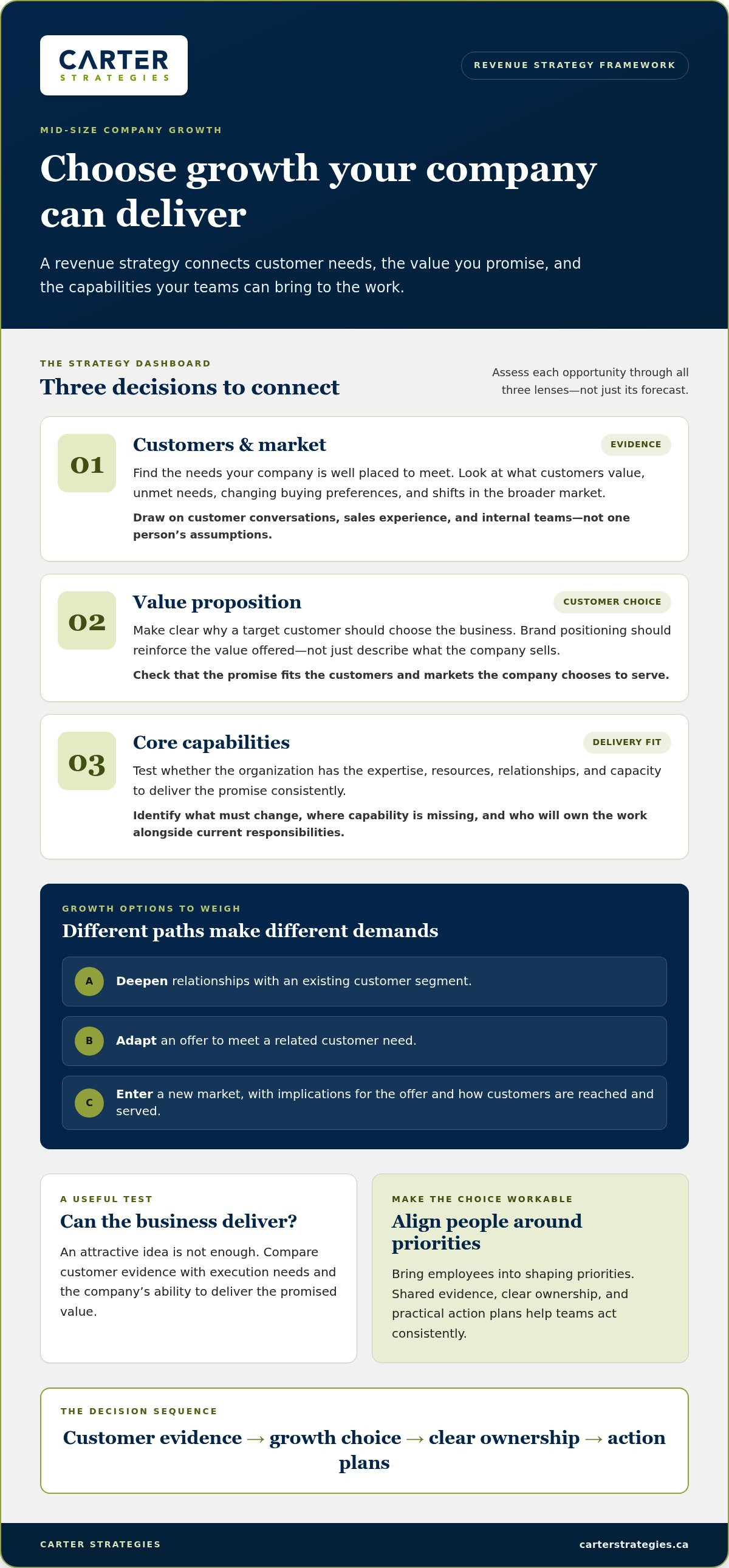
A revenue opportunity only makes sense in relation to the customers it serves, the value the company offers, and the work required to deliver that value. A mid-size company revenue strategy links these factors so leaders can assess not just whether an opportunity looks attractive, but whether the business can pursue it with focus and credibility.
Start with customers, the market, and the value proposition
Customer and industry insights help clarify which customer segments have needs the company is well placed to meet. Look beyond broad descriptions of buyers: consider what problems they need solved, what they value in a provider, and how their needs differ across segments. Compare those insights with the company’s strengths and the alternatives customers can choose.
Brand positioning makes the value proposition clear in the market. It should express why a target customer should choose the business, not simply describe what the company sells. If a firm’s advantage is deep knowledge of a particular type of client, for example, its positioning and go-to-market choices should reinforce that advantage rather than compete on a different promise. The National Center for the Middle Market’s resource on strategic planning for middle market companies also treats planning as part of how companies define and pursue growth.
These choices influence which revenue streams deserve attention. A company might deepen relationships with an existing segment, adapt an offer to meet a related need, or enter a new market. Each option has different implications for the offer, brand positioning, and how the company reaches and serves customers. Go-to-market strategy connects those decisions, while marketing and sales priorities put them into practice. Strategy sets direction; it doesn’t prescribe every campaign or sales activity.
Match growth choices to core capabilities
Next, examine whether the organization has the expertise, resources, relationships, and capacity to deliver the promise. Existing strengths can point to adjacent opportunities: a firm trusted for one service may be able to address a related customer need. But interest in an opportunity isn’t enough. Consider what teams would need to change, where added capability is required, and who would own the work alongside current responsibilities.
Marketing, sales, and other functions need a shared view of the customer, the offer, and the growth priority. Connected planning can prevent one team from promoting an offer the business isn’t prepared to deliver, or sales from pursuing customers the company hasn’t chosen to serve. For more on bringing these functions into alignment, see Marketing and Revenue Alignment: A Guide for Mid-Market Company Leaders.
Customer value identifies the opportunity, core capabilities shape what the company can deliver, and shared priorities turn that fit into a path to revenue. Apply that test before committing people and attention to a new direction. Strategic business planning can help leaders connect these choices with practical action. Strategic business planning support provides an outside perspective as the company sets its direction.
How to Compare Revenue Growth Opportunities for Strategic Fit
A promising idea can still be the wrong priority if it rests on weak customer evidence, stretches the company’s capabilities, or has no clear owner. Compare options against the same criteria before committing attention. This gives the management team a practical way to discuss trade-offs without assuming every company should follow the same growth path.
Compare options against consistent decision criteria
List the opportunities under consideration, then review the evidence, fit, and work each one requires. A simple rating such as “strong,” “unclear,” or “weak” can prompt discussion, but the reasons behind each rating matter more than the score.
| Growth option | Customer evidence | Strategic fit | Execution ownership |
|---|---|---|---|
| Grow with existing customers | What customer feedback, renewal patterns, or unmet needs support the opportunity? | Does the offer build on the value the company already delivers? | Which teams would deepen relationships or shape the offer? |
| Enter an adjacent market | What direct evidence shows that this customer group has a relevant need? | Does the company’s value proposition translate to this market? | Who would validate the opportunity and lead the go-to-market decisions? |
| Change an offer or channel | What customer input suggests the current offer or route to market needs to change? | Would the change strengthen the company’s positioning or confuse it? | Which teams must adapt the offer, sales approach, or customer experience? |
For each option, record where the customer and industry insights came from and what remains an assumption. Then test whether the business can deliver the promised value with its current core capabilities. Identify the functions involved, the decisions they need to make, and who will take responsibility. If the evidence is incomplete, define what the team needs to learn before moving forward rather than treating an attractive forecast as proof.
Know when diversification is, and isn’t, a fit
Strengthening an existing revenue stream may be the better choice when customers have related needs the company can already serve. An adjacent opportunity may make sense when it addresses a distinct, supported need and fits the company’s brand positioning. A new channel or offer isn’t automatically strategic; it must connect to customer value and the organization’s ability to deliver.
For example, a B2B professional services firm might weigh expanding a service for current clients against adapting its expertise for a neighbouring customer segment. The second option deserves further consideration only if customer evidence supports the need, the value proposition remains clear, and a team can own the work. For commercial firms evaluating adjacent public sector opportunities, strategic guidance from govconarchitect.com can help assess requirements and execution readiness. Broader Growth Strategy and Planning for mid-size businesses can help put these choices in context.
The comparison is a decision aid, not a formula. A sound mid-size company revenue strategy may favour deepening current relationships, pursuing an adjacent market, or changing an offer. The right choice depends on evidence, fit, and ownership, not on a universal growth playbook.
How to Turn Revenue Strategy Choices into Shared Priorities
A strategy gains traction when people understand the choices behind it and know how their work contributes. Turning a revenue decision into a shared priority doesn’t require every employee to make the strategic call. It does require leaders to hear relevant perspectives, explain their reasoning, and assign clear ownership for what happens next.
Use this sequence to move from evidence to aligned priorities:
- Review the evidence. Bring together customer and industry insights, sales experience, and relevant operational information. State what the evidence supports and where assumptions remain.
- Involve relevant employees. Invite perspectives from people who speak with customers, deliver the offer, or understand the processes affected by the decision.
- Choose priorities. The management team weighs the evidence, fit, and capacity, then identifies a manageable set of strategic choices.
- Assign ownership. Name a leader responsible for advancing each priority and involve the teams whose work will contribute.
- Review progress. Agree on measures and a regular opportunity to discuss what’s advancing, what’s blocked, and what the team is learning.
Involve the people closest to customers and delivery
Employees often hear customer questions, see where an offer creates value, and notice operational constraints before those details reach senior leaders. Structured discussions can bring these observations into the decision process. Ask what customers are requesting, where the current approach works, and what would need to change to deliver a new promise. The management team remains accountable for strategic decisions, but it can test assumptions with people who know the work firsthand.
That involvement is practical, not symbolic. Employees can surface opportunities leaders hadn’t considered and identify barriers early. Sharing the reasoning behind a decision also helps teams understand why some initiatives take priority and others wait. An executable business strategy needs both clear leadership and employee understanding.
Make priorities actionable and reviewable
For each priority, define the intended outcome, an owner, the next decisions to make, and the measures that will help the team assess progress. Measures might track customer response, engagement with an offer, progress through a sales process, or whether a key capability is in place. Select indicators that relate to the strategic choice, not simply data that’s easy to collect. Set targets only when the company has a sound basis for them.
This framework establishes direction and accountability; it isn’t a detailed strategic roadmap or an execution checklist. Teams can develop the specific action plans after leaders agree on priorities and ownership. For related guidance on moving from direction to delivery, see Bridging the Gap Between Vision and Execution.
A mid-size company revenue strategy becomes more actionable when leaders and employees can connect a priority to its purpose, owner, and measures. Carter Strategies’ strategic business planning supports planning that aligns teams around strategic priorities.
When Strategic Support Can Help a Mid-Size Company Move Forward
Outside strategic support can help when leaders see opportunities but lack a shared way to assess them, when priorities keep shifting, or when teams aren’t working from the same understanding of customers and the company’s direction. It can also help when the organization needs strategic expertise but doesn’t require a full-time executive role. These signals point to a need for clearer decisions and leadership, not a lack of effort from employees.
Strategic advisory helps leaders set direction, decide which priorities deserve attention, and clarify who will lead them. The company’s teams then carry those decisions into their work. Keeping these roles clear helps prevent disconnected initiatives and ensures people understand the purpose behind the priorities.
What a collaborative strategic advisor contributes
An advisor can bring an outside perspective to competing ideas, help the management team test its assumptions, and guide a process for aligning around priorities. Involving employees who understand customers and the company’s work adds insight to the discussion and helps make the resulting direction more meaningful to those responsible for it.
At Carter Strategies, employees contribute ideas and help build alignment and ownership of strategic priorities. Leslie Carter brings more than 25 years of experience in business strategy and brand management. Her role is to support the company’s strategic thinking, while its people remain central to carrying decisions forward.
Choose a support model that fits the strategic need
Project-based support can suit a defined strategic need, such as clarifying growth priorities or shaping a go-to-market strategy. A retainer arrangement can provide ongoing advisory support as leaders work through strategic decisions and maintain alignment. In either case, the scope should reflect the business need and identify the decisions the work will support.
Fractional CMO and CRO Services provide part-time marketing or revenue leadership rather than a full-time executive position. This can fit a company that needs senior-level guidance to connect marketing or revenue priorities with its broader direction. Carter Strategies’ Strategic Business Planning and Fractional CMO/CRO Services help companies clarify priorities and align teams around them.
If competing priorities or a gap in strategic leadership is holding back your mid-size company revenue strategy, bring the challenge to Carter Strategies. Explore strategic planning support on a project or retainer basis.
Set Your Next Growth Decision in Motion
Choose one open question that could shape your next growth decision. Write down what the leadership team needs to learn, who can help answer it, and when you’ll return to the discussion. A clear question gives the next conversation a purpose and helps the team move from broad possibilities to a decision it can examine.
Use that discussion to identify what remains uncertain and what the company can test before making a larger commitment. The aim isn’t to force agreement immediately. It’s to make the next decision easier to discuss, assign, and revisit as new information emerges. That gives your mid-size company revenue strategy a practical next step without adding another undefined initiative.
Bring the question to your next leadership meeting and leave with one agreed action, one owner, and a date to review what the team learns. Small, deliberate decisions can help your company move forward with confidence.
Frequently Asked Questions
Is revenue strategy different from sales strategy?
Yes. Sales strategy guides how a sales team finds, qualifies, and advances opportunities, while revenue strategy also considers the broader choices shaping how the company earns revenue. For example, sales leaders may refine how they prioritize prospects, while company leaders decide which offers and customer relationships the business will support. The distinction helps teams avoid expecting a sales process alone to resolve a wider business decision.
Can a mid-size company grow revenue without entering a new market?
Yes. A company can improve results within its current market by examining how existing customers use its offers and where relationships lapse. For example, leaders might compare renewal patterns across customer groups or look for points where customers stop using a service. That can reveal ways to improve the experience or retain business without assuming expansion into a new market is necessary.
What information should leaders review before changing a revenue strategy?
Alongside customer and market information, review how revenue is distributed across offers and customer groups, whether a small number of accounts account for a large share, and how upcoming renewals may affect the outlook. Compare forecasts with actual results and check whether teams use consistent definitions in their records. This can expose blind spots in the numbers before leaders change direction.
How often should a mid-size company revisit its revenue strategy?
Revisit it in step with the company’s strategic planning and decision cycles, then take a closer look when a meaningful change challenges a key assumption. A brief check-in can determine whether the original rationale still holds; a full strategy review is warranted when the customer base, offer, or business direction has materially changed. The goal is timely attention, not constant revision.
Can employee involvement improve ownership of revenue priorities?
It can, especially when leaders create a clear way for employees to raise concerns before decisions are finalized. Ask teams to identify what could make a priority difficult to carry out, and invite them to suggest how those risks could be addressed. This helps leaders spot practical issues early. After deciding, explain which feedback shaped the choice and what will happen next.
When should a mid-size company consider fractional revenue leadership?
Consider fractional revenue leadership when decisions about marketing and revenue need consistent senior-level direction, but the organization doesn’t need a full-time executive in that role. For example, a company changing its go-to-market direction may need a leader to guide choices across functions and keep them connected to business goals. Fractional leadership provides executive-level guidance while the company’s teams remain responsible for their work.


