


A slowdown doesn’t automatically mean one team has failed. It may signal that parts of the business aren’t working together. When growth eases, leaders may suspect softer demand, an offer that no longer stands out, or internal priorities and capabilities that are getting in the way. The causes of stagnant business growth aren’t always visible in a single report. Adding activity before finding the constraint can leave teams busy without moving the business forward.
A slower period doesn’t automatically mean your business has a deeper problem. First, distinguish a temporary fluctuation from a persistent pattern. Then compare what customers and employees are reporting with business performance. This shared evidence can help your team determine whether the constraint is market-facing, internal, or both.
This article explains what to investigate, whose perspectives to include, and how to agree on focused priorities your team can act on. The goal isn’t to assign blame. It’s to connect leadership direction with employee understanding and build a practical path forward together.
Key Takeaways
- Define growth using the measures your company has chosen. Distinguish a lasting plateau from a temporary fluctuation or decline.
- Investigate the causes of stagnant business growth across market conditions, strategic choices, and internal capacity before settling on an explanation.
- Compare possible causes with observable signals, evidence sources, and the teams affected. Note what the evidence does and doesn’t show.
- Build a practical response by gathering evidence, testing hypotheses, choosing focused priorities, and reviewing progress with your team.
- Include employee perspectives in strategic planning to connect leadership direction with shared priorities and action plans.
What does stagnant business growth look like, and when should leaders pay attention?
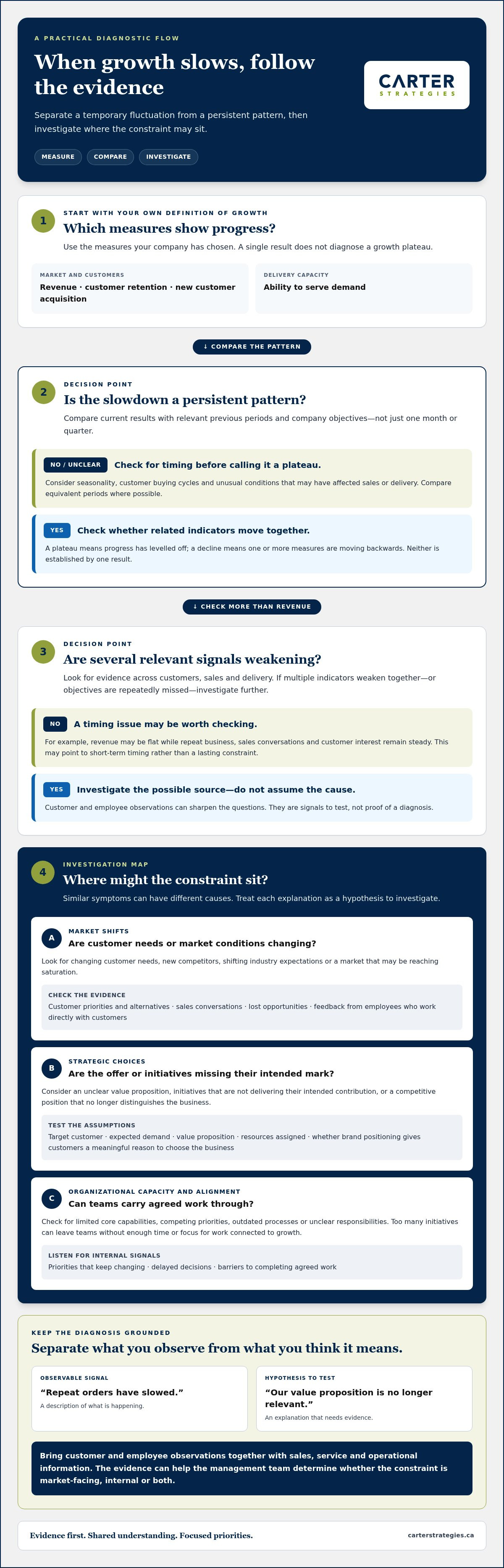
Stagnant business growth is a sustained lack of meaningful progress against the growth measures a company has chosen. Measures may include revenue, customer retention, new customer acquisition, or the ability to serve demand. A plateau means progress has levelled off; a decline means one or more measures are moving backwards. Neither can be diagnosed from a single result.
Revenue is useful, but it doesn’t tell the whole story. Sales may hold steady while repeat business weakens, fewer qualified prospects enter the pipeline, or delivery constraints limit how much work the company can take on. Reviewing several indicators helps leaders see whether the business is maintaining its position, losing momentum, or facing a constraint that needs investigation. It also reduces the risk of mistaking a visible symptom for one of the causes of stagnant business growth.
The term Economic Stagnation usually describes a wider economic condition. A company’s growth plateau is narrower: it concerns the company’s progress against its own objectives. Market conditions may influence performance, but they don’t explain it on their own.
How can leaders tell a growth plateau from a temporary slowdown?
Start with the company’s history and stated objectives. Compare current results with relevant previous periods, rather than relying on a single month or quarter. A seasonal business, for example, should compare equivalent periods where possible. Consider timing, changes in customer buying cycles, and unusual conditions that may have affected sales or delivery.
Next, check whether the pattern appears across related indicators. If revenue is flat but repeat business, sales conversations, and customer interest remain steady, the evidence may point to a short-term timing issue rather than a lasting constraint. If several indicators weaken together, or the company repeatedly misses its objectives, investigate further. There’s no universal threshold: the right interpretation depends on the company’s measures, history, and goals.
Which early signals deserve a closer look?
Signals can appear before they show up clearly in overall revenue. Review what customers are doing and saying. Are buying decisions taking longer? Are customers returning less often? Do sales conversations reveal new objections, changing needs, or stronger competition? Check the market’s response to current offerings, too. These observations can help leaders frame questions, but they don’t prove a cause by themselves.
Look inside the business as well. Employees may report that priorities keep changing, decisions are delayed, or teams face barriers to completing agreed work. Ask people closest to customers and delivery what they observe, then compare their accounts with available sales, service, and operational information. Keep facts separate from explanations: “repeat orders have slowed” is an observable signal; “our value proposition is no longer relevant” is a hypothesis to test.
Pay attention when a pattern persists against the company’s objectives, appears in more than one relevant measure, or is echoed by customer and employee observations. These signals don’t settle the diagnosis. They give the management team a clearer starting point for investigating what’s holding growth back.
What causes stagnant business growth across markets, strategy, and operations?
The causes of stagnant business growth can sit outside the company, in its strategic choices, or in its ability to carry those choices through. A flat sales result alone can’t tell leaders whether customers are buying less, an initiative is missing its mark, or internal complexity is slowing delivery. Similar symptoms can have different causes. Treat each explanation as a hypothesis to investigate, not a conclusion to act on.
Start by sorting possibilities into three areas:
- Market shifts: Changing customer needs, new competitors, shifting industry expectations, or a market that may be reaching saturation.
- Strategic choices: An unclear value proposition, initiatives that aren’t delivering their intended contribution, or a competitive position that no longer distinguishes the business.
- Organizational capacity and alignment: Limited core capabilities, competing priorities, outdated processes, or unclear responsibilities that make it harder to deliver agreed work.
How can market shifts or a weaker value proposition limit growth?
Customers may change what they need, how they assess options, or what they expect from providers. A competitor may offer a more relevant solution, or the market may have fewer new customers to reach than before. These conditions can limit demand even when the company’s internal work is sound. But don’t assume a market shift is the cause simply because sales have slowed.
Test the explanation with customer and industry insights. Review what customers say about their priorities and alternatives. Look for patterns in sales conversations, lost opportunities, and feedback from employees who work directly with customers. Ask whether the company’s brand positioning still gives customers a meaningful reason to choose it. For leadership teams navigating unclear market differentiation, bringing in senior communications guidance from NarrativeOne can help clarify the overarching narrative and public profile. A weaker response to an offer could point to changing needs, unclear differentiation, or an issue elsewhere in the customer experience. The evidence helps distinguish among these possibilities.
How can strategic choices and internal complexity constrain progress?
A company can spread attention across too many initiatives, leaving teams without enough time or focus to advance the work most connected to growth. Compare current initiatives with the company’s objectives and core capabilities. If an initiative isn’t delivering its intended results, review the assumptions behind it: the target customer, expected demand, value proposition, and resources assigned. Underperformance is a reason to examine those assumptions, not automatic proof that employees have executed poorly.
Internal complexity can create a different constraint. Repeated approvals, outdated processes, or unclear ownership may slow decisions and make it harder to respond to customers. In technical operations, drag often stems from overburdened systems, where external support from firms such as Trinity Networx, LLC can help eliminate infrastructure bottlenecks. Ask the people doing the work where handoffs stall, which decisions are delayed, and whether priorities conflict. Their observations can help determine whether the problem is capacity, process, or alignment, rather than a lack of effort.
These categories can overlap. A market shift may expose an outdated strategy, while competing initiatives make it harder to adapt. Inclusive strategic planning brings customer evidence and employee perspectives into the same discussion, helping leaders test explanations before setting priorities.
How can leaders compare possible causes before choosing a response?
Once you have a few plausible explanations, compare them with evidence instead of choosing the one that best fits a senior leader’s first impression. The causes of stagnant business growth can produce similar symptoms. A useful diagnosis should explain what the company sees and identify evidence that could support or weaken each hypothesis.
Build a working comparison table with the management team and employees close to customers and delivery. Record observable signals separately from interpretations. For example, “fewer qualified prospects are progressing” is an observation; “the market has moved on” is an explanation to test.
| Hypothesis | Observable signals | Evidence to review | Teams to involve |
|---|---|---|---|
| Customer needs or market expectations have shifted | New objections, changed buying criteria, or reduced response to an offer | Customer and industry insights, sales conversations, lost-opportunity feedback | Sales, marketing, customer-facing employees |
| The value proposition or strategic focus is unclear | Customers struggle to explain the difference or teams describe priorities differently | Customer feedback, current strategy, brand and sales materials | Management team, marketing, sales |
| Internal capacity or coordination is limiting progress | Agreed work is delayed, ownership is unclear, or hand-offs repeatedly stall | Action plans, decision records, employee observations, delivery information | Teams responsible for decisions and delivery |
Use the table as a starting point, not a scoring exercise. Note which details come from customers or business records, which are internal interpretations, and what information is missing. A gap in the evidence doesn’t confirm or disprove a hypothesis. It shows what to learn next.
What evidence helps test a market-related explanation?
Compare customer and industry insights with what sales and customer-facing employees hear directly. Look at how customers describe their needs, the alternatives they consider, and the reasons they choose or reject an offer. Then compare those descriptions with the company’s value proposition. A market explanation is more credible when it fits several observations, not just one weak sales result. If accounts differ, identify which customer groups or situations differ before drawing a broad conclusion.
What evidence points to a strategic or organizational constraint?
Ask employees how priorities translate into decisions, responsibilities, and action plans. Look for repeated hand-offs, unclear ownership, or conflicts that keep agreed work from moving. Compare these accounts with the management team’s assumptions about how work gets done. If leaders believe a priority is clear but employees interpret it differently, that gap is evidence to examine. It may indicate a need to clarify direction or responsibilities, rather than add another initiative.
Before choosing a response, ask whether a hypothesis connects the relevant evidence, fits the company’s objectives, and reflects the realities employees face. Keep competing explanations visible until you address gaps in the information. This comparison helps leaders choose a focused next step instead of treating a correlation, a single measure, or one person’s opinion as proof of cause.
What should a business do first when growth stops moving?
Resist launching another initiative before the team understands what’s holding progress back. A useful response moves from a clear description of the slowdown to evidence, tested explanations, focused priorities, and review. This sequence helps the management team act on the constraint rather than the loudest opinion or most visible symptom.
Use these steps to guide the work:
- Define the slowdown. State which company objectives or growth measures aren’t progressing, and describe the period or pattern the team is examining.
- Gather evidence. Bring together relevant performance information, customer feedback, and observations from employees who work with customers or deliver the work.
- Test possible causes. Compare explanations with the evidence. Record what supports each one, what contradicts it, and what remains unknown.
- Select focused priorities. Choose a small set of actions that address the best-supported constraint and fit the company’s direction and capacity.
- Review progress. Agree on indicators and review points, then use what the team learns to adjust its explanation or action plans.
Before the management team settles on a cause, invite relevant employees to share what they’re seeing. Sales, customer-facing, and delivery teams may notice different parts of the same problem. Their input can reveal which assumptions need testing and what practical barriers could affect the response.
How can teams turn a diagnosis into focused priorities?
Make the reasoning visible. State the evidence, the working explanation, and the assumption that still needs testing. Then ask employees in affected parts of the organization what the explanation means for their work. Which decisions, hand-offs, or capabilities need attention? What might prevent the proposed action from moving forward? This discussion connects leadership direction with day-to-day understanding before action plans are finalized.
Choose actions that address the diagnosed constraint. If customer feedback suggests the offer no longer matches a key need, examine the value proposition rather than simply increasing activity. If employees describe unclear ownership, clarify responsibilities before adding more work. A broader growth strategy and planning framework can help connect the diagnosis to company objectives and coordinated action.
How should leaders learn from the response?
Set indicators that reflect both the suspected cause and the strategic priority. For example, if the team is testing whether changing customer needs are affecting demand, track relevant customer feedback alongside the measure tied to the objective. If the concern is internal coordination, review whether agreed work is moving through the decisions and responsibilities identified in the plan. Choose review points that suit the work; a universal schedule won’t fit every initiative.
At each review, ask what changed, what the evidence supports, and what remains uncertain. A response may confirm the working explanation, point to another constraint, or show that an action plan needs adjustment. Diagnose, act, and learn without treating a single result as proof of success or failure.
If your team needs support turning evidence into focused priorities and action plans, work with Carter Strategies on growth planning.
How can inclusive strategic planning help a company address stagnant growth?
Once leaders have tested possible explanations, the work shifts from diagnosis to shared direction. Useful strategic planning connects evidence, leadership choices, employee perspectives, and action plans. It gives the management team a way to make informed choices while ensuring people responsible for the work understand the priorities and how their contributions fit.
This matters because the causes of stagnant business growth can cross team boundaries. A market-facing issue may require a change in the offer, while an internal barrier may call for clearer ownership or a different sequence of work. A plan developed in isolation can miss those connections. Involving employees brings day-to-day knowledge into the discussion before priorities are finalized.
Why should employees contribute to a growth diagnosis?
Employees hear different parts of the story. Sales teams may notice recurring customer questions, while delivery teams see where commitments become difficult to meet. People working across operations can identify repeated hand-offs or conflicting demands that aren’t obvious in a high-level report. Bringing these observations together helps leaders compare evidence with their assumptions.
Involvement also makes priorities easier to understand. When employees can discuss what a decision means for their work, they can help shape practical action plans and identify barriers early. Participation alone won’t resolve a growth constraint or guarantee results. It can build understanding and ownership, giving teams a clearer basis for acting together.
When might outside strategic leadership support the work?
An outside perspective can help when leaders need to step back from competing explanations, clarify priorities, or connect customer evidence with organizational choices. Leslie Carter brings more than 25 years of business strategy and brand management experience to this work. The aim isn’t to replace knowledge inside the company, but to bring perspectives together and translate strategic direction into work the organization can own.
Where the constraint relates to marketing or revenue strategy, Fractional CMO/CRO Services provide senior-level leadership without a full-time executive hire. Strategic Business Planning connects the company’s direction with priorities and action plans, while Go-To-Market Strategy focuses attention on how the business reaches and serves its intended market. Each addresses a different strategic need; the right fit depends on what the evidence points to.
Carter Strategies involves employees in identifying priorities and building alignment and ownership. Advisory offerings are available on both a project and retainer basis, so the work can be shaped around the company’s needs. A shared plan won’t remove uncertainty, but it can clarify what the team is choosing to do, why it matters, and how progress will be reviewed.
If you’re ready to align evidence, priorities, and employee perspectives, discuss strategic business planning.
Make the next growth decision with clarity
You don’t need to resolve every uncertainty before moving forward. You do need a clear view of what the team knows, what it still needs to test, and which decision will help the business learn. This discipline keeps the causes of stagnant business growth from becoming a debate that circles around assumptions without changing what happens next.
Choose a priority the organization can understand, assign clear ownership, and agree on what evidence would prompt a change in direction. Give the team room to raise new information as the work unfolds. A growth plan should guide decisions, not become a fixed document that employees follow when the evidence has changed.
When leadership and employees share a practical view of the challenge, the company can move from uncertainty to considered action. If your team is ready to align around its next growth priorities, start a conversation with Carter Strategies. Take a focused next step towards building momentum with purpose.
Frequently Asked Questions
How do you know if business growth is stagnant or just slowing temporarily?
Check whether the business is tracking behind its own forecast and what is driving the difference. For example, a delayed contract may shift expected sales into a later period without changing the number of active opportunities. A shortfall across several customer groups or revenue streams may call for a different investigation. Separate timing effects from changes in volume, mix, and conversion so the leadership team can describe the issue precisely.
Can a business be profitable and still have stagnant growth?
Yes. Profit can remain healthy while the company’s reach or capacity stays unchanged. For instance, a business may earn more from a smaller number of high-value engagements while adding few new customers. Leaders can examine where profit comes from, whether revenue depends on a narrow set of accounts, and whether the current business model can support expansion. Profitability is one measure of business health, not a complete picture of growth potential.
Is stagnant business growth always a sign that the company’s strategy is failing?
No. Assess a strategy against the conditions and assumptions it was built on, as well as the organization’s ability to act on it. Before declaring the strategy unsuccessful, review whether the intended customer, offer, and route to market remain relevant, and whether the company has followed through on its choices. The causes of stagnant business growth may call for refining an assumption, improving implementation, or changing direction.
What should a leadership team review first when growth stops?
Begin with the composition of growth, not only the total. Break results down by customer group, offering, channel, or account concentration, using categories that make sense for the business. A stable overall figure can hide growth in one area and a sharper decline in another. This view helps the leadership team decide where to focus its next inquiry and avoids treating unlike parts of the business as if they share one problem.
Can changing customer needs cause a business growth plateau?
Yes. For example, business customers may begin favouring a different service arrangement or decision process, even if the underlying need remains. A company could then see longer sales cycles or requests for different terms without an immediate drop in total sales. Track the language customers use in proposals, renewal discussions, and product or service requests. Changes in those details can reveal where the offer needs closer examination.
How can employee feedback help identify the causes of stagnant growth?
Gather feedback by asking for specific examples, not just general opinions. A consistent set of prompts can ask employees what has become harder for customers, what work is repeated, and where a decision creates delays. Compare themes across roles and teams, then follow up on points that affect customer outcomes or business priorities. This approach can surface patterns that a broad staff meeting may leave unspoken.
How often should a company review its growth priorities?
Set the review rhythm according to how quickly relevant information changes and when leaders can make meaningful decisions. A priority tied to an active sales initiative may need discussion alongside its decision milestones, while a longer-term capability goal may fit an established planning cycle. Keep the timing consistent enough for teams to prepare, but allow an earlier review if a key assumption changes or a major decision is needed.


