


A marketing team can stay busy while the business loses ground. The financial impact of a weak marketing leader often shows up in disconnected campaigns, rising acquisition costs, missed conversions and results that are difficult to link to revenue.
It is reasonable to expect marketing investment to support business growth, but activity and a steady stream of campaigns are not enough. Without clear priorities and alignment across marketing, sales and finance, teams can struggle to focus resources and explain what their work achieves.
This article explains how weak marketing leadership can affect budget decisions, customer acquisition, conversion rates and the ability to demonstrate marketing’s contribution to financial results. It also examines how shared goals, useful measures and coordinated planning can turn marketing activity into a clearer growth plan.
Key Takeaways
- Reactive campaigns can drain budget when marketing priorities are disconnected from sales goals. Align planning early to focus investment on work that supports growth.
- Use customer acquisition cost alongside customer lifetime value to assess whether attracting and retaining customers supports profitability.
- Connect marketing measures to revenue and shared business objectives so executives can see how activity contributes to results.
- Clear priorities and useful financial measures help marketing leaders respond to scrutiny from CEOs, CFOs and boards.
- Bring sales and marketing teams together around lead quality, messaging and follow-up to support stronger conversions and more coordinated sales cycles.
Budget waste from reactive marketing decisions
Reactive decisions can turn marketing spend into disconnected activity. A campaign launches before sales agrees on its audience, message or follow-up, and the content attracts interest that does not convert. The cost extends beyond media spend: staff time, production work and missed opportunities also consume resources without advancing business priorities.
Poor strategy and execution can waste campaign spending, weaken conversions and make revenue harder to forecast. The financial effect depends on the campaign’s purpose, audience fit, sales alignment and measurement. For example, launching before confirming target customers can leave marketing and sales working toward different outcomes, even when both teams are active.
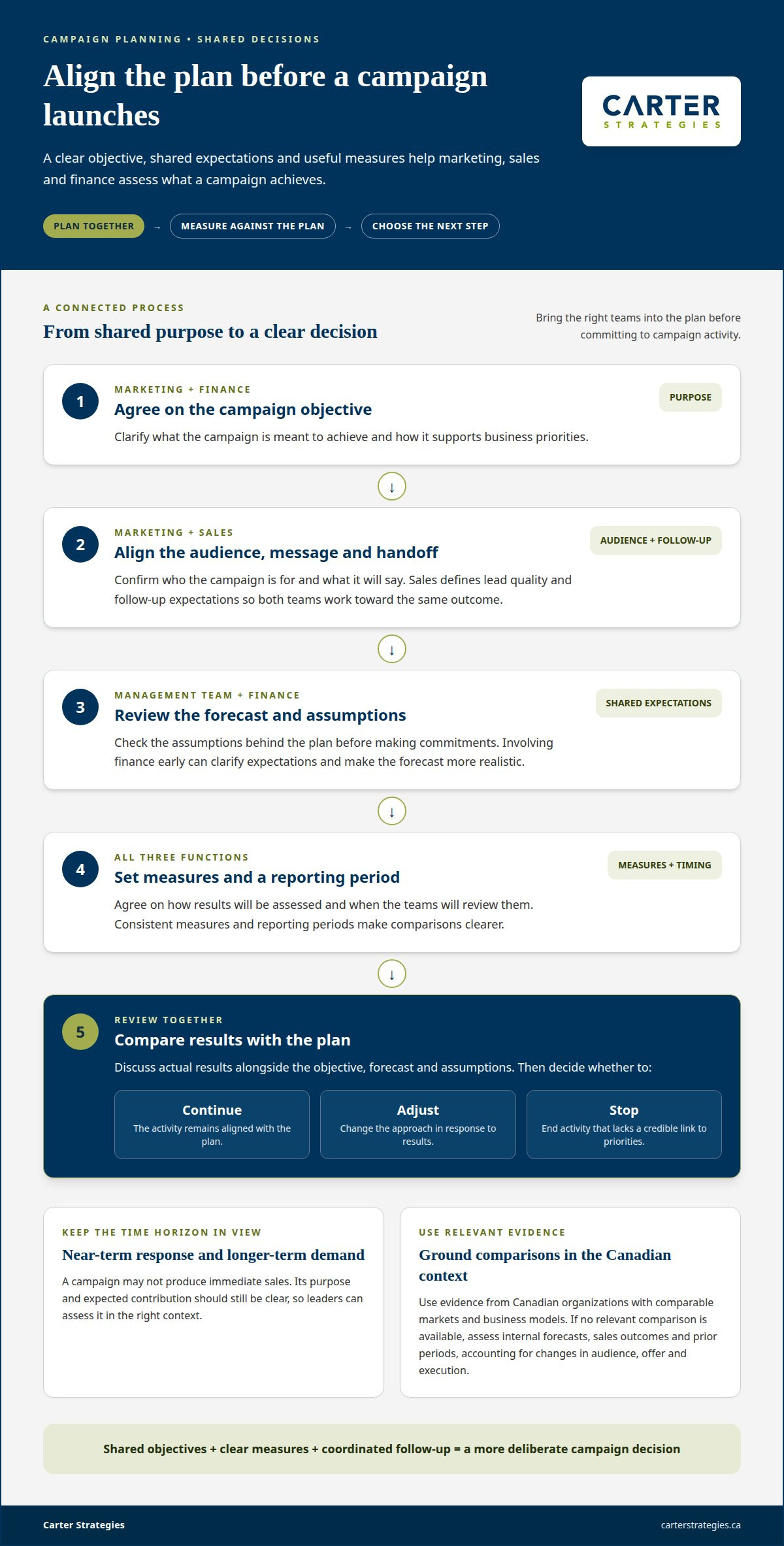
Pressure to justify marketing investment makes disciplined planning essential. Before approving a campaign, marketing and finance can agree on its objective, forecast, assumptions and measures. Sales can define lead quality and follow-up expectations. Together, these functions create a practical basis for comparing results with the plan and deciding whether to continue, adjust or stop an activity.
Financial planning should distinguish between near-term response and work that supports longer-term demand. A campaign may not produce immediate sales, but its purpose and expected contribution should still be clear. Without that context, leaders may cut useful activity too early or continue funding work with no credible link to business priorities.
Replacing a marketing leader and rebuilding a team can involve recruitment, onboarding, lost institutional knowledge and delayed decisions. The impact depends on the role, team structure and transition. A leadership change alone will not resolve unclear priorities or weak measurement, so the organization should also address the planning and decision-making practices behind the problem.
Weak budget allocation and measurement can lead to continued spending on low-converting activity, misread sales delays and overlooked work that supports future demand. Without consistent measures and agreed reporting periods, leaders cannot readily distinguish a campaign issue from a timing or handoff problem. That uncertainty can weaken the next budget decision.
For a Canadian benchmark, use evidence from Canadian organizations with comparable markets and business models. Findings based only on U.S. companies should not be presented as Canadian results. When no relevant comparison is available, assess campaigns against internal forecasts, sales outcomes and prior periods, while accounting for changes in audience, offer and execution.
Involving finance early can make budgets more realistic and clarify how teams will track performance against forecasts. The management team can review assumptions before making commitments, then discuss actual results with marketing and sales. This makes budget decisions more deliberate and gives employees a shared understanding of what the investment is meant to achieve.
Customer acquisition cost and lifetime value
Customer acquisition cost (CAC) helps a business understand the resources required to win a customer. Customer lifetime value estimates the net profit associated with that customer relationship over time. Considered together, these measures help leaders judge whether acquisition is building durable customer equity or attracting customers whose future contribution does not support the organization’s goals.
Weak marketing leadership can make this comparison difficult when teams define customers, acquisition sources or outcomes differently. One team may count every inquiry as a new customer opportunity, while finance focuses on completed sales and associated revenue. Agreeing on definitions lets marketing, sales and finance discuss performance using the same terms instead of interpreting separate reports.
There is no universal financial-performance gap that applies to every company with effective or ineffective marketing leadership. Results depend on market conditions, customer mix, the value proposition and execution across teams. A useful assessment looks beyond a leader’s title: examine whether customer acquisition and retention decisions rely on clear priorities, reliable information and accountability across the customer relationship.
For a practical review, compare customer groups by acquisition source and buying behaviour. A professional services firm, for example, could distinguish customers who return for additional work from those whose engagement ends after one project. This can show whether marketing attracts the right prospects, whether the service experience encourages repeat business and where the organization should focus customer-facing effort.
Brand loyalty can support retention when a business consistently delivers on the expectations its marketing creates. If customer feedback reveals a gap between the promise and the experience, marketing and service teams can investigate the cause. They may need to clarify the message, improve the handoff or share customer insights with the teams responsible for delivery.
Use customer lifetime value as a planning guide, not a stand-alone verdict. Leaders should consider a relationship’s profitability, the resources required to serve customers and the reasons people stay or leave. Reviewing these factors helps teams decide which customer relationships merit attention and how brand management can support enduring value.
A marketing strategy can help connect customer priorities with acquisition and retention decisions. It is particularly relevant when teams have different views of their best customers or lack a shared approach to growing customer relationships.
Use shared indicators such as customer lifetime value, customer acquisition cost and return on marketing investment to compare performance across campaigns, segments and time horizons. Customer lifetime value represents the total net profit attributed to a customer’s future relationship with a business. It can help marketers determine how much to invest in acquiring and retaining customers while staying within profitability thresholds. Marketing leaders can demonstrate value by tracking marketing’s contribution across the customer lifecycle, from acquisition to retention.
Do not treat a 30% increase in customer lifetime value over 12 months or reviewing profit-and-loss statements 5-10 times per month as standard targets. Set performance goals and review frequency based on the organization’s context, available information and decision-making needs.
Connecting marketing activity to business outcomes
The financial impact of a weak marketing leader is harder to establish when reports show clicks, impressions and downloads without connecting them to sales. These measures describe activity, not necessarily business outcomes. A strategic measurement plan links each campaign to a customer action, such as a qualified sales conversation, a signed contract or a repeat purchase. This helps finance and marketing see where budgets support growth and where activity needs to change.
To quantify the return on investment (ROI) impact of ineffective leadership, compare marketing expenditure with the revenue or other defined return it generates. Apply consistent attribution rules, time periods and funnel stages, then compare actual results with the original forecast. This can show where performance falls short, but it cannot attribute every change to leadership alone. Market conditions, pricing and sales follow-up also affect results.
The Spring 2025 CMO Survey reported that 51.8% of marketers found focusing data and analytics on important marketing problems challenging. Among respondents at B2B services companies, 76.9% identified demonstrating marketing’s financial impact as a challenge. These survey findings are U.S. results, not Canadian benchmarks. They point to a practical issue: organizations need to select metrics that answer business questions, not simply report every available measure.
Vanity metrics can mask weak performance. A campaign, for example, may increase website visits while qualified opportunities and sales remain unchanged. A useful review follows the path from exposure to response, lead quality, sales progression and revenue. If visits rise but qualified opportunities do not, examine audience fit, message clarity and the handoff to sales before renewing the campaign.
To assess the financial impact of a weak marketing leader, bring marketing, sales and finance into a shared review. Agree on funnel stages and measures attributable to revenue, then compare performance across campaigns and customer groups. Ask where prospects stop progressing, whether sales accepts the leads and what customer or industry insights explain the pattern. This can distinguish a targeting issue from a follow-up problem or an offer that does not meet customer needs.
- Set one business objective for each campaign.
- Choose measures tied to that objective, such as qualified opportunities or revenue.
- Review results with sales and finance against the same reporting period.
- Change the audience, message or investment when evidence shows a mismatch.
These steps make budgets more accountable without treating a single metric as proof of cause. When executives can see how activity connects to sales outcomes, they can make clearer decisions about priorities, performance and future investment.
Pressure on CMOs to demonstrate marketing’s financial impact
Marketing leaders face growing scrutiny from executives who expect clear evidence of business contribution. The Spring 2025 CMO Survey found that 64% of surveyed senior marketers considered demonstrating the financial impact of marketing actions their most pressing challenge. That pressure can shift a CMO’s position from setting direction toward defending every campaign, particularly when finance and marketing use different measures of success.
The pressure comes from several levels. In the 2025 survey, 61% of marketing leaders reported greater scrutiny from CEOs, while 50% reported more pressure from board members. Since fall 2023, surveyed marketers said pressure to prove marketing’s value had increased by 20% from CEOs, 52% from CFOs and 21% from boards. Each group may look for different evidence: growth and customer relevance, financial return, or progress against organizational priorities.
That scrutiny can fuel imposter syndrome, especially when marketing teams are asked to demonstrate results they cannot measure consistently. A leader may treat every fluctuation as a personal failure instead of examining the campaign, sales handoff, market conditions and agreed objectives. Accountability still matters. Separate evidence about performance from assumptions about individual competence, then address gaps with the people responsible for the work.
Start with collaboration. The CMO, CFO, sales leader and CEO can agree on the business outcome, reporting period and measures before approving an initiative. A campaign intended to support sales growth, for example, should have an agreed path from marketing activity to qualified opportunities and revenue. Marketing teams can report progress, explain changes and identify decisions that need adjusting, rather than presenting a dashboard without context.
Useful reporting explains both results and the reasons behind them. Compare current performance with prior periods, then note factors such as a market shift, creative fatigue or changes in lead quality. The CMO Survey reported that 43.4% of marketers considered it likely or very likely that a top marketing leader would become CEO. That finding suggests the role can connect marketing priorities with broader business leadership, not only campaign reporting.
Boards and executives can strengthen accountability by agreeing on a focused set of shared measures and review points. Marketing can report outcomes in terms of growth, efficiency and strategic value, while finance helps define assumptions and sales contributes buyer and pipeline insights. When measures show a gap, teams can decide whether to change the audience, investment, message or sales process. Clear ownership turns scrutiny into decisions instead of repeated requests to prove marketing’s worth.
Lower conversion rates and longer sales cycles
Weak marketing leadership can lower conversions by sending poor-fit leads to sales, using inconsistent messages or leaving next steps unclear. The financial impact of a weak marketing leader often becomes visible when marketing and sales pursue different audiences or define qualified leads differently. Sales teams spend time qualifying prospects unlikely to buy, while suitable buyers may receive slow or conflicting follow-up. Both departments lose time, and prospects face more friction before deciding.
Misaligned marketing and sales efforts can raise customer acquisition costs and slow business growth. Campaigns produce fewer suitable customers when targeting, offers and follow-up work against one another. Teams can also waste time revising creative before clarifying whether the audience, message or sales handoff is causing the problem.
Consider a manufacturer launching a campaign before sales and operations agree on customer priorities. Marketing may promote a product or capability that sales cannot clearly explain or operations cannot support on the expected schedule. Prospects ask for clarification, sales conversations stall and revenue may be delayed. Because the problem crosses departments, changing the advertisement alone may not resolve it.
Creative choices affect response, so teams should test messages against a defined customer action. A simple, direct message may serve a different purpose from polished brand creative. Leaders can set a clear test, agree on what counts as a conversion and use the findings to guide the next decision, rather than assuming one style will work for every audience.
To diagnose a conversion problem, trace the buyer journey from first contact to sale. Compare lead quality, response times, sales acceptance and reasons prospects decline. If marketing-generated inquiries do not progress, examine audience criteria and campaign promises together. If sales conversations stall, review follow-up and whether the discussion addresses buyer needs.
- Agree on the characteristics of a qualified lead with sales.
- Match campaign messages to the value proposition sales can support.
- Review handoffs and follow-up for delays or unclear ownership.
- Test one message or audience change at a time, then apply the learning.
These steps help marketing teams focus on conversion barriers instead of simply increasing activity. They also make room for innovation: teams can test a new message or customer approach while keeping the objective and evaluation criteria clear.
Discuss your conversion and sales alignment challenges to identify where clearer priorities can support progress.
A clear measure of progress matters. Sales and marketing misalignment can leave sales teams spending time qualifying poor-fit leads, so the handoff deserves attention alongside campaign performance. In manufacturing, delays between marketing and sales can postpone revenue realization. Shared customer priorities and a clear path from inquiry to sales conversation are therefore important when assessing conversion problems.
AI-driven marketing for Kiehl’s produced a 207% higher conversion rate. That result can be considered alongside the specific audience, message and conversion goal involved, rather than treated as a guarantee for another business. Teams can use evidence from their own buyer journey to decide whether to adjust targeting, promises or follow-up, and keep sales and marketing aligned as they learn.
Carter Strategies: Marketing Strategy
Carter Strategies helps organizations address unclear marketing priorities through Marketing Strategy, Business Strategy Development, Fractional CMO and CRO services, and Growth Strategies and Planning. This support is useful when marketing activity is disconnected from sales goals, teams lack shared measures or leaders need clearer accountability for growth.
The work connects business priorities with practical marketing direction and involves the people responsible for carrying it forward. CEOs and management teams can use this approach to clarify where marketing should focus and how progress relates to business outcomes.
Contact Carter Strategies to discuss your organization’s marketing priorities.
Build marketing leadership around shared priorities
The financial impact of a weak marketing leader is easier to address when the next step is a clear conversation about priorities, decision-making and team ownership. Rather than treating every performance gap as a campaign problem, CEOs and management teams can consider how marketing direction connects with business strategy and how employees can contribute to practical action plans.
Carter Strategies offers Business Strategy Development, Marketing Strategy, and Fractional CMO and CRO services. These offerings can help organizations seeking clearer strategic direction or senior marketing and revenue leadership. The work begins by understanding the business challenge and aligning the people responsible for progress, rather than imposing a plan without their involvement.
Contact Carter Strategies to discuss marketing impact. A focused conversation can help your team identify a practical next step and move forward with greater clarity.
Frequently Asked Questions
How does weak marketing leadership affect revenue and sales growth?
Weak marketing leadership can slow revenue growth when an organization changes its market message without giving sales teams a clear reason for buyers to choose it. In a B2B services firm, prospects may hear different explanations from different representatives, making decisions harder and forecasts less reliable. Leaders can assess whether the value proposition addresses buyer priorities and gives sales conversations a consistent, relevant case for action.
How does weak marketing leadership affect customer retention, churn, and lifetime value?
Weak leadership can increase churn when the post-purchase experience fails to match expectations set by marketing. Customers, for example, may lose confidence if a service is promoted as responsive but communication becomes inconsistent after onboarding. Marketing and customer-facing teams can review recurring feedback, renewal conversations and reasons customers leave. These signals can help identify whether the issue lies in the promise, the experience or the handoff between teams.
How does weak marketing leadership affect brand value and pricing power?
Weak marketing leadership can erode brand value when customers struggle to understand how an organization differs from alternatives. If messaging focuses mainly on features or broad claims, buyers may compare offerings primarily on price. Clear brand positioning gives customers a specific reason to prefer the business and supports stronger pricing conversations. Leaders can assess whether customer-facing teams explain that difference consistently and connect it to customer priorities.


