


What if the very growth you have worked so hard to achieve is actually the thing quietly dismantling your company's operational stability? For many mid-market leaders, hitting revenue targets often brings a surprising amount of internal friction and strategic drift. You might find that while your leadership team sets clear priorities, the frontline staff struggles to translate those goals into daily action. Adopting a practical scaling a business framework is the only way to ensure that your expansion does not lead to disproportionate chaos or wasted resources.
It is frustrating when marketing and sales efforts pull in opposite directions, creating silos that stall your progress. You deserve a structured, repeatable approach that builds market share without sacrificing organizational health. This article provides a clear, actionable framework to scale your business sustainably while keeping your teams aligned and operational friction minimal. We will look at how to establish strategic priorities that every employee can own, bridging the gap between high level planning and boots on the ground execution to drive disciplined growth through 2026 and beyond.
Key Takeaways
- Distinguish between simple linear growth and building scalable capacity to ensure long-term organizational value.
- Learn why top-down strategies often stall and how to foster authentic ownership through inclusive strategic planning.
- Adopt a practical scaling a business framework that integrates market clarity, capability alignment, and consistent tracking.
- Build a predictable operational rhythm to translate high-level priorities into actionable milestones for every department.
- Identify how fractional leadership can provide the senior-level perspective needed to guide your company through complex growth phases.
Defining the Scaling a Business Framework: Growth Versus True Scalability
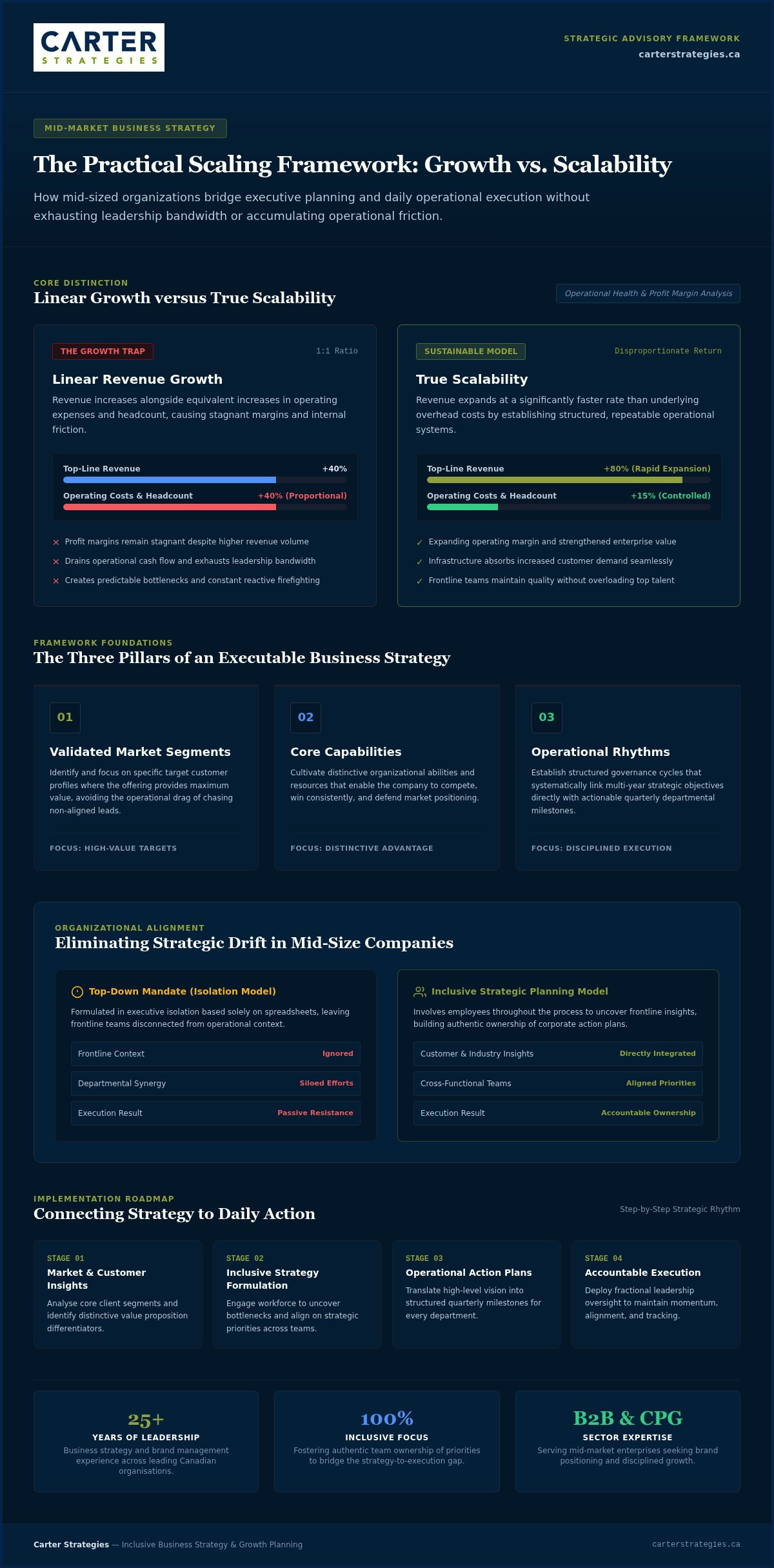
Many mid-market leaders mistake getting bigger for getting better. While revenue growth is a standard benchmark, it often masks underlying operational friction that can eventually stall a company. A scaling a business framework serves as an integrated roadmap that connects your high-level vision to daily execution. Without this structure, businesses often fall into the trap of linear growth, where every dollar of new revenue is offset by a dollar of new expense. This approach isn't sustainable; it eventually exhausts leadership bandwidth and drains operational cash flow.
Pushing for growth without clear systems creates predictable bottlenecks. You might see your top performers becoming overwhelmed or your customer service quality dipping as volume increases. This happens because the processes that worked for a $10 million company rarely survive the transition to $50 million. Mid-market firms don't need the rigid, academic formulas used by global conglomerates. Instead, they require a pragmatic framework that values internal buy-in as much as financial metrics. By focusing on organizational health and alignment, leaders can build a foundation that supports expansion rather than collapsing under it.
Growth Versus Scale: Understanding the Crucial Distinction
Growth and scale are not interchangeable terms. Growth refers to adding revenue alongside equivalent increases in operating expenses and headcount. If your costs rise at the same rate as your sales, your profit margin stays stagnant. In contrast, true scalability allows you to increase top-line revenue at a significantly faster rate than your underlying costs. Achieving this requires a shift from doing more to doing things differently, ensuring your infrastructure can handle increased demand without a proportional spike in overhead. Leaders who ignore this distinction often find themselves trapped in a cycle of constant hiring and fire-fighting.
Essential Components of an Executable Business Strategy
For a scaling a business framework to work, it must be grounded in reality, not just theory. An executable business strategy relies on three pillars:
- Validated Market Segments: You must identify specific target customer profiles where your offering provides the most value, rather than chasing every lead.
- Core Capabilities: These are the distinctive abilities and resources that allow your organization to compete and win repeatedly.
- Operational Rhythms: You need structured cycles that link quarterly milestones with multi-year objectives, ensuring the team stays focused on the right priorities.
By aligning these components, leadership can bridge the gap between planning and implementation. This fosters a culture of shared accountability where every employee understands how their daily tasks contribute to the company's long-term success.
Why Traditional Top-Down Scaling Approaches Stall Mid-Size Companies
Traditional strategic planning often feels like a closed-door exercise. Executives spend weeks refining financial models and slide decks, only to hand them off to a workforce that had no hand in creating them. This isolation is a primary reason why even a well-intentioned scaling a business framework fails to gain traction. When strategy is treated as a top-down mandate, it lacks the nuanced reality of daily operations. Purely financial targets might look impressive in a boardroom, but they rarely generate the authentic workforce commitment needed to sustain long-term growth. Without a clear connection to the "how" and "why" of expansion, employees often view new directives as additional burdens rather than shared goals.
This disconnect creates significant operational drag. When frontline teams misunderstand executive intent, they default to old habits or implement changes in ways that create more friction. This isn't a failure of effort; it's a failure of alignment. To scale predictably, leadership must move beyond the role of the solitary visionary and embrace a more collaborative model. By involving the people who are closest to the customer, you ensure that your strategic priorities are grounded in reality and supported by the people responsible for implementation.
The Pitfalls of Strategy Formulated in Isolation
Management teams frequently prioritize high-level growth targets while overlooking the friction points that frontline employees navigate every hour. A spreadsheet might show that increasing output by 20% is mathematically sound, yet it fails to account for a legacy software bottleneck or a breakdown in communication between departments. Understanding the five stages of small business growth helps leaders recognize when their current structure is no longer fit for purpose. Without this insight, imposing change from above often triggers passive resistance. Employees don't necessarily fight the plan; they simply don't have the context or the tools to execute it effectively. This gap between executive theory and operational reality is where most scaling efforts begin to crumble.
Securing Authentic Strategy Ownership Across the Organization
Sustainable scale requires a shift from command-and-control to inclusive collaboration. When you involve employees in the planning process, you uncover grounded customer and industry insights that rarely reach the executive suite. These insights are the raw materials for a resilient strategic direction. Collaboration isn't just about being polite; it's about building deep accountability and personal pride in company outcomes. Frontline staff who help identify a problem are far more likely to take pride in the solution. This inclusive approach is vital for bridging strategy and execution, ensuring that strategic priorities are owned across the organization. If your current plans feel disconnected from the reality of your team, you might benefit from a more inclusive strategic planning approach that fosters genuine ownership and long-term results.
The Four Core Pillars of a Mid-Market Scaling Framework
Building a sustainable scaling a business framework requires moving beyond simple revenue targets. It demands a disciplined structure that keeps your team aligned as complexity grows. While academic models like the Six S Framework for scaling a business provide valuable theoretical foundations, mid-market leaders need a practitioner's approach. This framework rests on four integrated pillars: market clarity, capability alignment, disciplined focus, and consistent tracking. By following a clear sequence, you can assess your expansion readiness and avoid the organizational confusion that often accompanies rapid growth.
Success in 2026 relies on your ability to say no to the wrong opportunities. Disciplined focus is just as much about choosing what not to pursue as it is about identifying your next move. When sales, marketing, and operations pull in conflicting directions, you waste precious resources. These pillars ensure every department works from the same playbook, turning strategic intent into measurable business progress.
Step 1: Grounding Decisions in Customer and Industry Insights
Effective scaling begins with objective data, not executive intuition. You must gather customer and industry insights to understand how buyer behaviours are shifting in the current Canadian economic climate. For instance, with the Bank of Canada holding interest rates at 2.25 percent as of September 2026, capital allocation must be precise. Identify your high-margin client relationships and validated market segments. Using market realities to shape your strategic investments prevents you from overextending into areas where your competitive advantage is thin.
Step 2: Defining Core Capabilities and Differentiated Brand Positioning
Once you understand the market, you must isolate what your firm does uniquely well. Your core capabilities are the engine of your growth. If you cannot clearly articulate your distinct value proposition, your brand positioning will likely falter in a crowded market. Referencing a structured approach to business strategy development helps ensure your positioning remains disciplined. This clarity must extend across all commercial and operational communications, ensuring that what you promise in sales is exactly what your operations team delivers.
Step 3: Establishing Focused Action Plans and Measurable Priorities
A common mistake is trying to do too much at once. To scale effectively, narrow your company-wide priorities to three to five core initiatives annually. Develop unambiguous action plans that include named accountability and specific resource commitments. When everyone knows who is responsible for what, you eliminate the "bystander effect" that stalls many growth projects. Aligning your management team around identical revenue targets ensures that marketing and sales efforts reinforce one another, creating a unified front that drives sustainable scale.
Executing the Framework: Turning Strategy into Team Action
Execution is where the theoretical meets the practical. A scaling a business framework often fails not because the vision is wrong, but because the operational rhythm is missing. You need a predictable cadence that keeps strategic priorities at the front of every conversation. This isn't about micromanagement; it's about maintaining momentum. When leadership translates high-level goals into practical departmental milestones, the team understands their specific role in the larger mission. Building transparent review cadences allows you to solve friction points early without resorting to blame, fostering a culture of shared accountability.
Healthy communication between management teams and operational frontline personnel is the lifeblood of this process. It ensures that the people doing the work feel heard and that the people leading the work stay grounded in reality. Without this bridge, even the best plans remain static documents rather than living strategies.
Designing Cross-Functional Accountability Systems
Silos are the enemy of scale. For growth to be sustainable, you must assign explicit ownership for strategic outcomes rather than relying on vague, shared tasks. It isn't enough to have goals that "everyone" is responsible for; you should clarify how your marketing strategy directly enables sales execution and delivery quality. This creates cross-functional harmony and reduces internal friction. You can learn more about how growth strategy and planning establishes this essential internal alignment. If your team is struggling to stay on the same page, you can book a strategic planning session to bridge these gaps and drive results.
Tracking Meaningful Operational Progress
Numbers tell a story, but only if you track the right ones. When tracking the success of your scaling a business framework, you must select leading indicators that signal strategic progress long before the financial quarter closes. This is particularly vital in the current economic climate. For example, in late 2026, 41.6 percent of Canadian businesses expected inflation to be a major obstacle, while 25.2 percent struggled with recruiting skilled employees (Statistics Canada, 2026). If your framework doesn't track these operational realities, you're flying blind.
Avoid vanity metrics that look good on paper but obscure team burnout or operational delays. Instead, establish quarterly strategy adjustments based on empirical performance feedback. This allows you to stay agile and responsive to market shifts while keeping your core objectives in sight. Disciplined tracking ensures that your growth is both measurable and manageable.
Securing Strategic Direction: Fractional Leadership and Advisory Support
Mid-market leaders often reach a plateau where their internal bandwidth is stretched to the limit. You might have a solid team, but they are often too close to daily fires to see the broader strategic landscape. This is where an experienced external perspective becomes vital. By the end of 2026, it is projected that over 40 percent of North American mid-market companies will use fractional leadership to bridge these gaps (Frak, 2025). Adopting a scaling a business framework requires senior-level guidance that can navigate complex transitions without the long-term commitment of a full-time executive hire. External advisors provide the necessary distance to identify blind spots and the hands-on experience to fix them.
Scaling is not a solo sport. It requires a mentor who has been in the trenches and understands that a plan is only as good as the people who believe in it. The right support helps you move from identifying a challenge to implementing a solution with methodical precision. This ensures your growth roadmap is not just a document, but a living strategy that drives results.
How Fractional Executive Leadership Accelerates Scalable Growth
Fractional leadership offers a pragmatic solution for businesses that need specialized marketing and revenue expertise but aren't ready for a permanent C-suite salary. A fractional CMO or CRO brings a seasoned authority to your management team, ensuring direct alignment between your commercial messaging, sales processes, and customer retention strategies. This approach allows you to apply high-level brand management and revenue operations without unnecessary corporate overhead. You can review fractional CMO leadership options to understand how strategic executive placement fits into your current growth phase. This model is particularly effective for businesses that need to stabilize their operations while simultaneously pushing for market expansion.
Collaborating with Carter Strategies for Sustainable Market Expansion
Building a resilient scaling a business framework requires more than just data; it requires relationship skills and a belief in inclusive collaboration. Carter Strategies provides business strategy development and fractional CMO/CRO advisory services for mid-market Canadian organizations. With more than 25 years of experience in strategic planning and brand management, I help executive teams translate high-level vision into employee-owned action plans. My approach involves employees throughout the process to uncover their ideas and foster genuine ownership of strategic priorities. This collaborative method ensures that your strategy is not a top-down exercise but a shared mission. You can connect with Carter Strategies today to assess your organization's scaling priorities and begin building a roadmap that delivers measurable business progress.
Building a Resilient Foundation for Sustainable Scale
Sustainable expansion requires a shift from isolated planning to collective ownership. True scalability differs from mere revenue growth by focusing on underlying capacity and operational focus. By adopting a practical scaling a business framework, you bridge the gap between executive vision and frontline execution. This involves a disciplined operational rhythm where your people are the engine of your success.
The right perspective makes all the difference during complex transitions. With more than 25 years of hands-on business strategy and brand management experience, I help Canadian mid-market leaders translate high-level vision into employee-owned action plans. My advisory engagements are available on both a project and ongoing retainer basis, providing the flexibility your organization needs to thrive.
Connect with Carter Strategies to align your leadership team on the strategic priorities that drive sustainable scale. Your path to predictable growth starts with a single step toward alignment. You have the vision; now it's time to build the framework that makes it a reality.
Frequently Asked Questions
What is the difference between growing a business and scaling a business?
Growing is a linear process where revenue and costs rise together, often leaving profit margins stagnant. Scaling is the ability to increase top line revenue significantly faster than underlying expenses. It requires shifting from "doing more" to "doing things differently" by building systems and alignment. True scale creates long term organizational value by protecting your profitability as you expand into new markets.
How do I know if my mid-size company is ready to implement a scaling framework?
You are ready when your current operations begin to crack under the weight of new volume. Common signs include team friction, a decline in service quality, or a revenue plateau that persists despite increased effort. Implementing a scaling a business framework at this stage provides the integrated roadmap needed to connect your vision to daily execution. It helps you identify capacity bottlenecks before they stall your progress.
Why do traditional strategic plans fail to achieve their projected results?
Most strategic plans fail because they are purely financial exercises developed by the management team in isolation. When strategy is imposed from the top down without employee input, it lacks the nuanced reality of daily operations. Frontline staff often view these plans as academic or disconnected from their daily work, leading to passive resistance. Authentic results require a shift toward inclusive planning where those responsible for implementation also have a voice.
How does employee involvement improve strategic execution?
Involving employees surfaces grounded customer and industry insights that rarely reach the executive level. This collaboration fosters a sense of shared accountability and personal pride in company outcomes. When staff members understand the "why" behind strategic priorities, they are far more likely to take ownership of the "how." This alignment reduces operational drag and ensures that high level goals are translated into practical, daily actions that drive progress.
What role does fractional leadership play in scaling a mid-market company?
Fractional leadership provides mid-market companies with specialized marketing and revenue expertise without the overhead of a full-time executive hire. A fractional CMO or CRO acts as a strategic guide, bridging capacity gaps and aligning commercial messaging with sales execution. This senior level perspective is vital during growth phases, as it allows leadership to focus on direction while ensuring the operational foundation remains stable and capable of supporting expansion.
How many strategic priorities should a leadership team focus on at once?
A leadership team should focus on no more than three to five core strategic priorities annually. Attempting to pursue too many initiatives at once dilutes your resources and creates organizational confusion. Disciplined focus is as much about choosing what not to do as it is about identifying your next move. By narrowing your focus, you ensure that every department is pulling in the same direction, which is essential for achieving measurable results.
How do we align our marketing strategy with actual sales and revenue delivery?
Alignment begins by establishing a unified scaling a business framework that links marketing efforts directly to sales outcomes. You must ensure that marketing strategy is not a siloed exercise but a functional tool that enables revenue delivery. By using shared revenue targets and transparent review cadences, you can solve friction points early. This inclusive approach ensures every lead generated by marketing is supported by an operational process designed to convert customers.


