


In 2026, tariff uncertainty is a cash-flow and business-value problem as much as a sourcing issue. A business strategy for economic uncertainty in 2026 should start by mapping tariff exposure across suppliers, customers and margins, then stress-testing cash flow under different conditions. Protect liquidity, prepare options to shift suppliers or resources, and direct growth investment towards areas with sound demand and profitability.
For Western Canadian businesses, changing trade conditions can make it harder to plan costs, protect margins and decide where to invest. Responding with across-the-board cuts may ease immediate pressure, but it can also weaken the capabilities and customer relationships that support future growth.
This article lays out practical ways to assess tariff exposure, strengthen supply chains, safeguard business value and manage cash flow without losing sight of growth. You’ll see how to connect financial priorities with customer and industry insights, and turn decisions into action plans your team can own.
Key Takeaways
- Set strategic priorities against clear scenarios, and decide in advance when to pause, scale down or redirect resources.
- Assess how tariffs and changing business sentiment could affect your customers, margins and investment plans.
- Look beyond revenue to identify pressure on profitability, then focus on the customers, products and services that contribute the most value.
- Review supplier dependencies and delivery options to spot where diversification or more flexible operations could reduce disruption.
- Bring financial measures and employee insight together so growth priorities can become practical, owned action plans.
1. Strategic priorities, acquisitions, and growth planning
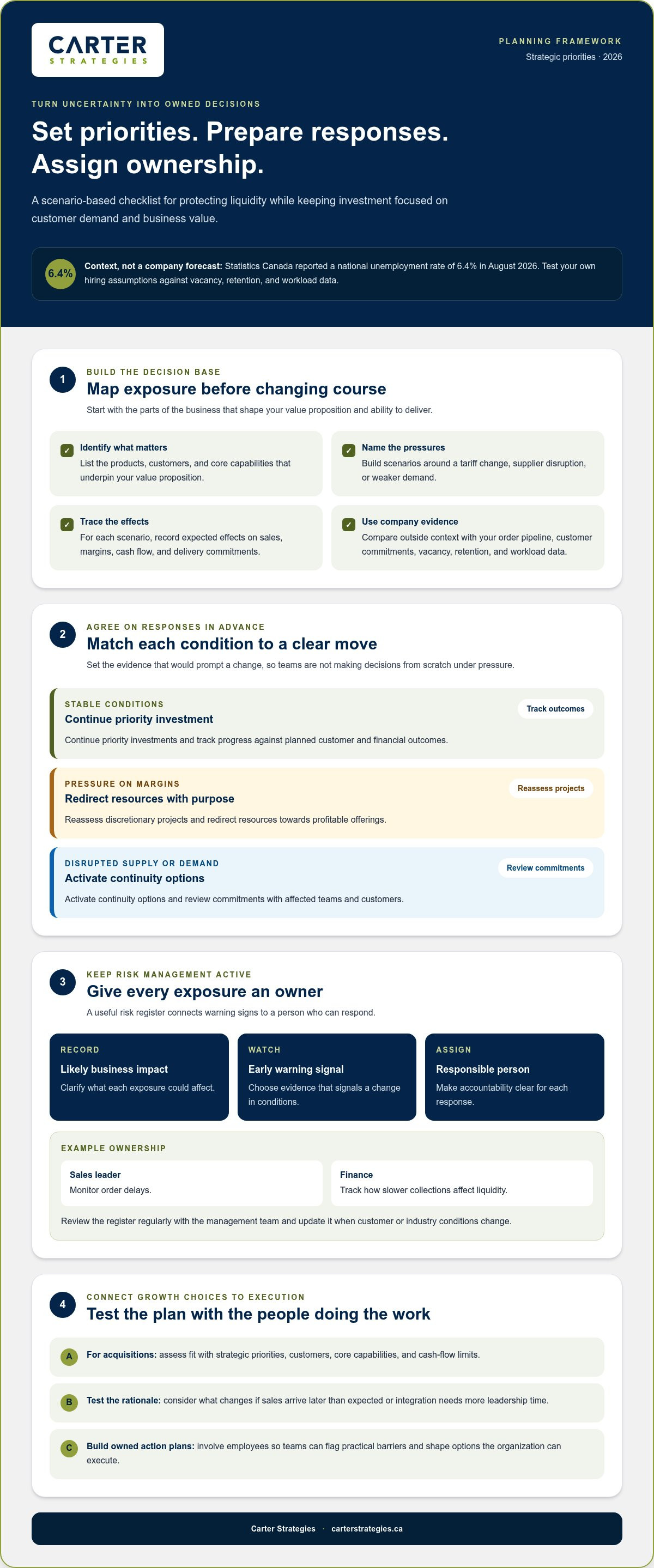
In uncertain conditions, clear priorities matter more than a long list of initiatives. Identify the products, customers, and capabilities that underpin your value proposition, then link investment decisions to that evidence. For example, a Canadian manufacturer facing unpredictable input costs might protect investment in a product line with steady demand while delaying a lower-priority expansion. The decision should reflect the facts, not a blanket freeze across every team.
Build scenarios around specific business pressures, such as a tariff change, a supplier disruption, or weaker demand. For each scenario, record the expected effect on sales, margins, cash flow, and delivery commitments. Statistics Canada reported a national unemployment rate of 6.4 percent in August 2026. Leaders can use that context while testing their own hiring assumptions against vacancy, retention, and workload data. Company-level evidence should guide decisions about staffing and growth.
Set a response for each scenario before conditions worsen. Decide which projects to continue, pause, or scale down, and specify what evidence would prompt a change. If order volumes fall, for instance, a business could pause a planned facility expansion and redirect resources to retaining its strongest customer accounts. These choices can preserve liquidity while keeping attention on activities tied to current demand.
- Stable conditions: Continue priority investments and track progress against planned customer and financial outcomes.
- Pressure on margins: Reassess discretionary projects and redirect resources towards profitable offerings.
- Disrupted supply or demand: Activate continuity options and review commitments with affected teams and customers.
Use a risk register to clarify ownership. For each exposure, record its likely business impact, an early warning signal, and the person responsible for responding. A sales leader might monitor order delays while finance tracks how slower collections affect liquidity. Review the register with the management team regularly and update it when customer or industry conditions change. That keeps risk management useful for decisions, rather than leaving it as a document set aside after planning.
Apply the same scenario-based discipline to acquisitions. Before pursuing a target, assess its fit with strategic priorities, customers, core capabilities, and cash-flow limits. Test whether the rationale still holds if sales arrive later than expected or integration requires more leadership time. Growth planning should also involve employees in shaping action plans. Teams close to customers and operations can flag practical barriers early, helping leaders choose options the organization can execute.
2. How can Western Canadian businesses navigate tariff-driven economic uncertainty?
Start by mapping tariff exposure across suppliers, products, customers, and sales markets. More than 50,000 Canadian small businesses are directly exposed to U.S. tariffs, Canadian counter-tariffs, or both. For a regional exporter, exposure may sit in imported components, customer contracts, or price-sensitive demand. Trace each connection before changing operations or investments. That map shows which decisions need immediate attention and which can wait.
Business sentiment offers context, but it shouldn’t replace company-level evidence. A survey of 520 Canadian business leaders found differing responses to economic conditions, while nearly half had not fundamentally changed capital allocation. In July 2026, Canadian small business confidence stood at 58.3 points, and manufacturing confidence reached 53.7 points. Compare those indicators with your own order pipeline, customer commitments, and margin trends. Then decide whether to defer, continue, or redirect planned investments.
Price decisions need the same discipline. Canadian small firms planned to raise prices by an average of 2.7 percent, but a broad increase may not suit every product or customer. Identify which inputs face tariff pressure, calculate their effect on margins, and assess how much customers can absorb. Test targeted price changes alongside alternatives, such as adjusting product mix or delivery methods. Involve sales and operations teams, who can flag customer concerns and practical limits.
Canadian businesses also contend with domestic regulations and interprovincial barriers. Provincial and municipal approvals can extend real estate and construction timelines, while other regulatory hurdles can delay projects and add uncertainty. Before committing resources, map each project’s approvals, dependencies, and decision points. Include these in cash-flow forecasts and investment reviews. This helps leaders distinguish a delayed opportunity from one that no longer fits their priorities.
When debt and cash-flow pressure persist, Canadian law provides structured options. The Bankruptcy and Insolvency Act (BIA) and the Companies’ Creditors Arrangement Act (CCAA) provide ways to address mounting debt, work with creditors, and stabilize operations. A Licensed Insolvency Trustee can advise businesses facing sustained pressure. Treat early warning signs, such as tighter cash flow or more difficult debt servicing, as reasons to arrange a timely financial review.
Government support may also form part of a response plan. In August 2026, the federal government announced a C$7.5 billion tariff support package for affected Canadian businesses. It included a C$1.5 billion Regional Tariff Response Initiative. Track relevant program announcements alongside tariff and regulatory changes, then assess whether support aligns with your business needs. A clear exposure map, grounded forecasts, and informed advice help leaders respond without making rushed decisions.
3. How can businesses protect and create value?
In 2026, manufacturing, fuel-dependent small firms, and restaurants face clear cost and margin pressures. Input product costs were squeezing 77 percent of Canadian manufacturers, while fuel costs affected 60 percent of small firms nationally. Those figures point to different vulnerabilities: manufacturers should examine material costs, while fuel-sensitive businesses should track transport and operating expenses. Restaurants need to watch both customer demand and the costs behind each sale.
Start with a product-level margin review. Compare selling prices with input, labour, delivery, and service costs, then identify where profitability has weakened. An 80/20 analysis can show which customers and products or services generate the greatest share of profit and value. Protect those relationships and offerings, while investigating low-performing work that consumes capacity without supporting the business’s value proposition.
Food and beverage businesses can face revenue volatility even when sales resemble previous years. Canadian restaurants may bring in similar revenue but earn less profit as operating costs rise and margins tighten. Track sales alongside expenses rather than treating revenue as a reliable measure of business health. For example, a restaurant can compare contribution by menu item and service period, then adjust purchasing or staffing to match customer demand.
Workforce decisions require the same balance. Across-the-board reductions can weaken customer service or the core capabilities that distinguish a business. Before reallocating responsibilities, compare workloads, recurring tasks, and customer needs. Ask employees where processes create delays or duplicate effort, then simplify work that does not improve customer outcomes. This helps leaders assess staffing needs while involving the people closest to daily operations.
Reduce reliance on a single source of revenue by reviewing customer, product, and market concentration. A B2B professional services firm dependent on one large account, for instance, can assess which related services meet existing client needs and identify prospects in adjacent markets. Test new opportunities against delivery capacity and expected contribution. Growth creates value when it adds profitable demand without stretching teams beyond what they can support.
Make performance visible with a small set of regularly reviewed measures: gross margin, operating expenses, cash collections, and customer retention. Use them to spot changes early and assign clear ownership for follow-up. Automation and AI can help map workflows, improve cost visibility, and strengthen controls, but teams still need to assess the results. A disciplined review connects financial signals with employee insight, helping the business protect value and focus effort on its strongest opportunities.
4. Supply-chain resilience and supplier diversification
Map the path of each critical input, from supplier through production to customer delivery. Record the supplier, location, lead time, substitute options, and business impact of a delay. A Western Canadian food producer, for example, could map ingredients, packaging, transport, and cold-storage dependencies separately. This shows where one disruption could stop several operations. It also helps teams prioritize alternatives based on customer commitments, not convenience alone.
Cost pressure makes this review urgent for manufacturers. Shipping and receiving costs affected up to 63 percent of Canadian manufacturers, more than double the level in February 2026. Compare supplier quotes alongside delivery reliability, quality, minimum order requirements, and the cost of switching. A lower unit price may not reduce total exposure if longer delivery times require more inventory or increase the risk of missed customer orders.
Build resilience by qualifying alternative suppliers before a disruption forces a rushed decision. Compare suppliers by location, capacity, input quality, delivery performance, and ability to meet changing demand. Consider local production when it suits the product and operating model. Predictive analytics can help teams spot demand shifts and potential supply interruptions earlier, but assign clear owners to these signals and agree on how to respond.
Supplier lead times can shape how early a business must forecast demand. In a telecom division managed by the author, component lead times were 6-12 months in the mid-90s. The division reduced supplier lead times by 43 percent, then needed to forecast demand 5-6 months ahead instead of 9-12 months. The example shows how supplier performance can affect planning cycles, inventory decisions, and the speed of a response.
Review sourcing, production, and delivery processes for opportunities to adapt. A manufacturer might qualify more than one input source, adjust production schedules, or change how products reach customers. A service business could assess whether remote delivery can maintain service during a transport disruption. Employees responsible for purchasing, production, and customer commitments can identify practical limits before leaders change a process.
Turn the review into a working plan. For each critical input, name the primary and alternative suppliers, the trigger for switching, the decision owner, and the impact on customers or production. Review the plan when supplier performance, customer demand, or delivery conditions change. This gives leaders a practical way to navigate disruptions, manage costs, and adjust operations without treating every supply risk as equally urgent.
5. Cash flow, profitability, and business-value risks
Cash pressure can build before revenue clearly declines. In uncertain periods, compare expected receipts with payroll, supplier payments, debt service, and planned investments. Prepare cash-flow scenarios for stable demand, slower customer payments, and weaker sales. For each scenario, identify commitments that can be deferred and those that protect essential operations. This gives leaders options before liquidity becomes an urgent concern.
Track how pressure moves through the business. Tighter cash flow can make debt servicing more difficult, while changing asset values may complicate refinancing. Review these signals together instead of waiting for a missed payment or financing deadline. If a forecast shows a widening gap between collections and obligations, review spending, customer terms, and capital allocation early.
Revenue alone does not measure business health. A Canadian restaurant, for example, may earn revenue similar to previous years while rising operating costs reduce profitability. Compare sales with labour, input, and delivery expenses across relevant periods. If sales hold but margins narrow, identify what costs have changed and which menu items or service periods contribute enough to support the operation.
Protect value by improving visibility into financial performance and streamlining operations. Assign owners to track cash collections, operating costs, and profitability, then review changes with the management team. Identify underperforming assets and assess whether they still support business priorities. Automation and AI can help clarify workflows, strengthen controls, and make cost information more useful for decisions.
Capital decisions should account for current performance and future options. Separate investments needed to maintain essential capabilities from projects that can wait for clearer demand. A smaller Canadian developer, for instance, may have less flexibility to pause a project than a larger firm with a stronger balance sheet. Compare the consequences of continuing, slowing, or deferring work before committing resources.
Preserve liquidity where possible, but avoid cuts that undermine revenue or customer delivery. Review payment timing, inventory commitments, discretionary spending, and the contribution of each major activity. The federal government’s August 2026 tariff support package included a C$500 million BDC Pivot to Grow liquidity stream. Assess support programs alongside your own forecasts and operating needs.
A practical review connects cash-flow scenarios, profitability measures, asset decisions, and accountable owners. Update the view when customer payments, financing conditions, or operating results change. If leadership needs to connect those financial choices to strategic priorities, develop a business strategy that links capital allocation with executable action plans.
Carter Strategies: Business Strategy Development
Carter Strategies helps leadership teams turn economic pressures into clear strategic choices through Business Strategy Development. It is a practical next step when tariffs, supplier changes, or cash-flow concerns make priorities unclear, or when growth plans need to reflect current customer and industry insights.
Carter Strategies develops plans with employee involvement, giving teams a role in identifying opportunities, testing assumptions, and shaping action plans. That input connects financial decisions with customer needs and day-to-day execution. Marketing Strategy, Fractional CMO and CRO services, and Growth Strategies and Planning can support related strategic priorities.
To discuss your business priorities, contact Carter Strategies.
Turn strategic choices into shared action
A business strategy for economic uncertainty in 2026 has value when it guides everyday decisions, not just executive discussions. The next step is to make ownership visible: clarify who will act, what progress looks like, and how teams will raise new risks. When employees understand the reasoning behind priorities, they can connect changing conditions with practical decisions in their roles.
Set regular leadership reviews to assess whether assumptions still hold and actions are making the intended progress. Keep the conversation open across functions so customer-facing teams, operations, and finance can share different signals. This creates a disciplined way to adjust direction while keeping the organization’s longer-term goals in view.
If your leadership team is ready to turn its priorities into a plan with clear ownership, contact Carter Strategies to discuss your strategy. A focused next step can help your team move forward with clarity and shared commitment.
Frequently Asked Questions
How can Western Canadian businesses navigate tariff-driven economic uncertainty?
Give leaders a clear process for tariff-related decisions. Assign an internal owner to track policy announcements, brief affected teams, and flag decisions for executive review. Prepare customer communications for changes to delivery timing or product availability, and make each message specific to the affected order. For contracts or pricing commitments, have appropriate legal and finance advisers review proposed changes before communicating them. This keeps responses coordinated without making assumptions about individual agreements.
How can businesses protect and create value?
Strengthen what sets the business apart, then explain that difference clearly to customers. A service firm, for instance, can examine why clients choose its expertise over alternatives and refine how it presents that advantage. Test the message with customers before making a broader change. Consistent delivery matters too: align the customer experience with the promise so the brand’s reputation reflects what teams can reliably provide.
Is it better to focus on forecasting or flexibility during uncertain economic times?
Use forecasting to guide decisions, and retain the flexibility to adjust them. Keep a rolling view of sales, expenses, and hiring needs, updating assumptions as actual results come in. Choose a few early indicators that matter to your business, such as postponed customer approvals or longer sales cycles. Give relevant managers authority to propose adjustments when those signals change. This makes forecasts useful working tools rather than fixed annual commitments.
What is the current economic environment in Canada?
Canada’s economic environment varies across sectors and businesses, so one national description cannot capture every company’s conditions. A business serving public institutions, for example, may see different purchasing patterns from an exporter or a local service firm. Use national economic commentary as background, then compare it with your own customer activity, operating conditions, and financing needs before changing plans.
What are the 2026 economic growth, inflation, and interest rate forecasts for Canada?
No single forecast applies equally to every Canadian business. Growth, inflation, and interest-rate projections vary by forecaster and publication date, so record the source and date for each assumption in your planning model. Test how changes in those assumptions affect decisions, such as a planned expansion or hiring commitment. Treat forecasts as planning inputs, not guaranteed outcomes.
How can Canadian businesses stress-test cash flow and budgets for 2026?
Make budget reviews useful by assigning an owner to each major revenue and spending assumption. Separate signed commitments from planned purchases, then compare actual results with budget figures at each financial review. Ask department leads to explain material differences and identify which decisions they control. For example, a sales lead can clarify whether a delayed order reflects timing or a changed customer decision, helping finance interpret the variance.
What cost-control strategies can businesses use without undermining growth?
Improve how work gets done before cutting activities that support customers. Ask employees to identify repeated approvals, avoidable rework, or handoffs that slow delivery. Choose one process to simplify, assign an owner, and track whether service quality changes after the adjustment. This can free staff time for customer-facing work while preserving the expertise and relationships that help the business compete.
How should Canadian companies manage debt, liquidity, and access to financing in 2026?
Prepare for financing discussions by organizing management accounts, ownership records, current business plans, and explanations for recent performance. Match each financing request to a clear business purpose, such as equipment replacement or working capital, and show how funds support operations. Compare repayment timing with expected cash generation before committing. If debt restructuring is under consideration, seek advice from a qualified Canadian professional familiar with the company’s circumstances.


