


The strongest answer to “How are you different from your competitors?” is a specific value proposition customers can experience, backed by consistent execution. Developing a competitive advantage in a crowded market means identifying what customers value, where alternatives fall short, and which strengths your business can reliably deliver. Claiming better service or quality is not enough; customers need to experience the difference.
Standing out is difficult when competitors serve similar customers with similar offers. A strategy built around undercutting prices can also leave little room to invest in the capabilities that set your business apart. The practical task is to understand your position, then choose where your business can create distinct, lasting value.
This article explains how to use customer and industry insights to assess your market position, identify opportunities competitors may overlook, and differentiate through customer experience. It also covers how brand positioning, team alignment, and consistent execution can turn a strategic choice into an advantage customers recognize over time.
Key Takeaways
- Map what customers value against competitor strengths to find a credible point of difference, rather than copying familiar offers.
- Assess your position with customer evidence and business indicators such as retention, satisfaction, repeat purchases, and referrals.
- Connect brand positioning to the experience your team delivers, so the promise customers hear matches what they receive.
- Build lasting advantage around strengths competitors can’t easily replicate, then keep improving as customer needs and market conditions change.
- Turn market findings into focused priorities and action plans your team understands and can carry out.
1. Differentiating through execution and customer experience
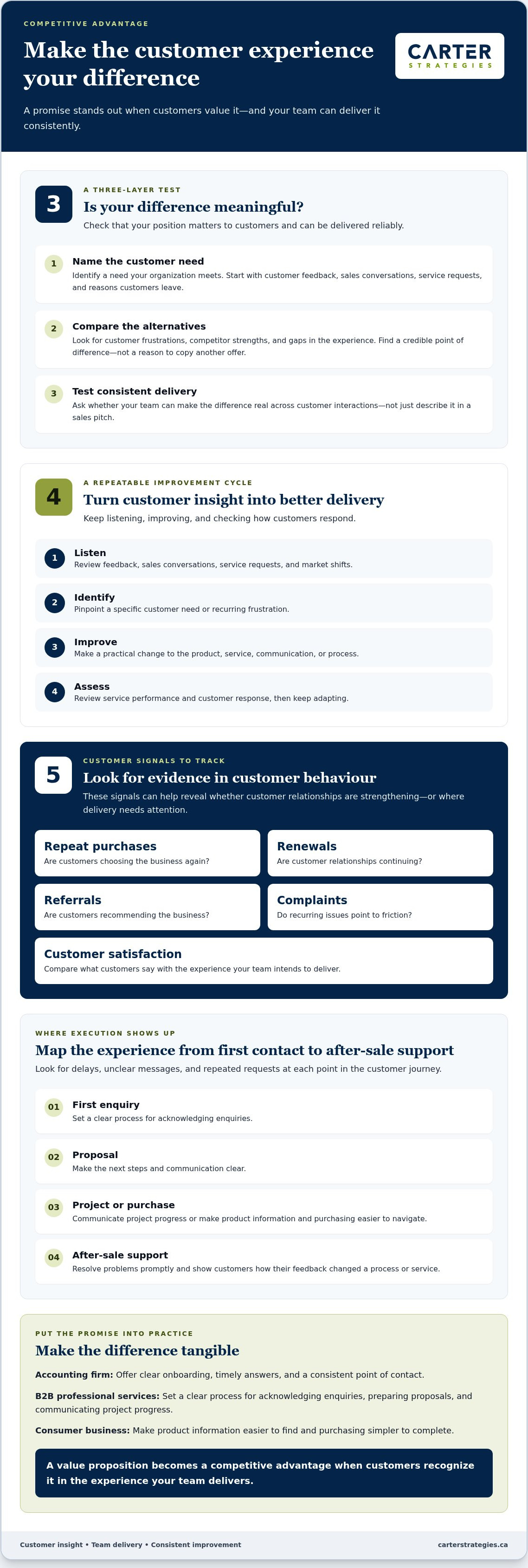
In a crowded market, customers can quickly compare similar offers. A business can stand apart through the experience surrounding its product or service. Consider a Canadian accounting firm offering expertise similar to its competitors. It could differentiate through clear onboarding, timely answers, and a consistent point of contact. Each interaction reinforces its value proposition. A promise of responsive service means little if clients wait days for a reply.
Start with customer and industry insights, not management assumptions. Review customer feedback, sales conversations, service requests, and reasons customers leave. Compare those findings with market trends, competitor strengths, and recurring customer frustrations. If customers struggle to understand what happens after signing a contract, for example, simplify the transition and explain the next steps. Competitor analysis should uncover gaps and expectations, not prompt you to copy another company’s offer.
Execution makes a difference visible. Map the customer journey from first enquiry to after-sale support, then identify where delays, unclear messages, or repeated requests create friction. A B2B professional services firm might set a clear process for acknowledging enquiries, preparing proposals, and communicating project progress. A consumer business might make product information easier to find and purchasing simpler to complete. These practical changes can build a more reliable experience than broad claims about being “the best.”
Relationships also shape how customers judge an offer. A business serving a defined group, such as independent Canadian retailers, can build trust by understanding their seasonal pressures and communicating in relevant terms. Invite customers to explain what works and what causes difficulty. Then show how their feedback changed a process or service. Visible follow-through strengthens the relationship; a feedback form without action does not.
Loyalty depends on repeated experiences, not one exceptional interaction. Track repeat purchases, renewals, referrals, complaints, and customer satisfaction to see whether relationships are strengthening. If customers return but report inconsistent support, that signals a delivery issue to address. Recognize loyal customers with thoughtful, relevant communication and resolve problems promptly. Retaining customers can support greater lifetime value than relying only on a steady stream of new acquisitions.
Customer preferences change, so differentiation requires ongoing attention. Regularly review feedback, market shifts, and service performance with employees who deal directly with customers. If buyers increasingly prefer online self-service, test a clearer digital process while keeping human support available for complex needs. For leaders developing a competitive advantage in a crowded market, the disciplined cycle is to listen, identify a specific need, improve delivery, and assess the response. That is how customer experience becomes a practical source of success.
2. How Do I Know If a Company Has a Competitive Advantage?
Use a three-layer test to decide whether your position is meaningfully different. First, identify a customer need your organization meets. Next, compare your offer with competitors’ alternatives. Finally, ask whether your team can deliver the difference consistently. A Canadian bookkeeping firm, for example, might offer incorporated consultants plain-language reporting tailored to their business decisions. That position matters only if customers value it and the firm can deliver it reliably.
Look for evidence across your product or service, brand, and customer response. A product distinction could be a feature that solves a specific use case; a service distinction could be smoother onboarding. Brand identity should make the difference easy to recognize, not simply add attractive design. Ask customers what they associate with your organization, why they chose it, and what they would miss if it disappeared. Their answers show whether your difference matters to them or only seems distinctive to your team.
Comparative and differential advantages describe different strengths. A comparative advantage means delivering similar value more efficiently or at lower cost, perhaps through streamlined internal systems. A differential advantage means customers see an offer as distinct and superior, such as specialized expertise for a clearly defined need. Values can also set an offer apart beyond price. A business might make repairability central, then support that promise through product design, service policies, and clear customer communication.
Price competition can attract buyers, but repeated discounting can narrow margins and leave less capacity to improve your offer. Differentiation requires investment in capabilities, service, or communication. Its risk is choosing a distinction customers do not value. Compare both approaches by looking at customer demand, delivery requirements, and the effect on sustainable margins.
Niche marketing helps a business focus on a group whose needs broader competitors serve less directly. Define that group by a shared need or use case, such as accounting support for incorporated consultants, then shape the offer and sales message around that need. A focused position can make your business more relevant without claiming to serve everyone.
Test a positioning strategy by sharing a clear value proposition with target customers and asking what they understand, value, and would choose instead. Then track observable responses, such as qualified enquiries, repeat purchases, and reasons for choosing or rejecting the offer. If customers repeat the intended distinction and their decisions reflect it, the position has evidence behind it.
Sales pitches should state who the business serves, what problem it solves, and why its approach is different. Use a concrete proof point, such as a defined onboarding process or specialized service, rather than an unsupported claim of being “the best.” Teams shaping these choices can connect customer evidence to business strategy development and practical priorities.
3. Brand strategy and operational execution
A brand earns recognition when its promise matches the customer experience. Brand positioning should define whom you serve, the value you offer, and the qualities your organization intends to be known for. A Canadian engineering firm, for example, might position itself around practical guidance for complex projects. Its website, proposals, meetings, and project delivery should all reinforce that focus. If the sales pitch promises clarity but project updates confuse clients, execution weakens the brand.
Turn positioning into operating choices. Identify the strengths behind the promise, then connect each strength to a repeatable practice. A firm known for responsive advice could assign clear ownership of client questions and give staff authority to resolve routine issues. A consumer business promising dependable quality could review production checks alongside customer complaints. These practices make brand identity part of daily work, rather than a slogan managed only by marketing.
Reputation grows through evidence customers can observe and share. A professional services firm might earn trust through useful explanations, dependable follow-through, and consistent advice across client teams. A retailer might build credibility with accurate product information and accessible support. Employees shape both experiences. Ask staff who speak with customers where the brand promise breaks down, then assign owners to address those gaps.
PwC considered a brand operationally differentiated if it excelled in at least two of six operational components. That finding points to a practical test: assess how well the business performs across its operations, not just how distinctive its messaging sounds. Review customer service, production, and supply chain management for delays, errors, or uneven standards. For example, compare common service complaints with how the team resolves them, then change the process that causes recurring problems.
An earned brand is built through repeated delivery, not a campaign alone. Choose a small set of customer commitments, such as clear project updates or consistent product quality. Translate each into observable behaviours, training, and decision-making guidance. Then use customer feedback and operational reviews to check whether delivery matches the promise. If teams cannot explain or consistently apply a commitment, simplify the message and focus the work.
Execution also determines whether a brand advantage is difficult to replicate. Competitors can borrow a phrase or visual style; they cannot quickly copy the trust created by experienced employees, shared service habits, and reliable systems. Align leaders and front-line teams around the same priorities, then review progress through customer feedback, service issues, and quality checks. A focused brand strategy matters when the organization consistently delivers its strengths, learns from gaps, and improves the experience over time.
4. Sustainable competitive advantages and economic moats
An economic moat is a strength that makes it harder for competitors to copy an advantage or win customers. It may come from specialized expertise, trusted relationships, efficient systems, infrastructure, or economies of scale. For example, a Canadian logistics company with well-designed routing processes could serve customers efficiently while maintaining reliable delivery. The moat is not the process alone; it is the organization’s ability to keep delivering value through it.
Test a potential moat with three questions: Does it matter to customers? Can the business maintain it? How easily could a competitor reproduce it? A patent-protected process may limit legal copying, while technical expertise takes time to develop. A recognizable brand can support customer preference, but messaging alone is easy to imitate. Stronger protection comes when a customer benefit depends on people, systems, and accumulated know-how working together.
Network effects can deepen an advantage. A service may become more valuable as more people use it, such as a marketplace where additional buyers attract more sellers and greater choice attracts more buyers. This dynamic depends on continuing to serve both groups well. User growth alone does not show whether the service delivers value or operates sustainably. Track participation quality, customer experience, and the resources needed to support the growing network.
Durability also requires adaptability. Customer preferences, technology, and industry conditions shift, so revisit the assumptions behind an advantage with employees close to customers and operations. A Canadian software provider, for instance, might find that clients now value easier integration more than a feature it once emphasized. It can protect its position by updating capabilities while keeping the core customer benefit clear.
Long-term growth requires discipline around profit and delivery. Assess which offerings create value, where processes strain the team, and whether growth depends on one person or relationship. If a consulting firm’s reputation rests on its founder’s expertise, documenting methods and developing other specialists can reduce dependence on that individual. Sustainable growth connects customer value with capable teams, efficient operations, and financial discipline.
Separate enduring strengths from temporary momentum by reviewing why customers prefer your business. Ask whether buyers stay because of accumulated expertise, dependable systems, or a trusted relationship, or because of a feature competitors can quickly match. Then identify the investment needed to maintain that strength. A moat based on outdated processes can erode, while one supported by learning and careful reinvestment can stay relevant as conditions change.
Review your advantage regularly through customer retention, repeat purchases, referrals, service quality, and financial results. If demand weakens or competitors reproduce a feature, identify what still makes the business valuable and where it must adapt. A sustainable advantage is not a permanent shield. It is a set of strengths the organization renews through learning, investment, and consistent choices.
5. Competitor analysis and market research
Compare competitors across price, product, and positioning using evidence customers can see. Record public prices and offer terms, compare features and service boundaries, then note each brand’s intended audience and main promise. A Canadian outdoor retailer, for example, could compare winter product ranges, delivery options, and durability claims. The aim is to identify unmet needs, not copy the closest rival.
Canadian businesses can use Statistics Canada data, provincial economic development agencies, trade association reports, and direct customer interviews to understand market conditions. For funding, explore federal and provincial grants tied to research, innovation, export development, or productivity, then match eligibility requirements to the proposed project. Treat funding as possible support for research, not proof that a market opportunity exists.
Build a competitor map that includes direct rivals and alternatives customers use instead. A mid-sized food producer might compare other brands, private-label products, and the option of making a similar item at home. For each alternative, document the target buyer, problem addressed, product features, service experience, and evidence behind its claims. Ask sales and service employees to add examples from customer conversations, which often reveal why buyers switch or stay.
Then look for patterns. If several competitors promote broad selection but customers struggle to choose, clearer guidance could help your business stand out. If competitors compete on speed, compare the full customer journey, from placing an order to resolving a problem. A difference matters only if your organization can deliver it consistently and customers value it enough to change their behaviour. Record each possible gap, the evidence supporting it, and the capability required to act.
Market research should test the assumptions behind your opportunity. Interview current customers, lost prospects, and people who chose another option. Ask what they needed, what shaped their decision, and which alternatives they considered. A Canadian B2B supplier could test two positioning statements in sales conversations, then track which one prospects understand and recall. Pair those responses with engagement signals, such as meeting requests, repeat enquiries, or reasons for declining.
Separate a useful insight from an attractive theory by setting a clear decision rule before testing. Define what customer response would justify refining the offer, changing the message, or dropping the idea. Review the results with employees responsible for sales and delivery; their input can reveal execution constraints early. This keeps the team focused on a market position it can support, rather than a claim that sounds distinct but fails in practice.
If competitor findings point to a strategic choice your team needs to align around, develop a business strategy grounded in market evidence and executable priorities.
Carter Strategies: Business Strategy Development
Carter Strategies helps leadership teams turn market findings into clear priorities and action plans through Business Strategy Development. Turn to this support when your competitive analysis points to an opportunity, but leaders and employees need to align on where to focus and how to deliver the strategy. Marketing Strategy can connect your differentiated position with the customers you intend to serve.
Rather than treating strategy as a plan developed in isolation, the work brings employee perspectives into the process to build understanding and ownership. The result is a practical direction your team can carry into decisions and execution. Visit Carter Strategies to learn more or get in touch.
Turn market insight into a clear next move
Developing a competitive advantage in a crowded market takes more than strong analysis; it calls for leadership choices teams can act on. Bring together the people responsible for decisions and delivery to agree on what the findings mean for the business. A shared understanding can turn competing priorities into a clear direction.
Start with one decision your team can move forward now. Clarify who owns the next step, how progress will be reviewed, and what new information could change the direction. This keeps the strategy connected to day-to-day work and gives employees a meaningful role in carrying it forward.
If your leadership team is ready to discuss its market and priorities, contact Carter Strategies to start a conversation. A clear next step can help your team move forward with purpose.
Frequently Asked Questions
How are you different from your competitors?
Identify what customers notice and remember about working with your business, then compare that impression with the alternatives they considered. Ask recent customers what nearly led them to choose another supplier and what tipped the decision. Compare their answers with your proposals, onboarding materials, and service commitments. If customers cite a strength your team does not explain clearly, make that evidence easier to recognize during the buying process.
How Do I Know If a Company Has a Competitive Advantage?
Look for a repeatable pattern in results, not one successful sale. Compare customer groups, offerings, or sales channels to see where the organization performs better and why. For example, review whether a particular service line brings stronger renewals while requiring less corrective work. A useful assessment connects the outcome to a capability the company can sustain, rather than assuming every positive result comes from its market position.
How can sales craft a pitch based on differentiation?
Build the pitch around the prospect’s stated priorities, not a standard company introduction. Sales can ask what success would look like, which internal constraints matter, and what evidence the buyer needs to proceed. Then connect one relevant capability to that decision and use a specific example the team can substantiate. Close by confirming what remains unresolved. This keeps the discussion useful and helps sales avoid claims the delivery team cannot support.
What is a competitive advantage in business, and how is it measured?
A competitive advantage is a business strength that helps the organization win or retain customers relative to alternatives. Measure it by combining customer outcomes with the resources required to produce them. For example, compare renewal patterns and customer feedback with the staff time or rework associated with delivery. Review the same measures across comparable customer groups. This gives leaders a clearer view of whether an apparent advantage supports sound operations as well as customer preference.
How can a business identify unmet customer needs in a crowded market?
Examine the work customers do to compensate for an inadequate offer. A business-to-business supplier could review support tickets for repeated spreadsheet workarounds, then ask affected customers what those workarounds help them accomplish. Support employees can help distinguish a frequent inconvenience from an isolated request. Before redesigning the offer, test a small change with the customers who raised the issue and observe whether it removes the workaround.
What strategies help a small business differentiate its brand and offerings?
Make it easier for customers to understand which offer fits their situation. A small outdoor equipment repair shop, for instance, could distinguish routine maintenance from complex repairs in its service descriptions, explaining what each includes and whom it suits. Use consistent language across the website, estimates, and in-person conversations. Review customer questions with staff; repeated confusion may signal that the offer structure or brand message needs clearer wording.
How can businesses build a competitive advantage through customer experience?
Study the handoffs customers do not see, since delays often arise between teams rather than during direct interactions. A home renovation company could map how a confirmed design moves from sales to scheduling and installation, then identify missing information that causes rescheduling. Assign an owner to each handoff and record where work stalls. This helps leaders address the source of customer frustration instead of asking front-line staff to apologize repeatedly.
What role do innovation and product quality play in standing out from competitors?
Innovation gives a business ways to address changing needs; quality determines whether customers can rely on the resulting offer. Set a clear test before introducing a change, such as whether a new feature reduces a recurring product issue without creating another. Ask production, sales, and support employees to review early feedback together. Their combined perspective can reveal defects or usability problems before the change becomes part of the regular offer.


