


A pivot should respond to evidence, not frustration alone. Knowing how to pivot a business strategy successfully means identifying what is not working, understanding customer and market needs, and testing a focused change before committing the whole business. Measures such as revenue, gross margins, operating profit and unit economics can help show whether the current direction is sustainable.
If growth has stalled or customers aren’t responding as expected, it’s reasonable to question whether the strategy still fits. But changing direction too quickly can put effective products, customer relationships and team capabilities at risk. A thoughtful pivot starts with listening and analysis, then involves people across the business in decisions that affect their work.
This article explains why a pivot may be warranted, how to assess customers, competitors and market gaps, and how to shape a strategy for change. You’ll also learn how to test a new direction, set clear goals and align teams around practical action plans, helping the business adapt with focus rather than react without a plan.
Key Takeaways
- Use performance measures and customer response to decide whether a change is warranted, rather than pivoting out of frustration.
- Research customer needs, competitor offerings and market gaps before choosing a new direction.
- Test a potential revenue stream on a small scale to learn what works before changing the wider business.
- Define the pivot’s scope, goals and measures of progress so the team can assess its impact.
- Involve employees in shaping the strategy and action plans to build alignment and ownership for the change.
Business Strategy Pivoting, What, When & How?
A pivot changes how a business serves its market, for example by changing its product, target customer or revenue model. Compare options against customer demand, financial performance, operational capacity and the evidence behind each direction.
Signals for a Strategic Pivot
Signals for a strategic pivot include sustained changes in customers, competitors, markets or technology that weaken the fit between an offering and its audience. These signals matter because falling performance can point to a changed market, not just a short-term sales problem.
Track revenue, gross margins, operating profit and unit economics alongside customer feedback and competitor activity. If customers increasingly request a service you don’t provide, or a competitor meets their needs more effectively, investigate the gap before revising the strategy. Emerging technology can also make an existing offer less relevant.
A business may need a pivot when progress stalls despite investment, or when demand centres on just one product feature. Distinguish a temporary dip from a persistent pattern by comparing recent performance with past results and reviewing the assumptions behind the current model.
Opportunity-Led and Reactive Changes
An opportunity-led pivot follows evidence of unmet demand or a promising customer group. A reactive change responds to pressure without first establishing its cause. The distinction matters because a rapid shift can discard products, relationships or capabilities that still support the business.
For example, a company might explore selling an existing product to B2B customers if consumer demand is weak but business buyers have a clear need. That is a hypothesis to test, not proof of a viable market. By contrast, cutting an offering after one disappointing period may address a symptom rather than the underlying issue.
Before acting, identify what is not working and what remains effective. Then compare the opportunity with the resources, skills and customer relationships the business can carry forward.
Testing New Revenue Streams
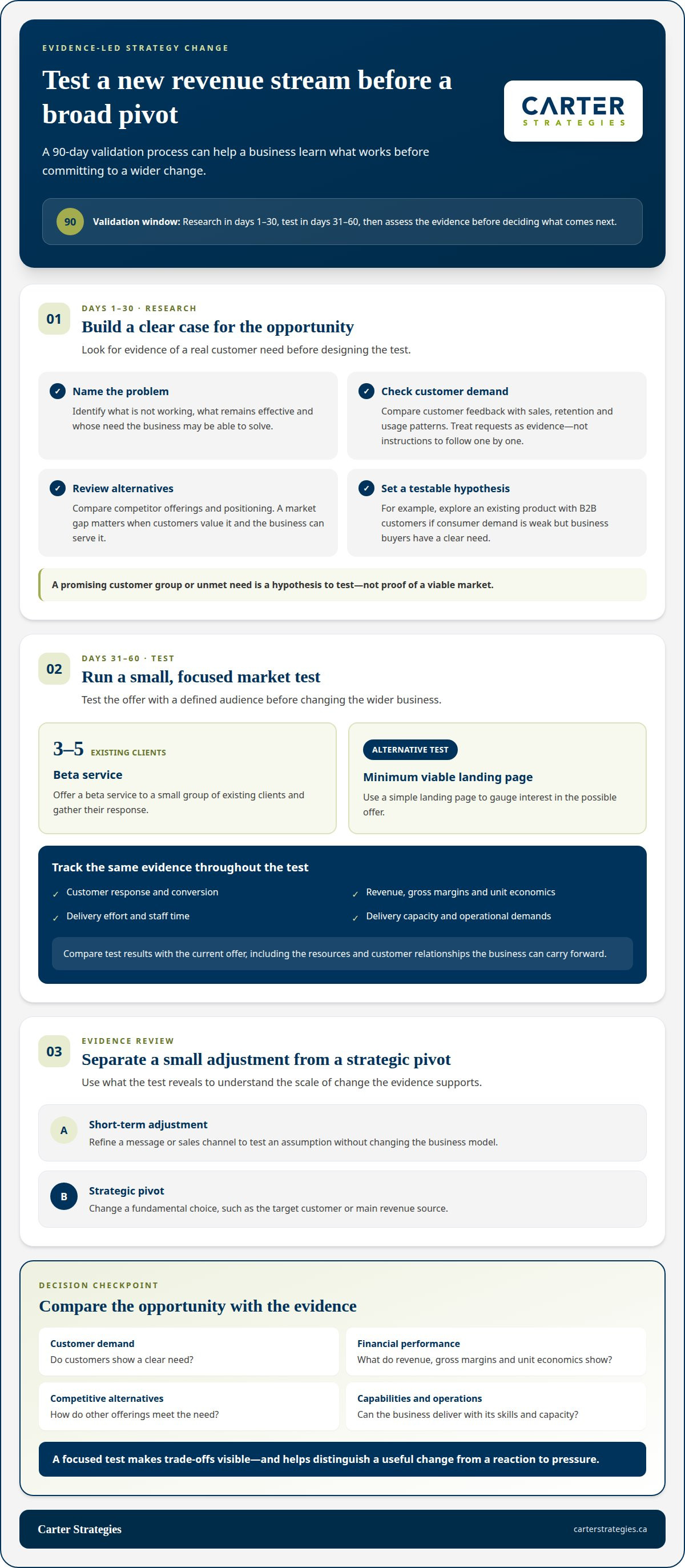
Gradual testing evaluates a possible revenue stream before the business commits to a broad change. A 90-day validation process can organize the work: use days 1-30 for research and days 31-60 for testing, then assess the evidence before deciding what comes next.
During testing, offer a beta service to 3-5 existing clients, or use a minimum viable landing page to gauge interest. Track customer response, conversion, delivery effort, revenue, gross margins and unit economics. Compare results with the current offer, and note operational demands such as staff time and delivery capacity.
Short-term adjustments, such as refining a message or sales channel, can test an assumption without changing the business model. A strategic pivot changes a more fundamental choice, such as the target customer or main revenue source. Use the results to tell the difference.
Comparing Pivot Options
Compare product, customer and business-model changes using the same criteria: customer demand, competitive alternatives, financial performance, core capabilities and operational requirements. This makes trade-offs visible and helps leaders explain why one option fits better than another.
For instance, changing a product feature may preserve the current customer base, while targeting a new segment may require a different marketing strategy, channel or brand voice. A new business model can affect revenue timing and delivery processes. Map these differences before choosing a direction, and include employee input on execution.
Track operating profit, gross margins, revenue and unit economics during the change, alongside customer retention and delivery resources. In Canada, assess regulatory obligations, funding-program conditions and tax treatment in light of the proposed activity, sector, province or territory, and revenue model. Include these considerations in the financial and operational review before committing to a major shift.
Researching customers, competitors and market gaps
Customer and industry insights help leaders test whether an offering solves a real problem. Compare what customers say with competitor choices and business performance before changing direction.
Target Customers and Their Problems
Customer research identifies which people or organizations share a problem your business can solve, helping leaders focus on a viable target. Interview at least 10 people in the intended market and ask about their needs, current alternatives and barriers to buying. Look for consistent problems, not isolated requests. Then identify at least 10 potential clients who have the problem and budget for a solution.
Separate observations from assumptions. For each interview, record the customer’s role, the task they need to complete, what they currently use and what remains unresolved. Compare responses across customer groups, such as existing buyers and prospective B2B clients. This reveals whether the same offering needs a clearer value proposition or a different target market.
Competitor research adds context to that feedback. Review 5-10 competitors’ offerings, pricing, size and positioning, then compare their strengths with your core capabilities. Note where customers are underserved and where an established competitor already meets the need. A market gap matters only when customers value it and your organization can serve it.
Customer Feedback in Decision-Making
Customer feedback is evidence to help refine an offering, not an instruction to follow every request. Changing a feature customers rely on can create dissatisfaction, even when leaders intend to improve the product. Group feedback by recurring need, customer type and buying stage, then compare it with usage, sales and retention patterns.
Test a small change before making a broad revision. For example, adjust one service feature for a defined customer group, then gather feedback and measure the effect. If customers respond differently from the interview group, revisit the assumption instead of scaling the change automatically.
Starbucks offers a useful prompt for examining how an offer and customer experience fit together. It began as a single Seattle retail store selling coffee makers, coffee beans and related products, rather than freshly roasted coffee by the cup. The example encourages leaders to examine what customers value in the whole experience, not just the product. For another business, that could mean studying convenience, advice, service or the buying process.
Bring employees into the analysis alongside customer feedback and performance data. Front-line teams can identify recurring objections, delivery problems and mismatches between the promise and the actual experience. Connect those observations to a specific goal, such as improving retention or clarifying the offer for a target group. A business strategy development process can help translate evidence into aligned priorities and action plans.
Reasons to pivot, including market opportunities and adversity
A pivot may follow a new market opportunity, persistent adversity or evidence that customers no longer value an offer. Common risks include reacting before diagnosing the problem, changing too much at once, and choosing a direction without validating demand or aligning the team.
Market Opportunities and Adversity
An opportunity-led pivot pursues a market need, while an adversity-led pivot responds to declining performance or changing conditions. Both can prompt useful innovation, but the distinction helps leaders decide whether to pursue emerging demand or address an immediate threat.
Twitter began as an offshoot of Odeo in 2006, a podcasting platform affected by iTunes’ arrival. That example shows how an external shift can make an existing model less viable and prompt a new direction. Yet adversity alone is not a strategy. First, identify whether the pressure comes from customer preferences, competition, technology or internal execution.
Financial signals can also be a reason to delay. If operating profit, gross margins, revenue or unit economics show that an offer still performs, changing it before understanding a short-term decline could weaken a working business. Explore other options first, such as adjusting the product, channel or marketing approach. A pivot makes sense when evidence points to a deeper mismatch, not simply because results have fluctuated.
Repurposing Products for New Markets
Repurposing a product means adapting an existing offer to meet the needs of a different customer group. It matters because a weak response from the original target may reflect poor audience fit, rather than a product without value.
For example, a product designed for individual buyers might solve a specific operational problem for B2B customers. Before shifting the target, test whether business buyers recognize that problem, have a reason to adopt the offer and can access it through a suitable sales channel. The same product may need changes to its features, packaging, service or value proposition.
Keep what works, then test the smallest change that addresses the new market’s needs. Compare customer responses and delivery demands with those of the existing offer. A new audience can require different sales conversations and support, so involve employees who understand those interactions before committing the wider business.
Adapting to Market Conditions
Adapting to market conditions means adjusting products or channels as customer behaviour and competition change. It matters because an effective offer can lose relevance when its features or buying experience no longer match demand.
During disruption, review which product features remain useful and which create friction. Chipotle’s digital sales grew by 174.1% in 2020, illustrating how a changing market can increase the importance of digital channels. For another business, social media or online sales may offer a better route to customers, but the choice should fit their buying habits and the company’s capacity.
Digital marketing is not a substitute for product-market fit. Test a channel with a defined audience and message, then compare responses, qualified demand and resulting revenue. If a channel attracts attention but few suitable customers, adjust the target or offer before expanding the campaign. This keeps a channel change distinct from a full strategic pivot.
Defining a business pivot
A business pivot is a deliberate change to how a company serves its market when its current direction no longer fits. The change may affect a core product, customer group, key feature or business model. A strategic pivot goes beyond a campaign adjustment: it changes important choices about what the business offers, whom it serves or how it earns revenue.
Consider Wrigley’s early shift. In 1892, it sold baking powder alongside soap; in 1893, it moved into manufacturing and selling chewing gum. The example shows a change in the company’s central offer, not simply a new way to promote soap. To define a pivot, identify the strategic choice changing and the customer need the new direction intends to meet.
Not every adjustment qualifies. Revising a sales message, changing a social media channel or improving a product feature can support the existing strategy without changing its foundation. By contrast, redirecting sales from individual consumers to businesses could alter the target market, sales process and value proposition. State which elements will stay, which will change and why the distinction matters.
A clear definition also sets boundaries. Name the problem behind the change, the customer whose needs will guide decisions, and the part of the offer being reconsidered. Kutol Products Company negotiated a 1933 contract with Kroger to produce wallpaper cleaner, then introduced Play-Doh through its subsidiary Rainbow Crafts Company in 1956. Its product history illustrates how a different use can lead to a new market and offer.
Before you pivot your business, describe the new direction in plain language. For example: “We will serve independent retailers with a subscription service built around our existing inventory.” That statement identifies a customer, an offer and a business model. Leaders can then test whether employees understand the change and whether sales, service and operations can support it.
Define success through goals tied to the chosen direction, not activity alone. If a company shifts towards B2B professional services, it might assess qualified buyer interest, repeat business and delivery requirements. The specific measures should reflect the new model and the current offer. Without clear goals, teams can interpret “pivot” differently, pursue conflicting priorities and mistake motion for progress.
A strong pivot definition connects evidence to action: what changed in the market, what the business will do differently and what it will retain. Wrigley’s move to gum illustrates a change in core offer; a minor package redesign would not. This distinction helps leaders scope the decision, explain its purpose and align teams before wider implementation.
Developing a pivot strategy
A pivot strategy turns a proposed direction into clear choices, measurable goals and coordinated work. It connects customer evidence with the organization’s core capabilities, financial needs and ability to deliver, making the strategic shift an executable plan rather than an announcement.
Start by stating the new direction and the reason for it. Define the customer, the offer and the value the business intends to provide. Then set goals for revenue and customer traction that fit the new model. For example, an organization moving toward a subscription offer needs to plan for recurring customer relationships, not just initial sales.
Set the scope before assigning resources. Identify which products, markets, channels and internal processes will change, and which will continue. A roadmap can connect strategic goals to milestones, owners and measures. If a new platform is central to the pivot, specify how it supports the customer experience and which teams must adapt their work.
Use a 90-day validation process to learn before scaling. The research phase runs from days 1-30; testing runs from days 31-60. During testing, offer beta services to 3-5 existing clients or run a small pilot. Use days 61-90 to review results, refine the plan and decide whether the evidence supports wider implementation.
Choose measures that fit the strategy. Track customer response, revenue, gross margins, operating profit and unit economics, alongside delivery capacity and employee workload. A pivot towards a new customer group may also call for different sales channels or brand messaging. Review measures at each milestone so teams can adjust the plan without losing sight of its goals.
Involve employees and key stakeholders while shaping the roadmap. Sales teams may hear objections first, while operations staff can identify delivery constraints. Explain why the change is needed, how the organization will respond and what will change for each group. Invite practical concerns before finalizing action plans, then assign clear ownership across departments.
Plan for financial fluctuations as the business moves towards a more sustainable foundation. Map expected revenue changes, operating requirements and resource commitments against the current business. Discuss assumptions with the management team and relevant business advisors. A written review schedule helps leaders respond to new evidence instead of treating early forecasts as fixed expectations.
For a pivot that needs focused priorities, team alignment and practical action plans, explore business strategy development.
Carter Strategies: Business Strategy Development
Carter Strategies helps leadership teams turn a potential pivot into clear priorities and coordinated action through Business Strategy Development. This can help when customer and industry insights point to a new direction, but the management team needs to align goals, people and execution. The work can involve employees in strategic planning, connect Marketing Strategy to the business direction, and shape Growth Strategies and Planning around organizational priorities. Fractional CMO and CRO services can also bring senior marketing and revenue leadership into the planning process.
For support aligning your team around a practical strategy for change, contact Carter Strategies.
Turn the next strategic choice into shared progress
A pivot doesn’t end when a new direction is announced. Leaders need to keep making deliberate choices as customer needs, team capacity and business priorities evolve. Set a clear point to revisit the direction, and decide what evidence would prompt the organization to continue, adjust or reconsider its approach.
Knowing how to pivot a business strategy successfully means treating change as part of leadership, not a one-time event. Keep the purpose clear while staying open to what the business learns. With focus and considered decisions, your team can move forward with greater confidence.
Frequently Asked Questions
Why would you consider a pivot?
Consider a pivot when the business’s current approach repeatedly fails to solve a problem customers will act on, or when an emerging opportunity better fits its capabilities. For example, a firm may find that clients value its specialist knowledge but struggle to apply it internally. That pattern could point to a different service format, not necessarily a different area of expertise. Pinpointing the mismatch helps leaders choose a focused response.
What are the financial impacts of a pivot?
A pivot can change cash flow, fixed commitments and revenue timing, while creating competing demands on staff and leadership attention. For example, a business adding a new offer while maintaining its existing one must account for the resources each requires. Map expected transition cash needs against current obligations, and identify which commitments can be adjusted if adoption takes longer than planned.
What are the key steps to pivot a business strategy successfully?
Leaders learning how to pivot a business strategy successfully can start by naming the decision that needs to change, assigning an accountable owner and setting a review point. Next, identify which choices the owner can make independently and which require leadership approval. This structure helps teams resolve issues without waiting for repeated executive direction. Documenting the rationale also gives new employees and partners a consistent explanation of the change.
How do you validate a new business strategy before committing resources?
Before committing wider resources, test whether the proposed strategy can work in day-to-day operations. Walk through a typical customer journey with the relevant teams, from initial enquiry through fulfilment and follow-up. Record handoffs, decision delays and service gaps. This rehearsal can expose constraints that customer interest alone won’t reveal, helping leaders refine responsibilities and processes before expanding the change.
How should businesses assess customer needs and market demand before a pivot?
Assess demand by examining the choices customers make, not only what they say they like. Explore how buyers currently solve the problem, what would prompt them to switch and who else must approve a purchase. For example, an employee may welcome a new business service while a finance lead controls procurement. Understanding these different roles can clarify the offer, sales process and audience for a credible market test.
How much does a business strategy pivot typically cost, and how long does it take?
The cost and duration depend on what changes, how much work the business can absorb internally and whether the pivot requires new systems, capabilities or customer support. A change to positioning has different resource demands from a new delivery model. Build a transition plan that separates essential commitments from optional ones, then review capacity and dependencies before expanding. This gives decision-makers a practical basis for sequencing the work without assuming every pivot follows the same schedule.
How should leaders communicate a strategy pivot to employees, customers, and investors?
Communicate the change with messages suited to each group’s decisions and concerns. Employees need clarity about priorities and how to raise implementation issues; customers need to know whether their service, terms or points of contact will change. Investors need a clear explanation of the business rationale and how leadership will review progress. To explain how to pivot a business strategy successfully, keep the central reason consistent while tailoring the details to each audience.


