


A growth plan can be approved and shared yet still go nowhere. Understanding why most growth plans are never implemented starts with a simple reality: teams struggle to act when priorities compete, ownership is unclear, leaders don’t reinforce the direction, or employees can’t see how their work contributes. The plan itself isn’t the outcome; coordinated action is.
That gap frustrates leaders and teams alike. People can be committed to growth and still get pulled toward urgent work, new ideas, or departmental goals that don’t align. When that happens, stalled progress isn’t simply an effort problem. It often reflects how the plan was built and how the organization supports its execution.
This article explains why growth plans lose momentum and how clear priorities, named accountability, visible leadership support, and stronger organizational alignment can get them moving again. It also explores why plans need room to adapt as circumstances change, and how practical action plans connect strategic priorities to the work teams do every day.
Key Takeaways
- Keep a growth plan adaptable when leadership or organizational direction changes, and revisit it often enough to maintain momentum.
- Translate strategic priorities into a focused set of initiatives, clear action plans and work teams can connect to the end goal.
- Match responsibilities with the people, capacity and resources needed to carry out the work, then track progress and share updates.
- Engage key people early and define ownership and measures of success so accountability is clear across the organization.
- Bring internal and external perspectives together to identify shared challenges and align plans that might otherwise pull teams in different directions.
3.3 At the End of a Process That Never Ends: What Are the Results of Planning?
A growth plan must guide action while leaving room for change. Leadership shifts, new evidence, and pilot results can all affect its direction.
Adapting plans and goals
An adaptable plan keeps priorities relevant as circumstances change instead of treating every original target as fixed. This matters when a leadership change resets decision-making or customer and industry insights reveal a different opportunity. As implementation unfolds, new information can change the goal. Leaders should explain what changed, why it matters, and which commitments remain in place.
Pilot projects give teams a way to test an approach before extending it across the organization. Toronto’s High Park Movement Strategy offers a public example of phased change: City Council approved it in May 2023, and the first changes were introduced in August 2023. These included weekend and holiday road closures and road adjustments for walking and cycling. The example shows how implementation can begin with practical changes, then continue as plans develop.
Reviewing and updating growth plans
Review a growth plan regularly during implementation, rather than relying only on an annual review. A monthly progress check-in can be as short as 30 minutes. Teams can review the last 30 days, surface obstacles and assign next steps for the next 30 days. That rhythm helps leaders spot shifting assumptions before they undermine delivery.
A review should distinguish between a change in execution and a change in direction. If a new leader revises priorities, the organization needs to assess how that decision affects current work, internal ownership, and external commitments. Even a plan built around a four-year horizon needs more frequent strategic reviews, so teams can make appropriate pivots without losing sight of the intended outcome.
Risks of delay or abandonment
Delaying or abandoning a growth plan can leave teams with unfinished work, repeated planning, and declining momentum. When people switch to new ideas before completing current priorities, another plan may replace the one already underway. Missed tasks can then cascade, draining team energy and making progress harder to track. A change-management approach can support alignment through stakeholder involvement, transparency, and candid discussion.
For Canadian small businesses, implementation can be especially challenging when employees have competing responsibilities and staff capacity is limited. A plan may stall if the people, time, or technology required are unavailable. Clear sequencing is essential: protect the work that matters most, adjust goals when conditions change, and explain each adjustment to employees and external stakeholders.
Turning strategic priorities into actionable operations
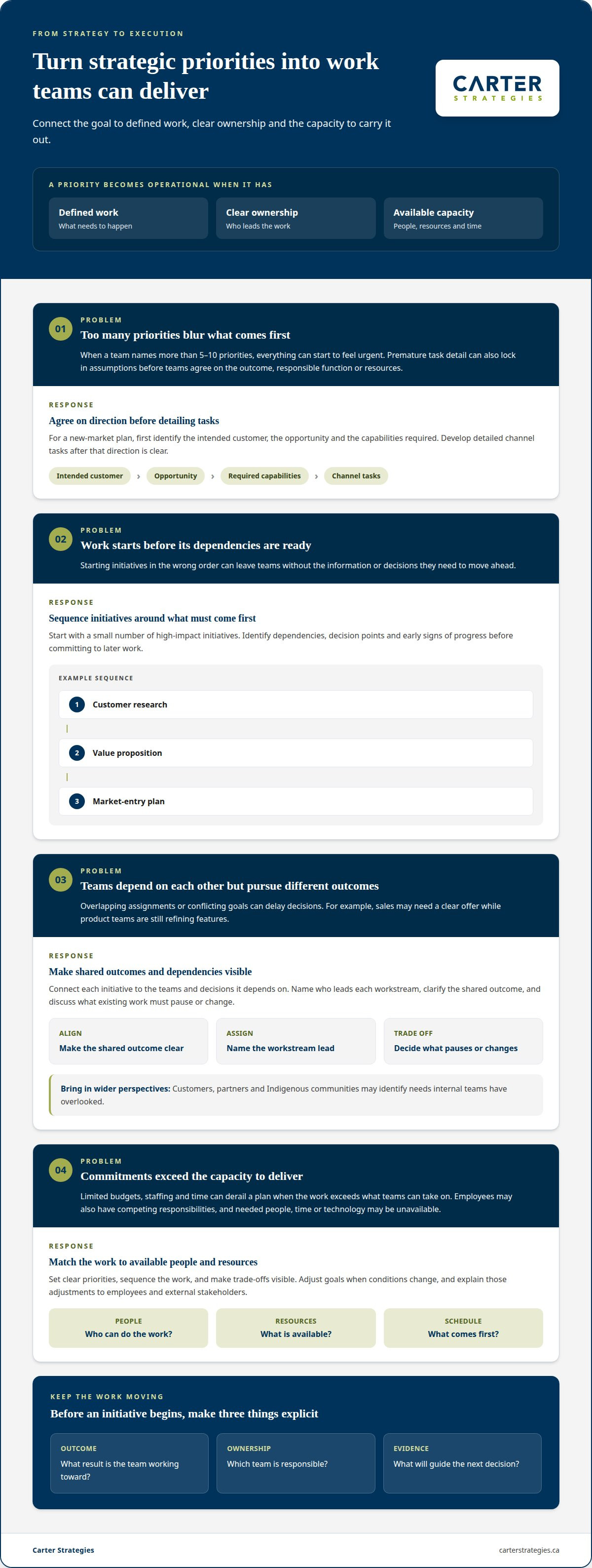
A strategic plan becomes operational when each priority connects to defined work, ownership, and capacity. Without that link, departments can stay busy while progress on shared goals stalls.
Too many priorities and premature detail
A long priority list spreads attention across work that may not have equal value or readiness. If a team names more than 5-10 priorities, it risks treating everything as urgent and giving members no clear basis for choosing what comes first. Premature detail creates a related problem: teams can spend time specifying tasks before agreeing on the outcome, responsible function or resources needed.
For example, a plan to enter a new market should first identify the intended customer, the opportunity, and the capabilities required. Detailed channel tasks can follow once that direction is clear. A strategic plan needs enough detail to guide action, but not so much that teams treat early assumptions as fixed before testing them.
Sequencing initiatives
Sequencing initiatives means ordering work so early actions prepare the ground for later commitments. Start with a small number of high-impact initiatives, then identify dependencies, decision points, and early signs of progress. For example, customer research may need to inform a value proposition before a team builds a market-entry plan.
Quick wins can build momentum, but they should support the larger goal rather than distract from it. Set an initial outcome, name the team responsible, and agree on what evidence will guide the next decision. This approach prioritizes effective execution over rushing to finish the plan, while leaving room to adjust details as teams learn.
Competing team priorities
Competing priorities arise when departments commit to different outcomes or assign the same people to overlapping work. The result is often delayed decisions. A sales team may need a clear offer while product colleagues continue refining features, leaving neither team able to complete its contribution alone.
Connect each initiative to the teams and decisions it depends on. Make the shared outcome visible, clarify who leads each workstream, and discuss what existing work must pause or change. External perspectives can also shape priorities. For instance, considering customers, partners, and Indigenous communities may reveal needs internal teams had overlooked.
National priorities can also clarify how broad goals become practical commitments. According to the United Nations, delivering Sustainable Development Goal 4 requires education financing to become a national investment priority. For a business, the lesson is to connect a stated goal to the decisions, accountable teams and resources that can move it forward.
For organizations aligning business priorities with execution, inclusive growth planning can help connect direction with practical action.
Implementation responsibilities and management support
Limited budgets, staffing, and time can derail growth plans when commitments exceed available capacity. Leaders need to match the work to people, resources, and schedules, then make trade-offs clear.
Assigning implementation responsibilities
Implementation responsibilities identify who champions each part of a plan and who tracks delivery. Without named owners, teams may assume someone else will coordinate decisions, schedules, or progress updates. For each initiative, assign a lead, identify supporting groups, and set a clear reporting route. Include middle managers when defining responsibilities, since they connect leadership decisions with day-to-day work.
Management support makes those assignments workable. Leaders need to confirm that initiative owners have decision-making authority, staff capacity, and access to required technology. They should review schedules and budgets with the owners, then remove barriers to action. For example, if a project lead can’t get timely input from another department, a manager can clarify priorities and agree on the next decision.
Leadership support and stakeholder buy-in
Leadership support means consistently backing the plan through decisions, communication, and investment. Stakeholders are more likely to understand a transition when leaders explain its purpose, listen to staff concerns, and show how responsibilities will change. For example, a new leader can meet with employees before resetting direction, then clarify which commitments continue and which need to change.
Buy-in develops through involvement, not a one-time announcement. Invite affected teams to identify risks, dependencies and information they need to contribute. Share progress and decisions with those groups, including employees responsible for implementation. According to the United Nations, achieving Goal 8 requires reforming the financial system to address rising debt, economic uncertainty and trade tensions while promoting equitable pay and decent work for young people. The example reinforces that stated priorities need supporting decisions and coordinated action.
Budget, staffing, and time constraints
Limited resources derail growth plans when leaders approve more work than teams can deliver alongside existing responsibilities. A plan may require specialized skills, technology, or staff time that departments haven’t set aside. If leaders treat implementation as an addition to everyone’s workload, competing deadlines can delay tasks and weaken follow-through.
Make capacity visible before setting timelines. Initiative owners can identify required skills, staff time, tools, and budget, while managers clarify which current activities can pause or move. If a team lacks capacity for every initiative, reduce or sequence commitments instead of treating all deadlines as fixed. Track schedule and budget changes alongside progress, then communicate decisions to affected stakeholders. This keeps the plan connected to what the organization can actually deliver.
Leadership engagement and clearly defined roles
Leadership engagement connects an organization’s mission to the decisions and behaviours that move its strategic plan forward. Clear roles help employees understand the purpose of their work and how progress will be assessed.
Ownership and accountability
Ownership means assigning a specific person to guide each strategic outcome, while accountability makes progress visible. For a customer-retention objective, for example, the plan should identify an owner, define success, and clarify which teams contribute. Appropriate KPIs turn broad goals into evidence leaders and employees can review together.
One person can coordinate an outcome without doing every task alone. The owner brings contributing groups together, surfaces obstacles, and reports whether agreed actions are moving forward. Shared delivery does not mean responsibility is unclear. When a sales initiative depends on service improvements, both teams need defined contributions and a clear way to resolve missed commitments.
Accountability also requires a consistent review process. Leaders can compare each KPI with its intended result, discuss gaps, and decide whether to adjust actions or support. If customer-retention progress slows, the owner might bring forward feedback from customers and frontline employees. That evidence helps the management team address the cause rather than treat a missed target as an isolated performance issue.
Leadership engagement
Leadership engagement is the active role senior leaders play in explaining direction, listening to employees, and reinforcing agreed priorities. It matters because employees notice whether leaders’ decisions match the mission they communicate. If executives endorse a growth goal but reward only short-term departmental results, teams receive conflicting signals about what should guide their work.
Leaders can support alignment by connecting each strategic objective to the organization’s purpose and explaining what must remain consistent. They should also involve employees who will carry out the work before finalizing execution plans. Those conversations can surface practical barriers, clarify handoffs, and build understanding of why the direction matters across functions.
During reviews, leaders should ask what progress shows, what obstacles remain, and which decision is needed next. They can recognize follow-through, address competing demands, and communicate changes in direction directly. For instance, if customer feedback challenges an assumption behind a growth objective, leaders can discuss the evidence with affected teams before revising measures or actions. This keeps engagement active after the plan’s initial announcement.
Alignment on organizational challenges and success
Organizations align around growth when they agree on the challenge, the desired outcome, and the evidence of progress. A shared vision gives teams a common reference point, but implementation also depends on connecting that vision to current conditions, practical choices, and expected results.
Start by comparing the organization’s plans and commitments. A business may have strategic, community, housing, or economic development plans, each with useful goals but separate owners and timelines. If those plans compete for the same staff or address connected challenges independently, work can become disjointed. Mapping shared outcomes, dependencies, and decision-makers helps leaders see where plans support one another and where priorities need coordination.
Then bring internal and external perspectives into the assessment. Employees can identify process barriers and capability gaps; customers, partners, and donors can describe changing needs. Consider those views alongside the organization’s strengths, weaknesses, and changing environment. For example, if customers find an offer difficult to understand, teams can examine the value proposition, service experience, and market conditions before choosing a response.
Alignment requires candid discussion, not automatic agreement. The management team can test whether functions understand the central challenge in the same way, then ask what evidence supports that view. If sales sees a demand problem while operations sees a delivery constraint, both perspectives matter. Clarifying the relationship between those issues helps teams choose a shared objective instead of pursuing separate fixes.
Define success in terms people can observe. For a growth objective, specify the intended customer or market, the change the organization wants to create, and the measures that will show progress. Then connect those measures to each team’s contribution. A marketing group might track whether the target audience understands the offer, while sales examines customer response. The measures differ, but they should point toward the same outcome.
Review how related plans fit together as circumstances change. If a new customer need alters a market priority, leaders can assess the effect on staffing, timelines, and existing commitments. This keeps the strategic plan connected to current conditions without discarding useful work. Recording the decision and its rationale also helps employees understand what remains important and what has changed.
When priorities remain disconnected across teams, discuss aligning your growth strategy around shared organizational challenges and measurable outcomes.
Carter Strategies: Growth Strategies and Planning
Carter Strategies helps leadership teams turn growth priorities into an aligned direction and practical action plans. Its Growth Strategies and Planning and Business Strategy Development services can help when teams lack shared priorities, clear ownership, or agreement on the challenges they need to address.
When growth depends on clearer market direction, Marketing Strategy can connect customer and industry insights to organizational priorities. Fractional CMO and CRO services provide senior marketing or revenue leadership for businesses that need this expertise to plan and advance their strategy. Advisory work is available on a project or retainer basis.
If your growth plan needs clearer priorities and stronger team alignment, contact Carter Strategies to discuss your needs.
Make the Next Growth Decision Count
Understanding why most growth plans are never implemented matters only if it changes the next decision. Before adding another initiative, identify what the organization must protect, stop, or resource to make its chosen direction possible. That choice can turn a planning conversation into a clear commitment for leaders and teams.
When the direction or execution model needs work, Carter Strategies offers Business Strategy Development and Marketing Strategy, along with Fractional CMO and CRO services. The right support depends on whether the priority is clarifying business direction, strengthening market strategy, or adding senior leadership capacity.
Contact Carter Strategies to discuss your plan and the practical decisions that could move it forward. With a shared direction and a clear next step, your team can build progress through purposeful action.
Frequently Asked Questions
What percentage of strategic plans are successfully implemented?
No single percentage reliably describes every organization’s implementation success. Results depend on what a business counts as success: completing activities, meeting milestones, or achieving intended outcomes. These measures are not interchangeable. Before comparing results, define the measurement period and success criteria, then use consistent records to assess performance. Without a shared basis, a percentage can obscure whether a plan produced meaningful business change.
Why do business growth plans fail during implementation?
A growth plan may fail to gain traction when it remains separate from routine operating decisions. Managers may review project tasks, for example, while leaving hiring approvals, customer-service procedures, or sales processes unchanged. The planned work then competes with established ways of operating. Connecting a growth initiative to existing decision forums and operating practices helps make the required changes part of normal business activity.
What are the most common barriers to executing a growth strategy?
Approval bottlenecks, disconnected information, and incentives that reward local results can obstruct execution. For instance, a department may meet its own target by reducing time spent on customer follow-up, even if that weakens a broader growth effort. Companies can look for mismatches between performance measures, information systems, and approval paths. These operational barriers often explain why work stalls even when teams understand the strategic direction.
How does lack of leadership commitment affect plan implementation?
Without active executive involvement, cross-functional decisions can remain unresolved because no senior leader brings the right decision-makers together. A proposed change to customer onboarding, for example, may require agreement from sales, service, and operations. If those groups can’t settle the trade-offs, the initiative can become stuck between departments. A named executive sponsor can convene decision-makers and ensure the issue reaches a clear resolution.
How do unclear goals and KPIs prevent growth plans from being implemented?
Unclear measures can lead departments to define success differently and optimize for conflicting results. A sales group might focus on new contracts while finance tracks whether those contracts produce sustainable returns. If the strategic goal doesn’t clarify how those outcomes relate, teams can report progress that doesn’t answer the same question. Agreeing on shared definitions prevents disputes about what a measure includes and how to interpret performance.
What steps help businesses turn a growth plan into an actionable roadmap?
Translate the intended outcome into changes to customer-facing and internal processes. For example, a company introducing a new service can map how customers learn about it, purchase it, receive it, and seek support. This can reveal operational gaps that a list of marketing or sales activities might miss. Document the required decisions and handoffs, then confirm that the roadmap reflects how the business will deliver the full customer experience.
How can companies track progress and hold teams accountable for growth plans?
Record both early signals and final outcomes so teams can see whether activity is leading to results. For example, a company could monitor customer inquiries alongside completed purchases, then note what changed when the measures diverge. A brief decision log can capture the reason for adjustments and their effect on the plan. If reports track activities without linking them to decisions, adjustments, or outcomes, they may not show whether the plan is changing how the business operates. Comparing activity records with outcome measures can help teams identify where implementation is stalling.


