


Adding senior expertise doesn’t have to mean taking ownership away from the people closest to the work. The benefits of fractional leadership are clearest when an experienced leader helps close a capability gap, sharpen strategic decisions and connect priorities to the team responsible for carrying them out.
If growth is slowing because your management team lacks a specific skill set, or senior leaders are stretched across competing priorities, you may need added leadership capacity without losing focus or employee ownership. Outside advice alone won’t solve the problem if it stays disconnected from decisions and action.
This guide explains which leadership needs may suit a fractional arrangement, how to integrate that expertise with an existing team and what to put in place so the work leads to practical progress. You’ll also learn how to assess fit against your growth priorities and track results through clear outcomes, not simply meetings or activity. The goal is a stronger connection between strategic direction and the people who make it happen.
Key Takeaways
- Identify whether your leadership gap calls for ongoing part-time direction, focused advice or full-time coverage.
- See how the benefits of fractional leadership depend on matching senior expertise to a clear business priority and decision-making role.
- Compare fractional leaders with full-time hires, consultants and interim executives by mandate, time commitment, continuity and team ownership.
- Set up the relationship to work with your existing team by sharing context, involving employees, agreeing on measures and reviewing progress.
- Learn how Carter Strategies connects business strategy development with fractional CMO and CRO leadership to align priorities with growth.
What fractional leadership means for a growing Canadian company
Fractional leadership brings experienced executive capability into a company on a part-time or scoped basis. The leader works on a defined business mandate, contributing direction and decision-making within an agreed area, rather than simply taking on a queue of extra tasks. For example, a company might need senior marketing leadership to clarify its market priorities or revenue leadership to connect sales decisions with its growth plans.
The arrangement differs from a full-time executive role in time commitment and scope. It also differs from a project advisor, who typically assesses a question and delivers recommendations, and from an interim executive, who steps into a role full-time for a defined period. Fractional leaders contribute to the leadership process over an agreed period, though their authority, responsibilities and involvement depend on the mandate. The Fractional Executive overview offers additional context on the model and how it differs from consulting and interim management.
There is no standard schedule or universal job description. One company may need input on a specific strategic decision; another may need regular participation in leadership discussions and follow-through on agreed priorities. The company and fractional leader should define the scope, decision role, communication rhythm and expected outcomes together. Clear boundaries help the leader contribute where needed while keeping accountability visible to the management team.
How fractional leadership differs from advice alone
Advice can clarify a decision, but a recommendation alone doesn’t connect that decision to other company priorities or the people responsible for acting on it. A fractional executive can work with the management team as choices develop, raise questions, weigh trade-offs and connect direction with leadership decisions. This does not mean the leader automatically has authority over every function. Decision rights need to match the agreed mandate, and internal leaders remain essential to decisions that affect their teams and work.
Why mid-sized companies consider the model
As a company grows or changes direction, its existing leadership structure may not cover every capability the next stage requires. The team might know its customers and operations well but have limited senior experience in marketing strategy or revenue planning. A fractional leader can add that perspective without displacing the people who understand the business from the inside.
That combination matters for companies working across different markets, customer groups or provinces. An outside executive can help test assumptions and frame strategic choices; employees can contribute customer and industry insights and identify what the company can deliver in practice. Used this way, fractional leadership connects specialized expertise with internal knowledge. That is where the benefits of fractional leadership can support clearer choices and stronger shared ownership.
Five benefits of fractional leadership, and when each matters
The benefits of fractional leadership depend on the business need it addresses. A defined mandate helps a company decide where senior expertise can contribute, what decisions the leader should shape and how the work connects to the team’s priorities. Without that clarity, flexibility can become a vague role with no shared measure of progress.
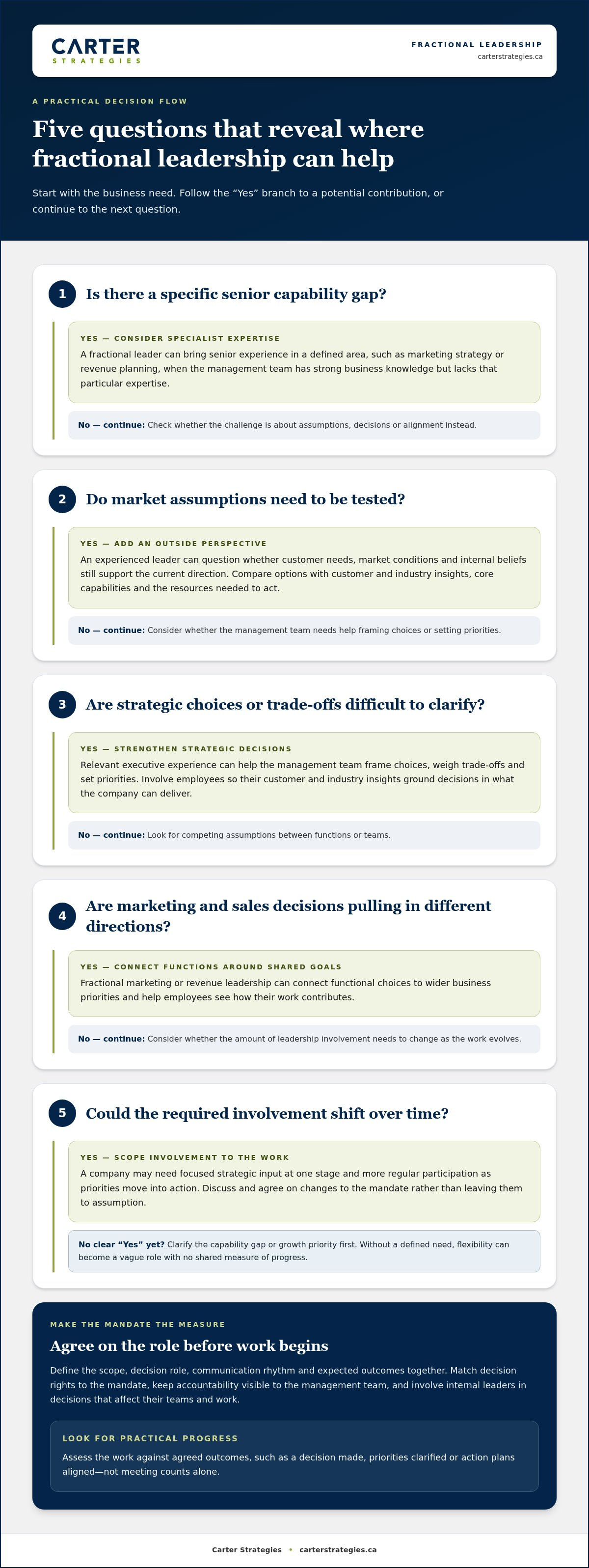
Consider these five benefits in relation to a specific capability gap or growth priority:
- Access specialist expertise. A company building a clearer marketing strategy or strengthening revenue planning can bring in an experienced leader for that defined need. This can help when the management team has strong business knowledge but lacks senior-level experience in a particular area.
- Test assumptions with an outside perspective. A leader who is not immersed in existing routines can ask whether customer needs, market conditions and internal beliefs still support the current direction. This is useful when considering a new audience, offer or growth path. Compare the options against customer and industry insights, core capabilities and the resources needed to act.
- Strengthen strategic decisions. Relevant executive experience can help the management team frame choices, weigh trade-offs and set priorities. Employees can contribute customer and industry insights, grounding decisions in what the company knows about its market and its ability to deliver.
- Connect functions around shared goals. Marketing and sales decisions can pull in different directions when teams work from separate assumptions. Fractional marketing or revenue leadership can connect those choices to wider business priorities and help employees see how their work contributes.
- Adjust involvement as needs change. A company may need focused strategic input at one stage and more regular participation as it puts priorities into action. A scoped mandate lets involvement reflect the work required, with changes discussed and agreed rather than left to assumption.
Each benefit matters under different conditions. A capability gap calls for relevant expertise; unclear market assumptions call for informed challenge; disconnected functions call for shared priorities. Assess value by agreeing on practical outcomes tied to the mandate, such as a decision made, priorities clarified or action plans aligned. Meeting counts alone won’t show whether the work is helping the business move forward.
Make the mandate the measure
Fractional leadership creates value when a clearly defined mandate connects experienced judgment to company priorities and the team’s ability to act. That principle keeps the role focused without treating an outside executive as a substitute for internal knowledge. Carter Strategies provides business strategy development and fractional CMO and CRO services, connecting executive perspective with collaborative planning and accountability. Explore Carter Strategies’ business strategy and fractional leadership work.
Fractional leadership versus full-time hires, consultants, and interim executives
These arrangements can all bring experience into a company, but they answer different needs. The useful comparison isn’t simply who has the strongest credentials. Consider what the company needs the person to do, how they’ll take part in decisions and who will carry the work forward internally.
Fractional executive or full-time executive?
A full-time executive usually provides sustained, day-to-day leadership across an ongoing function. That presence may suit a company that needs regular decisions, close coordination across teams and continuous attention to a broad mandate. A fractional executive provides targeted leadership on a part-time or scoped basis. That may suit a company with a defined gap, such as needing senior direction for marketing or revenue priorities while existing leaders continue to own other areas.
Part-time involvement doesn’t automatically mean weak commitment or limited influence. The scope, access to leadership discussions and decision responsibilities determine how the fractional leader contributes. Agreeing on these details helps the executive and team work from shared expectations.
Comparison by role
- Full-time executive: The mandate covers an ongoing function; the time commitment is full-time; the position sets the decision role; continuity is built into the role; internal ownership sits with the executive and their team.
- Fractional executive: The mandate focuses on defined leadership needs; the time commitment is part-time or scoped; decision involvement is agreed in advance; continuity follows the engagement; internal leaders and employees retain ownership of their work and contribute to decisions.
- Consultant: The mandate is often a defined question or body of work; the time commitment is tied to that engagement; the consultant typically advises rather than holds an executive decision role; continuity depends on the scope; internal leaders own decisions and implementation.
- Interim executive: The mandate is temporary coverage of an executive position; the time commitment is typically full-time for a defined period; decision responsibilities depend on the role and authority granted; continuity lasts through the appointment; internal teams continue to carry out the work.
Fractional executive, consultant, or interim leader?
A fractional leader guides an ongoing mandate; a consultant typically advises on defined work. A consultant might assess a marketing challenge and recommend a direction. A fractional marketing executive may stay involved in leadership discussions as the company considers priorities and decisions. An interim executive, by contrast, steps into a role to provide temporary coverage. These are useful distinctions, not universal job descriptions. The written scope should clarify participation, authority and accountability.
Start with the work required. If the company needs a deliverable or outside analysis, an advisory engagement may fit. If it needs temporary coverage, an interim appointment may fit. If it needs specialized leadership connected to an ongoing priority, a fractional mandate may be appropriate. The benefits of fractional leadership depend on matching the model to the gap, then making decision roles and internal ownership clear from the outset.
What makes fractional leadership work with an existing team?
A fractional leader works best when the role strengthens the team’s ability to make and carry out decisions, rather than creating a separate stream of direction. The management team brings knowledge of the business, while employees understand how customers experience its choices and how work gets done. The leader’s role is to connect those perspectives to the mandate, not replace them with outside assumptions.
Build the working relationship in deliberate steps:
- Define the mandate. Name the business priority, the decisions the leader will shape, the expected contributions and the internal partners involved. Clarify what remains with the CEO, management team and employees.
- Share context. Provide a grounded view of the company’s goals, current plans, customer and industry insights, constraints and previous decisions. The fractional leader should understand the reasoning behind the current direction before recommending changes.
- Involve employees. Bring in people who understand customers, operations and the work affected by the mandate. Ask what supports the current approach, where assumptions need testing and what obstacles could limit action.
- Agree on measures. Choose project-specific indicators tied to the priority, along with decision owners and action plans. Measures should help the team judge progress, not reward activity unrelated to the intended outcome.
- Review progress. Set review points that fit the work. Use them to check decisions and actions, surface barriers and adjust the plan when new information changes the picture.
Set a clear mandate and working relationship
Shared context is essential before the fractional leader recommends a direction. For example, a marketing priority may depend on sales capacity, customer needs or a change in the company’s value proposition. Discussing these connections with relevant people helps the leader understand what the business can act on and gives employees a chance to test assumptions with practical knowledge.
The mandate should also describe how the leader will work with internal partners and where decision authority sits. Clear expectations prevent duplicated direction and give employees a reliable route for raising questions or risks. The details should reflect the company’s needs; no single meeting schedule or level of involvement suits every mandate.
Turn leadership input into shared action
Once priorities are agreed, translate them into action plans with a named owner, a clear next step and a relevant review point. Employees can flag dependencies, test whether proposed actions fit the work and identify the support they need. This makes accountability shared: the fractional leader guides the mandate, while internal owners remain responsible for their actions and contribute to course corrections.
Team involvement turns strategic direction into an executable business strategy because the people responsible for acting on it help shape, test and own the plan. Carter Strategies supports leaders in aligning priorities with employee insight and action plans through collaborative strategic planning.
How Carter Strategies connects fractional leadership to business growth
Fractional leadership adds value when executive expertise supports the company’s direction and helps its people act on shared priorities. Carter Strategies connects business strategy development with fractional CMO and CRO leadership so marketing and revenue decisions contribute to wider growth goals, rather than developing as separate plans.
The work starts with the company’s priorities and the questions its leaders need to answer. CEOs, boards and the management team bring their view of the business, while employees contribute knowledge of customers, operations and the realities of delivery. This collaborative process helps test assumptions before priorities become action plans. It also builds alignment and ownership, connecting strategic direction to the people responsible for carrying it forward.
Connect marketing and revenue leadership to company priorities
Marketing strategy and revenue strategy need to reflect the company’s broader direction. Customer and industry insights can clarify which needs matter, while brand positioning helps define how the company should stand apart. With those choices in view, a fractional CMO or CRO can work with leaders to connect marketing and sales priorities to business goals and shape action plans the team can carry out.
That connection matters when marketing activity, sales priorities and growth plans rely on different assumptions. The goal is not to add another isolated plan. It is to help leadership and employees understand how choices relate, what needs attention first and how progress will be assessed against the mandate. The benefits of fractional leadership depend on this fit between senior expertise, company priorities and internal ownership.
Choose a practical next step for your leadership team
Before defining a mandate, identify the capability gap and the strategic priority it affects. Is the challenge a need for clearer marketing direction, stronger alignment between marketing and revenue, or a broader business strategy question? Naming the issue helps determine what leadership involvement should contribute and which people inside the company need to be part of the work.
Carter Strategies’ advisory work is available on project and retainer bases. Principal Leslie Carter brings more than 25 years of business strategy and brand management experience to this work. The focus is strategic direction, alignment and accountability, not tactical marketing execution. A practical starting point is a collaborative discussion about the priority, the team’s perspective and the outcomes that would show progress.
If your leadership team is working through a growth priority or capability gap, discuss business strategy and fractional leadership with Carter Strategies.
Turn a leadership gap into a clear next step
Before choosing a leadership arrangement, name the decision or growth priority that needs attention. What choice is stalled? What new direction is the company weighing? What would help the leadership team know it has made progress? These questions turn a general concern into a focused mandate and help distinguish a capability gap from a broader need to revisit company priorities.
The benefits of fractional leadership are easier to assess when the mandate is tied to a business need and the people responsible for acting on it. Use that clarity to decide what expertise the team needs, where leadership input should make a difference and how employees can contribute to the next phase of growth. The right next step should strengthen the company’s ability to make informed choices and move forward together.
For support defining that priority and connecting it to practical action, explore collaborative business strategy support. Start a conversation with Carter Strategies about the priorities your leadership team needs to move forward.
Frequently Asked Questions
Is fractional leadership only suitable for start-ups?
No. Established and mid-sized companies can also benefit when growth or a change in direction creates a leadership gap. For example, a company adding a new service line may need experienced marketing direction while its existing leaders continue running established operations. The benefits of fractional leadership depend on whether the company has a defined need for senior expertise, not on its age or stage alone.
Can a fractional leader work with an existing management team?
Yes. A fractional leader can work alongside an existing management team, adding specialized perspective without displacing internal expertise. To avoid competing instructions, agree on a primary internal counterpart and clarify how the leader’s input reaches other decision-makers. For example, a marketing leader might work closely with the CEO and the person responsible for sales, while employees contribute customer knowledge and remain responsible for their own work.
How long does a fractional leadership engagement last?
There’s no standard duration. The engagement should reflect the mandate: a defined strategic question may call for a project-based arrangement, while an ongoing leadership need may call for continued involvement. Set review points so the company can assess whether the original priority still matters, what progress has been made and whether the scope should continue, change or close. Let the work guide the decision rather than assuming a fixed timeline.
Can fractional leadership support both marketing and revenue priorities?
Yes, when the mandate connects the two. For example, marketing may be shaping the company’s value proposition while sales is deciding which customer needs to prioritize. Senior leadership can bring those choices into the same strategic discussion. Agree on who owns each decision and how marketing and revenue priorities support wider business goals. This is strategic leadership, not a substitute for clear internal responsibilities.
What is the difference between a fractional executive and a consultant?
A fractional executive participates in leadership around an ongoing mandate, while a consultant often advises on defined work and provides recommendations. For example, a consultant may assess a strategic question and present options; a fractional executive may also take part in leadership discussions as the company considers those options and tracks agreed priorities. The distinction depends on the actual scope, so define the expected role rather than relying on the title alone.
Do fractional leaders make decisions or only provide advice?
They may contribute to decisions, but their authority depends on the mandate and the company’s governance. Some roles focus on shaping choices with the CEO and management team; others may include specific decision responsibilities. Clarify which decisions the leader can make, which they can recommend and which remain with internal executives or the board. Putting those boundaries in writing helps the team know when to seek input and who is accountable.
How can a company assess whether fractional leadership is working?
Assess progress against outcomes agreed for the mandate, rather than activity alone. Depending on the work, useful evidence could include a key decision resolved, a strategic priority adopted by the relevant leaders or an action plan advanced by its internal owners. Review what has changed, what remains blocked and whether the work still addresses the original need. If the measures don’t reflect the priority, revise them with the people responsible for delivery.


