


What makes strategy implementation for businesses work? It takes more than adding reports. Teams need shared ownership and a clear connection between company priorities and day-to-day decisions. A strategy can set a direction, yet teams may interpret priorities differently, follow separate plans, or wait for leaders to turn decisions into tasks. The result is activity without enough coordination or visible progress.
That gap is frustrating for leaders and employees alike. Assigning an owner shouldn’t mean adding another layer of oversight, and implementation shouldn’t feel like a top-down handoff. People need to understand how their work contributes to the priorities and have a meaningful role in moving them forward.
This article explains how to turn business priorities into clear action plans, accountable owners, and coordinated work. You’ll learn how to connect leadership decisions with team responsibilities, choose useful measures, and adjust actions as evidence or conditions change. The aim is a shared rhythm: leaders provide direction, teams contribute insight, and everyone can see how work is advancing the strategy.
Key Takeaways
- Turn strategic priorities into coordinated decisions, practical action plans, and regular learning, rather than treating implementation as a handoff.
- Translate company priorities into clear contributions for each team, with accountable owners and the resources to move work forward.
- Connect leadership direction with employee input so teams can raise barriers and adapt as conditions change.
- Use a steady review rhythm to separate routine progress updates from decisions about priorities, resources, and trade-offs.
- Effective strategy implementation for businesses connects shared ownership with measurable progress. Strategic advisory support can help clarify choices and align teams.
What Strategy Implementation Means for a Business, and Why Plans Stall
A strategic plan can set a clear direction without changing what teams prioritize on Monday morning. Leaders may agree on growth, customer experience, or stronger brand positioning, while departments continue following separate plans and using different measures of success. The gap is not necessarily a lack of effort. It often means the strategy hasn’t been translated into coordinated work.
Strategy implementation for businesses is the ongoing process of turning strategic priorities into aligned decisions, action plans, and learning. Strategic planning sets direction and determines where the business will focus. Implementation carries those choices into everyday work, tracks progress, and helps leaders respond when conditions or evidence change. It doesn’t replace planning; it makes the plan actionable.
What does strategy implementation include?
A concise working definition is: Strategy implementation is the coordinated work of turning strategic intent into decisions, resources, actions, and learning. As outlined in this overview of strategy implementation, a priority needs to shape choices across the organization rather than sit apart from them in a planning document.
In practice, priorities guide what leaders fund or defer, which decisions need management team agreement, and what each team contributes through its action plans. For example, if improving customer retention is a priority, teams might coordinate customer research, service changes, and retention measures instead of launching unrelated initiatives under the same label. Each contribution should connect to the shared goal while reflecting the team’s role and knowledge.
A list of projects is not an implementation system unless people understand why the work matters, who can make decisions, and how progress will be reviewed. Clear choices, shared ownership, and regular review turn strategic intent into an executable business strategy.
Why can a sound strategy lose momentum?
Plans often stall when priorities compete for the same people, time, or attention. If leaders add work without deciding what should pause, teams must make those trade-offs themselves. Unclear decision rights create more friction: one group waits for approval while another moves ahead, leaving related work out of sequence.
Employees may also lack the context behind a priority. A short announcement can name the goal but leave unanswered what success means, why the business chose it, or how teams should manage conflicts with existing commitments. That isn’t an employee failure. It’s an alignment gap leaders need to address through discussion and clear decisions.
The practical test is whether priorities influence weekly choices and connect work across teams. If they don’t, another announcement won’t close the gap. Clarify the decisions, ownership, and review process, then make sure teams understand how to act on them.
How Business Strategy Moves from Priorities to Coordinated Action
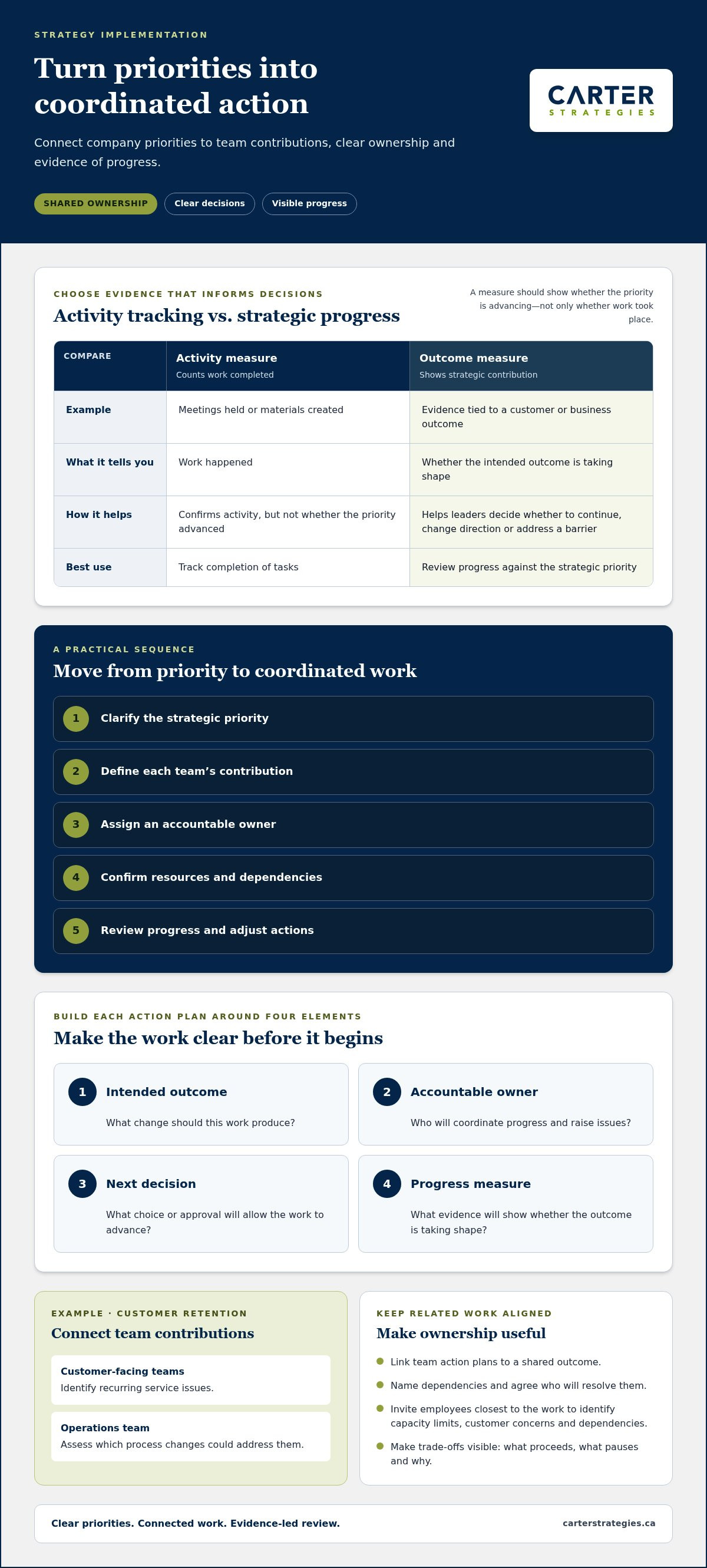
A priority becomes actionable when people can see what needs to change, who is responsible for moving it forward, and how their work connects with other teams. A practical sequence is to clarify the priority, define team contributions, assign ownership, confirm resources and dependencies, then review progress and adjust. This is where Bridging the Gap Between Vision and Execution becomes practical: the company’s direction needs to show up in decisions and work across teams, not just in separate departmental plans.
Turn strategic priorities into clear action plans
Each action plan should connect a strategic priority to a specific outcome. Define four elements before work begins:
- Intended outcome: What change should this work produce?
- Accountable owner: Who will coordinate progress and raise issues?
- Next decision: What choice or approval will allow the work to advance?
- Progress measure: What evidence will show whether the intended outcome is taking shape?
Choose measures that show strategic contribution, not just activity. Counting meetings or materials can confirm that work happened, but it won’t show whether the priority advanced. A measure tied to a customer or business outcome gives leaders a better basis for deciding whether to continue, change direction, or address a barrier.
For example, a company focused on improving customer retention might ask customer-facing teams to identify recurring service issues, while an operations team assesses which process changes could address them. The action plans should share a related outcome and clarify the hand-off between identifying an issue and acting on it. If one team’s work depends on another’s decision, name the dependency and agree who will resolve it.
Make ownership and communication part of the work
Managers help teams understand the purpose and boundaries of a priority: what matters most, which decisions teams can make themselves, and which need broader agreement. They should ask employees closest to the work to identify capacity limits, customer concerns, or dependencies that could affect delivery. This input can improve the plan before a missed hand-off or competing commitment slows progress.
Clear ownership gives teams a point of coordination, not a reason to work in isolation. An owner keeps commitments visible, brings decision-makers together when priorities compete, and communicates changes to affected teams. The owner doesn’t have to complete every task. Each team still needs to understand its contribution and raise practical concerns early.
When leaders resolve trade-offs, make the decision visible: what will proceed, what will pause, and why. Teams can then adjust their action plans without guessing which priority takes precedence. Carter Strategies’ business strategy development connects strategic choices with team alignment and practical action planning.
Top-Down Rollout or Shared Execution: Which Approach Sustains Progress?
A top-down rollout can communicate a decision quickly, but it often leaves teams to work out what that decision means for their day-to-day responsibilities. Shared execution connects leadership direction with employee context: leaders set priorities and decision boundaries, while teams help identify the work, risks, and dependencies involved. In strategy implementation for businesses, that distinction affects whether teams carry out a plan together or interpret it separately.
The approaches differ in how they handle four parts of implementation:
- Ownership: A handoff assigns work after key choices are made. Shared execution clarifies ownership while involving the people responsible for the work.
- Communication: A rollout sends information in one direction. Shared execution creates dialogue about how priorities affect teams and where work connects.
- Decision-making: A handoff can leave authority unclear when teams face trade-offs. Shared execution defines which decisions sit with team leads and which require leadership agreement.
- Adaptation: A rollout can treat the plan as fixed. Shared execution uses relevant evidence and feedback to adjust the approach without losing sight of the priority.
Employee involvement doesn’t mean asking everyone to approve every choice. Leaders still need to make timely decisions and maintain focus. Their role is to explain the direction and invite useful input from people who understand customers, processes, and the practical demands of delivery. That’s also a foundation for aligning teams around strategy.
What changes when employees help shape implementation?
One-way communication tells employees what has been decided. Dialogue adds context: why the priority matters, what it changes, and where teams can decide how the work gets done. That conversation can reveal a dependency between departments, a process that could slow delivery, or a customer concern leaders didn’t see during planning.
For example, a new service commitment may depend on sales setting accurate expectations and operations having the capacity to meet them. Employees in either group can point out where the hand-off could break down. Leaders can then assign decision rights and resolve the issue before it becomes a recurring source of rework. Input informs the decision; it doesn’t require consensus on every detail.
How should leaders balance consistency with adjustment?
Keep the strategic priority steady unless evidence supports changing direction. Review the assumptions and tactics used to advance it. Adjust the route when evidence changes, but don’t quietly change the destination. Customer and industry insights, operational feedback, and progress measures can help the management team decide whether a tactic needs refinement.
Set a clear escalation rule: if a proposed change affects another team’s commitments, shifts shared resources, or alters a core priority, bring it to the leaders responsible for those decisions. If the change stays within the agreed outcome and team boundaries, the accountable owner can guide it. The article How to Align Teams with Company Strategy Successfully explores alignment as a practical part of execution. This approach gives teams room to respond without pulling the organization in competing directions.
A Practical Business Strategy Implementation Rhythm for Mid-Size Teams
Implementation stays active when teams revisit priorities as part of their work, not only at annual planning time. A repeatable rhythm helps a mid-size company review progress across functions, surface barriers early, and make decisions before separate workstreams drift apart. Reviews should help the people doing the work, not become another reporting exercise.
Set ownership, measures, and review points
Start by naming one accountable owner for each strategic priority. Clarify which teams contribute, who can make day-to-day decisions, and which issues need leadership input. The owner keeps the work connected but shouldn’t become responsible for completing every team’s tasks.
Agree on a small set of measures tied to the intended outcome. A measure should help answer whether the priority is advancing, not simply count activity. For example, a team tracking a service improvement might examine a relevant customer outcome alongside a measure of delivery progress. Choose indicators that fit the priority, and set targets using your organization’s evidence rather than a generic benchmark.
Set review points to match the work and the decisions it requires. A team-level check can identify whether actions are on track and what support is needed. A leadership review can address shared resources, competing priorities, or changes affecting several teams. End each review with a clear decision, an owner, and a next step.
Use review meetings to learn and remove barriers
Keep routine progress updates brief and focused. Ask:
- What has moved forward since the last review?
- What has changed in the evidence, customer and industry insights, or operating conditions?
- What decision or dependency is blocking the next action?
When a team can resolve an issue within its agreed authority, record the action and owner, then let the work continue. If resolving it requires shifting shared resources or changing another team’s commitments, bring the decision to the appropriate leaders. This protects leadership time while ensuring consequential trade-offs aren’t made by default.
Record decisions somewhere the affected teams can use. A decision that stays in meeting notes won’t guide the next week’s work. Share what changed, who owns the follow-up, and whether another team needs to adjust its action plan. This keeps growth priorities connected across functions, a core concern in growth strategy and planning for mid-size businesses.
For strategy implementation for businesses, the rhythm matters less than whether it creates clear decisions and learning. Keep measures relevant, invite employees to flag practical barriers, and adjust actions when evidence calls for it. If your leadership team needs help connecting priorities to shared ownership and review, explore Carter Strategies’ strategic advisory approach.
How Strategic Advisory Support Helps Businesses Implement Strategy
Strategic advisory support can help when leaders know the business needs to move forward but haven’t agreed on which choices matter most, how teams should contribute, or how to manage competing priorities. An advisor can structure those discussions, connect decisions to practical action plans, and help the management team build an executable business strategy with the people responsible for carrying it forward.
This support doesn’t transfer accountability to someone outside the business. Leaders and employees retain ownership of decisions and implementation. The advisor helps create the conditions for that ownership: clear priorities, aligned leadership, meaningful employee involvement, and a practical way to turn discussion into coordinated work.
When can outside strategic perspective help?
An outside perspective can help when departments are working from disconnected plans, leaders give teams conflicting direction, or important decisions remain unresolved because priorities compete. These situations call for more than another status report. They call for a focused discussion about the choices the business needs to make, the assumptions behind them, and the impact on the people doing the work.
A facilitator can bring management and employee perspectives into the same strategic discussion. Leaders contribute business context and clarify the decisions they need to make. Employees can explain how priorities meet day-to-day realities, where work depends on another team, and what might create delivery barriers. This exchange can surface differences early and build a shared understanding of what the strategy asks of each group.
Principal Leslie Carter brings more than 25 years of business strategy and brand management experience to this work. That experience can inform the discussion while keeping the organization’s context and people central to the decisions.
Connect leadership expertise to the priorities at hand
Business strategy development and growth planning can help a company clarify its direction, choose practical priorities, and connect them to team action. Advisory support can help leaders examine customer and industry insights, focus the work, and identify where teams need to coordinate. A sound process draws out questions before settling on answers, so action plans reflect both strategic intent and delivery realities.
If a priority centres on marketing or revenue, fractional CMO or CRO support provides senior-level coordination in that area. The focus is to connect leadership decisions with the organization’s chosen direction and responsibilities, while keeping the teams responsible for the work involved.
Advisory work can be structured on a project or retainer basis, depending on the organization’s needs and the work ahead. The aim is to strengthen internal clarity and accountability. The business makes its decisions, assigns ownership, and leads implementation; the advisor helps keep priorities and action connected.
Ready to discuss your strategic priorities and the path from planning to action? Discuss your business strategy with Carter Strategies.
Choose the Next Priority and Move It Forward
The next opportunity that reaches your leadership team can test whether the business is building towards a deliberate future or simply responding to whatever appears. Before adding it to the agenda, ask what capability it would strengthen and whether it supports the direction you want the company to take. That question can help leaders make choices with the organization’s longer-term purpose in view.
If you’re ready to consider what that future should look like and how to move towards it, discuss your strategic priorities with Carter Strategies. A clear choice today can shape what your business is ready to do next.
Frequently Asked Questions
What is strategy implementation in a business?
Strategy implementation in a business is the process of putting chosen strategic priorities into practice. A useful working document can include the priority, key assumptions, affected teams, and decisions still needed. Keeping assumptions visible helps leaders distinguish a delivery issue from a change in the conditions the strategy was based on. It also gives teams a shared reference point when questions arise between formal reviews.
Who is responsible for implementing a business strategy?
The organization’s leadership is responsible for ensuring the business can carry out its strategy. Make that responsibility visible by mapping each priority to its executive sponsor, day-to-day lead, contributing functions, and decision authority. This map can reveal gaps, such as an initiative with no clear decision-maker or one person expected to coordinate work across teams without authority to resolve conflicts.
How do you measure whether strategy implementation is working?
Choose measures with a clear definition, a reliable data source, and a person responsible for keeping them current. Before setting a target, check what the current data can establish and whether teams interpret the measure the same way. For example, if departments define a qualified customer inquiry differently, their figures won’t provide a consistent view. Clear measurement rules make results more useful for leadership decisions.
Can a business change its strategy during implementation?
Yes. A business can change its strategy when leaders have a sound reason to revise a choice, not simply because the work has become difficult. Document the decision, the evidence or assumption behind it, and the implications for existing commitments. This creates a record leaders can revisit and helps prevent different teams from acting on different versions of the plan.
How do you get employees engaged in strategy implementation?
Give employees practical ways to contribute beyond a launch presentation. A manager might invite a cross-section of affected roles to review a proposed change in customer communication, then gather feedback through team discussions or a shared question channel. Close the loop by explaining which suggestions shaped the approach and why others weren’t adopted. Follow-through shows that input informs the work, even when leaders retain final decision authority.
What is the difference between strategy development and strategy implementation?
Strategy development produces choices about the business’s direction; implementation applies those choices to the organization’s work. One practical distinction is the output: development may document priorities and the rationale behind them, while implementation clarifies how those choices affect budgets, role expectations, customer commitments, and existing initiatives. Comparing the outputs can help leaders spot a plan that names an ambition but leaves its organizational implications unresolved.
How often should a business review its strategy implementation?
Set review points around when useful decisions or meaningful evidence are expected, rather than following a schedule for its own sake. A review may also be triggered by a major customer shift, a delayed dependency, or a change in leadership assumptions. Keep a calendar of planned decision points alongside these triggers. This helps the management team respond to material changes without turning every routine update into a strategy meeting.


