


The hidden costs of a misaligned leadership team include slower decisions, duplicated work, unclear accountability, and employees pulling in different directions. When leaders don’t share priorities or assumptions, teams spend time resolving mixed signals instead of advancing the business. Alignment doesn’t require agreement on every detail. It requires clarity about goals, decision ownership, and how leaders will work together.
If you’re seeing friction between functions or plans that stall after they’re announced, the problem may not be a lack of effort. Leaders can believe they’re aligned while holding different views of what matters most or how success will be measured. That gap reduces productivity and makes it harder for employees to act with confidence.
This article explains how leadership misalignment takes hold, how it affects execution and trust, and how shared goals, measures, and consistent communication can close the gap. You’ll also learn how to spot signs of misalignment and build a practical path from leadership priorities to coordinated action across the organization.
Key Takeaways
- Spot misalignment by comparing how leaders describe the organization’s priorities, success measures and decision ownership.
- Clarify who owns key decisions and where leaders need to collaborate to prevent avoidable delays.
- Connect shared goals to a focused set of measures so teams can see what progress means in practice.
- Give employees consistent messages about priorities and change, while making room for questions and disagreement.
- Use regular leadership check-ins to surface conflicts early and keep plans connected to day-to-day work.
1. Leadership Misalignment: How Does It Happen and What Fixes It?
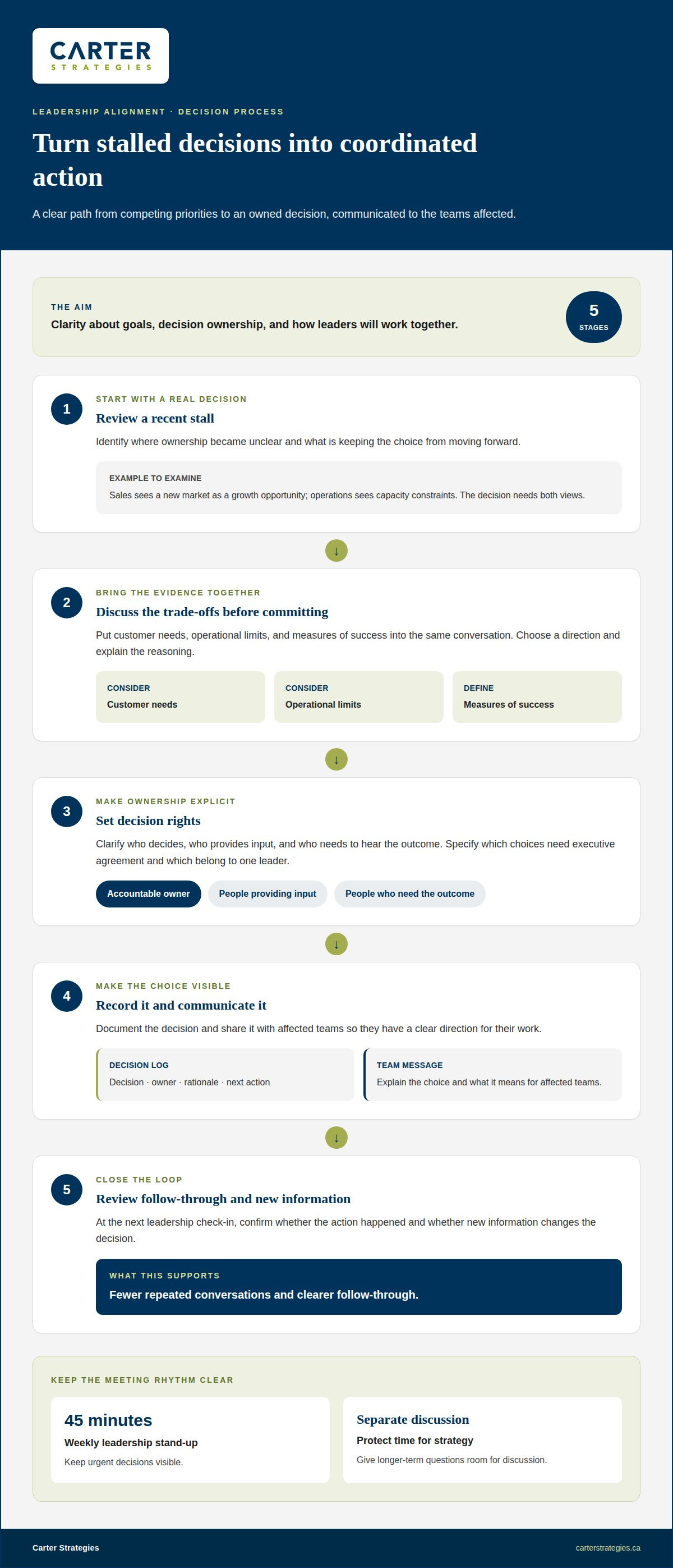
The hidden costs of a misaligned leadership team often begin with stalled decisions. One executive may approve a priority while another questions its assumptions or delays resources. Teams then wait for clarification, revisit earlier choices, or pursue competing plans. A market opportunity can lose momentum during that hesitation. The issue isn’t simply that leaders disagree; it’s that they lack a shared way to reach, record, and act on decisions.
Strategic thinking works best when leaders test assumptions together before committing teams to action. For example, a sales leader may see a new market as an immediate growth opportunity, while operations sees capacity constraints. A focused discussion can bring customer needs, operational limits, and measures of success into the same decision. The executive team can choose a direction, name the trade-offs, and explain its reasoning. Shared decision-making doesn’t mean every leader has equal authority on every issue. It means contributors can raise evidence before the decision owner acts.
Unclear executive roles make this process harder. If the CEO, finance lead, and business-unit leaders all assume they own a resource decision, it can circulate through meetings without resolution. Leaders can clarify decision rights by recording the accountable owner, the people who provide input, and those who need to hear the outcome. They should also specify which decisions require executive agreement and which belong to one leader. This creates accountability without requiring consensus on every operational choice.
A weekly leadership meeting can provide a regular place to resolve competing priorities, but it needs a decision log. Record the decision, its owner, the rationale, and the next action. At the next meeting, review whether the action happened and whether new information changes the choice. A 45-minute weekly standup can keep urgent decisions visible, while a separate strategic discussion protects time for longer-term questions. The purpose is not more meetings. It’s fewer repeated conversations and clearer follow-through.
How does misalignment affect customer satisfaction and retention? When leaders give teams conflicting priorities, customers may receive inconsistent information, delayed responses, or service changes without a clear explanation. These experiences can weaken confidence and give customers less reason to stay.
Are there Canadian studies or benchmarks on the cost of leadership misalignment? The Bank of Canada offers a relevant Canadian perspective: misaligned managerial incentives can raise the perceived cost of capital and reduce long-run investment. This describes a potential economic mechanism, not a universal dollar benchmark for leadership misalignment.
To restore momentum, executive teams can review a recent stalled decision, identify where ownership became unclear, and assign one accountable decision owner. Then document the decision and communicate it to affected teams. This sequence turns alignment into visible work, rather than agreement expressed only in a meeting.
2. What is organizational misalignment and why does it matter?
Organizational misalignment occurs when leaders’ priorities, assumptions, or actions pull teams in different directions. It can exist even when every executive has seen the same strategy presentation. Leaders may all endorse growth, for example, but disagree about which customers to serve, what to fund, or what success means. Without clarity on those choices, employees receive competing priorities instead of guidance toward shared outcomes. The Canada Energy Regulator describes working in a misaligned, inconsistent, or cross-purposes manner as giving rise to material organizational risk.
Shared exposure to a strategy is not the same as shared clarity. An executive may interpret “improve customer experience” as faster service, while another sees it as expanding support options. Both may leave a strategy meeting believing they agreed. Their teams then develop different plans, assign different measures, and make conflicting trade-offs. To define a priority clearly, leaders can state the intended outcome, the customer or business need it addresses, and the actions that will signal progress. A precise definition gives every function a common reference point.
Misalignment spreads through everyday decisions. Consider a product launch: marketing prepares a campaign, sales promises a delivery date, and operations plans around a different launch window. Middle managers must interpret the disagreement, while employees wait for direction or proceed on incompatible assumptions. If leaders don’t resolve the underlying choice, project teams may redo work or delay decisions. The visible disagreement is only one sign; conflicting instructions and repeated changes can reveal a wider pattern.
Strategy execution weakens when every department treats its own targets as the organization’s main priority. Finance may defer spending while sales expects new support to meet growth goals. A practical response is to connect departmental plans to a short list of agreed business outcomes. For each priority, define the accountable leader, necessary cross-functional contributions, and decisions that leader can make. This makes trade-offs explicit and helps employees understand which actions take precedence when capacity is limited.
Executives can test alignment by asking each leader to describe the organization’s current priorities, expected results, and key trade-offs independently. They can compare answers, identify material differences, and resolve them before communicating decisions to teams. Then, managers can translate the agreed direction into team-level actions and raise conflicts through a regular review. For organizations working through this process, inclusive strategic planning can connect executive priorities with practical action plans. The goal is not identical language from every leader; it is a consistent direction employees can act on.
Inconsistent leadership messages and employee trust
Employees notice leadership misalignment through daily instructions, not just executive meetings. A director may announce a service improvement while another leader continues rewarding speed over resolution quality. Front-line teams then face competing expectations and struggle to explain what matters most. When leaders’ actions contradict their words, employees may question whether a change will last. Trust depends on consistent follow-through, not a polished announcement.
Feedback can reveal where the gap appears. In a pulse survey, employees might report that priorities change without explanation, managers give different answers, or concerns go unanswered. Leaders can compare those responses with examples from team meetings and project handoffs. Then they can identify the message that needs clarification, decide who will communicate it, and explain what remains flexible. This treats feedback as evidence for action, rather than a measure to file away.
Consider a team asked to reduce response times while also handling more complex customer issues. If executives don’t explain how to balance those goals, managers may set different expectations. One team might rush conversations; another may avoid difficult cases. Employees then spend time interpreting leadership signals instead of serving customers. A shared explanation, reinforced in manager briefings and team updates, gives people a clearer basis for decisions.
Inconsistent messages can also affect engagement and retention. Organizations in the bottom quartile for alignment indicators had 25% higher regrettable turnover than organizations in the top quartile. That comparison points to a business risk, but it doesn’t explain every departure. Leaders should examine exit feedback alongside employee comments about trust, workload, and changing priorities. Patterns can help distinguish a temporary disagreement from a workplace problem that repeatedly undermines commitment.
What are the risks of leadership conflict for workplace culture and employee mental health? Repeated conflict can make employees less willing to raise concerns, ask for direction, or challenge decisions. Uncertainty and sustained tension may increase workplace stress, especially when managers leave teams to reconcile conflicting instructions without support.
An employee-first response makes leaders accountable for the conditions their decisions create. Executives can agree on the change message, model the behaviours they expect, and clarify what teams can decide independently. Managers also need a clear way to raise contradictions before they reach employees. For example, a regular manager check-in can surface inconsistent guidance, assign a leader to resolve it, and share the agreed answer with affected teams.
Morale improves when employees see their feedback change how leaders communicate and coordinate. Closing the loop matters: acknowledge the concern, state the action, and report what happened. When leaders can’t change a decision, they should explain why and identify where employees still have input. This respects employees’ effort and gives them a more reliable basis for commitment.
4. Misalignment’s impact on productivity and work speed
Misalignment can slow productivity even when every team is busy. Work stalls at handoffs, employees repeat analysis, and managers spend time reconciling different assumptions. In one construction example, a client tracked 200 projects in separate spreadsheets. When information sits in disconnected files, leaders and project teams can struggle to see dependencies, spot conflicting plans, or identify which work needs attention first. The delay then spreads beyond the original decision.
Duplicated work is another sign of competing direction. Imagine two departments preparing separate forecasts for the same initiative because leaders haven’t agreed on a planning assumption. Both teams use time and expertise, yet neither forecast gives the organization a shared basis for action. Reviewing project records can reveal repeated analyses, overlapping deliverables, and work redone after a change in direction. These patterns show where coordination is consuming capacity.
Misalignment can also slow modest changes. Small pivots in a misaligned leadership team may require repeated meetings, drawing managers away from supporting employees, customers, and delivery. The effect is harder to see when conversations are scattered across calendars and functions. Reviewing recent pivots can show where the same issue keeps coming up and which teams are waiting to proceed.
Distributed and hybrid teams face a particular coordination challenge when updates reach people at different times. A remote employee, for example, may work from an earlier project brief while colleagues in the office have heard about a revised requirement. The resulting rework may look like an individual performance problem, when the underlying issue is inconsistent access to current information. Teams can reduce this friction by keeping working documents current and making changes visible to everyone affected.
What are the costs of conflicting priorities and duplicated work among executives? They can consume staff capacity, delay work, and leave teams with outputs that don’t support the same plan. The impact depends on how much work is repeated and whether delays affect customers or delivery commitments.
What are the hidden costs of leadership team misalignment? They include lost momentum, less capacity for planned work, and strain on the people expected to absorb repeated changes. These effects can remain hidden when teams track completed tasks but not rework, waiting, or interruptions.
How can organizations measure the cost of leadership team misalignment? Compare planned work with actual progress, then record repeated tasks, waiting time, and changes that require rework. Briefly review affected projects to identify recurring operational causes. This gives leaders a clearer view of where productivity is being lost and which work processes need attention.
5. Shared vision, success measures, and communication
A shared vision becomes useful when leadership teams translate it into priorities employees can act on. One practical exercise asks each executive to independently name the organization’s three current priorities. Compare the answers before discussing them. If leaders identify different priorities, the gap shows where assumptions or communication have diverged. Agree on the few outcomes that matter most, then explain how each priority supports the organization’s direction.
Success measures make those priorities concrete. A one-page strategy can state three business outcomes for the next year and connect each outcome to no more than seven measures. For example, a growth priority might pair a customer outcome with a measure of progress and a named accountable leader. Measures should show whether the organization is advancing its shared goals, not simply record activity. Leaders can also state what the organization will start and stop doing in the next 12 months.
Communication needs a clear rhythm. Leadership teams can use weekly or biweekly check-ins to review progress, identify conflicts, and agree on messages before managers share them. Written updates give distributed teams a consistent reference between meetings. When priorities change, leaders should explain what changed, why it changed, and what remains stable. That clarity helps employees operate with fewer competing interpretations.
Difficult conversations belong in the leadership room, not in informal side discussions after decisions. A team can make space for disagreement by asking which assumption needs testing, what evidence would change the decision, and who owns the next action. Listening means reflecting a concern accurately before responding. When leaders can admit confusion without fear of repercussions, they can address misunderstandings before they become mixed instructions for employees.
Communication should distinguish fixed decisions from areas where teams can adapt. For a service change, executives might set the customer outcome and timing while inviting front-line employees to recommend how to deliver it. Managers can gather feedback through team discussions, pulse surveys, or skip-level conversations. Leadership teams can then review recurring concerns, respond, and clarify how employee input shaped the plan.
To put shared priorities into practice, bring leaders together to define outcomes, measures, decision ownership, and the communication rhythm. Develop shared strategic priorities with an executable plan that connects leadership decisions to team action. Revisit the measures when markets shift or strategy changes, and update messages before employees receive conflicting direction. Consistent communication is ongoing work, not a single announcement.
Carter Strategies
Carter Strategies helps leadership teams turn competing priorities into an executable business strategy. When leaders need shared direction, clearer goals, and action plans grounded in employee input, Business Strategy Development connects strategic choices with day-to-day work. Marketing Strategy can align market priorities with the organization’s broader direction, while Fractional CMO and CRO services provide senior marketing or revenue leadership for planning and growth decisions.
Consider this support when decisions repeatedly stall, teams interpret priorities differently, or plans lack clear ownership. The work focuses on aligning leaders and teams around practical priorities, measurable progress, and shared accountability. If your leadership team is ready to address misalignment, contact Carter Strategies to discuss your organization’s needs.
Make alignment part of how you lead
The hidden costs of a misaligned leadership team are easier to address when alignment becomes an ongoing leadership practice, not a one-time planning exercise. As your organization changes, make room to revisit assumptions, hear employee concerns, and adjust how teams work together. This keeps strategic direction connected to the realities people face in their roles.
Start with a practical conversation: what is getting in the way of shared progress, and what would help leaders act with greater clarity? The answer can show whether your next step is a sharper strategy, stronger leadership coordination, or greater ownership across teams. Addressing the issue together gives people a meaningful role in shaping the path forward.
If your leadership team is ready to work through those questions, contact Carter Strategies to discuss alignment support. A clear, shared direction can help your people move forward with confidence.
Frequently Asked Questions
Need Help Aligning Your Leadership Team?
Yes. Carter Strategies supports leadership teams through Business Strategy Development, Marketing Strategy, and Fractional CMO and CRO services. Before beginning, identify a recent business challenge that exposed different assumptions, such as launching an offer or responding to a change in customer demand. That example gives leaders a concrete starting point for examining how they interpret information and what support would help them work through strategic decisions together.
How quickly can alignment problems be fixed?
The time needed depends on the source and reach of the problem. A misunderstanding about one initiative may be addressed once leaders clarify the assumptions behind it. A deeper pattern involving incentives, management habits, or repeated conflict takes sustained attention. Leaders can assess progress by revisiting the original issue and checking whether they handle new decisions differently, rather than relying only on agreement expressed in a discussion.
Leadership Misalignment: How Does It Happen and What Fixes It?
Misalignment can arise from different beliefs about what customers need, how the market is changing, or which risks deserve attention. Leaders may interpret the same customer feedback differently because each function sees a different part of the relationship. A useful first step is to compare the evidence each leader is using, then agree on what additional customer or industry insights would help resolve the disagreement.
What causes misalignment during rapid growth?
Rapid growth can bring new customer groups, products, or operating demands that challenge assumptions behind an established business model. A company expanding into a new market, for example, may find its existing sales approach doesn’t match how those customers make decisions. Leaders should review whether the organization’s capabilities, customer knowledge, and business model still fit its growth ambitions, then address gaps before scaling further.
What is organizational misalignment and why does it matter?
Organizational misalignment occurs when the choices different parts of a business make don’t add up to the intended outcome. It matters because results depend on connected functions, not isolated activity. A change to an offer, for example, can affect sales materials, customer support, and delivery requirements. Mapping those dependencies before a major change helps leaders see where coordination is needed and where unintended consequences may arise.
How does leadership misalignment affect employee engagement and turnover costs?
Misalignment can make employees less confident that their work will be supported or sustained. When experienced people leave, the organization may also lose customer knowledge, working relationships, and context not captured in procedures. Leaders can look for gaps in handovers, repeated questions from new team members, and disruptions to customer relationships. These signals show how departures affect organizational knowledge beyond the immediate hiring process.
What is the financial impact of poor executive alignment on productivity and decision-making?
Poor alignment can affect financial performance when leaders commit resources based on different assumptions or overlook connected risks. Finance teams can examine forecast changes, budget reallocations, and variances between planned and actual results for affected initiatives. They can then ask whether those changes followed new market evidence or unresolved executive disagreement. This distinction helps leaders focus on decisions that may need better analysis or clearer communication.
How does leadership team misalignment affect strategy execution and revenue growth?
Misalignment can create gaps across the customer journey that limit the value of a growth strategy. Marketing may attract prospects whose needs don’t match the sales conversation, or onboarding may fail to deliver what customers expected. Leaders can review the journey from initial interest through renewal, noting where customer needs, promises, and delivery diverge. This can help identify which part of the revenue process needs closer coordination.


