


The cost of siloed teams shows up in the customer journey. What happens when sales and marketing don't communicate is that buyers can receive inconsistent messages, sales teams can lack useful context, and marketing may not learn which leads are progressing. The result is avoidable friction and missed opportunities to work towards the same business goals.
Each team understandably focuses on its own targets and day-to-day demands. But buyers experience one company, not separate departments. A promising campaign can lose momentum if follow-up lacks context or sales feedback never reaches marketing.
These gaps affect both the buyer experience and the teams responsible for growth. Shared prospect information, regular meetings, common measures of success, and practical feedback can help sales and marketing coordinate. The aim is to connect what marketing communicates, what sales hears from customers, and what the business needs to achieve.
Key Takeaways
- Agree on what qualifies as a sales opportunity so campaigns and follow-up support the same buyer journey.
- Plan content and campaigns together, using sales conversations to shape messages around customer needs and objections.
- Share prospect information in a common system so both teams can see engagement, context, and next steps.
- Use regular meetings to clarify priorities, review lead quality, and resolve handoff issues before they affect buyers.
- Build a feedback loop that helps marketing learn what sales hears and helps sales use relevant campaign insights.
1. How can these improvements help Sales and Marketing be more effective?
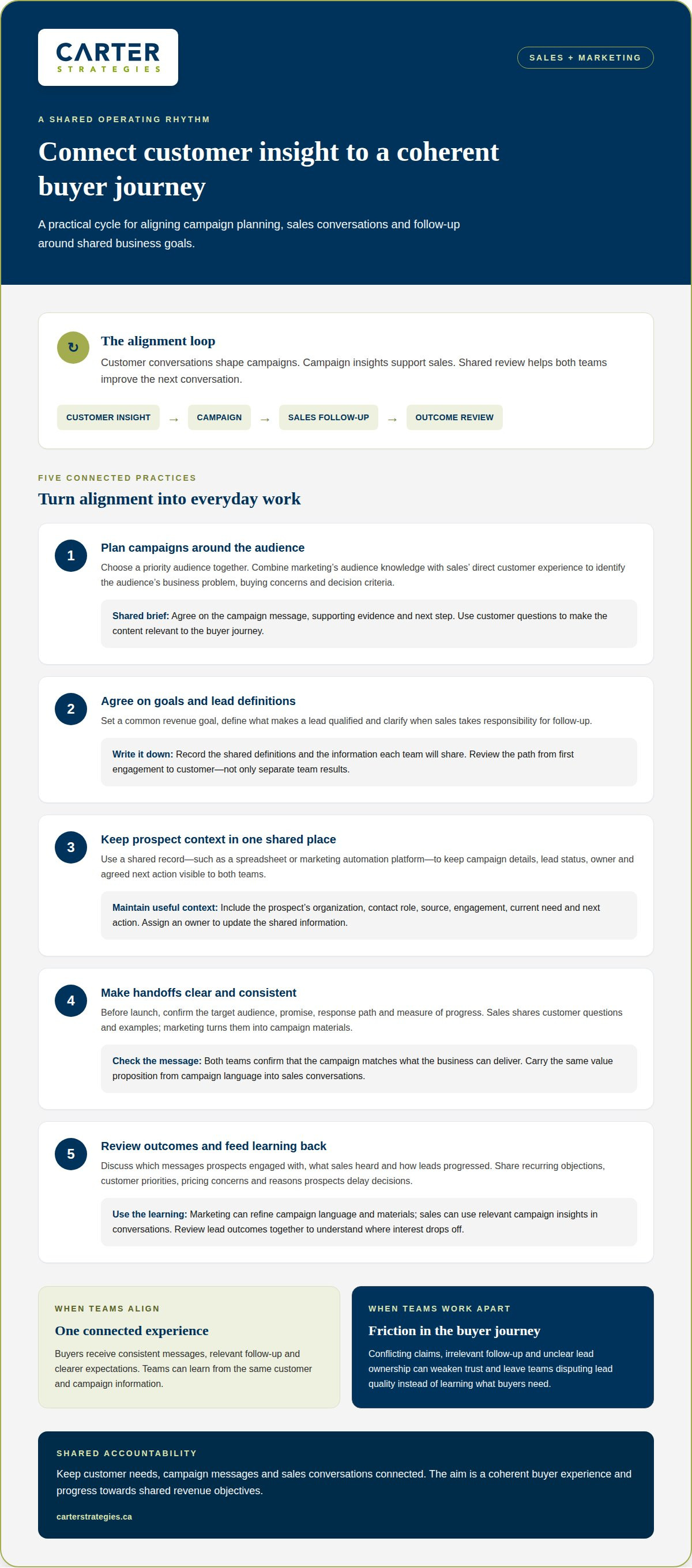
Collaborative campaign planning combines marketing’s audience knowledge with sales’ direct customer experience. Choose a priority audience, then ask both teams to identify its business problem, buying concerns, and decision criteria. For example, a campaign for Canadian manufacturers might address production delays, while sales adds questions prospects raise during discovery calls. Use a shared brief to agree on the campaign message, supporting evidence, and next step. This gives content a practical role in the buyer journey instead of leaving marketing to guess what sales needs.
Agree on a shared revenue goal before assigning activities. Marketing might focus on attracting suitable prospects, while sales follows up and reports which conversations become qualified opportunities. Define what makes a lead qualified and when sales takes responsibility for follow-up. A short written agreement can record those definitions and the information each team will share. When marketing reports campaign responses and sales reports opportunity progress, leaders can assess the path from first engagement to customer, rather than looking at one department’s results alone.
Data sharing helps ground campaign decisions in customer experience. Sales can summarize recurring objections, customer priorities, pricing concerns, and reasons prospects delay decisions. Marketing can use those insights to refine campaign language, choose relevant examples, and develop materials that answer real questions. In return, marketing can share which messages and campaigns attracted each prospect. Reviewing lead outcomes regularly can help both teams distinguish a strong-fit inquiry from someone who needs more information before speaking with sales.
Shared collaboration platforms make information easier to maintain. A spreadsheet or marketing automation platform can hold campaign details, lead status, owner, and agreed next action. Internal collaboration tools can help teams discuss drafts, record decisions, and flag changes without creating competing email versions. Choose one shared location for each working document and assign an owner to update it. For example, sales can add a common objection to the campaign brief, while marketing records how it will respond in the next content revision.
Build campaigns around clear handoffs. Sales contributes customer questions and examples; marketing turns them into content and campaign materials; both teams check that the message matches what the business can deliver. Before launch, confirm the target audience, promise, response path, and measure of progress. After launch, discuss what prospects engaged with and what sales heard. This cycle makes collaboration repeatable: customer conversations inform campaigns, and campaign results inform sales discussions. The goal is shared accountability for a coherent buyer experience and revenue objectives.
2. What happens when Sales and Marketing don’t work together?
When sales and marketing operate separately, buyers may encounter conflicting claims, irrelevant follow-up, or a gap between their interest and a sales conversation. Poor communication can make the customer experience feel disjointed, weakening trust and giving customers less reason to stay. A prospect who hears one promise in a campaign and another from sales must resolve that mismatch before deciding whether to proceed.
The effects also reach inside the business. If marketing is measured on lead volume while sales is accountable for qualified opportunities and closed business, both departments can meet their own targets while the revenue process stalls. Marketing may generate leads sales considers unsuitable; sales may overlook prospects who need more education before they are ready to talk. Teams then spend time disputing lead quality instead of learning what buyers need.
Smarketing describes a way of working that brings sales and marketing together around shared goals, communication, and responsibility. It doesn’t mean merging departments or expecting either team to do the other’s job. It means agreeing on practical definitions: what makes a lead ready for sales, what follow-up should happen, and how sales will report outcomes. A shared understanding helps avoid delays because prospects don’t have to repeat their needs or wait while teams sort out ownership.
Alignment can also improve revenue decisions. When both teams review lead progression and closed business, they can see which audiences, messages, and sales conversations contribute to opportunities. That evidence helps marketing focus campaigns on relevant prospects and helps sales prioritize follow-up with useful context. It also gives managers a clearer view of where interest drops off, rather than leaving them to rely on separate departmental reports.
Consistent communication matters to customers. If a campaign explains a service in plain language, sales should carry that same value proposition into conversations. For example, marketing can describe a business outcome, while sales explains how the offering addresses a prospect’s specific need without overstating what it can deliver. Consistent expectations reduce confusion and support trust throughout the buying relationship.
Practical alignment steps include setting a common revenue objective, defining lead handoffs, reviewing a sample of leads together, and sharing customer feedback with campaign planners. Teams can also agree on a shared message and check whether their incentives reward qualified opportunities and customer fit, not activity alone. These practices make collaboration part of the operating rhythm rather than a one-off discussion.
For organizations that need to connect team priorities with growth plans, inclusive strategic planning can help turn shared goals into clear actions and accountability.
3. Shared prospect information and CRM systems
A customer relationship management system can give sales and marketing a shared record of each prospect’s journey. Agree which details belong there, including the prospect’s organization, contact role, source, engagement, current need, and next action. For example, sales can see that someone requested a case study before booking a conversation, while marketing can trace the campaign that prompted the request. To understand what happens when sales and marketing don't communicate, identify which customer details are hidden, missing, or recorded differently across teams.
Disconnected spreadsheets, inconsistent field names, and unclear data ownership can weaken that shared view. One team might mark a contact “qualified” after an initial response, while another expects a confirmed need and decision process. Review the current systems together: identify where prospect details live, who updates each field, and what information is difficult to find. Then agree on a sharing protocol that defines access and record updates. These decisions help both teams work from a consistent account of prospect activity.
Shared definitions also make lead scoring more useful. Sales and marketing can agree which signals indicate interest, such as a demo request, repeat visits to a product page, or discussion of a specific business challenge. Define which signals prompt follow-up and what information sales needs before contacting someone. A score should guide attention, not replace judgement. For instance, a demo request may prompt direct outreach, while an introductory article visit may call for more relevant information first.
Connect CRM processes to shared goals and KPIs. Marketing can report campaign engagement and qualified leads; sales can report accepted leads, opportunity progress, and closed business. Review those measures together to find where prospects pause. If a campaign attracts interest but few prospects become opportunities, examine audience fit, messaging, lead definitions, and follow-up. A practical way to understand what happens when sales and marketing don't communicate is to trace a prospect’s record from initial response to outcome, then identify where context or ownership went missing.
Use CRM reviews to troubleshoot the process, not assign blame. Regular reviews can reveal missing notes, delayed follow-up, or recurring objections that current materials don’t address. Sales can document customer and industry insights, while marketing records how those findings inform future planning. Assign an owner to each process change and review whether records and handoffs improve. This makes the CRM a working tool for coordination, learning, and accountable decisions, rather than a static store of contact names.
4. Open communication and regular meetings
Open communication gives sales and marketing a routine place to raise issues before they reach customers. Regular meetings can focus on current priorities, buyer interactions, and decisions that need input from both teams. For example, marketing can explain a campaign change while sales shares questions prospects ask during calls. End each discussion by recording the decision, owner, and next action. That record makes follow-through visible without relying on informal updates.
Use meetings to discuss the buyer funnel from both teams’ perspectives. Marketing can describe how prospects first engage through search, social media, or email. Sales can explain what happens after a prospect responds, including whether the contact is ready for a conversation. If the teams spot a gap, such as prospects asking for details sales hasn’t received, assign someone to address it. This makes the meeting a working session, not a round of separate status reports.
Specific examples keep discussions grounded. Review a recent social media campaign and compare its promise with the questions sales heard from interested prospects. If marketing’s message emphasizes speed but buyers ask about implementation requirements, clarify the content and sales response together. Discuss what the business can deliver, what needs explanation, and which customer concerns remain unresolved. This shared review helps teams present a consistent picture across interactions.
A clear agenda prevents meetings from becoming open-ended. Set aside time for campaign updates, lead handoff concerns, customer feedback, and decisions requiring shared ownership. Ask sales to bring examples of useful and unhelpful content; ask marketing to show which messages prospects engaged with. Close by assigning each action to an owner and noting how the teams will report progress. These steps turn discussion into accountable follow-through.
Make it safe to raise problems early. If a sales representative finds that a campaign attracts the wrong audience, explore the targeting, message, and follow-up process rather than assigning blame. Marketing can explain the campaign assumptions, while sales describes what happened in customer conversations. Together, agree on a change and identify what evidence will show whether it helped.
Keep communication active between meetings. A shared internal channel can flag an urgent message change, a customer concern, or an update to sales materials. Use it to alert colleagues, then reserve decisions with broader impact for the regular meeting. This helps both teams respond to important interactions while keeping priorities, responsibilities, and customer communications aligned.
5. Communication and feedback between sales and marketing
Businesses can improve sales and marketing communication by creating a regular feedback loop, agreeing what information to share, and assigning clear follow-up. For example, sales can report why qualified prospects hesitate, while marketing uses that feedback to adjust campaign messages and materials.
Make feedback specific enough to guide a decision. Instead of saying leads are poor quality, sales can describe the pattern: prospects lack the required need, fall outside the intended audience, or expect a service the business doesn’t provide. Marketing can compare those observations with campaign targeting and prospect responses. Reviewing a sample of leads together helps both sides understand what happens after a handoff, rather than relying on general impressions.
Sharing useful customer insights helps marketing create materials sales will use. Sales representatives can identify common objections, questions about value, and differences between customer segments. Marketing can respond with relevant case studies, clearer explanations, or content that addresses those concerns. Sales can then report whether prospects find the material useful in conversations. This exchange connects marketing decisions to real interactions and gives sales a practical way to contribute to future messaging.
Close the loop on every lead. Sales should record whether it reached the prospect, what the prospect needed, and the next step. Marketing can use that information to see which campaigns lead to meaningful conversations, not just initial interest. If a lead isn’t ready, agree whether further education or later follow-up makes sense. Clear outcomes help marketing refine its approach and help sales avoid contacting prospects without context.
Teams can make feedback routine through a shared review of lead examples, campaign results, and customer responses. Use a simple agenda: identify a pattern, discuss its cause, choose an action, and name the person responsible. For instance, if prospects in a territory don’t recognize the brand, sales can share examples and marketing can consider more focused messaging. Record the decision and revisit the result at the next review.
Keep the exchange constructive. A recurring mismatch may point to unclear audience definitions, inconsistent expectations, or a gap in sales materials, rather than one team’s failure. Agree on a shared definition of a qualified opportunity, then review whether both teams are applying it consistently. This makes communication between sales and marketing part of the work, not just an occasional meeting. To connect feedback with clear priorities and action plans, align sales and marketing priorities through a shared business strategy.
Carter Strategies: Marketing Strategy
Carter Strategies helps businesses address sales and marketing misalignment through Marketing Strategy grounded in shared priorities and customer insight. When disconnected plans, unclear ownership, or inconsistent messaging slow progress, a coordinated strategy can give teams clearer direction and a practical basis for working together.
For organizations seeking broader alignment, Business Strategy Development and Growth Strategies and Planning can connect marketing priorities with wider company goals. Fractional CMO and CRO services can provide senior marketing and revenue leadership when teams need strategic direction and accountability. Involving the people responsible for carrying the plan forward helps decisions reflect customer needs and the realities of execution.
If your sales and marketing teams need clearer priorities and a shared direction, contact Carter Strategies to discuss your goals.
Make alignment part of how the business operates
Understanding what happens when sales and marketing don't communicate is a starting point, not a lasting solution. The next step is to make alignment an operating choice: leaders give both teams room to shape priorities, raise concerns, and take responsibility for the customer experience. That means treating unclear ownership as a business issue, rather than leaving individual employees to bridge gaps on their own.
As priorities shift, revisit how sales and marketing work together. A new target market, service, or growth objective can change what buyers need and how teams contribute. Keep the working relationship connected to those decisions so it can evolve with the business, rather than relying on a plan that no longer fits.
When your team is ready to turn shared priorities into coordinated action, start a conversation with Carter Strategies. A clear next step can help your people move from separate efforts toward shared ownership and focused progress.
Frequently Asked Questions
What happens when Sales and Marketing don’t work together?
Prospects may receive disjointed information, while staff spend time correcting avoidable misunderstandings. For example, a buyer may respond to a campaign expecting one kind of support, then discover in a sales conversation that the offering solves a different problem. That mismatch can delay a decision and create extra work for both teams. Over time, leaders may also have less clarity about which activities move prospects forward.
How can these improvements help Sales and Marketing be more effective?
Sales and marketing can coordinate around the same customer needs instead of optimizing separate activities. For example, marketing can shape a campaign around questions sales hears during discovery, while sales uses the campaign’s message to frame a relevant conversation. Reviewing outcomes together helps each team adjust its work. This shared approach clarifies responsibilities and focuses effort on useful buyer interactions.
How can you improve your CRM and process to improve this problem?
Make the CRM reflect how prospects move through your sales process. Define clear stage names, required information, and ownership for moving a record forward. For example, a lead should not become an opportunity until the team has recorded a real business need and an agreed next step. Remove unused fields and train employees on the revised process so records remain consistent and useful.
What are the effects of poor communication between sales and marketing?
Poor communication can lead to repeated work, missing context, and inconsistent expectations for prospects. A salesperson may contact someone without knowing what prompted their inquiry, while marketing may continue sending introductory material after the prospect is already discussing a solution. These gaps can frustrate buyers and weaken employees’ confidence in each other’s work. Clear handoffs and shared customer context help prevent those breaks.
How does sales and marketing misalignment affect revenue and growth?
Misalignment can make revenue planning less reliable because teams interpret progress differently. Marketing may report strong engagement while sales sees few opportunities that fit its pipeline. Leaders then have a weaker basis for deciding where to focus staff, campaign effort, or sales attention. Shared definitions and reviews of opportunity outcomes help connect activity to business priorities and reveal where the path to revenue needs attention.
How does misalignment between sales and marketing affect lead quality and conversion rates?
It can lead to disagreement about what makes a lead suitable, leaving sales to sort through contacts that may not be ready or relevant. Lead quality depends on fit with the intended customer and evidence of a current need, not simply the number of responses. For instance, a smaller group of prospects with a defined business challenge may be more useful than a larger list with little context.
What causes communication breakdowns between sales and marketing teams?
Breakdowns often arise when teams use different success measures, handoff responsibilities are unclear, or each team has limited access to the other’s customer information. Marketing may focus on campaign engagement while sales prioritizes active opportunities. If nobody owns the transition between those activities, important context can disappear. Separate planning cycles and conflicting assumptions about the target customer can widen the divide.
What are common signs that sales and marketing are not aligned?
Look for recurring disputes about lead quality, sales materials that go unused, and campaign messages that differ from sales conversations. Another sign is that teams report separate results but cannot explain how their activities connect to shared business goals. Employees may also request the same information repeatedly or pass prospects back and forth without a clear next step. These patterns point to gaps in process and shared understanding.


