


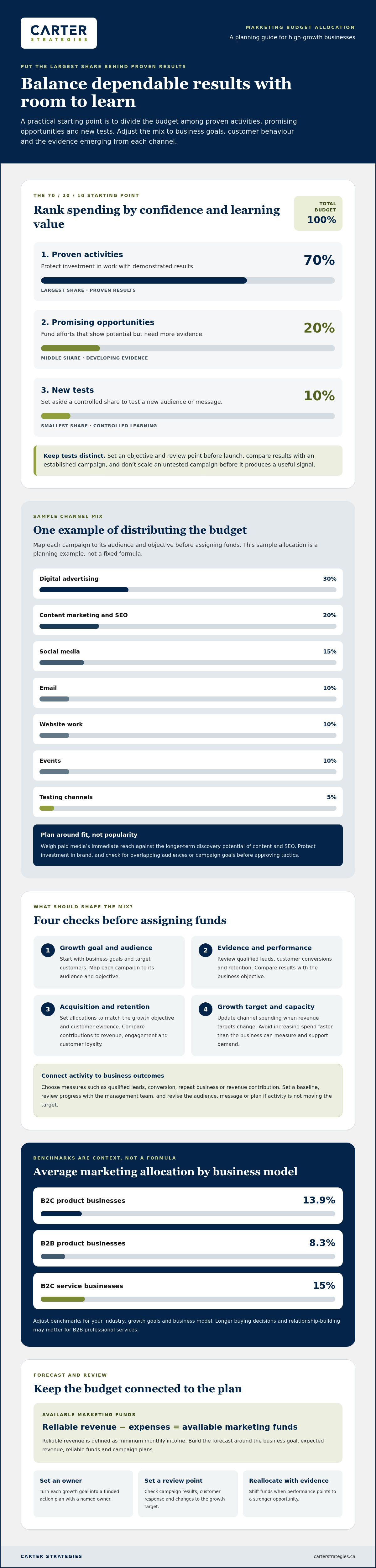
High growth doesn’t call for spreading marketing spend across every available channel. A practical starting point is to direct 70% of the budget to activities with proven results, 20% to promising opportunities and 10% to new tests. For companies managing a marketing budget for high growth, the key is to adjust that mix to business goals, customer behaviour and the evidence emerging from each channel.
It’s reasonable to want clear benchmarks when every investment needs to support growth and teams are weighing competing priorities. This article explains how to set a budget around business objectives, prioritize channels, assess longer-term impact, and interpret company-size benchmarks without treating them as a universal formula. You’ll also learn how to review results and shift spending when performance points to a stronger opportunity.
Key Takeaways
- Start with business goals and customer needs, then set a budget that supports the growth priorities your team can act on.
- Separate proven channels from promising opportunities and new tests so experimentation doesn’t displace work that already performs.
- Assess marketing’s longer-term contribution alongside immediate results, using measures tied to your business objectives.
- Prioritize channels based on audience fit and performance, and adjust allocations as evidence develops.
- Use company-size benchmarks as context, not a fixed formula; your industry, growth goals and business model should shape the final allocation.
What factors do you consider when allocating your marketing budget across different channels and tactics?
Start with the growth goal, target customers, and evidence from past campaigns. Then divide spending among proven work, promising opportunities, and controlled tests.
-
Separate proven, uncertain, and untested activities
Reserve 70% of marketing spending for activities with proven results, 20% for promising efforts, and 10% for new tests. This allocation, recommended by BDC Senior Business Advisor Mallika Kazim, balances dependable results with learning. Review the evidence behind each tactic, including qualified leads, customer conversions, and retention. Don’t scale an untested campaign before it produces a useful signal.
Set a clear objective and review point before launching a test. For example, test a new audience or message in one campaign, then compare its results with an established campaign. Keep test spending separate from proven investments so experimentation doesn’t quietly consume funds allocated to reliable channels.
-
Distribute funds across channels, campaigns, and categories
Map each campaign to its audience and objective before assigning funds to advertising, content, SEO, social media, email, website work, events, or partnerships. One sample allocation assigns 30% to digital advertising, 20% to content marketing and SEO, 15% to social media, and 10% each to email, website work, and events. It reserves 5% for testing channels.
Use that mix as a planning example, not a fixed formula. For a high-growth budget, weigh paid media’s immediate reach against the longer-term discovery potential of content and SEO, while protecting investment in brand. Before approving overlapping tactics, check whether they target the same audience or serve the same campaign goal.
-
Balance customer acquisition and retention
Set acquisition and retention allocations according to your growth objective and customer evidence. Startups building awareness may need to emphasize finding and converting new customers, while scale-ups can fund both acquisition and activities that encourage repeat purchases. Before shifting funds, compare each group’s contribution to revenue, engagement, and customer loyalty.
To allocate a high-growth marketing budget across paid media, content, SEO, and brand, connect each investment to a stage in the customer journey. Paid campaigns can generate reach, useful content and SEO can support discovery, and brand work can reinforce recognition. Track how these efforts work together, not just their standalone conversions.
-
Forecast spending against growth and revenue targets
Build the forecast around the business goal, expected revenue, reliable funds, and campaign plans. To estimate available marketing funds, subtract expenses from reliable revenue, defined as minimum monthly income. If revenue targets change, update channel spending and forecasts together, then review the impact with the management team.
Avoid increasing spending faster than the business can measure and support demand. Rapid increases can amplify weak campaign performance, strain conversion capacity, or leave too little room to adjust. Set review points and reallocate based on campaign results, customer response, and the revised growth target.
Aligning the marketing budget with business strategy and goals
Set the business direction first, then assign marketing spend to the goals and customer groups that matter most. Use benchmarks for your business model as context, not as a substitute for customer evidence or team priorities.
-
Connect marketing investment to business strategy
Translate the business strategy into a marketing target before setting allocations. If the priority is entering a new Canadian market, identify the customer segment, value proposition, and evidence needed to support that move. Involve employees across sales, service, and marketing. Their customer and industry insights can reveal barriers an executive-only plan might miss.
Connect every proposed investment to an outcome and a measure. A brand-positioning initiative might aim to improve recognition among a defined audience, while a lead-generation campaign could track qualified opportunities. Don’t approve spending simply because a channel is popular. Ask how it supports the strategy and which metric will show progress.
-
Match spending to business goals
Turn each growth goal into a funded action plan with a named owner, timeline, and measure. For a goal to increase sales by 20%, identify the customer segment and the work needed to reach it. Website improvements, advertising, or added marketing capacity may support that goal, but each requires a clear role and a way to assess results.
Choose metrics that link marketing activity to business outcomes, such as qualified leads, conversion, repeat business, or revenue contribution. Set a baseline before a campaign begins, then review progress with the management team. If spending generates activity without moving the target, revise the audience, message, or plan instead of automatically adding funds.
-
Account for business models and common expenses
Compare your model with relevant benchmarks, then adjust for sales cycles and customer behaviour. Average marketing allocations are 13.9% of revenue for B2C product businesses, 8.3% for B2B product businesses, and 15% for B2C service businesses. These figures offer context, not a prescribed budget; B2B professional services may need to account for longer buying decisions and relationship-building.
For small businesses, list essential expenses before selecting optional campaigns. Separate ongoing needs, such as website costs and marketing tools, from campaign spending, promotional materials, and new channel tests. Identify which expenses support the current target and which can wait. If priorities remain unclear, business strategy development can help connect goals, team input, and marketing investment.
How do you measure the long-term impact of marketing spend?
Measure immediate campaign results alongside customer and brand outcomes that develop over time. A useful review links each effort to a business metric, actual spending, and a decision about what to change.
-
Balance brand building and performance marketing
Track brand-building and performance marketing as connected parts of the customer journey. Performance campaigns can show responses quickly, while brand efforts build recognition and consideration that may influence later choices. Set a distinct objective and measure for each, then examine how both support the same business goal. Avoid shifting all spending to the channel with the fastest visible response.
Include measures such as qualified leads, conversion, repeat business, and customer feedback. For example, compare a campaign’s immediate lead activity with later changes in branded enquiries. Review findings with sales and marketing partners, since customer conversations can explain results that analytics alone may not capture.
-
Track short- and long-term performance
Separate early indicators from outcomes that need time to emerge. Monitor campaign responses and actual spending monthly or at least quarterly, then assess broader business measures over a longer period. Marketing changes may take 3-6 months to show results, so don’t treat an early fluctuation as a final verdict.
Use a consistent scorecard that links each effort to its purpose. A content initiative might track audience engagement and qualified enquiries, while a retention effort tracks repeat purchases. Record the starting point, review period, and target to help the team distinguish a delayed result from an ineffective tactic.
-
Review campaign performance and ROI
Review campaign performance against its stated objective, audience, and actual spending. A Revology-commissioned survey of commercial leaders found 67% did not know the return on their marketing investments. Make every campaign accountable by recording its intended outcome, tracking results, and documenting what the team will continue, change, or stop.
Calculate return on investment by comparing the value attributed to a campaign with its spending, using the same method across channels. Don’t rely on clicks alone when the business goal is qualified opportunities or sales. Check your assumptions with finance, sales, and marketing partners before reallocating funds.
-
Calculate CAC, LTV, payback period, and marketing ROI
Calculate customer acquisition cost (CAC) by dividing acquisition spending by the number of new customers gained in the same period. Estimate customer lifetime value (LTV) from the value a customer contributes over the relationship. Payback period measures how long that contribution takes to recover CAC; marketing ROI compares attributable value with marketing spending.
Use consistent time periods and include relevant acquisition costs in each calculation. Compare CAC and LTV by customer segment, not just across the whole business. Review allocations quarterly and monitor spending and campaign metrics monthly or at least quarterly. Shift funds when performance data supports a change.
Choosing and prioritising marketing channels
Prioritize channels based on how well they reach target customers and support revenue goals. Managing a marketing budget for high growth means assessing audience fit, campaign purpose, and evidence before expanding spending.
Use benchmarks to inform decisions, not dictate them. A channel’s contribution depends on customer behaviour, your offer, and the next action customers need to take.
- Map the customer journey before selecting channels. A B2B buyer may need useful information and several conversations before choosing a supplier, while a retail customer may purchase after seeing a relevant social media promotion. Match each channel to a decision-making stage, then identify where current marketing efforts lose attention or momentum.
Ask sales and customer-facing employees which questions come up most often. Their examples can reveal whether customers need education, proof, reminders, or a direct path to purchase. Don’t fund a channel simply because competitors use it. Confirm that it reaches your audience and supports a defined customer action.
- Compare channel roles and costs before setting priorities. Social media ads are described as a lower-cost tactic, while television campaigns are higher-cost. Cost alone doesn’t show whether a channel reaches the right people or contributes to sales, so consider the expected audience and campaign purpose too.
For example, a small business testing an offer could compare social media advertising with search advertising. Assess audience relevance, traffic quality, and what visitors do next. If a channel attracts attention but few qualified enquiries, examine the message and landing page before increasing its allocation.
- Check what each benchmark measures before using it. A survey of chief marketing officers found online marketing budgets allocated 9.8% to search advertising, 9.3% to digital display advertising, and 10.1% to social advertising. These figures describe portions of online budgets, not recommended shares of total marketing spend.
Companies making at least 50% of sales online spent roughly 27% of marketing costs on mobile. Treat that figure as context for assessing mobile customer behaviour, not as a required allocation. Review how customers browse and purchase through mobile before changing channel spending.
- Compare campaigns using the same goal and measurement window. Assess qualified leads against qualified leads, or sales against sales, rather than judging one channel by clicks and another by revenue. Record campaign timing, audience, and offer so the team can distinguish channel performance from differences in execution.
A disciplined approach to managing a marketing budget for high growth links each allocation change to a specific finding. For instance, shift spending toward stronger qualified traffic while maintaining a measured test for emerging customer needs. Record the reason for the shift, then use the next review to see whether it improved the intended outcome.
Marketing budget benchmarks by company size
For Canadian companies, include applicable taxes and channel-related compliance in forecasts. Their treatment depends on jurisdiction and activity. Interpret spending benchmarks in light of revenue, company stage, objectives, and audience, rather than treating one percentage as a fixed rule.
- Compare benchmarks by company size, then check how each figure is measured. Small businesses spend about 8.11% on marketing on average. Gartner’s CMO Spend Survey puts larger organizations’ average marketing budgets at 7.7% of total revenue. These figures use revenue as the denominator, which makes them different from shares of an overall company budget.
Employee-based figures use another denominator: companies with fewer than 100 employees allocate roughly 46% of their overall budget to marketing; mid-sized organizations with 100-499 employees allocate around 33%. Companies with 500-999 employees allocate around 12%. Don’t compare these directly with revenue percentages. First identify the budget base and the population measured.
- Match the benchmark to your growth stage and operating model. The 2025 B2B Marketing Benchmarks Report, based on more than 300 marketing leaders, says companies growing more than 30% allocate more than twice as much to marketing as companies growing less than 10%. It also reports 13% of revenue for product-led growth companies, compared with 9% for sales-led companies.
Use these findings to frame a discussion, not to set an automatic target. A scale-up pursuing a new segment may need a different allocation from a steady-growth company with established demand. Before changing the plan, review objectives, sales capacity, and customer evidence with the management team.
- Clarify what “marketing budget” includes before applying a benchmark. The same report says marketing receives approximately one-third of the combined Sales and Marketing budget. That share differs from marketing as a percentage of revenue. If your organization reports combined functions, separate the budgets before comparing results or setting a new allocation.
For cost planning, identify the main drivers instead of relying on a generic estimate. Audience size, campaign frequency, creative production, channel selection, and internal capacity all affect the forecast. In Canada, account for applicable taxes and compliance work within the relevant channel plan, and have finance reflect the organization’s jurisdiction and activity.
- Set a working range based on your company’s baseline, then document why it fits. Compare current marketing spend with revenue, growth objectives, audience needs, and the resources required to deliver the plan. Revisit assumptions when revenue targets or business priorities shift. A benchmark should inform the decision, not replace it.
Use marketing strategy support to connect budget assumptions with business priorities and a practical growth plan.
Include applicable taxes and channel-related compliance costs in the relevant channel plan, with finance assessing their treatment based on the organization’s jurisdiction and activity. Before using stated company-size and revenue benchmarks, check their denominator and population. Account for audience size, campaign frequency, creative production, channel choice, and internal capacity when forecasting costs.
Carter Strategies: Business Strategy Development
Carter Strategies helps leadership teams connect business priorities with marketing investment through Business Strategy Development and Marketing Strategy. Turn to this support when benchmarks alone don’t clarify which growth priorities deserve funding, or when teams need to align around a budget and action plans.
Growth Strategies and Planning helps translate business direction into shared priorities. Fractional CMO and CRO services provide senior marketing and revenue leadership for organizations that need strategic guidance without hiring every leadership role full-time. The work focuses on planning and alignment, not tactical marketing execution.
To discuss how strategic support could fit your growth priorities, contact Carter Strategies.
Turn your budget into a shared growth plan
Managing a marketing budget for high growth takes more than selecting channels. People across the business need to understand what each investment supports, who owns the work, and how the team will respond when results change. When those decisions stay connected, marketing priorities can adapt with the business rather than operate separately from it.
Carter Strategies supports this alignment through Business Strategy Development, Marketing Strategy, and Fractional CMO and CRO services. If your leadership team is weighing competing priorities or needs a clearer link between strategy and marketing investment, take the next step together.
Discuss your marketing budget with Carter Strategies, and move forward with a plan your team can own.
Frequently Asked Questions
What is marketing ROI?
Marketing ROI helps assess whether a campaign created value beyond sales that might have happened anyway. For a seasonal promotion, compare results with a similar period or customer group that didn’t receive the campaign, while accounting for other changes that could affect demand. This incrementality check adds context to platform reports and helps leaders judge whether observed sales reflect campaign influence or existing customer intent.
What are common mistakes in managing a marketing budget?
A common mistake is treating every campaign as equally useful just because it produced activity. A high volume of low-fit enquiries, for example, can consume sales time without supporting the business’s ideal customer profile. Before funding a repeat campaign, compare lead quality with the characteristics of customers the company can serve well. This connects budget decisions to operational capacity and the organization’s chosen market.
Why is a digital marketing budget important?
A digital marketing budget helps leaders make deliberate choices about online audience reach, content, and campaign learning. It can also clarify who owns each activity and which teams need access to results. For example, a shared plan can help marketing and sales agree on how to handle an online enquiry. Without that coordination, campaigns may attract attention while customer follow-up remains unclear.
How much should high-growth companies spend on marketing as a percentage of revenue?
Choose a percentage by modelling what the growth plan requires, rather than adopting a universal target. Start with the customers you intend to reach, available sales capacity, and the contribution your business earns from each sale. Then test whether the planned investment fits the company’s cash needs and delivery capacity. This gives leaders a defensible budget tied to business conditions, not just a benchmark.
How do you manage marketing budgets across channels using performance data and attribution?
Set attribution rules before campaigns launch, then apply them consistently across channels. Use clear campaign names and tracking tags so analytics, sales records, and finance reports can be compared. For B2B organizations, include offline conversations that follow digital engagement, such as a conference meeting after a prospect reads campaign content. Documenting those connections helps teams interpret channel reports without treating every interaction as a separate sale.
What tools and processes help track marketing spend and prevent budget overruns?
Use a shared campaign calendar alongside finance and analytics records, with consistent campaign identifiers across systems. Before launch, record planned dates, responsible team members, and expected supplier commitments. As work progresses, compare scheduled activity with invoices and campaign reporting, then flag discrepancies for the budget owner. This cross-check can reveal duplicate charges, missed commitments, or campaigns continuing past their planned end date.


