


Growth doesn’t always require a new business. It can come from earning revenue in a new way from customers, expertise or assets you already have. A revenue stream is a distinct source of income, such as direct sales, subscriptions or an added service. To understand how to identify new revenue streams, look for customer needs your business can meet, then assess whether each opportunity fits your capabilities and can support sustainable margins.
It makes sense to look beyond your existing offers, but a promising idea needs more than enthusiasm. It should solve a real customer problem and suit the people, priorities and resources involved in delivering it.
This article explains what revenue streams are, where to find ideas and how to assess market potential, margins, feasibility and strategic fit. You’ll see how customer and industry insights, practical testing and clear priorities can distinguish an actionable opportunity from a distraction. The aim is not to pursue every possible source of income, but to identify options that align with your business and merit focused evaluation.
Key Takeaways
- Compare possible income sources with your value proposition, customer needs and core capabilities before pursuing them.
- Look for ideas in customer feedback, sales patterns and employee observations, then test whether the need reaches beyond a few customers.
- Consider service-based offers that apply your existing expertise or relationships to a customer problem.
- Assess each opportunity for market potential, margin, feasibility, differentiation and the effort required to reach customers.
- Focus on a small number of promising ideas, validate demand with a pilot and use what you learn to shape the next decision.
What are Revenue Streams?
A revenue stream is a distinct way a business earns income from customers. Direct product sales, project fees and subscription payments are different streams because each depends on a different offer and buying pattern. A business model explains how an organization creates value, delivers it to customers and earns income in return. For example, a digital publisher might earn from individual content purchases, advertising and paid access. Its business model connects these streams to its audience, capabilities and financial priorities.
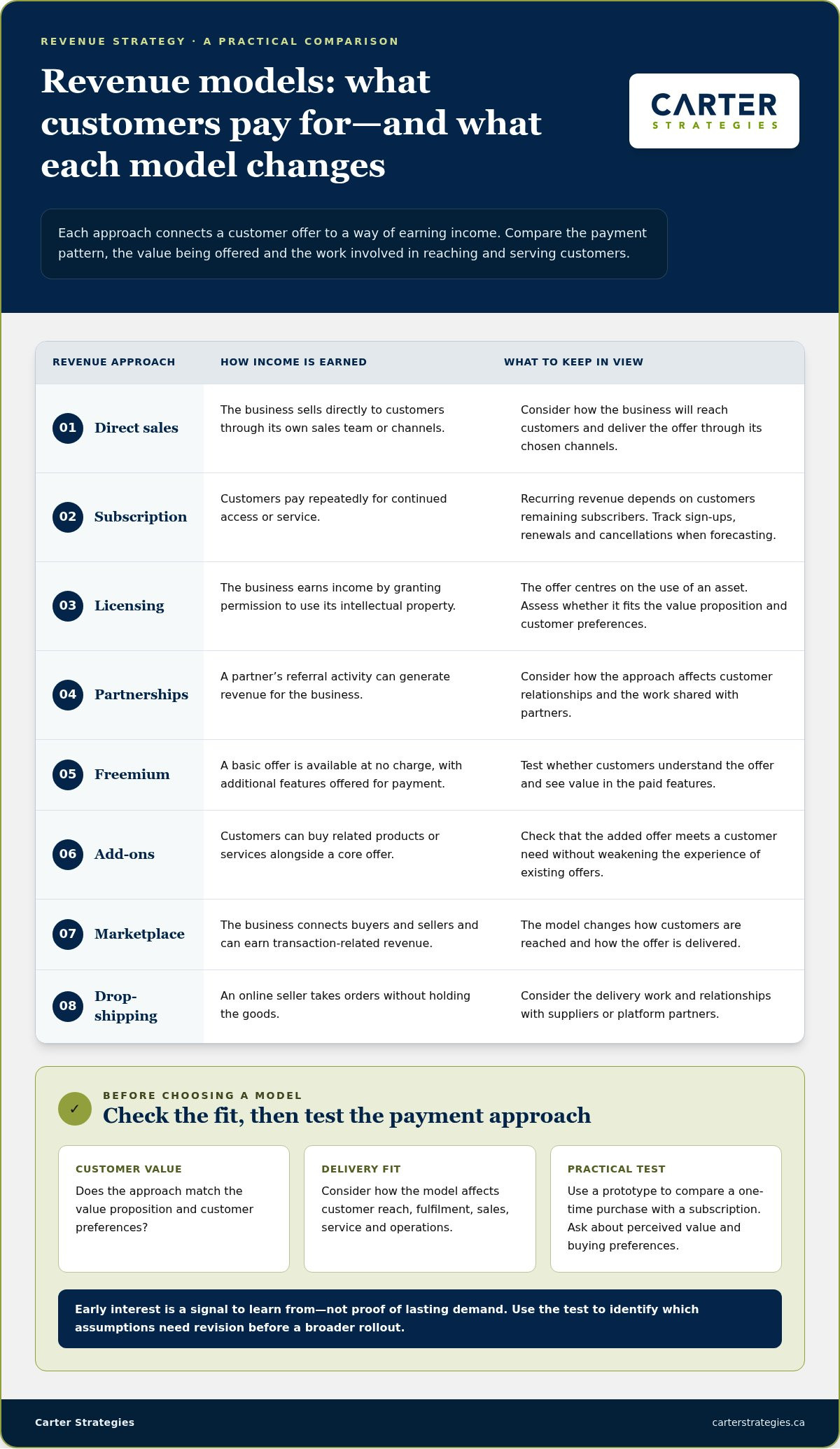
Subscription, licensing, partnership and add-on models differ in what customers pay for and how income is generated. Subscriptions charge for ongoing access; licensing grants permission to use intellectual property; partnerships can generate referral revenue; and add-ons sell related products or services to existing customers. Their suitability depends on the value proposition and customer preferences, not simply the possibility of recurring revenue.
Other common models include direct sales, online marketplaces, freemium offers and drop-shipping. A freemium software provider, for instance, might offer basic access at no charge and charge for additional features. A marketplace can connect buyers and sellers while earning transaction-related revenue. Drop-shipping lets an online seller take orders without holding the goods. Each model changes how the business reaches customers, fulfils its offer and manages relationships with suppliers or platform partners.
- Direct sales: The business sells to customers through its own sales team or channels.
- Subscription: Customers pay repeatedly for continued access or service, supporting recurring revenue if they remain subscribers.
- Licensing or partnerships: The business earns from permitted use of an asset or a partner’s referral activity.
- Freemium or add-ons: A free or core offer creates a path to paid features or related purchases.
Business model innovation means changing how an organization creates, delivers or earns value, rather than changing only the product. Digital transformation can support this shift. A company with in-person sales might add e-commerce to reach customers through another channel. A mobile app can support engagement and create opportunities for in-app purchases. These changes affect the customer experience and the work required across sales, service and operations, so consider the whole model before committing.
Test the revenue approach as well as the offer. A prototype can reveal whether customers understand a proposed payment structure or prefer another way to buy. For example, present a one-time purchase and a subscription option to a defined customer group, then ask about perceived value and buying preferences. The goal is to learn which assumptions need revision before a broad rollout, not to treat early interest as proof of lasting demand.
Forecast each stream using its own drivers. A subscription forecast depends on new sign-ups, renewals and cancellations; a project forecast depends on potential work in the pipeline and when customers may proceed. Compare expected bookings with delivery capacity, and update assumptions as sales information changes. Revenue is recognized when goods are sold or services are rendered, even if the customer has not paid yet. Separating revenue timing from cash collection helps leaders interpret financial performance more clearly.
Gathering ideas from customers, competitors, trade shows, social media, and staff
Useful research combines customer and market evidence with information your business already holds. Sales records, trade-show notes, social media comments, competitor observations and staff input can reveal different signals. Compare them before choosing which ideas to investigate.
Sources of Revenue Ideas
Gather revenue ideas from people who encounter your products, services and market in different ways. Ask customers what they have trouble finding, and invite staff to share questions they hear repeatedly. At trade shows, record what attendees ask about, not just which displays attract attention. Review social media comments for recurring requests, and examine competitors’ public offers for differences in packaging or service. A shared log turns scattered observations into options the team can assess.
Customer Needs and Market Signals
Customer and market signals offer evidence of changing needs, buying choices and unmet expectations. Ask customers what alternatives they use, including competitors’ offers, and what those alternatives do better. Compare answers across customer groups rather than treating one account’s request as representative. Review industry news and changes in customer workflows for emerging needs. Then map each opportunity to business assets such as expertise, technology or customer relationships. This helps surface ideas that fit your strengths.
Data and Tools for Opportunity Research
Research tools help teams organize and compare evidence instead of relying on memory. A spreadsheet can capture the source, customer segment, problem, competing solution and follow-up question for each idea. Customer interviews add context; sales and service records show whether similar requests recur. Social listening tools can sort public comments by topic, while trade-show debriefs capture questions soon after conversations. Together, these sources help show what data and tools can reveal about revenue opportunities.
Use the evidence to protect customer relationships and existing profit. If a new service might replace a customer’s current purchase, for example, ask whether it meets an unmet need or simply shifts revenue between offers. Include account managers and frontline staff in the discussion: they can flag commitments or service expectations the proposal might affect. Consider whether the offer adds value without weakening the experience customers already receive. This check can reveal relationship risks before the team invests in development.
Next, test the clearest assumptions with a defined audience. Present prospective buyers with two positioning statements for the same offer, then ask which better communicates its value and why. A small customer discussion can expose confusing language before a broader campaign. Compare feedback with observed behaviour, such as follow-up requests or meeting interest, rather than relying on compliments alone. Record what evidence would lead you to proceed, revise or set the idea aside. This keeps exploration focused on opportunities grounded in customer needs.
Service revenue
Services can turn a business’s expertise, relationships or customer knowledge into a distinct offer. The opportunity is strongest when customers need help beyond the product itself and the business can provide it without weakening its core work.
Complementary Products and Services
A complementary service helps customers get more value from a product or service they already use. For example, a commercial equipment supplier might offer a site assessment to help buyers select suitable equipment, while a design firm could provide a review after a client completes a project. These offers can deepen customer relationships and extend the value proposition beyond the original sale.
Before developing a service, identify the task customers struggle with and who in the business can address it. Ask account managers and service employees where customers need additional guidance, then define what the offer includes and where its boundaries lie. Clear scope supports consistent delivery, helps customers understand what they are buying and lets the team assess whether the service fits its expertise and capacity.
Transaction-Based and Service-Based Revenue
Transaction-based revenue comes from a completed purchase, while service-based revenue comes from work performed for a customer. A retailer earns transaction revenue from a sale; a product specialist might earn service revenue by assessing a customer’s operating process. The distinction matters because each stream creates different delivery commitments and patterns of customer interaction.
A service can be tied to a defined project, ongoing access or work requested as needed. For example, a communications firm might deliver a single brand review, provide ongoing advisory support or complete separate assignments when clients request them. The first model depends on securing new engagements; ongoing support depends on continued customer value and consistent delivery. Choose an arrangement that matches how customers need help instead of forcing every service into a recurring format.
Service design also shapes how teams plan and deliver the work. Define the customer, expected outcome, scope, delivery process and responsibilities before introducing the offer. A professional firm developing a research service, for instance, should clarify what information it will gather and how the findings will support a client decision. Employees who deliver the work can identify necessary handoffs, tools or specialist knowledge. Their input helps the business design an offer customers can understand and staff can provide reliably.
Finally, assess whether the new service adds income or simply shifts demand from an existing offer. Compare customer response, delivery effort and the effect on related sales. A retailer adding product personalization, for example, should consider whether it creates additional value or mainly replaces standard purchases. Track how customers use the service and whether they return for related support. This helps leaders refine the offer, protect customer experience and decide how service revenue fits within the broader business.
Benefits of diversifying revenue sources
Relying on one source of income can leave a business exposed when customer demand shifts. A retailer dependent on in-store transactions, for example, may face pressure if customers change where they shop. Adding online sales or a related service can create another channel and reduce dependence on a single route. Diversification does not remove risk; it changes where the business earns income and which factors influence it.
Different sources can respond differently to market changes. A company selling seasonal products might add maintenance services that customers need throughout the year. A B2B firm earning project revenue could develop ongoing support for customers between projects. Recurring revenue is generally more predictable than transaction-based or service revenue when the customer base remains stable. The distinction helps leaders assess how each stream may contribute to financial planning.
Revenue diversification can also create room for innovation. A business might apply existing expertise to a new customer segment or adapt a product for an adjacent market. A food producer, for example, could explore a new format for customers with different usage needs. Before expanding, assess whether the opportunity fits core capabilities and strengthens the value proposition. New channels or offers should support the business’s direction, not pull employees away from priorities they can deliver well.
A broader mix can reduce reliance on one product, customer group or market. Consider a company that earns income from direct sales and a partner channel. If one channel slows, the other may continue to contribute, provided both reach customers effectively. A business serving multiple industries can also reduce its dependence on a single sector’s buying patterns. These differences matter: streams exposed to the same customers or market forces may offer little protection from shared disruptions.
Diversification has trade-offs. Adding a service may require staff time, new processes and ongoing customer support. A new product could compete with an existing offer or shift sales without increasing total profit. Map how the proposed stream generates income, which customers it serves and what resources it needs. Then compare its expected contribution with the attention it will demand from the team. A clear view of these connections helps avoid adding complexity without creating meaningful value.
Manage the portfolio as an active business decision. Track revenue, customer retention and delivery demands for each stream, then review them alongside market changes. If an online channel attracts new customers but reduces profitable in-person sales, assess the combined result rather than celebrating channel growth alone. Employees who manage customer relationships can flag shifts in demand early. Their observations, alongside sales and service data, help leaders decide whether to expand, adjust or discontinue an offer. Diversification works best when each stream supports customer value and the organization’s ability to deliver.
Evaluating market size, margins, feasibility, and differentiation
Compare opportunities against customer demand, delivery requirements and strategic fit. A decision matrix can make the trade-offs easier to see.
To assess costs, margins and profitability, estimate the resources each offer requires, then compare expected revenue with delivery and customer-acquisition expenses. A weighted opportunity matrix can score margin potential, market size, feasibility, differentiation, speed to market and customer value. This framework helps clarify how to identify new revenue streams worth evaluating further.
Assessing Market Opportunities
Market assessment compares an opportunity’s potential customers with the business’s ability to serve them distinctively. A large market alone does not make an opportunity practical or profitable.
Define the customer segment and problem first. Estimate market potential using evidence about the segment’s size, urgency of need and willingness to pay. Then assess feasibility: can your team deliver the offer with its current capabilities, or will it need new technology, training or partners? Include acquisition effort and expected margin in the comparison. Build a focused portfolio, not a list of every idea that scores well on market size alone.
Competitors and Market Gaps
Competitor analysis examines existing offers, customer groups and unmet needs in relevant markets. It matters because differentiation should give customers a clear reason to choose your offer.
Compare competitor positioning, channels and service scope using public materials and customer conversations. Look for gaps such as an underserved customer segment, a difficult buying process or support that ends too soon. Validate each gap with prospective customers: an absent offer may reflect limited demand, not an open opportunity. A distinct value proposition should address the gap using strengths your business can deliver consistently.
Partnerships, affiliate marketing and licensing can extend your reach without requiring you to build every capability internally. A complementary partner may introduce your offer to its customer base, while an affiliate arrangement can generate referral revenue. Licensing can create income from intellectual property. For each approach, clarify responsibilities, customer experience and how revenue or referrals will be measured. These arrangements need shared expectations and ongoing attention to work well.
Use a simple portfolio view to compare shortlisted opportunities. Score each against the same weighted criteria, then discuss differences with employees who understand delivery and customer needs. A strong score does not replace judgement; it gives the management team a shared basis for deciding what to explore, defer or drop. Prioritize a narrow set to keep resources and accountability clear.
For a launch, define the target audience, positioning, marketing channels and key performance indicators (KPIs). Track measures such as revenue, new customers, retention and margin against the objective. A pilot with a defined customer segment can test the offer before a broader rollout. Review results with the team, adjust the approach when evidence points to a better fit, and assign owners to next steps. Use these criteria to decide how to identify new revenue streams that merit a pilot. Explore growth strategies and planning to turn selected opportunities into focused priorities.
Carter Strategies: Business Strategy Development
Carter Strategies can help turn potential revenue ideas into clear strategic priorities through Business Strategy Development. The work connects customer and industry insights with your business’s capabilities, market position and growth objectives. This is useful when leaders see several possible opportunities but need to decide which ones fit, what the organization can deliver and how to align the team around action plans.
Rather than treating growth as a financial exercise developed in isolation, strategic planning should involve the people responsible for delivering the strategy. That shared understanding helps connect decisions about new revenue sources with practical priorities and execution. If you’re ready to discuss your growth priorities, visit Carter Strategies.
Turn the Next Opportunity into a Clear Priority
The next step is to turn a promising idea into a focused business decision. Ask what evidence would justify further investment, who needs to contribute and what the team must learn before committing resources. That makes how to identify new revenue streams a practical leadership question, grounded in customer response and the organization’s ability to deliver.
When those decisions need structure, Carter Strategies offers Business Strategy Development, Marketing Strategy, and Fractional CMO and CRO services. These services can connect growth opportunities with strategic priorities and team ownership, helping leaders decide what deserves attention and plan the work ahead.
Discuss your growth options with Carter Strategies and take a considered next step toward growth that fits your business.
Frequently Asked Questions
Can you prove there is customer demand?
Research can provide strong evidence of demand, but no result proves future sales with certainty. Look for customer actions, not just positive comments: a paid pilot, a preorder, a signed letter of intent or repeat use of a trial offer. For example, a facilities company could offer a paid site assessment before developing a full maintenance service. Compare commitments with interview feedback to see whether interest translates into buying behaviour.
What are common ways businesses identify new revenue streams?
Businesses often find opportunities by examining unused assets, customer requests and adjacent markets. A training company might package its existing expertise for a new industry, while a manufacturer could license a design it already owns. Review sales conversations for repeated requests, then ask employees where customers seek help beyond your current offer. The strongest leads connect a specific customer problem with something the business can deliver without losing focus on its core work.
How can customer research reveal unmet needs and revenue opportunities?
Customer research reveals unmet needs by showing what people do when current solutions fall short. Ask a recent buyer to describe the last time they faced the problem, what they tried and what made the process difficult. For example, a business software customer might explain that staff still use spreadsheets to prepare reports. That workaround could point to a paid service or feature, which you can discuss with other customers before shaping an offer.
How do businesses evaluate the market size and demand for a new revenue stream?
Estimate market size by defining the specific customers who face the problem, then determine how many you can realistically reach and serve. Separate broad interest from demand within your intended segment. For example, a Canadian supplier considering training for independent retailers should distinguish all potential retailers from those it can reach through its current channels. Validate the estimate through direct sales conversations, early sign-ups or a pilot, and compare responses across customer groups.
How can a business test a new product or service idea before investing heavily?
Test the central assumption with the smallest useful version of the offer. A professional services firm could describe a fixed-scope workshop to a small group of prospective clients and invite them to book a pilot. A prototype or sample can test usability, while a landing page can assess whether the message attracts qualified interest. Set a learning objective first, such as whether buyers understand the benefit, then use participant feedback to refine the offer.
What are the risks of adding new revenue streams, and how can businesses manage them?
New revenue streams can strain staff capacity, confuse customers or draw sales away from a stronger offer. A retailer adding a private-label product, for example, should track whether it attracts new buyers or mainly replaces purchases of existing products. Assign an owner, define available resources and monitor customer response alongside delivery demands. A limited pilot makes it easier to spot problems early and adjust the offer before it becomes part of standard operations.
How can businesses prioritize and measure the success of new revenue streams?
Prioritize opportunities by comparing customer demand, strategic fit, expected margin, delivery requirements and available evidence. Give each idea an accountable owner before launch. Set measures that reflect the goal: a new customer offer might track qualified leads, conversion and repeat purchases, while a support service could also monitor usage and renewal. Review the measures with employees who deliver the offer, so results guide decisions about refining, expanding or stopping it.


