


A market launch is not the same as market traction. B2B expansion can take 12 to 24 months to produce meaningful revenue growth, so planning how to avoid failed market expansion means preparing for a longer runway than the launch itself.
That timing can put pressure on cash flow, especially when hiring, operating costs and sales activity begin before revenue catches up. A promising opportunity may take time to gain momentum, so judge early results against realistic timelines and clear signs of progress.
This article explains how to assess expansion timing, buyer demand, regulatory and employment risks before committing resources. It also covers operational readiness and cash-flow planning, including how to test delayed-revenue scenarios and track leading indicators while sales develop. The goal is a decision your management team and employees can support, grounded in customer and industry insights and matched to the organization’s ability to execute.
Key Takeaways
- Allow 12 to 24 months for meaningful B2B revenue growth, and set progress measures that reflect the longer path to market traction.
- Use customer interviews and iterative research to test demand and adapt your value proposition before committing to expansion.
- Assess regulatory exposure and local employment requirements early so they inform your entry plan and risk management.
- Check whether your people, processes, suppliers and leadership can support the new market before accelerating investment.
- Model delayed revenue and cash-flow pressure, and track leading indicators while sales develop.
1. How long does market expansion actually take?
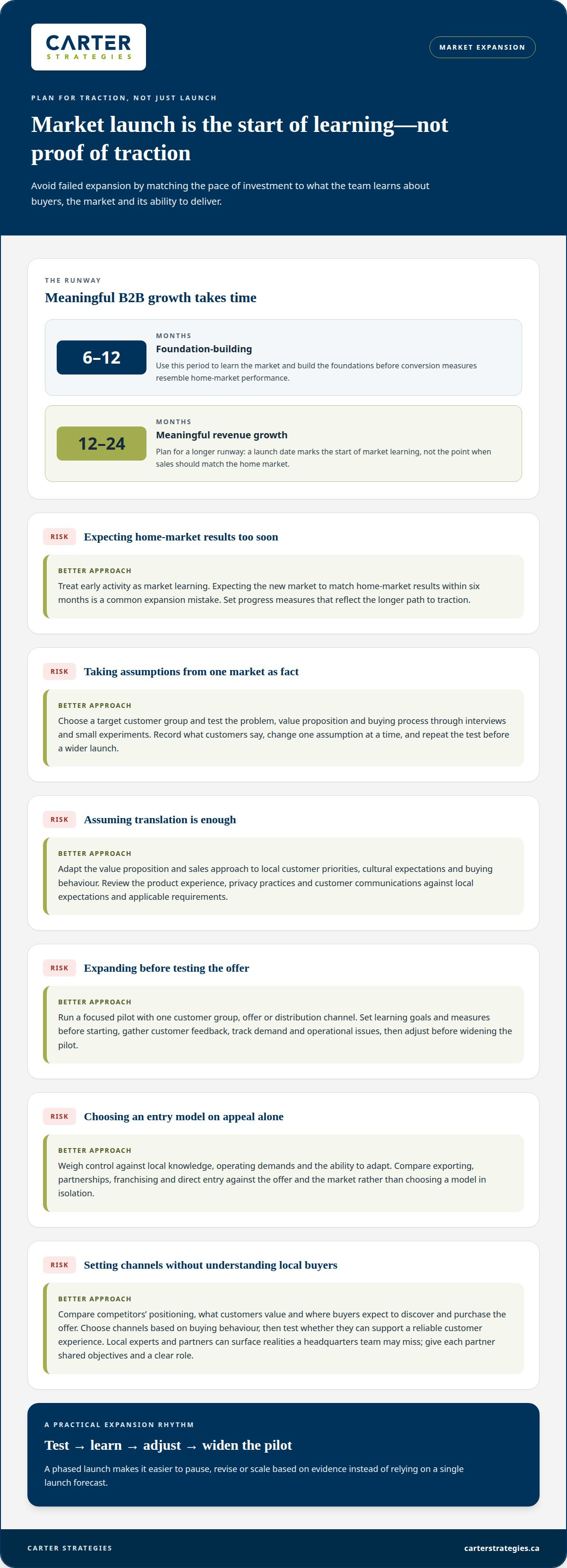
B2B expansion can take 12 to 24 months to produce meaningful revenue growth. A launch date marks the start of market learning, not the point when sales should match the home market. Plan for 6 to 12 months of foundation-building before conversion measures resemble home-market performance. Expecting the new market to match home-market results within six months is a common expansion mistake.
Use customer development and agile methods to make that time productive. Define a target customer group, then test the problem, value proposition and buying process through interviews and small experiments. Record what customers say, change one assumption at a time and repeat the test. This gives the team evidence to refine its offer before committing to a wider launch.
Localization means more than translation. Adapt the value proposition and sales approach to local customer priorities, cultural expectations and buying behaviour. Netflix’s international approach included localized content, flexible regional pricing, cultural adaptation and strategic partnerships. These elements show why a translated website alone cannot carry a market entry. Review the product experience, privacy practices and customer communications against local expectations and applicable requirements.
Assess local competition before setting prices and choosing distribution. Compare how alternatives are positioned, what customers value, and where buyers expect to discover and purchase the offer. Set pricing around customer value, competitive positioning and commercial objectives. Choose distribution channels based on buying behaviour, then test whether they can support a reliable customer experience. Local experts and partners can surface realities a headquarters team may miss, but give each partner shared objectives and a clear role.
Choose between exporting, partnerships, franchising and direct entry by weighing the required control against local knowledge, operating demands and the ability to adapt. Exporting can suit a focused test; partnerships can add local relationships, while franchising or direct entry requires a different level of operating commitment. The right choice depends on the offer and market, not on a model’s appeal in isolation.
Run a focused pilot by limiting the launch to one customer group, offer or distribution channel, then set learning goals and measures before starting. Gather customer feedback, track demand and operational issues, and adjust the offer before widening the pilot. A phased launch makes it easier to pause, revise or scale based on evidence rather than relying on a single launch forecast.
2. Market research and buyer interviews before expansion
To determine how to avoid failed market expansion, treat market research as a sequence of decisions, not a report completed before launch. Establish product-market fit in the current market and define what evidence would support entry elsewhere. As a suggested approach, B2B companies can interview around 50 people in a target market before deciding. Include prospective customers with different roles, buying responsibilities and familiarity with the problem. Ask about current workarounds, unmet needs, decision criteria and expectations. Look for patterns across interviews rather than letting one enthusiastic prospect set the strategy.
Begin with formative research to understand people’s needs and context. Ask target customers how they handle the relevant task today, what frustrates them and what would prompt a change. Notice the language they use to describe the problem, which may differ from internal terminology. Separate what customers say they want from the outcomes they need. This helps reveal whether the offer solves a meaningful problem or reflects assumptions carried over from another market.
Next, use directive research to explore possible solutions. Present alternative concepts, service models or value propositions, then ask participants what feels useful and what remains unclear. For example, a B2B service provider could test whether buyers prioritize specialized expertise, faster delivery or ongoing support. Go beyond asking whether an idea sounds appealing. Ask what customers would replace, how a decision gets approved and which objections could stop a purchase. Those answers can shape the offer and sales approach.
Research usability before scaling. Give participants a realistic task, such as finding a service detail, requesting information or completing an onboarding step. Watch where they hesitate, misread terminology or abandon the process. Evaluative research should measure usability against defined KPIs, such as task completion, errors, qualified enquiries or conversion through a specific step. Compare results across customer groups, then address friction that blocks the intended outcome. Tie every measure to a business decision; activity alone does not prove demand.
Connect findings to market strategy. Combine interviews with customer and industry insights about competitors, buying practices, channel preferences and local expectations. Identify which findings are consistent and which vary by customer segment. Then decide whether to adapt the product, revise the value proposition, change the route to market or pause entry. Repeat research as the offer develops: understand needs, explore solutions, then deliver and measure results. Leaders asking how to avoid failed market expansion can use this cycle to challenge assumptions before they become costly habits.
Bring employees who support sales and customer relationships into the review. Their questions can expose gaps between the proposed promise and the company’s ability to deliver it. A customer-informed strategic plan can connect research findings to clear priorities, ownership and next steps.
3. Assessing regulatory and employment risks
Regulatory readiness determines whether a market-entry plan can operate as designed. Before committing, map the rules that apply to the product, service, sales model and customer data in the target country. Assess licensing, marketing claims, privacy practices, contracts and any sector-specific approvals. Requirements depend on what the business sells and how it reaches customers. A legal review should identify obligations, responsible owners and decisions that could delay entry.
Employment assumptions need the same scrutiny. Classifying workers as employees or contractors can change a company’s obligations and operating model. Account for local rules on probation periods, notice periods, mandatory benefits, collective bargaining agreements and working time. Deliveroo withdrew from Spain after a law required delivery platforms to formally employ couriers rather than treat them as freelancers. The example shows how worker classification can affect commercial viability, not just payroll administration.
Build a risk register for each target country. For every exposure, record its likelihood, potential business impact, early warning signs, accountable owner and mitigation. Include regulatory changes, political instability, currency fluctuations, licensing delays, data handling and reliance on a local partner. Then test practical responses: pause hiring, change the sales model, update customer communications or delay launch. This turns broad concerns into decisions the management team can review.
Commercial risk assessment should connect compliance to the revenue plan. Review whether the proposed pricing, distribution channel, customer contracts and sales claims can operate within local requirements. A partner may provide market access, but the agreement should define responsibilities, performance measures, training and communication. Identify what happens if a partner misses targets or rules change. Establish decision points before launch so the team can adapt without losing sight of customer needs.
Bring local legal advisors into planning early, rather than treating their advice as a final sign-off. Their review can help interpret requirements and identify exposure before contracts, hiring or marketing commitments make changes harder. Ask internal teams to surface operational challenges too: sales may know which claims buyers expect, while people leaders understand recruitment constraints. This two-way review links local expertise with the company’s ability to deliver.
Revisit the assessment as the market evolves. Assign an owner to monitor regulatory updates, partner performance and employment assumptions, then establish a regular review rhythm tied to launch decisions. If a new requirement changes staffing, pricing or customer data practices, update the plan and forecast together. This discipline cannot remove every risk, but it helps leaders recognize pressure early and make informed choices about whether to proceed, adjust or pause.
4. Expansion planning and operational readiness
An expansion plan must match the business model to the market, not copy the home-market playbook. When entering multiple countries, companies need to adapt both their go-to-market and operating models. Sequence markets so leadership, funding and operational capacity can support each launch. Spreading resources across several markets at once can leave every team short of the people and attention needed to learn and deliver.
Set operational readiness gates before accelerating investment. Confirm that the offer can be delivered consistently, customer support can handle local demand, and internal processes have clear owners. Map each critical activity from order or contract through delivery and follow-up. Then test handoffs with the teams responsible for execution. The launch plan should reflect the company’s business model and the specific market, rather than assume existing processes will transfer unchanged.
Assess supply chains against the volume and reliability the expansion requires. Identify single-source suppliers, bottlenecks, delivery dependencies and the effect of disruption on customer commitments. Test whether inventory, service capacity and vendor performance can support planned growth. For example, a company entering a new market through a distributor needs clear performance measures, training, communication and shared objectives. Otherwise, sales plans may outrun the partner’s ability to deliver.
Staffing readiness goes beyond adding headcount. Identify which roles require local market knowledge, where recruitment may be difficult, and whether current leaders can oversee another operation. Hire strategic thinkers who can adapt to unfamiliar customer and operating conditions. Establish decision rights and escalation paths before launch, so local staff can address issues without creating a leadership bottleneck.
Expansion also changes financial and resource demands. Align market plans with the capital strategy, model operating and staffing needs, and include a capital buffer for delays or unexpected pressures. Test downside scenarios and operational stress points rather than relying only on expected growth. A forecast should account for delayed revenue and show which commitments the business can sustain if sales develop more slowly than planned.
Plans should address operational disruptions, supplier dependency, hiring constraints and currency fluctuations. For currency exposure, identify which revenues and obligations are in different currencies, then assess how exchange-rate movements could affect margins and cash needs. Consider suitable risk-management tools, including insurance and currency hedging. Assign an owner to review assumptions and update the plan as market conditions change.
Walmart entered Germany in 1997 by acquiring Wertkauf and Interspar. That example underscores why an acquisition or launch needs an integration plan covering people, processes, suppliers and decision-making. Set measurable readiness criteria, review them with affected employees, and scale only when the operating model can repeat reliably.
5. Expansion forecasting and cash-flow planning
A market-entry forecast should show when cash leaves the business, when revenue may arrive, and what happens if sales are delayed. Expansion revenue may be 12 or more months away, so a launch forecast based only on early sales can mislead. B2B companies are advised to budget for at least 18 months before assessing expansion ROI. That runway gives leaders a clearer basis for judging progress and deciding whether the plan remains viable.
Build the forecast from operating assumptions, not a top-line growth target. Map the expected sequence for customer acquisition, sales cycles, invoicing and payment collection. Include staffing, market research, distribution, service delivery and compliance commitments when they arise. Connect each assumption to an accountable team member, then update the forecast when customer or operational evidence changes. This makes it easier to identify the reason for a cash-flow gap.
Estimate market-entry requirements by listing one-time setup needs and ongoing operating commitments separately. Include staffing, inventory or delivery capacity, partner arrangements, customer support and market-specific adaptation. Model pricing around customer value, competitive positioning and long-term commercial objectives. Then compare expected revenue and margin with the timing of cash outflows. Do not treat projected sales as available cash before collection.
Use at least three scenarios: expected performance, slower revenue and a more difficult operating case. In each, test how delayed sales affect liquidity, staffing decisions, supplier commitments and the ability to maintain investment. Include cost volatility and working-capital cycles, since expansion can increase inventory pressure or lengthen the time between paying suppliers and collecting from customers. Set decision points in advance, such as when to slow hiring or revise the launch plan.
Track leading indicators while revenue develops. Pipeline quality, conversion, sales-cycle length, customer acquisition, retention and margins can show whether the entry model is gaining traction. Pair these measures with cash indicators, including burn-rate sustainability, liquidity timing and upcoming obligations. Review them together: a growing pipeline may still create pressure if conversion takes longer or payment arrives later than expected.
Expansion failures can stem from overestimated revenue, underestimated operating needs or a plan that stops funding the market too soon. Even after a strong launch, review the forecast regularly as customer behaviour and costs become clearer. Include local feedback in those reviews, and adjust pricing, sales assumptions or investment pace when evidence shifts. A global plan should leave room to adapt without losing financial discipline.
Turn these assumptions into an executable plan with clear priorities, owners and review points. Build a growth strategy and plan that connects market decisions to the resources and cash-flow realities required to carry them out.
Carter Strategies: Marketing Strategy
Carter Strategies helps management teams turn expansion research into clear priorities through Marketing Strategy and Business Strategy Development. When buyer demand looks promising but market positioning, sales focus or internal ownership remain unsettled, Growth Strategies and Planning can connect the opportunity to practical action plans. Fractional CMO and CRO services provide senior marketing and revenue leadership for planning and decision-making. The work brings leaders and employees into the discussion, aligns market choices with business priorities and clarifies what the organization can execute. That makes strategic planning a shared process, not a plan handed down after decisions are made. If you’re weighing a new market, contact Carter Strategies to discuss your priorities.
Make your next market decision actionable
Expansion is a leadership choice as much as a market opportunity. Before moving forward, make space for the people who will shape customer relationships, delivery and day-to-day decisions to share what they see. Their perspective can surface practical questions a plan built in isolation may miss. A practical way to understand how to avoid failed market expansion is to make the decision together, with clear ownership of what happens next.
Choose one immediate action: clarify the unresolved decision, assign an owner and agree on what evidence will inform it. That gives the management team a useful starting point without treating the plan as fixed. As the organization learns, revisit the decision and adjust direction deliberately.
If you’re ready to talk through your next market decision, discuss your expansion priorities. A focused conversation can help you identify a constructive next step and move ahead with greater alignment.
Frequently Asked Questions
How long does market expansion actually take?
There isn’t one schedule that fits every company. Separate the time needed to open for business from the time needed to establish a dependable commercial rhythm. A distributor agreement may move quickly, while building brand recognition or navigating a lengthy procurement process may take longer. Set distinct milestones for readiness, first transactions and repeatable performance so a launch date doesn’t become a misleading measure of progress.
How do you avoid making these mistakes?
Use a decision log to make assumptions visible. For each major choice, record who owns it, what evidence supports it and what would prompt a change. Invite someone outside the launch team to challenge the reasoning, especially where enthusiasm may be shaping forecasts. At leadership reviews, compare the original rationale with current conditions. This creates a record of why the team proceeded and makes course corrections easier to explain.
What does high-performance expansion planning actually look like?
It gives leaders a shared view of priorities, dependencies and decision rights. For example, a sales commitment should connect to the team responsible for fulfilment, service and customer follow-up. A useful planning rhythm brings these owners together for the same review, rather than asking each function to report separately. The group can then resolve trade-offs while they’re still manageable and keep local decisions connected to the company’s broader direction.
What went wrong?
Without a specific expansion case, the cause cannot be identified in advance. A useful review traces the sequence from the original decision to the outcome: which assumption changed first, when the team noticed and what action followed? Separate the initial cause from later symptoms. For instance, a missed sales target may be an outcome, while an unclear decision process may have delayed the response.
What are the main reasons market expansions fail?
Beyond weak market assumptions, execution can falter when senior leaders divide their attention across too many priorities or reward activity instead of progress. Teams may report meetings and launch tasks while overlooking whether customers are moving closer to a decision. Conflicting incentives can also pull sales, service and finance in different directions. Define a shared outcome and use it to guide trade-offs, accountability and leadership attention.
How can a company assess demand and market fit before expanding?
Look for evidence that customers are willing to change behaviour, not just say they like an idea. Stronger signals include allocating staff time to a trial, involving a purchasing decision-maker or explaining the steps required to adopt the offer. Compare these actions with polite interest that has no follow-through. A clear record of what customers did, not just what they said, helps distinguish curiosity from commercial intent.
What market research should businesses conduct before entering a new market?
Review company records for clues that can sharpen external research. Lost proposals, support requests and customer feedback can reveal unmet needs and where the current offer falls short. Organize those observations by customer type and reason, then compare them with what prospective buyers say. This can help the team determine whether an apparent opportunity reflects a broader pattern or a small number of unusual cases.
How do companies evaluate competitors and market saturation in a target market?
Assess whether buyers have viable alternatives, including internal solutions and delaying a purchase. Examine how often prospects cite the same providers, what they value about those choices, and why they still consider changing. A market may have several competitors yet leave a clear customer need underserved. Conversely, few visible competitors do not prove an opening if buyers see little reason to adopt the category or change established habits.


