


A weak strategy can cost a business more than time. The consequences of poor strategic planning include rushed decisions, lost market position, strained stakeholder trust, lower employee morale and competing demands on the same resources. These effects can build when leaders set direction without enough input from the people responsible for putting it into practice.
A clear plan should bring focus. But if it ignores the organization’s capabilities, changing market conditions and teams’ day-to-day realities, it can create more confusion than alignment. The strain may show up in delayed work, missed opportunities and employees who cannot see how their efforts contribute to shared goals.
This article explains how poor strategic planning affects decisions, market position, stakeholder trust, employee morale and business priorities. It covers how rushed timelines and unclear responsibilities can weaken execution, how outdated assumptions can reduce responsiveness, and what helps teams act on strategic priorities. The aim is to help you recognize the signs and understand how planning can connect direction with the people and resources needed to move forward.
Key Takeaways
- When timelines feel compressed, assess available resources and the work required. What pace supports sound decisions and effective execution?
- When an established approach seems less relevant, review assumptions about customers and the market. What has changed?
- When plans change, what do stakeholders need to know about the decisions and their effect on shared commitments?
- How can employees contribute to planning, and how does their work support the organization’s direction?
- Once broad goals are clear, translate them into focused action plans with clear ownership, resources and ways to track progress.
1. Aggressive timelines and rushed decisions
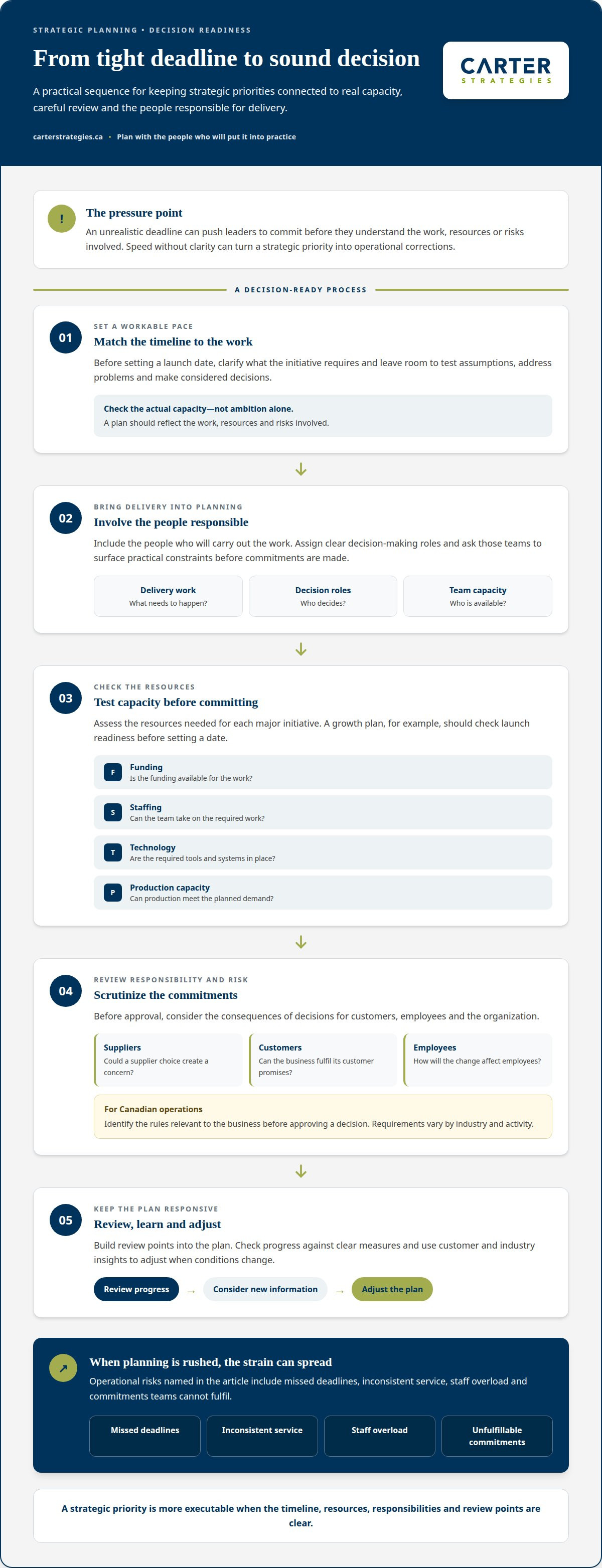
An unrealistic deadline can push leaders to make strategic decisions before they understand the work, resources or risks involved. A company pursuing growth, for example, might commit to a launch before confirming staffing, production capacity and customer demand. The team then has less room to test assumptions, address problems or achieve the intended result. Speed matters, but without clarity, a strategic priority can become a series of costly operational corrections.
Small businesses and large companies can both face the consequences of poor strategic planning, though their exposure differs. A small Canadian business may rely on a few people or a major customer, so a rushed decision can quickly disrupt daily operations. A larger company may have more teams and resources, yet coordination across departments can slow execution or magnify the effects of a mistaken decision. In either setting, plans should reflect real capacity, not ambition alone.
Operational risks include missed deadlines, inconsistent service, staff overload and commitments teams cannot fulfil. Poor planning can also prompt reactive decisions, with leaders responding to the latest problem instead of weighing it against agreed priorities. Before assigning a launch date, test each major initiative against available funding, staffing, technology and production capacity. Review progress against clear measures, then adjust the plan when customer or industry insights point to changed conditions.
Rushed decisions can also weaken legal and ethical judgement. A team focused only on a launch date may overlook the implications of a supplier choice, a customer promise or how a change affects employees. Xerox’s poor ethical and legal choices in the early 2000s damaged its reputation and made stakeholder trust difficult to regain. That example is not Canadian, but it shows why decision processes need time for scrutiny, accountability and considered review.
There are no sourced examples here of specific Canadian businesses harmed by poor strategic planning. Consider an illustrative Canadian food processor that expands production without checking staffing, supplier capacity or demand; the gap could leave it unable to meet commitments. Canadian plans should account for market changes, consumer preferences, evolving regulations and technological advances. Since requirements vary by industry and activity, leaders need to identify the rules relevant to their operations before approving a strategic decision.
To reduce risk, set a realistic timeline, involve the people responsible for delivery and assign clear decision-making roles. Test key assumptions, assess resources honestly and identify ethical or regulatory concerns before committing. Build review points into the strategic plan so new information can prompt a timely adjustment rather than another rushed response. These steps help a business pursue growth while keeping decisions connected to its capacity and responsibilities.
2. Loss of market position and competitive advantage
A strategy can weaken a market position when it assumes customers will respond as leaders expect. Motorola’s 2009 attempt to market luxury cellphones cost millions and gave competitors, including Apple, room to dominate the smartphone market. The lesson is practical: test demand, customer expectations and the competitive response before committing to ambitious initiatives. Without that planning process, implementation can consume resources while the market moves elsewhere.
Failed strategies can create financial costs through wasted development, marketing and operating effort, as well as missed revenue. If a product attracts few buyers, inventory or delivery commitments can pressure cash flow while fixed costs continue. Profitability may fall if a business discounts unwanted products or spends more to reach customers than sales justify. Iridium Satellite Communications invested in expensive satellite phones without properly gauging public demand, and consumers rejected them.
Market share can slip when planning overlooks a shift in customer behaviour or gives competitors time to respond. Blockbuster stayed focused on physical DVD rentals as entertainment moved towards digital streaming; it also declined an opportunity to purchase Netflix in the early 2000s. For a Canadian business, the practical step is to track customer and industry insights, then compare emerging opportunities with current capabilities before committing resources.
A merger can also distract from customers and weaken competitive performance if leaders underestimate integration work. UnumProvident’s 1999 merger incurred heavy integration costs but failed to align operations. An ambitious deal needs more than a growth rationale: planning should account for operational alignment, customer experience and how teams will combine. If customers encounter service gaps during implementation, satisfaction can fall and retention can weaken, even when the original initiative promised broader reach.
Launching for the wrong market creates a similar mismatch. Iridium’s satellite phones illustrate the risk of building around assumptions rather than demonstrated demand. Expanding beyond a core market can stretch staffing, expertise and customer support. Laidlaw International’s move into ambulance services alongside public transit stretched its resources thin and led to bankruptcy. Before expanding, assess whether the new market fits the organization’s core capabilities and existing customer relationships.
Market access often depends on partnerships, distribution and a clear value proposition. A plan that treats these as details may leave a product without the channels or relationships needed to reach buyers. To protect competitive position, leaders can review customer demand, competitor moves, delivery capacity and partnership needs together, then set measures for sales, margins and customer response. If those findings point to a strategic reset, growth strategy planning can help connect market choices with executable priorities.
3. Reputational damage and loss of stakeholder trust
When execution falls short of a public commitment, customers may question whether future promises are credible. UPS’s 2013 holiday shipping initiative failed to deliver packages on time and disappointed customers. The example shows how a plan’s impact extends beyond internal targets: customers experience the gap between the commitment and the service they receive. Repeated gaps can make it harder to retain confidence, even after operations improve.
Trust can erode when leaders make a strategic change without explaining its purpose or effects. Customers, suppliers, employees and investors may each need different information to understand what is changing and what remains dependable. Identify the stakeholders affected by each major initiative, then explain the decision, its expected effects and how progress will be communicated. Clear expectations help reduce confusion during execution.
Communication needs to continue as plans change. A single announcement cannot answer new questions when market conditions, resources or timelines shift. Planned status updates give stakeholders a consistent view of progress, challenges and decisions. Set an update rhythm, name a responsible owner and explain changes in plain language. If a commitment can no longer be met, communicate the adjustment promptly and describe the next step.
Involving stakeholders before approval can reveal risks an isolated management team might miss. Suppliers may identify delivery constraints; customer-facing employees may hear recurring concerns; customers may point to changing needs. Use focused discussions, surveys or one-to-one meetings to gather those perspectives during planning. Then show how feedback shaped decisions. That connection can strengthen buy-in because stakeholders see their input considered, not merely collected.
Partnerships also shape credibility. Weak relationships with customers, suppliers or other stakeholders can hinder planning and undermine shared commitments. Before depending on a partner, clarify each party’s role, expected contributions, communication process and approach to resolving challenges. When a partnership changes, tell affected stakeholders what this means for service, delivery or other commitments. Silence can leave others to draw their own conclusions.
Xerox’s poor ethical and legal choices in the early 2000s damaged its reputation and made stakeholder trust difficult to regain. Leaders can reduce similar risks by building review into major decisions: identify who may be affected, surface ethical concerns, assign accountability and record how decisions support stated values. When new information changes a plan, explain the reason and the next action. Consistent communication and visible follow-through help transform progress into evidence stakeholders can assess.
4. Employee morale, culture, and turnover
Employees can lose confidence when leaders set objectives without explaining how teams will achieve them. A plan that repeatedly changes direction can leave people unsure which work matters or who makes decisions. That uncertainty affects more than motivation: teams may duplicate effort, delay decisions or stop raising concerns. Clear priorities and defined responsibilities help employees connect daily work with the organization’s direction.
Communication gaps make that disconnect harder to address. Only 5% of employees understand their company’s business strategy, a gap associated with poor communication during implementation. Employees need more than a plan announcement; they need to know what is changing, why it matters and what their role involves. Managers can reinforce that understanding in team meetings, practical action plans and regular updates tied to organizational objectives.
Unrealistic goals can also damage morale. If a team is expected to deliver an initiative without adequate staffing, skills or time, employees may see the target as unattainable rather than motivating. Repeated pressure can reduce productivity, encourage turnover and weaken the culture needed for collaboration. Before setting objectives, involve the employees responsible for the work and assess capacity, dependencies and competing priorities.
Hewlett Packard’s 2002 merger with Compaq faced poor implementation that failed to align the companies’ cultures. The example shows that a strategic decision can change people’s roles and working relationships, not just an organization chart. During a merger or major shift, leaders should identify cultural differences, clarify decision rights and make space for employees to raise concerns. Ignoring those issues can make coordination harder and undermine shared ownership.
Employee involvement helps management develop plans grounded in operational experience. Work groups, roundtables, surveys and one-to-one meetings can surface obstacles senior leaders may not see. Customer-facing employees, for example, may identify a service problem, while production teams may flag a capacity constraint. Report what you heard, explain which ideas shaped decisions and assign owners to follow up. That response shows participation has a purpose.
To protect morale during execution, connect each priority to a clear owner, realistic resources and visible measures of progress. Managers can review workloads and barriers in regular check-ins, then adjust assignments when new information changes the plan. Employees should also understand how their contributions affect shared objectives. When teams know the reason for change and have a meaningful role in delivering it, they can raise risks earlier and stay aligned with stakeholders.
Review capacity against commitments, then adjust assignments before pressure becomes routine. A lack of strategic direction can contribute to lower employee productivity, higher turnover and a negative organizational culture. Inadequate staffing, too few skilled personnel and high employee turnover can undermine execution. Unrealistic goals can reduce morale and discourage employees from trying to achieve them.
Communicate strategic plans throughout the organization so employees understand their responsibilities and why changes are taking place. Revisiting priorities and resources regularly can help managers spot execution challenges, make adjustments and give employees a clearer basis for deciding what to focus on.
5. Lack of direction and unclear priorities
A strategic plan gives leaders a shared basis for choosing what the organization will do, fund and measure. Without that direction, departments can pursue separate goals: sales may seek new customers while operations focus on reducing workload. Both priorities may be reasonable, but without alignment they can compete for staff, funding and leadership attention. The result can be duplicated effort, delayed decisions and opportunities that pass without a clear owner.
Warning signs include teams describing different goals, repeated shifts in direction, and initiatives without accountable owners or measures. Another signal is a plan that lists ambitions but does not connect them to specific actions, timelines and resources. To assess these signs, ask employees to explain the organization’s priorities and how their work supports them.
Unclear priorities also make resource allocation harder. If every initiative is labelled urgent, managers cannot distinguish essential work from activity that can wait. For example, a Canadian professional services firm might pursue a new market, update its brand and redesign internal processes at once. If the same employees must lead all three, execution can stall across the board. A clear plan identifies trade-offs instead of treating capacity as unlimited.
Strategic goals become more useful when they connect the organization’s vision to practical action plans. Each priority needs a defined outcome, a responsible owner, required resources and a way to track progress. Leaders can compare actual results with intended outcomes and use customer and industry insights to understand gaps. This makes it easier to distinguish a flawed assumption from an execution delay and decide what should change.
Too much detail can create another problem. A long plan filled with competing objectives may obscure the choices employees need to make. Someone deciding between customer service work and a new initiative needs clear guidance about which comes first. Organize priorities so staff can see the connection between the organization’s vision, near-term work and longer-term goals. Revisit that order when evidence or business conditions change.
Reviewing progress helps leaders recognize failure early, before a weak initiative absorbs more attention and resources. Set regular review points, examine relevant measures and invite teams to explain barriers. If a target remains off track, determine whether the cause is unclear ownership, insufficient capacity, changing customer needs or an unrealistic objective. Then adjust the action plan, reassign responsibility or stop work that no longer supports the organization’s direction.
Check whether the plan’s actions match available capacity. Strategic planning defines an organization’s direction, priorities and actions to support long-term success. It helps leaders set goals, allocate resources and measure progress in alignment with the organization’s mission and vision.
A strategic plan communicates an organization’s goals, the actions needed to achieve them and other key elements developed during planning. Align strategic objectives with the organization’s broader mission and vision, then turn goals into action plans with assigned responsibilities, timelines and resources. Without a solid strategic plan, teams may lack direction, resources may be allocated inefficiently, decisions may become reactive and opportunities may be missed. When departments pursue different objectives, poor planning can cause confusion, delays and missed deadlines.
Carter Strategies: Growth Strategies and Planning
Carter Strategies helps businesses address unclear priorities through Growth Strategies and Planning. When leaders need to connect growth goals with available resources, customer and industry insights, and team responsibilities, this work can bring focus to the planning process. Business Strategy Development can clarify organizational priorities, while Marketing Strategy can align market choices with wider business direction. Fractional CMO and CRO services provide senior marketing and revenue leadership for companies that need those perspectives in their planning.
The right next step depends on the challenge: a business facing competing priorities may need strategic direction, while one struggling to align its market approach may need focused marketing planning. The work centres on practical priorities and team alignment, not a plan developed in isolation. To discuss your business’s planning needs, contact Carter Strategies.
Make your next strategic decision count
Recognizing the consequences of poor strategic planning matters when it can change the decisions ahead. Rather than revisiting every part of the plan at once, identify the choice with the greatest effect on your direction. Define what you need to decide, what evidence would inform that choice and who should contribute before you commit.
This gives your leadership team a practical starting point: one decision, a clear purpose and a way to assess the options. From there, you can decide what deserves attention next and move forward with greater focus.
Contact Carter Strategies to discuss your strategy. A thoughtful next step can help your organization build momentum.
Frequently Asked Questions
What are the main consequences of poor strategic planning for businesses?
Poor strategic planning can leave a business unable to make consistent choices as conditions change. Without agreed criteria for evaluating a new opportunity, for example, one department may prioritize short-term sales while another favours long-term capability building. Leaders can reduce this tension by defining decision principles, such as fit with the organization’s purpose, evidence of customer demand and capacity to deliver, then applying them consistently.
What are the effects of poor strategic planning on employee morale and turnover?
Poor planning can make employees less willing to contribute ideas or take initiative if they do not understand how decisions are made. That can narrow the organization’s pool of practical insights and make improvement harder. Turnover can also remove knowledge about customer needs, internal processes and past decisions. Clear decision principles and regular opportunities to contribute help employees see how their judgement can shape the organization’s work.


