


Reported figures show that 52% of executives and 43% of employees felt their organizations weren’t adequately prepared for change. A strategic planning readiness assessment tool helps leaders see where culture, employee perceptions and available capacity support or hinder a new direction. The results should shape the change strategy, not sit in a report untouched.
A clear plan and committed leadership may seem enough to move an organization forward. In practice, employees can face competing priorities, limited capacity or concerns that have not reached management. Understanding these realities before setting priorities can prevent avoidable friction during implementation.
This article explains how to assess organizational culture, gather useful employee perspectives and interpret readiness data. You’ll learn how to identify strengths and gaps, then use the findings to align leaders and employees around practical steps for strategic planning.
Key Takeaways
- Assess whether everyday behaviours, leadership decisions and available capacity support the change your strategic plan requires.
- Look for patterns in readiness data, then connect each gap to a practical response, clear ownership and follow-up.
- Gather employee perspectives across roles and teams to identify concerns and sources of support that leadership may not see.
- Choose data collection methods that protect honest feedback and make it possible to compare experiences across the organization.
- Measure leadership alignment, communication, resources and employee involvement so your assessment can guide focused action plans.
Organizational culture and change capacity
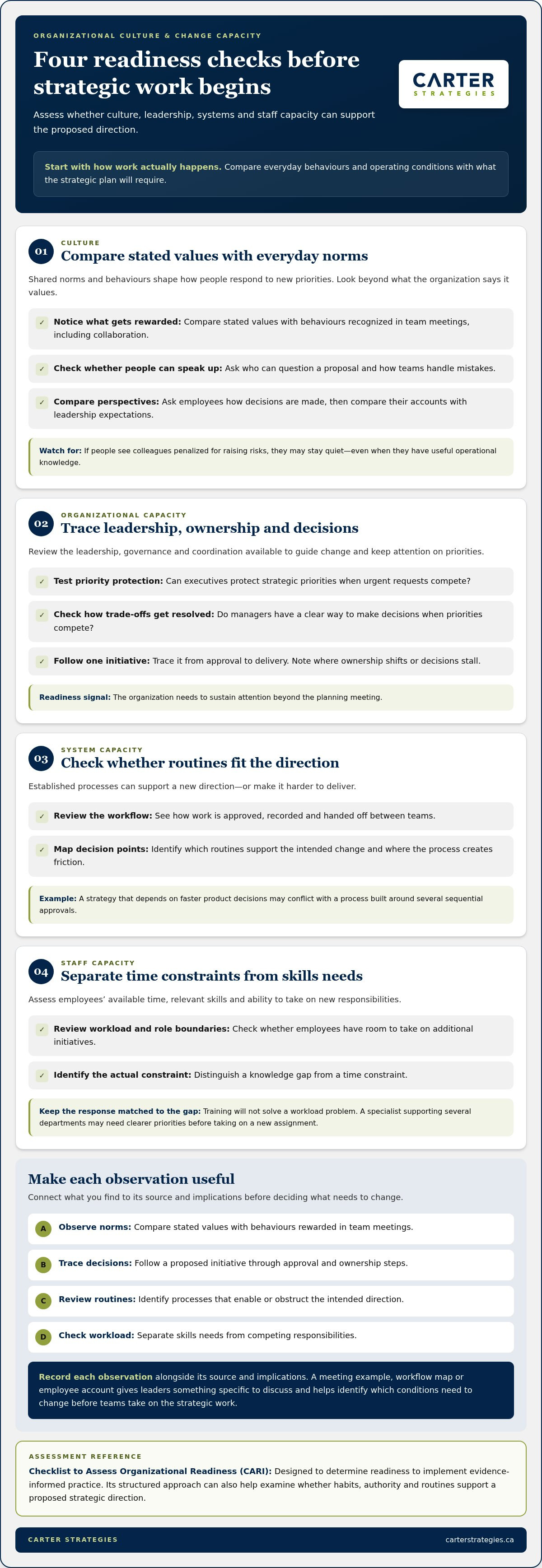
Organizational culture comprises the shared norms and behaviours that shape how people respond to new priorities. Look beyond stated values to everyday decisions: who can question a proposal, how teams handle mistakes, and whether leaders reward collaboration. If employees see colleagues penalized for raising risks, for example, they may stay quiet during planning, even when they have useful operational knowledge.
The Checklist to Assess Organizational Readiness (CARI) is designed to determine an organization’s readiness to implement evidence-informed practice. For strategic planning, its structured approach can help leaders examine whether habits, authority and routines support a proposed direction. Ask employees for examples of how decisions are made, then compare their accounts with leadership expectations. Differences can reveal cultural conditions to address before implementation.
Organizational capacity refers to the leadership, governance and coordination available to guide change. Examine whether executives can protect strategic priorities when urgent requests compete, and whether managers have a clear way to resolve trade-offs. Trace a proposed initiative from approval to delivery, noting where ownership shifts or decisions stall. This shows whether the organization can sustain attention beyond the planning meeting.
System capacity is the fit between established processes and the demands of a new direction. Review how work is approved, recorded and handed off between teams. A strategy that depends on faster product decisions, for instance, may conflict with a process built around several sequential approvals. Map the actual workflow, identify decision points and determine which routines support the intended change.
Staff capacity includes employees’ available time, relevant skills and ability to take on new responsibilities. Examine workload patterns and role boundaries before adding initiatives. A specialist who supports several departments may need clearer priorities before taking on a new assignment. Distinguish a knowledge gap from a time constraint, because training will not solve a workload problem.
Use a focused review to connect these conditions:
- Observe norms: Compare stated values with behaviours rewarded in team meetings.
- Trace decisions: Follow one proposed initiative through its approval and ownership steps.
- Review routines: Identify processes that enable or obstruct the intended direction.
- Check workload: Separate skills needs from competing responsibilities.
Record each observation alongside its source and implications. A meeting example, workflow map or employee account gives leaders something specific to discuss. Use the findings to decide which cultural or operating conditions need to change before teams take on the strategic work.
Analysing assessment data to shape a change strategy
Assessment data analysis means interpreting responses and records to decide how an organization should approach change. An assessment instrument can provide evidence, but that evidence needs context. Compare responses by role, department or location, then explore possible reasons for differences. One department, for example, may consider a customer issue urgent while another gives it lower priority. Address the underlying difference in the change strategy rather than simply averaging responses.
An organizational maturity assessment examines how consistently an organization performs across established practices. A readiness assessment focuses on whether it can carry out a specific proposed change. Use maturity findings to understand broader development and readiness findings to plan for the change ahead.
Risks of a strategic planning readiness assessment include biased answers, missing perspectives and treating a score as a complete diagnosis. Reduce these risks by comparing survey results with interviews, work examples and existing records. A single rating does not prove employee support or resistance. Consider who contributed, whose views may be missing and what evidence supports each interpretation.
Start by sorting findings into themes directly related to the planned change. These might include decision delays, inconsistent customer information or unclear measures of success. Then consider how each theme could affect the work. If a proposed service change depends on accurate customer records, inconsistent information may call for a data review before teams make planning decisions.
Use this process to convert findings into a response:
- Organize evidence: Group related comments and records under specific themes. Keep examples with each theme to make the reasoning easy to trace.
- Test interpretations: Compare different accounts and ask what workplace conditions could explain them. A delayed approval may reflect unclear authority, not lack of commitment.
- Identify consequences: Determine which findings could affect the timing, scope or sequence of planned work. Focus on issues that change the decisions leaders must make.
- Set the response: Assign an owner, a practical action and a review point to each priority issue. Define what evidence will show whether the response addressed it.
Keep a record linking each action to its supporting evidence and intended effect. This helps leaders revisit assumptions as new information emerges. If customer interviews later challenge an early interpretation, for example, the team can revise its proposed action rather than defend a conclusion based on incomplete evidence.
When analysis reveals competing priorities or unclear choices, structured business strategy development can help connect the findings to organizational direction and action plans.
Employee readiness and perceptions
Employee readiness is employees’ willingness and practical ability to participate in a proposed change. Assess whether people understand the strategic direction, see how their roles connect to it and have room to contribute. Employees may support a new customer focus but struggle to explain how it affects their weekly priorities. That difference points to a need for clearer communication about individual roles.
Employee perceptions are employees’ views of a change, its purpose and its likely effects on their work. Ask for specific examples rather than a general rating of support. “Which current task might this priority replace?” can reveal capacity concerns that a broad question about enthusiasm misses. Compare answers across teams, since sales and operations may experience the same direction differently.
Readiness signals are observable signs that employees can understand and act on the proposed direction. Examples include managers explaining a priority consistently, teams identifying relevant customer needs, and employees raising practical questions about delivery. Treat questions as useful evidence. If employees repeatedly ask who approves a decision, clarify decision rights before expecting coordinated action.
Employee participation gives staff the opportunity to shape planning with their knowledge and experience. Involve people who understand the daily work affected by a proposed priority, not just those who attend management meetings. Frontline staff, for example, may identify a handoff that delays customer responses, while department leaders see the broader resource issue. Bringing these perspectives together gives management a more grounded view.
Use focused prompts to distinguish understanding, support and ability. These are related, but they are not the same. An employee can agree with a strategic goal and still lack the time, information or authority to contribute. Ask employees to explain the change in their own words, name a likely effect on their work and identify one condition that would help them participate. Compare their responses with managers’ assumptions before making decisions.
Then translate employee feedback into targeted planning actions:
- Unclear purpose: If teams describe different reasons for a priority, align leaders on a shared explanation and connect it to customer or business needs.
- Unclear role: If employees can’t identify their contribution, define responsibilities and show how teams’ work connects.
- Limited capacity: If current commitments compete with planned change, sequence work and identify what must pause.
- Low confidence: If employees name a skill or information gap, plan focused guidance before assigning new responsibilities.
Close the loop by showing employees how their input affected the plan. For example, explain why a proposed action changed, who owns the next step, and how progress will be discussed. If feedback cannot be acted on immediately, state what decision remains open and when it will return for review. This makes participation visible and gives leaders concrete evidence to guide communication, responsibilities and the pace of implementation.
Readiness assessment data collection
Readiness assessment data collection is the planned gathering of evidence about an organization’s ability to carry out change. Combine employee input with operational records, meeting observations and examples of current work. For instance, compare staff comments about approval delays with a recent decision process. This gives management evidence to interpret instead of relying only on impressions.
Yes, free templates and basic assessment tools are available, and organizations can also create a short questionnaire. A template is a starting point, not a ready-made diagnosis. Adapt each question to the proposed strategic change, such as whether teams have the information, time and decision-making authority to act on a new priority.
Canadian nonprofits and businesses can adapt assessments to their province or territory, sector, workforce and communities served. Include relevant operating conditions and applicable privacy requirements in the collection plan. A nonprofit serving several communities, for example, may need questions that reflect different service settings. A business with teams across provinces may need consistent questions alongside room for local context.
Choose methods that fit the information you need. A questionnaire can collect comparable responses, interviews can clarify individual concerns, and small-group discussions can reveal shared work barriers. Existing planning documents and performance records can show how decisions or priorities move through the organization. Combining methods helps distinguish a broad pattern from one person’s experience.
Before collecting responses, define the change being assessed and the decisions the findings will inform. Then identify whose perspectives are needed. Include employees affected by the proposed work, managers responsible for enabling it and teams that depend on their output. If a new service model affects customer support and operations, gather input from both groups before concluding that either team is ready.
Use these steps to organize collection:
- Set the purpose: State the strategic shift and the decisions the assessment will guide.
- Select participants: Include roles and teams with direct experience of the work affected.
- Choose questions and methods: Match each question to a method, such as a survey for comparable views or interviews for detailed examples.
- Protect response quality: Explain how responses will be used, and provide a clear way to share concerns.
- Record context: Note team, location or operating conditions that may explain different responses.
A useful collection plan also sets expectations for reporting. Separate employees’ direct comments from the assessment team’s interpretation, and avoid attaching names to feedback when identification is unnecessary. For example, report that several roles described a handoff delay, then examine the process behind it. This keeps attention on work conditions and gives leaders clearer evidence for planning next steps.
What dimensions should a strategic planning readiness assessment measure?
A readiness dimension is a factor that can affect an organization’s ability to plan and act. Assess related factors rather than relying on one overall score. A team may agree on a goal but lack reliable information to choose between options. Assess each dimension against the decisions the planning process must support.
Strategic alignment is how consistently people interpret the organization’s direction. Ask leaders from different functions to describe the main outcome they expect, then compare their answers with current business priorities. If one group defines success as entering a new market and another as improving service in existing markets, resolve the difference before setting objectives.
Leadership commitment is the management team’s ability to make and sustain choices that support the direction. Examine whether leaders can explain trade-offs and maintain focus when new opportunities arise. Ask how they would choose between funding a proposed initiative and protecting an existing priority. Their reasoning reveals whether strategic choices have clear decision criteria.
Employee understanding is employees’ ability to connect organizational direction with the decisions they make in their roles. Ask affected teams which choices they expect to change, then compare answers across functions. Different interpretations may point to a need for clearer guidance on applying strategic priorities.
Resource capacity is the organization’s ability to direct people, information and tools toward planned priorities. Examine whether teams can shift effort when priorities change, not just whether resources exist today. A new market focus, for instance, may require coordination among sales, service and product teams. Assess whether current commitments leave room for it.
Decision governance is the set of roles and routines used to make strategic choices. Review how proposals reach decision-makers, what evidence they consider and how they communicate decisions. A recurring agenda item for strategic trade-offs can help leaders resolve conflicts before they become separate departmental plans.
Communication readiness is the ability to explain strategic choices in language that matters to different teams. Assess whether managers can translate a broad objective into the choices employees face. For example, ask how a customer-retention priority should affect decisions about service recovery and account follow-up.
Measurement readiness is the ability to track whether actions support intended business outcomes. Identify what information leaders need, who can interpret it and how often they will review it. A measure should help teams decide whether to continue, adjust or stop an action, not merely record activity.
Review these dimensions as a connected set. If teams agree on direction but lack decision criteria, clarify how competing initiatives will be assessed. If information is difficult to interpret, improve its connection to strategic choices. Connect readiness findings to strategic priorities by assigning an owner and review point to each significant gap.
Carter Strategies: Business Strategy Development
Carter Strategies helps organizations turn readiness findings into Business Strategy Development when leaders need to connect assessment results with clear priorities and action plans. This is a practical next step when the data reveals gaps in alignment, capacity or ownership, and leaders need a shared direction for addressing them.
Use assessment findings to inform strategic choices and involve employees in shaping the work, rather than treating the assessment as a standalone exercise. Carter Strategies can bring customer and industry insights, team perspectives and business priorities together in an executable business strategy. This creates a clearer link between the organization’s aims and the actions teams can own.
If you’re ready to connect readiness findings with your strategic priorities, visit Carter Strategies.
Put readiness insights to work
Next, decide how readiness findings will influence the choices ahead. Before starting a planning process, identify which decisions need leadership input, which require employee perspectives and how the organization will act on emerging evidence. This connects assessment work to real business choices instead of treating it as a separate exercise.
Use the strategic planning readiness assessment tool as a starting point for focused discussion. Bring unresolved questions to the table, identify the trade-offs leaders need to address and agree on how teams will contribute. A clear process gives people a meaningful role in shaping priorities and helps leadership distinguish immediate actions from issues that need further discussion.
If you’re ready to connect your organization’s priorities with its next planning decisions, contact Carter Strategies to discuss a practical path forward.
Effective strategic planning starts with honest conversations and advances through shared ownership. Your next step can bring both into focus.
Frequently Asked Questions
What is a strategic planning readiness assessment tool?
It’s a structured way to gather evidence about an organization’s ability to begin strategic planning. Use it to identify what preparation the planning process needs, not to issue a pass-or-fail verdict. If teams rely on different reports to understand customer needs, for example, leaders can agree on which information should guide planning before setting priorities.
What questions are included in a strategic planning readiness assessment?
Include questions that test whether employees can contribute useful knowledge to planning. A strategic planning readiness assessment tool might ask, “What customer need should influence our next direction?” or “Which source gives your team the clearest view of industry changes?” Responses can show leaders where customer and industry insights are strong, inconsistent or disconnected from planning discussions.
How do you assess an organization’s readiness for strategic planning step by step?
Start by defining the decisions the planning process must address. Identify which teams can inform those decisions, then gather relevant documents, employee perspectives and customer information. Compare the evidence and agree on any preparation needed before planning begins. If departments use different definitions of a priority customer, for instance, align those definitions before discussing growth opportunities.
How should assessment results be scored and interpreted?
Assess findings against consistent descriptions, not an assumed universal threshold. A strategic planning readiness assessment tool can group evidence as a strength, a gap or an unanswered question. For example, mark customer information as a gap when teams cannot identify a shared source. Record the evidence behind each rating, discuss conflicting views and assign a next step for issues that could affect planning.


