


What if your leadership team’s biggest constraint isn’t a lack of good ideas, but too many competing priorities? Strategic focus for leadership teams means agreeing on what matters most and what can wait. Without that clarity, leaders can send mixed signals, spread attention thin and leave employees unsure how their work connects to business goals.
It’s a familiar challenge: leadership discussions may produce a plan, but agreement at the top doesn’t automatically create understanding or ownership across the organization. Priorities need to reflect business realities and the insight of the people who will help put them into action.
This article explores how to narrow the focus, make deliberate trade-offs and connect leadership decisions to practical action plans. You’ll learn how to involve employees in building alignment, clarify who owns the work and make progress visible through measures that reflect more than financial results alone. The aim is an executable business strategy that gives leaders and teams clear direction without treating business performance and the people responsible for it as competing concerns.
Key Takeaways
- Build strategic focus for leadership teams by grounding choices in customer and industry insights, operational realities and financial information.
- Compare proposed priorities against their strategic contribution, customer relevance, core capabilities and organizational capacity.
- Make trade-offs explicit so leaders can distinguish urgent requests from work that advances business goals.
- Turn agreed priorities into clear action plans, named ownership and observable signs of progress.
- Use regular leadership discussions and employee input to keep decisions aligned and teams connected to the strategy.
What strategic focus for leadership teams means, and why it matters
Leadership teams rarely face a shortage of important work. Customer needs shift, operating issues demand attention, departments propose worthwhile initiatives, and growth goals compete for time and resources. The challenge is deciding which priorities should guide choices across the business, rather than treating every urgent request as equally important.
Strategic focus for leadership teams is shared agreement on the priorities that will guide important decisions. It helps leaders explain why some work takes precedence, what the organization will defer and how teams can connect their decisions to business goals. Focus is more than a list of goals or financial targets. It requires consistent choices and a common understanding of what those choices mean in practice. The broader idea of strategic leadership also centres on guiding an organization towards its direction and objectives.
How strategic focus differs from a strategic plan
A strategic plan sets direction and records choices, goals and intended actions. Focus is how leaders keep those choices present as new decisions arise. A plan may name several growth goals, for example, but leaders still need to decide which opportunities merit attention and which requests should wait.
A written plan does not automatically create shared understanding. Leaders build focus by explaining the reasoning behind priorities and applying them consistently. Daily operations still need attention, but urgent work should not displace strategic priorities without a deliberate decision.
Why leadership teams lose focus
Fragmentation often begins with reasonable departmental aims. One function may press to improve service, while another wants to introduce an offering or reach a new customer group. Each proposal can make sense on its own, yet the combined demand may exceed the organization’s time, resources or core capabilities. Without shared criteria, leaders can back different initiatives and leave teams to work out which one comes first.
Communication also plays a role. If leaders make choices in isolation and announce them only after the discussion ends, employees may understand what has changed without seeing why. They may struggle to connect their work to the priority or raise practical concerns early enough to shape the approach. That can weaken ownership and create mixed signals, even when leaders intend to move in the same direction.
This is a leadership challenge to solve together, not a reason to assign blame. Leaders can make the discussion more useful by asking what evidence supports each proposal, what the organization would need to pause and whose experience should inform the choice. Employee insight can surface execution risks and customer realities that are less visible at the leadership table.
Focus does not mean ignoring every new demand. It means testing requests against agreed priorities and making changes openly when circumstances warrant them. When leaders explain both the decision and its trade-offs, teams have a clearer basis for action. The strategy becomes a practical guide, not a document revisited only during planning discussions.
How leadership teams build focus from shared evidence
Once leaders agree that priorities need to guide choices, they need to establish what those choices should be based on. Shared evidence gives the discussion a common starting point. It helps the management team compare proposals on more than individual preference, while leaving room for informed judgement when the facts don’t provide a clear answer.
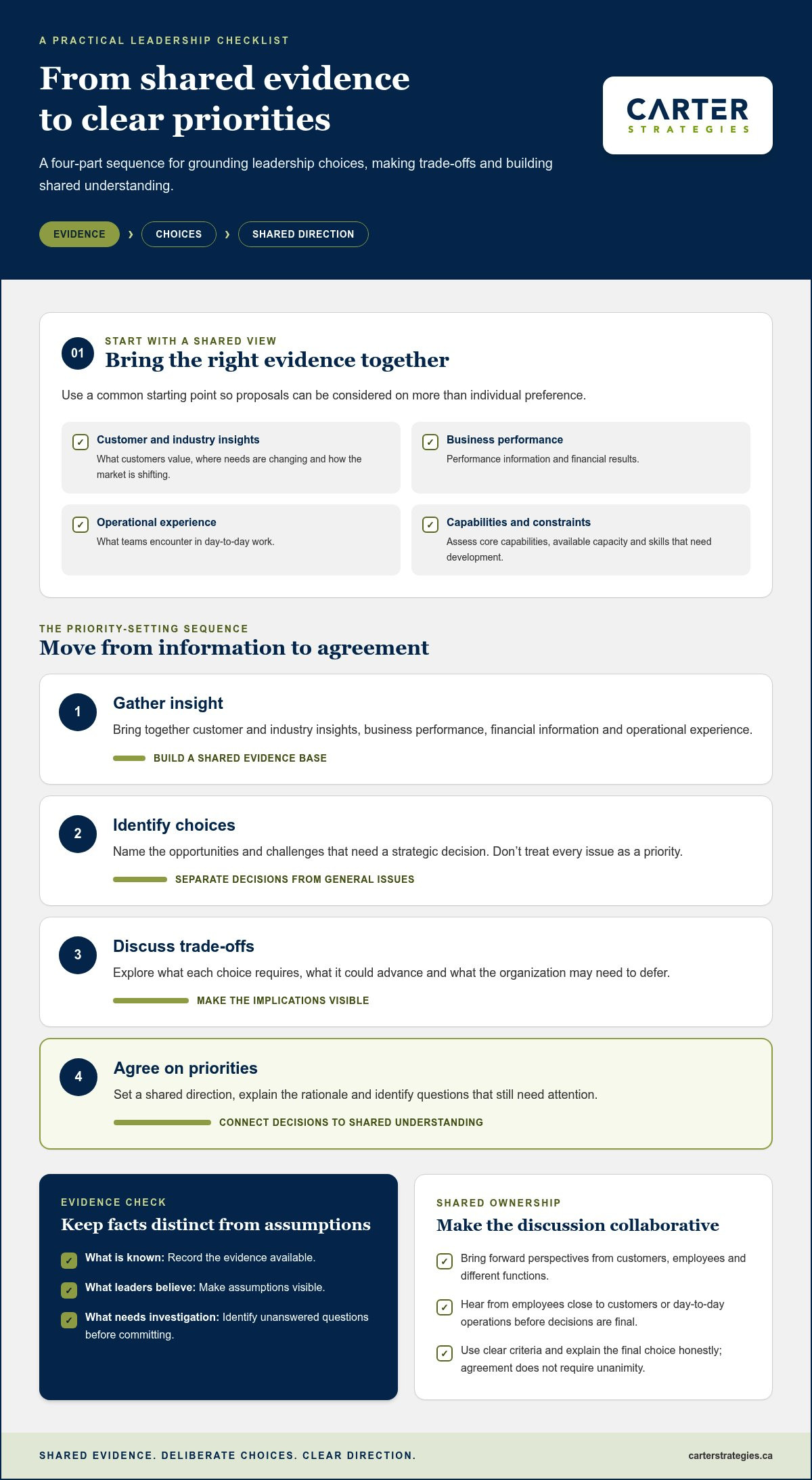
A practical sequence keeps the process grounded:
- Gather insight: Bring together customer and industry insights, business performance, financial information and operational experience.
- Identify choices: Name the opportunities and challenges that require a strategic decision, rather than treating every issue as a priority.
- Discuss trade-offs: Explore what each choice would require, what it could advance and what the organization may need to defer.
- Agree on priorities: Set a shared direction, explain the rationale and identify questions that still need attention.
This sequence supports strategic focus for leadership teams by connecting evidence to decisions, then decisions to a common understanding. It also gives leaders a clear basis for explaining how a priority was chosen.
Bring customer, industry, and organizational insight into the discussion
Customer and industry insights can show where needs are changing, which parts of the value proposition resonate and how the market is shifting. Pair those findings with performance information, financial results and operational experience. Before committing to a direction, leaders should also assess the organization’s core capabilities and constraints, such as available capacity or skills that need development.
Keep evidence distinct from assumptions. A team might know that customers have raised a concern, for example, but still need to explore how widespread it is or what is causing it. Record what is known, what leaders believe and what they need to investigate. This prevents an untested assumption from becoming the basis for a major commitment.
Make priority-setting a collaborative leadership practice
Each leader sees different parts of the business. Ask them to bring forward what they hear from customers, employees and their functions, along with evidence that supports or challenges their view. Then create structured ways for employees to contribute before decisions are final, such as focused discussions with people close to customers or day-to-day operations. Their input can reveal practical barriers and possible approaches early.
Collaboration doesn’t require unanimous agreement. It requires a fair hearing, clear criteria and an honest explanation of the final choice. Leaders can note where perspectives differ, what evidence would help resolve open questions and why a particular priority takes precedence. This helps employees see how their input shaped the discussion, even when the chosen direction differs from their initial preference.
For broader context on how priorities connect to direction and action, see Business Strategy Development: A Guide for Canadian Mid-Market Leaders. Carter Strategies’ business strategy development work connects evidence, leadership choices and team alignment to practical planning.
How to compare competing priorities and make deliberate trade-offs
Once leaders have identified possible priorities, they need a consistent way to compare them. A shared test helps prevent the most persuasive proposal or the loudest urgent request from automatically winning. It also makes trade-offs visible: choosing one direction affects what the organization can advance at the same time.
Use the same questions for each proposed priority. A simple comparison table can keep the discussion focused:
| Assessment area | Question for the leadership team |
|---|---|
| Strategic contribution | How directly does this support the organization’s direction and value proposition? |
| Customer relevance | What customer and industry insights support this opportunity? |
| Core capabilities | Do we have the strengths and resources to make credible progress? |
| Organizational capacity | Can the teams responsible take this on alongside their existing work? |
| Trade-off | What would we pause, defer or stop to make room? |
The table isn’t a scoring formula that makes the decision for leaders. It makes the reasoning explicit and helps compare proposals on consistent terms. If a choice appears strategically valuable but depends on capabilities the organization needs to build, leaders can discuss that gap rather than treating the opportunity as ready to pursue.
Use a practical test to assess each proposed priority
Start with strategic contribution: does the option reinforce the direction leaders have agreed on, or is it attractive for reasons that sit outside it? Then examine customer relevance and the evidence behind the opportunity. Finally, test whether the organization has the core capabilities and capacity to act. A growth initiative, for example, may fit the strategy and interest customers, but still require decisions about sequencing, skills or operational readiness.
For growth choices, growth strategy and planning for mid-size businesses should connect opportunity to what the organization can realistically support. Treat gaps as decisions to resolve: build a capability, adjust the scope, defer the initiative or select another priority.
Address the concern that focus means ignoring urgent needs
Focus doesn’t mean neglecting essential operational responsibilities or dismissing concerns raised by employees and customers. It means distinguishing work required to keep the business operating from strategic choices about where to direct additional attention and resources. An urgent customer issue may need a prompt response without becoming a new organization-wide priority.
Make trade-offs explicit and respectful. If leaders choose one initiative over another, explain the reason, what will be delayed and how the deferred need will be managed. Ask affected teams what the decision means for their workload and what risks it creates. This makes the choice accountable and gives leaders a chance to address practical consequences, rather than leaving employees to absorb competing demands without explanation.
That is how strategic focus for leadership teams becomes a disciplined way to choose, not a blanket refusal of new ideas. Leaders can revisit a decision when evidence or business conditions change, while avoiding the habit of adding priorities without making room for them.
How leadership teams keep strategic focus visible in decisions
Agreed priorities only guide the business when leaders use them in subsequent decisions. Translate each priority into action plans that clarify the intended outcome, who is accountable for moving the work forward and what signs of progress the team will review. This connects strategic direction to daily choices, rather than leaving each department to interpret the plan on its own.
Keep the measures useful and balanced. A financial result may show whether an outcome is being achieved, while a customer, operational or team indicator can help explain what is affecting progress. Choose observable measures that relate to the priority, and use them to prompt discussion rather than reduce strategy to a scorecard.
Build a review rhythm around strategic choices
Schedule recurring leadership discussions to review progress, obstacles and new evidence. The cadence should give leaders enough opportunity to notice changes without turning every short-term disruption into a reason to reset direction. Keep the conversation focused on strategic decisions, not routine updates that could be handled elsewhere.
For each review, ask: What has moved forward? What is getting in the way? Has new evidence changed the case for this priority? Does a current decision support the direction we agreed on? Record the decision, its owner and any follow-up action. A short decision log helps leaders see whether they are applying priorities consistently and makes unresolved issues easier to revisit.
Revisit assumptions when customer and industry insights, operating conditions or results challenge the original rationale. A change in direction may be warranted, but it should follow considered discussion of the evidence and consequences. That discipline distinguishes thoughtful adjustment from reacting to every new request.
Connect priorities with team understanding and accountability
Leaders need to explain not only what the priorities are, but why they matter and how different teams contribute. Connect each priority to specific responsibilities, decision-making authority and expected progress. Then invite employees to identify conflicts with existing work, unclear ownership or barriers leadership may not see. These conversations help reveal where action plans need adjustment before gaps become delays.
Indicators should support judgement, not replace it. If a measure moves in the wrong direction, discuss what may be driving the change and what response fits the agreed priority. A single result rarely explains the whole picture. Include relevant employee perspectives and customer context before changing course.
For related guidance on turning direction into action, explore Bridging the Gap Between Vision and Execution. If your leadership team is ready to connect priorities with accountable action plans, explore strategic planning support from Carter Strategies.
How Carter Strategies helps leadership teams find and sustain focus
An outside strategic perspective can help a leadership team examine familiar challenges through fresh questions. Where do assumptions stand in for evidence? Which opportunities support the business direction, and what choices would they require? This perspective doesn’t replace leaders’ knowledge of the organization. It helps bring their views into a structured discussion, surface differences and clarify the decisions the team needs to make together.
Carter Strategies works collaboratively with leadership teams and employees to identify priorities and build alignment around them. This approach to strategic focus for leadership teams connects leadership choices with the experience of people closer to customers and daily operations. Their input can reveal practical constraints, test whether a proposed direction can be acted on and build ownership beyond the management team.
What collaborative strategy advisory contributes
Leslie Carter brings more than 25 years of business strategy and brand management experience to this work. Strategic planning draws on leadership perspectives, employee insight and relevant business information to shape priorities. Those choices then need to connect to specific action plans, clear accountability and ways to assess progress. The aim is an executable business strategy that reflects business goals and the people responsible for carrying it forward.
Advisory work can be structured on a project or retainer basis, depending on the company’s needs. In either case, the work centres on strategic choices, team alignment and accountability for business strategy results, rather than handing down a plan for employees to interpret alone.
When to bring in strategic support
Consider bringing in outside support when leaders keep revisiting the same competing priorities, teams interpret direction differently or the business needs a clearer path for growth. These signals don’t mean the organization lacks capable leaders. They can indicate that the team needs dedicated space to review assumptions, hear different perspectives and make decisions that connect strategy with execution.
Fractional CMO or CRO leadership can add senior marketing or revenue expertise when a company needs that perspective as it considers growth, customer priorities or go-to-market choices. The focus is on leadership and direction, with priorities linked to the organization’s goals and the teams responsible for action.
Good strategic planning doesn’t end when leaders agree on priorities. It creates a shared basis for decisions, action and review, while allowing the team to adjust thoughtfully as evidence changes.
Make your next decision a point of alignment
At your next leadership meeting, choose one pending decision that could pull teams in different directions. Ask which business priority it supports, what evidence should guide the choice and what work may need to shift if you proceed. Then consider who will be affected and what they need to understand before the decision moves into action.
This deliberate practice can help turn strategic focus for leadership teams into a habit, not a statement that fades after planning discussions. It gives leaders a chance to test whether their choices reinforce the direction they’ve set, while making space to adapt when the evidence changes.
Progress starts with an honest conversation about what matters now and what the organization is prepared to prioritize. If your team is ready to clarify its direction and align around the choices ahead, discuss your strategic priorities with Carter Strategies.
Clear choices create a stronger basis for shared action. Your next step can begin with one decision made together.
Frequently Asked Questions
What is strategic focus for a leadership team?
Strategic focus for a leadership team is a shared view of the priorities that should shape its choices and attention. In practice, it gives leaders a common way to assess a new proposal: does it advance the chosen direction, or compete with work the team has already committed to? That clarity helps leaders explain decisions and gives employees context for how their responsibilities support the business.
Is strategic focus the same as strategic planning?
No. Strategic planning sets an organization’s direction and identifies priorities and actions. Strategic focus keeps leaders’ attention on the choices that matter within that direction. For example, a plan may set a goal to strengthen customer relationships, while focus helps leaders assess whether a new proposal supports that aim or pulls effort elsewhere. Both are needed: planning establishes direction, and focus shapes decisions as work unfolds.
Can a leadership team have more than one strategic priority?
Yes. An organization may need several priorities, especially when they support different parts of its direction. The key is to make their order and relationship clear. For instance, improving customer retention and developing a new offering may both matter, but one could need to come first if it informs the other. Leaders should be able to explain why each priority belongs and how the team will manage competing demands.
How should leadership teams respond when priorities conflict?
Bring the conflict to the leadership group that can make the decision, and clarify whether either item is an essential operating responsibility or a strategic choice. If both are strategic, compare their contribution and dependencies: one may need to come first, or the team may need to narrow the scope. Name the decision owner, document what changes and tell affected teams what to do next.
What role should employees have in setting strategic focus?
Employees can help leaders understand how proposed priorities will work in practice. A team close to customer interactions, for example, may identify a recurring need that changes how leaders assess a growth idea. Invite input early enough to inform the choice, then share what was heard and how it affected the decision. Employees don’t need a vote on every strategic choice to have a meaningful role in shaping it.
When should a leadership team revisit its strategic focus?
Review priorities at planned leadership check-ins, and sooner if evidence changes the basis for a key choice. A shift in customer needs, an unexpected constraint on a core capability or results that challenge an assumption may warrant a closer look. Before changing direction, separate a material change from a temporary fluctuation. Record whether the team will maintain, adjust or replace the priority, and explain the reason to affected employees.


