


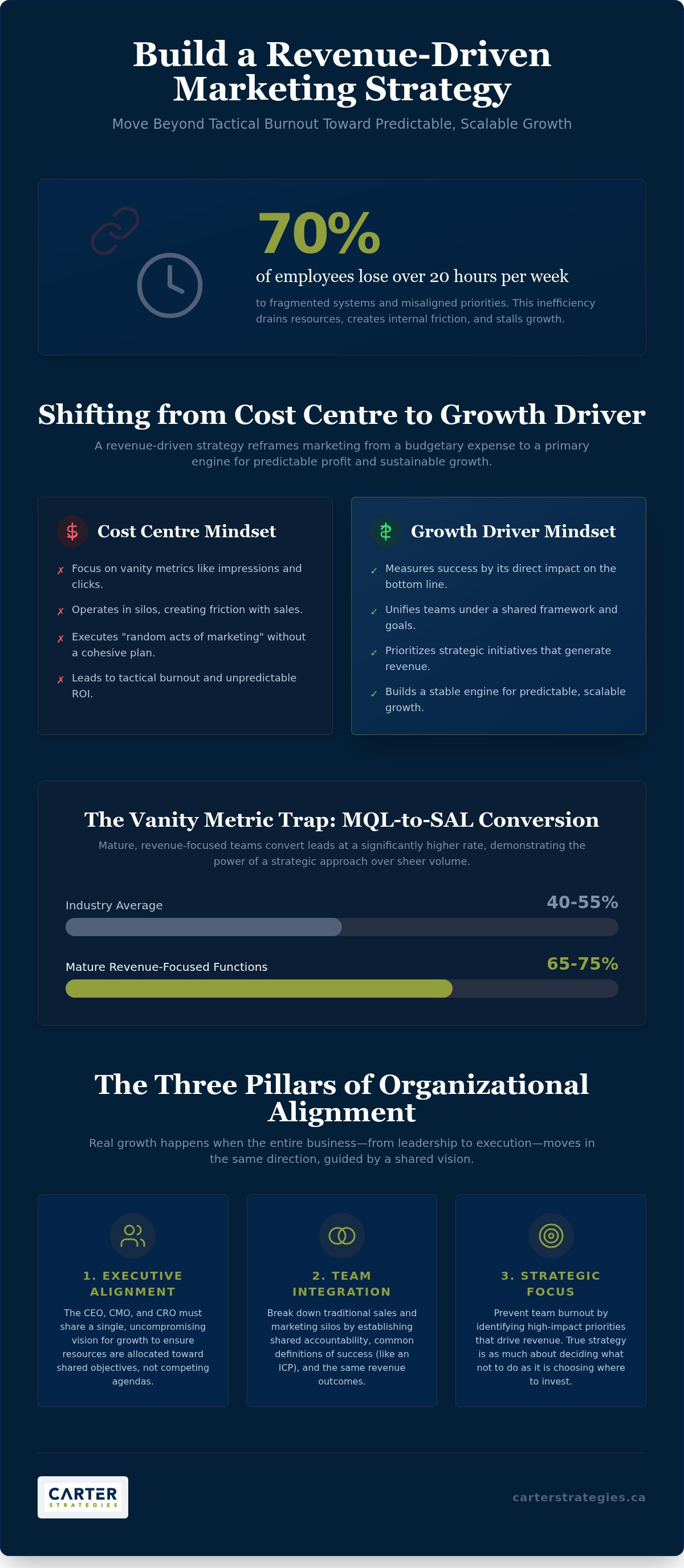
Seventy per cent of employees lose upwards of twenty hours every week to fragmented systems and misaligned priorities. This inefficiency drains resources that should focus on activation and insight. Most marketing and sales teams operate in silos, creating internal friction that stalls growth and leads to burnout. Chasing tactical wins while the needle on ROI refuses to move is a persistent challenge for mid-market leaders. It's time to stop treating marketing as a cost centre and start learning how to build a revenue-driven marketing strategy that drives predictable growth.
We agree that the disconnect between high-level vision and execution is the primary barrier to scaling. This article provides a clear roadmap to transition from tactical marketing to a high-level revenue strategy that aligns your executive leadership. We examine how to achieve benchmarks like the 40 to 55 per cent marketing-sourced pipeline seen in mature organizations. You will discover how to unify your departments and build a stable growth engine that eliminates friction and delivers measurable results.
Key Takeaways
- Shift focus from vanity metrics like impressions to a unified framework that measures success by its direct impact on your bottom line.
- Establish true executive alignment by ensuring the CEO, CMO, and CRO share a single vision to reduce internal friction and foster shared accountability.
- Learn the five-step process for how to build a revenue-driven marketing strategy to move beyond tactical burnout and toward scalable growth.
- Audit your current marketing spend to identify the difference between low-value tactical execution and high-impact strategic revenue priorities.
- Leverage fractional leadership as a pragmatic catalyst to bridge the gap between high-level vision and boots-on-the-ground implementation.
Defining the Revenue-Driven Marketing Strategy: Beyond the Lead Generation Trap
A revenue-driven marketing strategy is a unified framework where every activity is measured by its impact on the bottom line. It contrasts sharply with traditional marketing that fixates on vanity metrics like impressions or clicks. While those numbers look good in a slide deck, they often fail to correlate with actual growth. Mid-size companies frequently fall into a tactical trap. They do more, faster, without a strategic centre to guide the effort. Learning how to build a revenue-driven marketing strategy means shifting the focus from volume to value.
Mid-size firms often struggle because they have outgrown the scrappy, lead-at-all-costs phase of a startup but lack the massive resources of global conglomerates. They get stuck in the middle. Often, they hire for tactical marketing execution but wonder why the revenue hasn't scaled proportionally. A true revenue strategy requires a mindset shift. It moves marketing from a cost centre that spends budget to a profit centre that generates it.
The Problem with Vanity Metrics in Mid-Market Firms
Many organizations celebrate high volumes of Marketing Qualified Leads (MQLs), but these numbers are a distraction if they don't convert into actual sales. Research indicates that while industry averages for MQL-to-SAL conversion sit between 40 and 55 per cent, mature revenue-focused functions achieve 65 to 75 per cent. When marketing focuses solely on the top of the funnel, it leads to random acts of marketing that frustrate sales teams and drain resources. These fragmented efforts lack a cohesive growth plan.
This disconnect is often rooted in a lack of fundamental Revenue management principles, which require clear segmentation and forecasting to ensure every lead has a path to purchase. Without this foundation, marketing spend becomes a gamble rather than a calculated investment. A Revenue-Driven Strategy is the bridge between business goals and marketing execution.
Shifting the Mindset: From Cost Centre to Growth Driver
Transitioning to this model requires a fundamental shift in how leadership views the marketing function. Reframing marketing as an investment in the strategic roadmap is the first step toward a profit-centre mindset. This change allows leaders to make evidence-based decisions rather than relying on subjective qualifiers or gut feelings. It demands a higher level of shared accountability across the executive team.
Leaders must prioritize organizational health and team dynamics to ensure the strategy actually takes root. When marketing aligns with the broader business strategy development, it transforms into a primary growth driver. This alignment ensures that every dollar spent and every hour worked contributes directly to predictable pipeline development and sustainable revenue growth.
The Three Pillars of Organizational Alignment for Revenue Growth
A strategic plan is only as effective as the people who believe in it. In mid-size organizations, sophisticated growth models often fail because the internal culture remains fractured. When you are learning how to build a revenue-driven marketing strategy, the focus must shift from tools and tactics to the human architecture of the business. Real growth happens when the entire company moves in the same direction, driven by a shared understanding of what success looks like.
The first pillar is Executive Alignment. This requires the CEO, CMO, and CRO to share a single, uncompromising vision for growth. If the CEO prioritizes long-term brand equity while the CRO demands immediate quarterly cash flow, the marketing team becomes paralyzed by conflicting mandates. A unified executive front ensures that resources are allocated toward shared objectives rather than competing departmental agendas.
The second pillar involves Team Integration. Traditional silos, where marketing generates leads and sales attempts to close them, create massive inefficiencies. Research shows that 70 per cent of employees lose upwards of 20 hours a week to fragmented systems and disjointed workflows. Breaking these barriers requires a shift toward shared accountability, where both teams are measured by the same revenue outcomes.
Finally, Strategic Focus acts as the third pillar. Leaders must identify and execute on the top priorities that actually drive revenue. This prevents the common problem of team burnout caused by chasing too many tactical initiatives at once. True strategy is as much about deciding what not to do as it is about choosing where to invest.
Bridging the Gap Between Sales and Marketing
Friction often arises when sales and marketing teams use different definitions of success. Marketing may celebrate high lead volumes, while sales views those leads as low-quality distractions. To resolve this, teams must collaborate to define a clear Ideal Customer Profile (ICP). This shared framework ensures that marketing efforts attract the specific types of accounts that sales can actually close. For a deeper look at this process, see our guide on Marketing and Revenue Alignment. Aligning these functions is a prerequisite for any successful business strategy development initiative.
The Human Element: Securing Internal Buy-in
Strategic plans fail when employees feel like passive observers rather than owners of the vision. Practical leadership requires communicating the revenue strategy in a way that resonates across the entire organization. This means moving beyond high-level corporate-speak and explaining how each individual's work contributes to the collective goal. A practitioner’s approach recognizes that internal friction is natural during transitions. Managing this friction requires empathy, clear communication, and a commitment to shared accountability. When people feel heard and valued, they are more likely to support the changes necessary to drive measurable growth.
Auditing Your Current Marketing: Tactics vs. Strategic Revenue Priorities
Most mid-size companies mistake activity for progress. They invest heavily in tactical marketing execution, such as social media management or email blasts, without a cohesive revenue strategy to anchor those efforts. Understanding how to build a revenue-driven marketing strategy requires a ruthless audit of current spend. You must distinguish between "busy work" and strategic revenue priorities. A pragmatic audit reveals whether your team is merely chasing tactical priorities or building a predictable pipeline.
We utilize a Strategic Priorities Framework to filter out distractions. This framework ensures every dollar spent aligns with the bottom line. It forces leadership to realize that marketing is not a list of chores; it is a series of strategic choices. If a campaign does not contribute to organizational health or measurable growth, it is a drain on resources. A results-oriented approach values long-term success over the dopamine hit of a viral post that fails to convert.
Identifying the Tactical Trap
Signs of the tactical trap are often clear. You might see high lead volumes that your sales team ignores or marketing reports filled with vanity metrics that fail to impact your bank balance. Internal friction during strategy execution usually suggests a lack of a high-level strategic guide. Mid-size companies often struggle to scale because they lack the bridge between vision and implementation. For a deeper look at aligning your core objectives, explore our guide on Business Strategy Development. Without this foundation, your marketing team will continue to burn out by chasing too many tactical priorities at once.
Prioritizing Growth: The Focus Filter
Effective leaders distinguish between "urgent" tactical requests and "important" strategic priorities. A request for a new brochure might feel urgent, but optimizing your lead-to-opportunity conversion rate is infinitely more important. The role of a CRO or a strategic advisor is to ensure that every marketing dollar is tied to a revenue outcome. This focus filter prevents the "random acts of marketing" that plague many mid-market firms. By centralizing your Marketing Strategy around high-impact activities, you create a stabilizing force for the entire company. Shared accountability becomes the norm, and the path to growth becomes clear and intentional rather than reactive and chaotic.
Five Steps to Architecting a Scalable Revenue Strategy in 2026
Architecting a scalable engine for growth requires a shift from reactive planning to intentional design. In 2026, the competitive landscape demands a more rigorous approach to how to build a revenue-driven marketing strategy. This process involves five distinct stages that bridge the gap between high-level ambition and operational reality. By following these steps, mid-size firms move away from fragmented efforts and toward a unified growth model that prioritizes organizational health and shared accountability.
Step 1: Establishing the Strategic Roadmap
A vague vision is the enemy of execution. You must identify the three to five strategic priorities that must happen to hit your revenue goals. This clarity allows your team to ignore distractions and focus on high-impact work that actually moves the needle. Many leaders find that a strategic guide is necessary to facilitate these high-level conversations and ensure the final plan remains grounded in reality. For more on this process, review our insights on Growth Strategy and Planning.
Step 2 focuses on leadership alignment. You need a unified front at the executive level where the CEO, CMO, and CRO all agree on the growth roadmap. Step 3 involves mapping the entire revenue journey to identify every touchpoint where marketing contributes to the final sale. This visibility ensures that no part of the customer experience operates in a vacuum. It forces a shared understanding of how a prospect transforms into a loyal client through consistent engagement.
Step 4: Measuring What Matters
A revenue-driven strategy replaces vanity metrics with evidence-driven indicators. You should focus on your Customer Acquisition Cost, which is the total spend required to gain one new client, and your Customer Lifetime Value, which measures the total revenue a business expects from a single account. Pipeline Velocity measures the speed at which prospects move through your sales cycle and the total value they represent at any given time. This metric is essential for accurate revenue forecasting and identifying bottlenecks before they stall your growth. Avoiding corporate buzzwords helps keep your team focused on these practical, results-oriented outcomes.
Step 5 is the implementation of a rigorous feedback loop. You must regularly review performance results and adjust your roadmap based on real-world data rather than gut feelings. This iterative process ensures your strategy remains relevant in a changing market and fosters a culture of continuous improvement. If you are ready to move beyond tactical marketing, consider how Fractional CMO and CRO services stabilize your organization and drive measurable results.
Executing the Vision: Why Fractional Leadership is the Catalyst for Growth
Many mid-size business leaders hesitate to overhaul their growth models because they assume a high-level strategy requires a full-time, $250,000 executive. This budget objection is understandable, but it often becomes a barrier to progress. Fractional leadership provides a pragmatic solution for Canadian firms that need seasoned authority without the overhead of a permanent C-suite hire. It allows you to access specialized expertise while maintaining the flexibility your balance sheet requires.
A fractional leader acts as the stabilizing force needed when learning how to build a revenue-driven marketing strategy. They bridge the gap between high-level vision and the daily activities of your marketing and sales teams. This role is not about providing extra hands for tactical execution; it is about providing the strategic centre that ensures every hand is moving in the right direction. By focusing on organizational health and shared accountability, a fractional executive transforms a stagnant plan into a living roadmap for growth.
The Fractional CMO/CRO Advantage
Fractional leaders provide specialized marketing and revenue expertise on a part-time basis, allowing mid-market firms to scale their leadership alongside their revenue. One of the most significant benefits is the outside perspective they bring. An internal team can become desensitized to inefficient processes or departmental silos. A battle-tested expert identifies these organizational blind spots and introduces proven methodologies from diverse corporate environments. For a deeper look at how this model supports mid-market companies, review The Fractional CMO Guide.
Moving from Strategy to Execution
Carter Strategies helps organizations identify and execute their top priorities by acting as a strategic guide. We realize that a plan is only as good as the people who believe in it. Our practitioner-led approach focuses on securing internal buy-in and managing the friction that naturally occurs during organizational transitions. We don't just deliver a static document; we help you organize your team around a unified vision for growth. This ensures that the bridge between planning and "boots-on-the-ground" execution remains strong and resilient.
Transitioning to a revenue-driven model is a significant shift that requires both empathy and authority. We have been in the trenches and understand the practicalities of leadership in complex environments. If you are ready to stop chasing tactical priorities and start building a predictable pipeline, the right leadership is the essential first step. Contact us for a consultation to realize your company's full growth potential through our Fractional CMO and CRO services.
Unifying Your Team for Sustainable Growth
Transitioning your organization from a series of disjointed tactics to a cohesive growth engine requires more than just new software. It demands a fundamental shift in how your leadership team collaborates and measures success. True alignment between the CEO, CMO, and CRO is the only way to eliminate internal friction and ensure that every marketing dollar contributes to a measurable result. By auditing your current spend and prioritizing high-impact revenue goals, you can stop the cycle of tactical burnout.
Understanding how to build a revenue-driven marketing strategy is a journey that moves marketing from a cost centre to a primary growth driver. This transition is often best facilitated by an outside perspective that understands the unique pressures of the mid-market. Discover how Carter Strategies can help you build a revenue-driven roadmap. We provide seasoned fractional leadership that bridges the gap between high-level planning and boots-on-the-ground execution. Our pragmatic approach ensures that your strategy drives organizational health and measurable growth. You have the vision; we help you build the engine to realize it.
Frequently Asked Questions
What is the difference between revenue marketing and lead generation?
Lead generation focuses on the volume of prospects entering your funnel, often ignoring what happens after a contact form is submitted. Revenue marketing is a unified framework where every activity is measured by its impact on the bottom line. It requires sales and marketing to share accountability for the entire customer journey. Learning how to build a revenue-driven marketing strategy ensures your efforts result in closed deals rather than just a high volume of names.
How long does it take to see results from a revenue-driven marketing strategy?
Strategic alignment and the identification of priorities typically occur within the first thirty to sixty days. However, measurable growth in your pipeline usually requires three to six months to become evident. This timeframe allows your team to move away from reactive tactics and establish the systems needed for predictable revenue development. Modern organizations use data strategies to speed up this timeline by identifying and optimizing high-performing channels more quickly.
Does my company need a full-time Chief Revenue Officer (CRO)?
Most mid-size Canadian organizations don't require the high overhead of a full-time executive. Hiring a permanent leader at a top-tier salary is often unnecessary when you can access seasoned authority through fractional leadership. A fractional CRO provides the strategic guidance needed to build a growth engine without a long-term financial commitment. This model allows you to scale your executive expertise as your company grows and your strategic needs evolve over time.
How do we align our sales and marketing teams if they have different goals?
Alignment begins by establishing shared incentives and a single revenue goal. You must move beyond departmental silos and create a unified definition of success that both teams support. When both sales and marketing are measured by pipeline value and closed deals rather than disjointed metrics, internal friction decreases. Joint planning sessions and a shared Ideal Customer Profile ensure that everyone is working toward the same strategic priorities every day.
What are the most important KPIs for a revenue-driven strategy?
You should focus on metrics that reflect actual business growth and conversion efficiency. Essential indicators include the percentage of the pipeline sourced by marketing and the rate at which marketing-qualified leads become sales-accepted leads. Research shows that mature organizations achieve a 65 to 75 per cent conversion rate at this stage. Tracking these evidence-based numbers allows you to make informed decisions about where to invest your resources for the highest strategic impact.
Can a mid-size company implement these strategies without a large budget?
Budget size is less important than strategic focus and the elimination of waste. Many companies already lose upwards of twenty hours a week to fragmented systems and busy work. By auditing your current spend and removing low-value tactical execution, you can reallocate those existing resources toward a high-level revenue strategy. Success comes from doing fewer things with greater intentionality rather than simply spending more money on disjointed, tactical campaigns.
What is the role of a fractional CMO in building a revenue strategy?
A fractional CMO acts as a stabilizing force that bridges the gap between high-level vision and implementation. They provide the specialized expertise needed to help you understand how to build a revenue-driven marketing strategy without the cost of a full-time hire. By identifying organizational blind spots and securing internal buy-in, they ensure your strategic roadmap leads to measurable growth. They provide a practitioner's perspective to help your team execute the vision effectively.


