


What if your most ambitious business goals didn't require more of your personal time, but simply a better way to coordinate the talent you already have? For many leaders, the strategic planning process for mid-size companies often results in a polished document that sits on a shelf while departments continue to work in isolated silos. You likely feel the weight of managing tactical execution when you should be focusing on the next horizon. It's a common friction point that leads to leadership burnout, but it isn't a requirement for growth.
We understand that a plan is only as effective as the people who believe in it. This article outlines a pragmatic, people-centric framework designed to move your firm toward total alignment and measurable growth over the next 12 to 36 months. You'll learn how to bridge the execution gap, ensuring your leadership team focuses on strategic priorities rather than daily fires. We'll explore how to realize your revenue targets and organize your team for success without the burden of unnecessary overhead.
Key Takeaways
- Identify the common pitfalls of the "Mid-Market Muddle" and learn how to prevent your strategic plan from becoming a static document that gathers dust.
- Master a pragmatic strategic planning process for mid-size companies that focuses on internal truth-telling and narrowing your focus to three core priorities.
- Shift your strategy from a mathematical exercise to a human endeavour. This approach ensures total team alignment on your most important goals.
- Bridge the gap between high-level vision and tactical execution by developing a living roadmap that guides your team through the first 90 days.
- Explore how fractional CMO or CRO roles provide the strategic leadership required to scale your business without increasing full-time overhead.
Why Traditional Strategic Planning Fails Mid-Size Canadian Firms
Mid-size Canadian firms often find themselves trapped in the "Mid-Market Muddle." This occurs when a company outgrows the scrappy agility of its early years but hasn't yet established the enterprise-level systems needed to scale. It's a dangerous middle ground. At this stage, the founder's intuition is no longer enough to guide every department, yet the organization lacks a robust strategic planning process for mid-size companies to empower its managers.
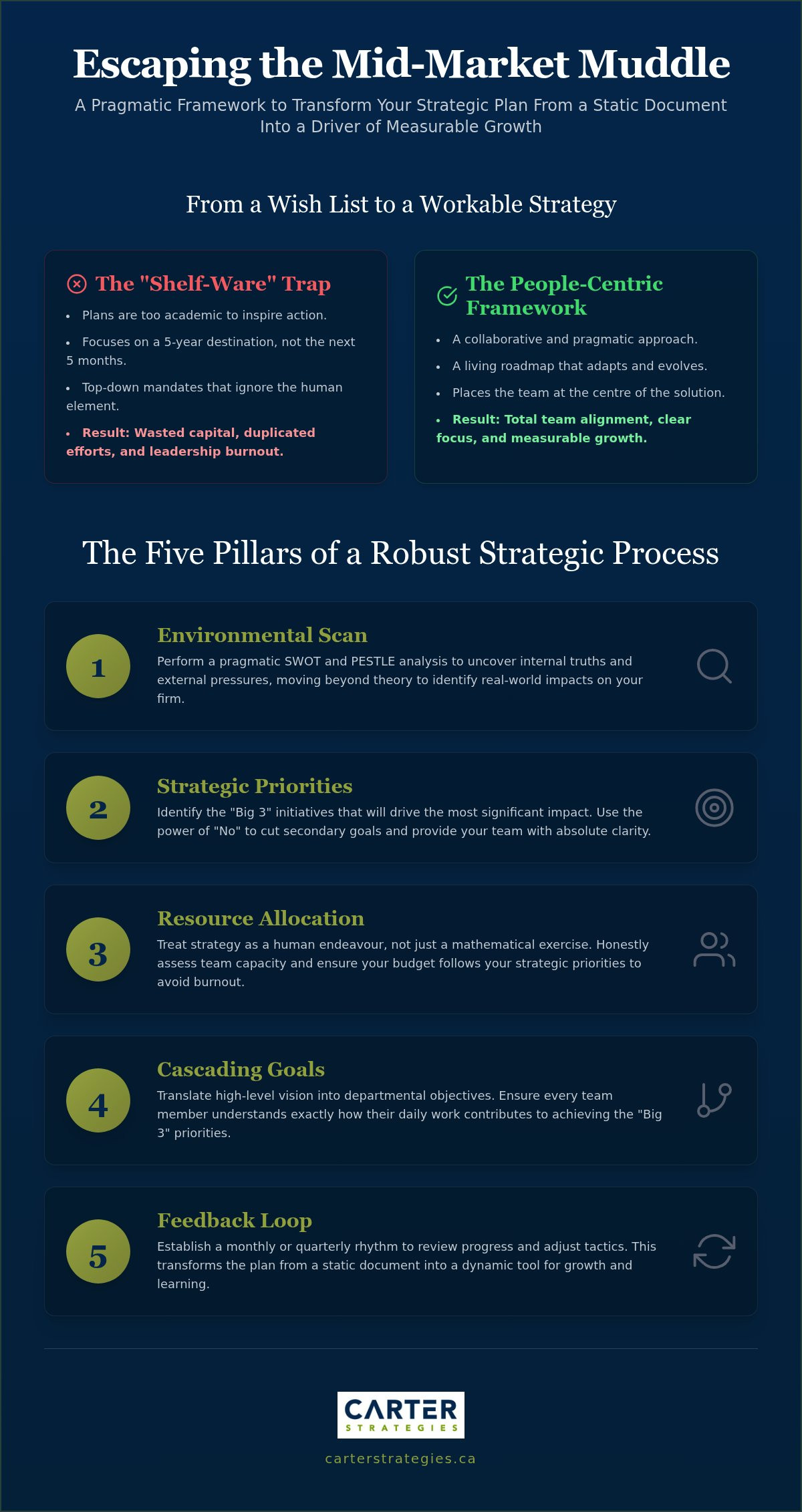
In this environment, the traditional strategic planning process often becomes an exercise in "Shelf-Ware." High-priced consultants deliver binders full of SWOT analyses and PESTLE charts that fail to inspire action. These documents are too academic for the reality of mid-market operations. They focus on where the company should be in five years without explaining how to survive the next five months. There is also a critical distinction between a financial forecast and a true growth plan. A forecast is a destination; a strategy is the vehicle. If you only have targets without a methodology to reach them, you don't have a strategy. You have a wish list.
The Disconnect Between Vision and Execution
Top-down mandates fail because they ignore the human element of corporate growth. When leadership imposes a plan without consulting middle management, buy-in evaporates. This approach fails to place the team at the centre of the solution. The cost of this misalignment is high. It manifests as wasted capital, duplicated efforts, and missed market opportunities. Strategic drift is the gradual departure from core priorities. It happens when your team spends all its energy on tactical execution instead of the goals that actually move the needle.
Recognizing the Need for a New Planning Framework
If your revenue has hit a plateau or your team feels constantly reactive, your strategic planning process for mid-size companies needs a reset. A broken process leads to a lack of focus and leadership burnout. You need a model that is collaborative and grounded in the practicalities of leadership. This means moving away from corporate jargon and toward a framework that emphasizes shared accountability. Successful firms recognize that a plan is only as good as the people who execute it. To learn more about aligning your team, explore our insights on Bridging the Gap Between Vision and Execution.
The Five Pillars of a Robust Strategic Planning Process
A robust strategic planning process for mid-size companies isn't about creating more work; it's about making the work you do more effective. It requires a move from abstract goals to concrete pillars that support sustainable growth. Unlike the rigid structures sometimes found in a Gartner strategic planning framework, mid-market firms must remain flexible enough to pivot when market conditions shift. Success depends on a methodology that balances high-level vision with the practicalities of day-to-day operations.
- Environmental Scan: Perform a pragmatic SWOT and PESTLE analysis to uncover internal truths and external pressures.
- Strategic Priorities: Identify the "Big 3" initiatives that will drive the most significant impact on your revenue and organizational health.
- Resource Allocation: Determine if your team has the actual capacity and budget to execute the plan without compromising existing operations.
- Cascading Goals: Ensure every department understands how their work contributes to the core vision.
- Feedback Loop: Establish a monthly or quarterly rhythm to review progress and adjust tactics as needed.
Establishing Your Strategic Priorities
Identifying the correct levers for growth requires discipline. Most leaders struggle not with finding ideas, but with narrowing them down to a manageable few. The power of "No" is your most effective tool. By cutting secondary initiatives, you provide your team with the clarity they need to excel at the primary ones. Our Strategic Priorities Framework helps leaders distinguish between urgent tactical fires and the long-term goals that move the needle for the business.
Resource Allocation: Beyond the Spreadsheet
Strategy often fails when it's treated as a mathematical exercise rather than a human one. Within a successful strategic planning process for mid-size companies, you must assess team capacity honestly to ensure your plan doesn't lead to burnout. Alignment means ensuring your dollars follow your strategy. If your top priority is market expansion but your budget remains tied to legacy products, your strategy is already compromised. As a leader, your role is to protect your team’s focus by refusing to let tactical distractions derail the roadmap. If you're struggling to balance these competing demands, a tailored approach to business strategy development can provide the external perspective needed to stay on track.
Leaders frequently mistake strategy for a mathematical exercise. They spend weeks perfecting financial forecasts and market share projections; however, they often overlook the human element that drives those numbers. The strategic planning process for mid-size companies is a human endeavour. If your employees don't see their own future reflected in your company's growth, they won't commit to the hard work of execution. This "Primacy of People" ensures that every individual understands how their specific contributions impact the broader vision.
To achieve this, we utilize facilitated discovery. This technique moves away from top-down mandates and instead invites team members to uncover the "how" behind strategic goals. It transforms the plan from a leadership directive into a shared mission. Staff members often object that strategy feels disconnected from their daily reality. We solve this by translating 36-month goals into 90-day priorities, making the abstract feel immediate and relevant.
Securing Employee Buy-In from the Start
Execution begins when you stop announcing a strategy and start co-creating the path to achieve it. This shift requires transparent communication and a willingness to listen to the friction points identified by your front-line staff. When teams participate in defining the execution steps, they develop a sense of ownership that no corporate memo can replicate. Buy-in is earned through clarity, not just consensus. It's about ensuring everyone knows the "why" even if they don't agree with every tactical choice.
Building Organizational Alignment
Misalignment often starts in the gaps between departments. When sales, marketing, and operations work in isolation, they inadvertently compete for resources and focus. We break these silos by establishing cross-functional strategic goals that require collaboration to succeed. This is where fractional leadership serves as a tool for alignment. A fractional CMO or CRO can model alignment behaviour at the executive level, bridging the gap between high-level vision and boots-on-the-ground execution. This creates a culture of shared accountability where success is measured by collective progress rather than individual department metrics. By centring the human element, you move from a static document to a living organization focused on growth.
Executing the Roadmap: Bridging the Gap Between Vision and Reality
The transition from high-level planning to daily execution is the most vulnerable phase of the strategic planning process for mid-size companies. Momentum is a fragile asset. If the first 90 days are spent in perpetual meetings rather than visible action, your team will quickly revert to their old, tactical habits. A successful roadmap is not a static binder; it's a living document that guides the "Rhythm of Business" (ROB). This rhythm ensures your top priorities remain front-and-centre during every weekly check-in and monthly review.
Strategic pivots are inevitable in an uncertain economy. Whether you are responding to the Bank of Canada policy rate sitting at 2.25% or navigating the $7.5 billion in federal measures protecting businesses from trade tariffs, leaders must adjust tactics without losing sight of the long-term vision. The goal is to evolve the plan without creating organizational whiplash. This requires a shift from "The Plan" to "The Work," where the roadmap serves as a practical guide for every department.
The First 90 Days: Building Execution Momentum
Success in the first quarter depends on identifying "Quick Wins." These are high-visibility, low-resistance projects that demonstrate the value of the new strategy to the entire organization. By securing these early victories, you build the psychological safety and trust required for more complex initiatives later. Establishing a clear governance structure for tracking progress ensures that accountability is baked into the culture from day one. To explore detailed execution tactics, see our guide on Growth Strategy and Planning for mid-size businesses.
Managing Performance and Accountability
Performance management must move beyond simple revenue targets. You need key performance indicators (KPIs) that reflect strategic health, such as team alignment scores or the velocity of priority project completion. This is where a fractional leader becomes invaluable. They provide the objective oversight needed to maintain focus when tactical fires threaten to derail the roadmap. When data shows a deviation from the plan, the leader's role is to facilitate an honest course-correction rather than assigning blame. This practitioner-led approach ensures that the strategic planning process for mid-size companies leads to actual results. If your organization struggles to maintain momentum after the initial planning phase, our Growth Strategies and Planning services provide the structure needed to bridge the execution gap.
Scaling with Precision: How Fractional Leadership Accelerates Strategic Priorities
Many mid-size Canadian firms reach a plateau where their growth outpaces their internal leadership capacity. This "Leadership Gap" occurs when the existing team is excellent at tactical execution but lacks the seasoned authority required to drive a complex strategic planning process for mid-size companies. Hiring a full-time, C-suite executive often feels like a premature financial burden; however, remaining without that expertise risks long-term stagnation. Fractional leadership offers a pragmatic alternative. It provides the high-level impact of a veteran strategist without the full-time salary and overhead associated with traditional executive recruitment.
A fractional CMO or CRO doesn't just manage a department. They integrate marketing and sales strategies into the core business plan. They ensure that specialized marketing and revenue expertise isn't siloed but instead serves the "Big 3" priorities identified earlier in your roadmap. This model allows business leaders to focus on their primary duties while a battle-tested expert handles the friction of organizational growth. Technology is a tool, but leadership is the driver. While some competitors suggest expensive software as the solution to execution gaps, we believe that high-level planning becomes reality through human alignment and shared accountability.
The Case for Fractional CMO and CRO Services
Aligning marketing and revenue strategies with the overall business plan is essential for measurable growth. A fractional leader provides the objective perspective needed to mentor internal teams and model the alignment behaviour required for success. They translate high-level vision into actionable tasks, ensuring the team remains focused on strategic priorities rather than tactical distractions. This approach secures buy-in because employees see a clear path forward guided by someone who has been in the trenches. For a deeper look at how this model supports your growth, read The Fractional CMO Guide for Canadian Mid-Market Leaders.
Partnering for Long-Term Organizational Success
Carter Strategies acts as a strategic guide rather than a tactical agency. We help firms move from reactive, ad-hoc marketing to a proactive, growth-oriented strategy. Our role is to facilitate the strategic planning process for mid-size companies by bridging the gap between high-level vision and boots-on-the-ground execution. We value internal buy-in as much as financial metrics, ensuring that the best solutions are uncovered through collaboration rather than imposed from the top down. If you're ready to move from static documents to organizational alignment and measurable growth, book a consultation with Carter Strategies to realize your growth potential.
Transforming Strategic Vision into Sustainable Growth
A successful strategic planning process for mid-size companies isn't defined by the volume of data in a binder, but by the clarity and commitment of the people executing it. You've explored how identifying a few core priorities and establishing a consistent rhythm of business reviews can prevent strategic drift. By prioritizing organizational health and human-centric alignment, you bridge the gap between high-level vision and the daily work that drives results. This approach ensures that your roadmap remains a living document rather than a static exercise.
Carter Strategies provides the seasoned executive leadership your firm needs to scale with precision. We offer a pragmatic, battle-tested methodology designed specifically for the Canadian mid-market, focusing on organizational alignment without the full-time executive overhead. If you're ready to move from tactical execution to proactive leadership, it's time to align your team and accelerate growth with Carter Strategies. Your next phase of measurable growth is within reach when you have a plan that places your people at the centre of the strategy.
Frequently Asked Questions
How long does the strategic planning process typically take for a mid-size company?
A typical strategic planning cycle for a mid-size firm usually spans eight to twelve weeks. This timeframe allows for thorough environmental scanning and internal truth-telling without losing momentum. Rushing the process often results in poor team buy-in, while extending it too long can lead to decision fatigue. It's a balance of deep analysis and decisive action that ensures the final roadmap is both accurate and ready for immediate implementation.
What is the difference between a strategic plan and a business plan?
Business plans are often foundational documents used for initial setup or securing financing. Conversely, the strategic planning process for mid-size companies focuses on long-term direction and competitive advantage over a 12 to 36 month horizon. While a business plan describes what you do, a strategic plan defines how you'll grow and evolve. It's a living guide that helps leaders navigate market shifts and internal transitions with confidence.
How often should a mid-size company review its strategic roadmap?
You should review your strategic roadmap monthly for tactical progress and quarterly for strategic adjustments. Waiting for an annual review is dangerous in a volatile economy where market conditions change rapidly. These regular business reviews keep your top priorities front-and-centre and allow for necessary course-corrections. This consistent rhythm ensures that the leadership team remains focused on long-term growth rather than getting lost in daily tactical fires.
What are the most common reasons strategic plans fail in the execution phase?
Execution fails when a plan is treated as a static document rather than a living roadmap. Common reasons include:
- Lack of leadership alignment on top priorities.
- Disconnected departments working in isolated silos.
- Failing to allocate the necessary budget or team capacity to new initiatives.
- Leadership burnout from managing daily tactics instead of the strategy.
Without a clear execution framework, even the best vision will gather dust.
How do you align employees with a new company strategy effectively?
True alignment requires moving from simply announcing a strategy to co-creating the execution path through facilitated discovery. Employees need to see their own future and daily contributions reflected in the company's growth targets. Transparent communication and active listening are essential to earn buy-in. When your team understands the "why" behind strategic shifts, they're more likely to take ownership of the outcomes and work collaboratively toward shared goals.
Can a fractional CMO help with the strategic planning process?
A fractional CMO provides the seasoned authority needed to integrate marketing strategy with your overall business objectives. They bridge the gap between high-level vision and boots-on-the-ground execution without the overhead of a full-time executive hire. By focusing on strategic priorities rather than tactical execution, they help mid-size firms navigate complex transitions. This model offers specialized expertise that ensures your marketing efforts drive measurable revenue growth and organizational alignment.
What is the "Strategic Priorities Framework" and how does it help growth?
This framework is a tool for organizational health that narrows your focus to the three most impactful levers for growth. Instead of chasing dozens of competing goals, the strategic planning process for mid-size companies uses this model to ensure resource allocation follows strategy. It provides a pragmatic roadmap that reduces internal friction. This focus ensures every team member pulls in the same direction, moving the firm from static documents to measurable progress.
How do we measure the ROI of a strategic planning consultant?
Evaluate success through specific growth metrics like increased revenue, improved profit margins, and the velocity of priority project completion. Qualitative indicators like total team alignment and reduced leadership burnout also demonstrate significant value. A successful consultant moves your firm from reactive decision-making to proactive growth. They deliver a battle-tested methodology that provides a high-level impact, ensuring the investment in their expertise translates into a more profitable organization.


