


Research based on over 20,000 strategic plans reveals that only 5.7% of organizations complete 75% or more of their strategic projects. It's a sobering reality for many Canadian leaders who invest months into high-level planning only to watch those initiatives stall during execution. You likely recognize the friction of departments working at cross-purposes or the resource drain caused by well-intentioned "strategic drifters" who aren't quite sure how their daily tasks move the needle. It's exhausting to lead a team that's busy but isn't actually gaining ground.
This article outlines a practical organizational alignment strategy designed to synchronize your high-level vision with daily operations. You'll discover how to bridge the gap between the boardroom and the front line so every team member drives your core priorities. We'll explore how to narrow your focus to 3-5 key objectives, clarify the connection between individual work and company ROI, and build a framework that turns your strategy into a living organizational reflex for accelerated growth.
Key Takeaways
- Learn to distinguish between tracking past metrics and directing future impact to prevent disengagement and ensure every effort contributes to growth.
- Develop a robust organizational alignment strategy that unifies siloed departments and focuses the entire team on 3-5 critical must-win battles.
- Discover how to translate high-level vision into departmental roadmaps that make the corporate strategy relevant and actionable for every individual contributor.
- Ensure leadership cohesion by establishing a framework where the executive team speaks with one voice and honours collective commitments.
- Recognize how fractional leadership acts as a catalyst to bridge the gap between marketing, sales, and your primary revenue objectives.
What is an Organizational Alignment Strategy?
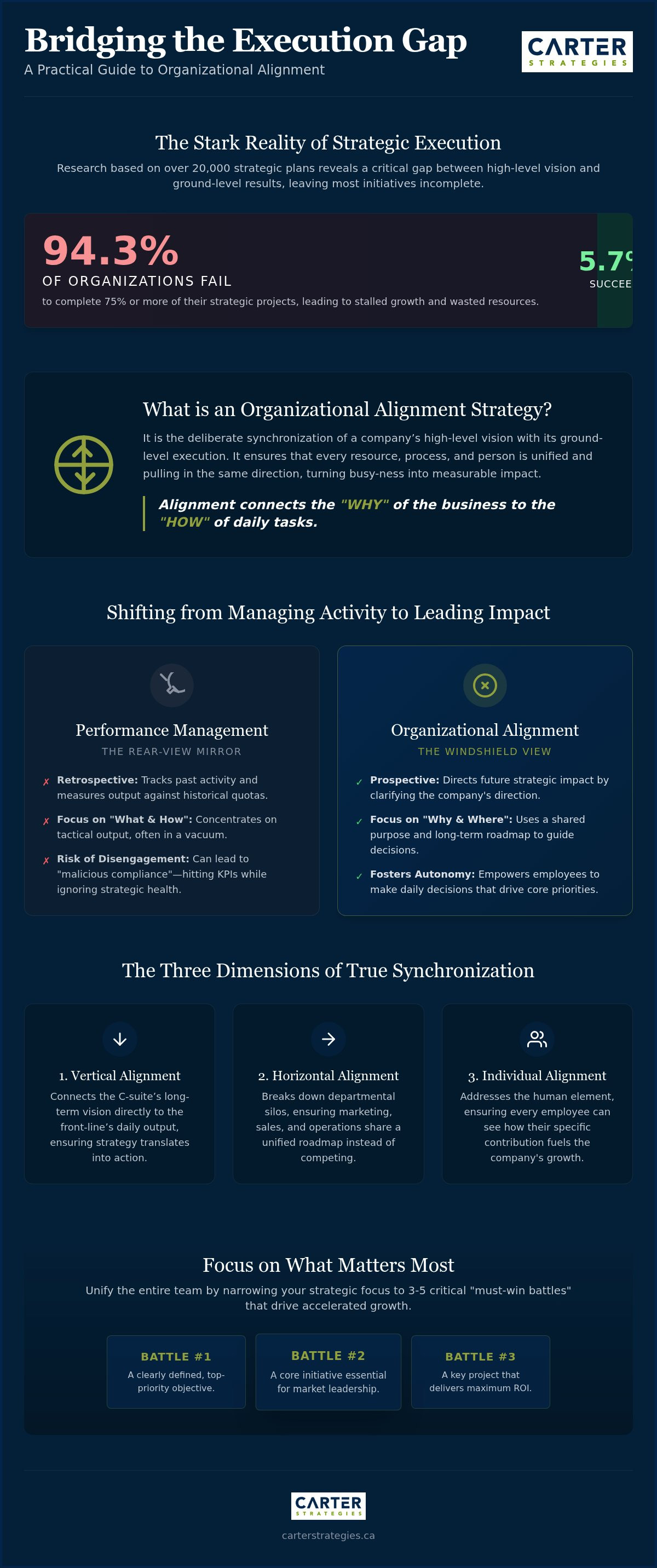
An organizational alignment strategy is the deliberate synchronization of a company’s high-level vision with its ground-level execution. It ensures that every resource, process, and person pulls in the same direction. Without this cohesion, even the most brilliant plans become shelfware. Strategic alignment is not a one-time event; it's a continuous discipline of connecting the "why" of the business to the "how" of daily tasks. It requires a commitment to clarity that begins with the executive team and permeates every layer of the firm.
Many leaders mistake activity for progress. You see teams working late and checking off tasks, yet the bottom line remains stagnant. This is the Execution Gap. Research indicates that a staggering 94.3% of organizations fail to complete at least 75% of their strategic projects. This failure rarely stems from a lack of effort. It happens because the work being done doesn't map back to the firm's core strategic priorities. Alignment turns busy-ness into impact by providing a North Star that filters out distractions. It ensures that every dollar spent and every hour worked drives a measurable return on investment.
Leadership plays the most critical role in maintaining this synchronization. It's not enough to announce a vision at an annual retreat. Executives must actively model this focus by honouring their commitments and speaking with one voice. When leadership is fragmented, the rest of the organization follows suit, creating silos that stifle growth and frustrate high-performing employees.
The Three Dimensions of Alignment
To achieve true synchronization, you must look at alignment through three distinct lenses. Vertical alignment connects the C-suite’s long-term vision directly to the front-line’s daily output. Horizontal alignment breaks down departmental silos, ensuring marketing, sales, and operations share a unified roadmap rather than competing for resources. Finally, individual alignment addresses the human element. It ensures every employee can realize how their specific contribution fuels the company's growth. When people understand their role in the bigger picture, they move from being "strategic drifters" to active drivers of the business.
Why Mid-Market Companies Struggle to Align
Mid-market firms in Canada face unique hurdles. As you scale beyond the founder’s direct oversight, you enter the "muddle in the middle." Management layers often dilute the original strategy, leading to confusion and internal friction. Resource constraints mean you don't have the luxury of waste. Every misaligned hour is a direct financial drain on the organization. Additionally, managing growth across diverse Canadian provinces introduces cultural and operational complexities. Moving from a single office to a national presence requires a deliberate business strategy development approach to maintain a unified focus. Without this, geographical gaps quickly turn into operational chasms that slow down your momentum.
Performance Management vs. Organizational Alignment
Management and alignment are frequently conflated, yet they represent two distinct philosophies of leadership. Performance management is inherently retrospective. It functions like a rear-view mirror, tracking past activity and measuring output against historical quotas. While necessary for accountability, it does not inherently drive progress. In contrast, an organizational alignment strategy is prospective. It functions like a windshield, directing future strategic impact by ensuring every team member understands where the company is headed and why their specific work matters for that journey.
When you over-manage metrics without the context of alignment, you risk fostering disengagement or "malicious compliance." This occurs when employees hit their specific KPIs while ignoring the broader strategic health of the firm. The Importance of Organizational Alignment lies in its ability to unify processes so that individual success and company growth are one and the same. By shifting the focus from supervising tasks to leading outcomes, Canadian business leaders can build organizations that are both healthy and scalable.
Traditional Management: The What and How
Traditional management often relies on annual reviews and rigid quotas. It focuses on the "what" and the "how" of tactical output, frequently in a vacuum. In mid-market firms, this top-down model creates friction. High-performers feel stifled by micromanagement, while departments may hit their individual targets without actually moving the needle on revenue. This disconnect often signals a need for more robust growth strategies and planning to ensure that tactical wins translate into long-term market gains.
Strategic Alignment: The Why and Where
Alignment focuses on the "why" and the "where." It uses a shared purpose and a clear long-term roadmap to organize team efforts organically. Instead of waiting for a manager’s directive, employees use the company’s strategic priorities to guide their own daily decision-making. This fosters true autonomy. When everyone knows the must-win battles for the next 18 months, the need for constant supervision vanishes. Continuous feedback loops replace the dreaded annual review, allowing for real-time course correction. This agile approach ensures the team stays focused on the target, even as market conditions shift. It turns an organizational alignment strategy from a static document into a living, breathing part of the company culture.
The 5 Pillars of a Unified Organizational Alignment Strategy
A successful organizational alignment strategy rests on five foundational pillars that transform a static plan into a dynamic engine for growth. These pillars ensure that the business doesn't just have a plan, but possesses the collective will and capability to execute it. When these elements work in concert, the internal friction that often plagues mid-market firms begins to dissipate, replaced by a steady, intentional momentum.
- Strategic Clarity: You must define the 3 to 5 must-win battles for the next 12 to 18 months. Ambiguity is the enemy of execution; if everything is a priority, nothing is.
- Leadership Cohesion: The executive team must speak with one voice. This requires a level of candour and shared accountability where every leader honours their commitments to the collective goal, not just their specific department.
- Capability Match: This involves honestly assessing if your team possesses the skills required for your growth strategy. You must align your human capital with the specific demands of your future roadmap.
- Cultural Reinforcement: Culture should reward behaviours that support the strategic direction. If you value innovation but only reward those who maintain the status quo, alignment will fail.
- Measurement Systems: Establish KPIs that track focus and strategic contribution. It's not about volume; it's about measuring the initiatives that actually move the needle on your primary objectives.
Achieving Absolute Strategic Clarity
Complexity is a barrier to realization. To ensure your team can digest and act upon your vision, we recommend a one-page strategy. This simplifies the complex and eliminates competing priorities that dilute organizational energy. For a deeper look at refining this focus, see our Business Strategy Development: A Guide for Canadian Mid-Market Leaders. By stripping away the noise, you provide a North Star that guides every daily decision.
Securing Employee Buy-in and Ownership
Alignment is not a top-down mandate; it's a collaborative process. You must move from telling your team what to do to involving them in how it gets done. This creates a sense of shared destiny. Address the "what's in it for me" question at every level to overcome resistance. Research shows mentions of "misalignment" in employee feedback have increased by 149% year-over-year, highlighting a critical need for leaders to foster psychological safety. When employees feel heard, they stop being "strategic drifters" and start taking ownership of the company's ROI.
Implementation: How to Align Your Team with Strategy
Moving from strategy to execution requires a shift in focus from what you want to achieve to how your team actually behaves. Implementation of an organizational alignment strategy is not a singular event; it's a persistent operational discipline. It demands that you move beyond the boardroom to the front line, ensuring every layer of the hierarchy understands the mission and their specific role within it. Consistency is your greatest ally here. A strategy that is communicated once is quickly forgotten. A strategy that is lived daily becomes an organizational reflex.
Conducting the Alignment Audit
Before you can realign, you must understand where the gaps exist. An alignment audit identifies the silos currently blocking your progress. Start by surveying your team with a simple question: "What are our top three priorities for the next 12 months?" In many mid-market firms, the answers vary wildly by department. This misalignment is often mirrored in your budget. Map your resource allocation against your strategic goals to see if you're actually funding your priorities. This process often uncovers "strategic drifters," which are legacy projects that consume time and capital but no longer move the needle on your growth targets. Identifying these drains is the first step toward reclaiming your team's focus.
Creating a Strategic Roadmap for Execution
A high-level vision is useless if it isn't translated into departmental roadmaps. Each team needs a clear path that helps them organize their efforts and makes the strategy relevant to their daily tasks. Setting short-term milestones provides early wins that maintain momentum and prove the value of the new direction. For a practical framework on this transition, read our guide on Bridging the Gap Between Vision and Execution. Equally important is the "stop-doing" list. To free up capacity for true alignment, you must explicitly identify and terminate initiatives that don't serve the core strategy. This creates the breathing room your team needs to realize their full potential on the projects that matter most.
Establishing a rhythm of business ensures these changes stick. Regular check-ins should focus exclusively on strategic priorities, not just tactical fires. This is supported by cascading communication, where the core message is reinforced at every level to prevent the dilution of intent. If you're struggling to move past the audit phase and need a partner to help streamline your operations, we can assist you in developing robust growth strategies and planning to secure your company's future.
Leveraging Fractional Leadership to Secure Alignment
Internal teams often find themselves too close to the daily friction to identify the structural gaps stalling their progress. An external perspective isn't just a fresh set of eyes; it's a diagnostic tool for deep-seated organizational misalignment. Fractional leadership provides mid-market firms with the seasoned authority needed to bridge the gap between high-level vision and operational reality. This model is particularly effective for executing a robust organizational alignment strategy because it focuses on shared accountability and the human element of corporate growth, rather than just financial metrics.
The practitioner advantage lies in implementation. Unlike large-scale management consulting firms that deliver a static report and depart, fractional leaders act as strategic guides who stay in the trenches. They galvanize teams around a specific growth strategy, ensuring that the executive team speaks with one voice and that departmental roadmaps remain synchronized. This approach provides the executive-level nudge needed to keep alignment on track during complex transitions without the overhead of a full-time hire.
Bridging Marketing and Revenue Silos
In many Canadian mid-size firms, marketing and sales operate as independent islands. A Fractional CMO or CRO acts as a unifying force, ensuring that marketing spend aligns with the actual sales reality and revenue targets. They synchronize the customer journey with the internal strategic framework to create a seamless experience for the client and a clear mandate for the team. When these silos are broken down, the organization can finally realize a measurable return on its marketing investments. For a detailed look at how this role functions, see The Fractional CMO Guide for Canadian Mid-Market Leaders.
Accelerating Growth Through Expert Guidance
Seasoned fractional leaders help you short-circuit the trial and error phase of strategic execution. They've seen the common pitfalls and understand how to navigate the "muddle in the middle" that occurs as companies scale. By providing a stabilizing force, they allow the founder or CEO to step back from micromanaging and focus on long-term vision. This expert guidance ensures that the organizational alignment strategy remains a living reflex within the company culture, driving efficiency and focus. If you're ready to stop the resource drain and focus your team on a unified path, partner with Carter Strategies to align your team and secure your next phase of growth.
Turning Strategic Vision into Operational Reality
Building a high-performing organization requires more than a sound business plan; it demands a relentless commitment to synchronization. A robust organizational alignment strategy ensures that your must-win battles aren't just boardroom talk but the driving force behind every departmental roadmap. By shifting from retrospective performance tracking to prospective strategic guidance, you empower your team to act with autonomy and focus. It's about moving from simply being busy to being impactful.
True alignment bridges the gap between marketing, sales, and revenue goals, turning siloed efforts into a unified engine for growth. Whether you're conducting an initial audit or integrating fractional leadership to catalyze change, the goal remains the same: a healthy, scalable business where every person understands their contribution to the bottom line. Our pragmatic, implementation-focused approach is designed specifically for mid-market strategic priorities.
Through our fractional CMO and CRO leadership, we help you secure revenue alignment without the overhead of a full-time hire. Accelerate your growth with Carter Strategies alignment expertise and ensure your team is focused on the priorities that matter most. Your strategy is only as strong as the people who believe in it; it's time to bring them into alignment.
Frequently Asked Questions
What is the first sign that my business is misaligned?
The most immediate sign of misalignment is the presence of conflicting priorities across different departments. You'll notice marketing teams generating leads that sales cannot close, or operations focusing on projects that don't match the C-suite's vision. When employees provide varied answers about the company's top three goals, it indicates a breakdown in your organizational alignment strategy. This internal friction often leads to wasted resources and stagnant growth despite high levels of individual effort.
How long does it typically take to achieve full organizational alignment?
Achieving initial alignment typically takes six to twelve months of consistent effort. It isn't a one-time project but a shift in operational rhythm. The first few months focus on the alignment audit and defining strategic clarity. Subsequent months involve cascading that message and adjusting measurement systems. While you'll see early wins in team cohesion quickly, embedding alignment into the company culture requires persistent leadership and regular quarterly reviews to maintain momentum as market conditions shift.
Can a mid-size company achieve alignment without a large management consulting firm?
Yes, mid-size firms often find better success with a practitioner-led approach than with large-scale academic consulting. Large firms frequently deliver dense reports that lack implementation depth. A mid-market company can achieve superior results by utilizing fractional leadership or internal frameworks that prioritize buy-in and shared accountability. This method focuses on practical execution and team dynamics, ensuring the strategy becomes a living part of the organization rather than a static document sitting on a shelf.
How do I measure the ROI of an organizational alignment strategy?
You measure the ROI of an organizational alignment strategy through both financial and operational metrics. Key indicators include an average increase in annual revenue growth and higher win rates for aligned sales and marketing teams. Operationally, look at the completion rate of strategic projects; research shows only 5.7% of organizations currently finish most of their plans. Improved employee retention and a clearer connection between individual tasks and company ROI also serve as definitive proof of successful alignment.
What is the difference between organizational alignment and team building?
Team building focuses on interpersonal relationships and morale, whereas organizational alignment focuses on strategic synchronization and operational focus. While team building might improve how people feel about their colleagues, alignment ensures they're all moving toward the same 3-5 strategic priorities. You can have a team that gets along perfectly but remains misaligned because they're working on projects that don't drive the company's core vision. Alignment provides the structural framework for collective success.
Why do strategic plans often fail during the execution phase?
Strategic plans usually fail because of a gap between high-level vision and daily execution. Research indicates that 74% of strategic goals and 71% of measures remain unassigned to specific owners. When a plan is treated as a financial exercise rather than a living roadmap, it fails to gain employee buy-in. Without clear communication and a "stop-doing" list to free up capacity, teams become overwhelmed by competing priorities and legacy projects that don't support the new direction.
How can a Fractional CMO help with internal team alignment?
A Fractional CMO acts as a strategic guide who bridges the gap between marketing, sales, and revenue goals. They provide the seasoned authority needed to break down departmental silos and ensure that marketing spend aligns with the actual sales reality. By focusing on growth strategies and planning, they help translate the C-suite's vision into actionable roadmaps for the team. This external perspective identifies deep-seated friction that internal leaders might overlook, catalyzing a more unified and focused culture.


