


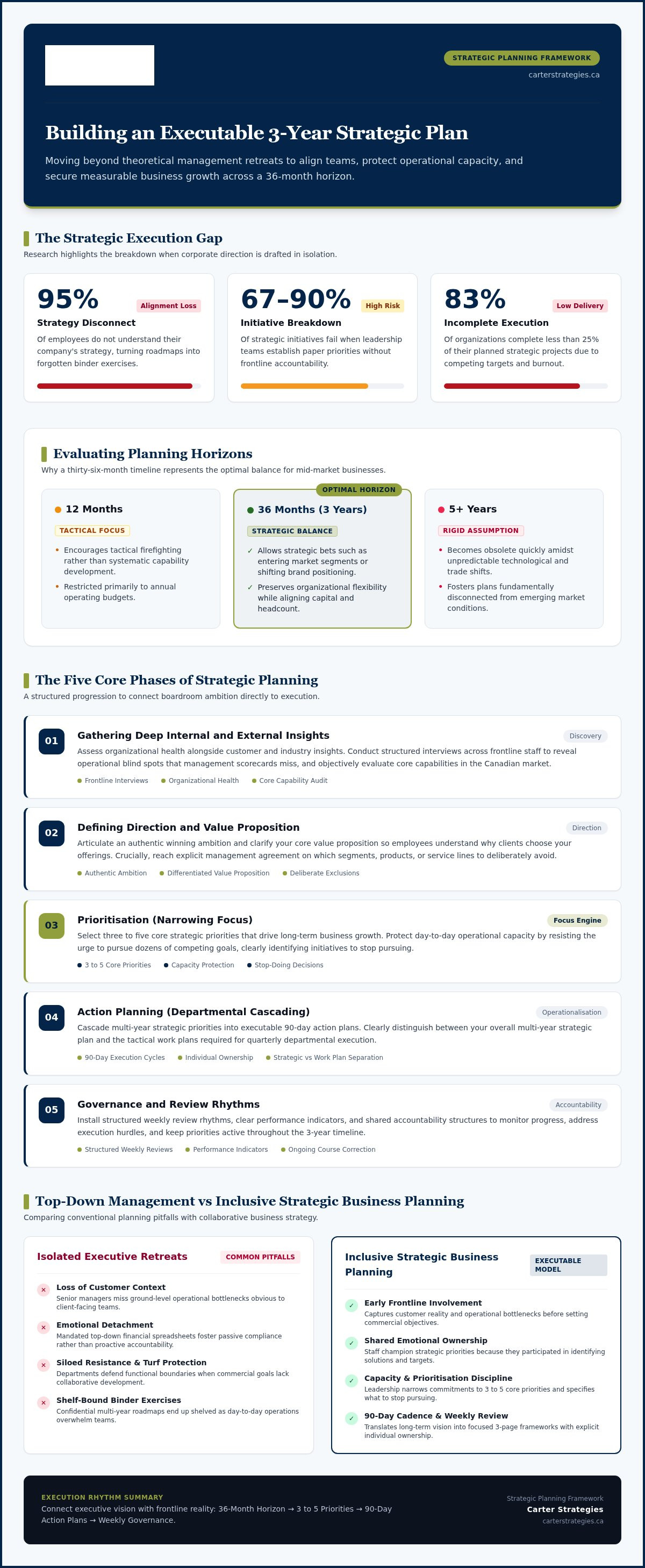
Research shows that 95% of employees do not understand their company's strategy, which explains why so many multi-year roadmaps end up as forgotten binder exercises on office shelves. If you lead a mid-market organization, you know the frustration of watching well-intentioned goals unravel into functional silos and competing corporate initiatives. When leadership teams build roadmaps in isolation, employees quickly burn out trying to chase competing targets without clear operational direction. Understanding how to create a 3 year strategic plan that succeeds requires moving beyond theoretical planning retreats and grounding your direction in shared accountability.
A business strategy must unify your people around clear commercial priorities rather than overwhelm them. Discover how to build an actionable three-year strategic plan that aligns your team and drives measurable growth across the organization. Below, we walk through the practical process to establish explicit thirty-six-month priorities for your capital and headcount, translate executive vision into a focused three-page framework, and install the performance indicators needed to connect high-level goals directly to quarterly execution.
Key Takeaways
- Shift from isolated executive retreats to inclusive strategic business planning that builds team buy-in and eliminates shelf-bound binders.
- Master how to create a 3 year strategic plan across five clear phases that unite organizational health, core capabilities, and your commercial value proposition.
- Protect your operational capacity by narrowing focus to three to five core strategic priorities while explicitly deciding which initiatives to stop pursuing.
- Translate multi-year growth targets into executable ninety-day action plans, clear individual ownership, and structured weekly review rhythms.
- Evaluate the trade-offs between internal leadership facilitation and external advisory support to prevent organizational hierarchies from stifling frontline input.
Why Traditional 3-Year Strategic Plans Fail and How to Reframe Them
Every growing mid-market company reaches a point where entrepreneurial momentum hits an operational wall. In response, leadership teams retreat to a boardroom to draft multi-year financial spreadsheets and ambitious revenue targets. Yet industry research shows that between 67% and 90% of strategic initiatives fail, and 83% of organizations complete less than 25% of their planned strategic projects. A conventional 3-year strategic plan sets strategic priorities, organizational direction, and measurable business growth on paper, but numbers on a ledger do not inspire human action. Mid-market organizations need an executable business strategy balanced against realistic day-to-day capacity, which requires re-evaluating how to create a 3 year strategic plan that employees actually champion.
Modern commercial success demands treating formal strategic planning as a collaborative alignment engine rather than a static financial exercise. Without employee engagement across functional departments, strategic priorities remain theoretical abstractions that stall during operational rollout.
The Pitfalls of Top-Down Management Exercises
Executive retreats that deliberately exclude frontline perspectives generate plans fundamentally disconnected from customer reality. When a management team spends months drafting a confidential roadmap in isolation, employees handed finished binders feel zero emotional ownership over required changes. This dynamic triggers immediate operational friction. Understanding bridging the gap between vision and execution eliminates internal execution barriers because it includes staff input early, ensuring commercial objectives match actual frontline capability.
- Loss of customer context: Senior managers miss ground-level operational bottlenecks obvious to client-facing teams.
- Emotional detachment: Mandated top-down targets foster passive compliance rather than proactive accountability.
- Siloed resistance: Departments protect internal turf when commercial goals lack collaborative development.
Why Three Years Is the Optimal Planning Horizon
Five-year plans become obsolete quickly amidst unpredictable technological shifts and shifting trade dynamics. Conversely, twelve-month operating budgets encourage tactical firefighting rather than systematic capability development. A thirty-six-month horizon allows meaningful strategic bets, such as entering new market segments or overhauling core brand positioning, while preserving vital organizational flexibility.
Balancing multi-year vision with operational reality is the central challenge when learning how to create a 3 year strategic plan. Mid-market leaders must focus on a tight horizon that aligns resources without sacrificing the agility required to navigate market changes.
Five Core Phases to Build an Executable 3-Year Strategic Plan
Executing an organizational transformation requires an intentional methodology that bridges the gap between high-level ambition and departmental reality. When leaders ask how to create a 3 year strategic plan, they often jump directly to writing tactical project lists. A structured process demands moving systematically through discovery, direction, prioritization, cascading, and governance. This sequence ensures that your team builds mutual commitment rather than merely checking administrative boxes.
Phase 1: Gathering Deep Internal and External Insights
Rigorous strategic business planning begins with honest discovery. Step outside the boardroom to assess your internal organizational health alongside customer and industry insights. Conduct structured interviews across frontline staff to reveal operational blind spots that executive scorecards regularly miss. At the same time, evaluate your existing core capabilities objectively. Determine where your operational strengths genuinely stand out in the Canadian marketplace, rather than assuming past successes will guarantee future performance.
Phase 2: Defining Direction and Value Proposition
Once you understand your baseline, clarify where the business must go over the next thirty-six months. Articulate an authentic winning ambition without relying on abstract marketing slogans. Sharpen your core value proposition so that every employee can clearly state why target clients choose your offerings over alternatives. Crucially, the management team must explicitly agree on which market segments, products, or service lines the company will deliberately avoid.
Phase 3 to 5: Priorities, Action Plans, and Governance
The back half of the planning cycle translates strategic clarity into operational traction:
- Phase 3 (Prioritisation): Select three to five strategic priorities that drive long-term business growth, resisting the urge to pursue dozens of competing ideas.
- Phase 4 (Action Planning): Cascade overarching priorities into departmental action plans, distinguishing your multi-year strategic plan vs. a work plan focused on tactical outputs.
- Phase 5 (Governance): Establish clear performance indicators, quarterly sprint goals, and disciplined review cadences with designated individual owners.
Research indicates that 74.3% of goals and 56.8% of projects in strategic roadmaps lack clear ownership, making Phase 5 the differentiator between execution and failure. For a deeper breakdown of this collaborative methodology, review our practical guide on business strategy development for Canadian mid-market leaders. If your executive team needs an experienced sounding board to guide this progression, consider partnering with an outside expert in business strategy development to foster genuine alignment from day one.
Aligning Strategic Priorities with Market Positioning and Capacity
Strategy is fundamentally about making deliberate choices; deciding what not to do matters just as much as choosing what to pursue. When leadership teams explore how to create a 3 year strategic plan, they often fall into the trap of approving every good idea discussed during executive sessions. Overloading an organization with ten or fifteen competing initiatives guarantees operational dilution, divides capital, and burns out key personnel. Sustainable mid-market growth requires aligning ambitious revenue goals with verified market demand and genuine internal capacity.
Filtering Initiatives Through the Strategic Priorities Framework
To protect team bandwidth, conduct an unsparing audit of all active corporate projects against your proposed strategic priorities. Mid-market companies frequently accumulate legacy processes, redundant reporting routines, and pet projects that quietly drain employee energy without generating commercial value. Establishing an explicit "stop-doing" list creates the operational room needed to execute high-impact goals.
- Eliminate legacy drag: Discontinue internal assignments that no longer support your core growth targets.
- Screen emerging opportunities: Establish strict evaluation criteria to vet unexpected commercial propositions before they disrupt your multi-year focus mid-cycle.
- Protect operational capacity: Balance headcount and project deadlines realistically so employees can deliver quality execution on primary priorities.
Connecting Marketing and Revenue Strategy to Business Goals
A business strategy falls apart when commercial execution operates in a vacuum away from corporate direction. Sales initiatives and marketing messaging must reinforce the same value proposition across every market touchpoint. Ground your brand positioning in authentic core capabilities; advertising strengths that operations cannot reliably deliver damages customer trust and demoralizes frontline staff.
Mid-sized enterprises often discover that mastering how to create a 3 year strategic plan exposes internal leadership gaps between marketing vision and sales reality. Integrating fractional executive leadership provides the specialized guidance needed to unite these commercial functions when internal resources are stretched thin. Take time to study our analysis of growth strategy and planning for mid-size businesses to see how disciplined commercial focus turns multi-year targets into sustainable market share.
Executing the Plan: Milestones, Accountability, and Review Cadences
A strategic roadmap remains purely theoretical until translated into weekly operational actions. Mid-market leaders often devote months to drafting vision statements, only to watch execution stall because no one established a cadence to manage progress. When deciding how to create a 3 year strategic plan, building the governance rhythm matters just as much as drafting the initial ambition. Disciplined organizations decompose thirty-six-month priorities into annual benchmarks, and then further subdivide those benchmarks into actionable ninety-day sprint objectives.
Execution requires balanced performance indicators. Track lagging financial results alongside leading operational drivers, such as pipeline health, process adoption rates, and team alignment scores. When teams track leading metrics, they catch performance bottlenecks weeks before they impact the bottom line.
Cascading Objectives to Frontline Action Plans
Senior leaders cannot execute strategy alone. High-level corporate goals must cascade into operational action plans owned by departmental teams, defining explicit success criteria to prevent hesitation.
- Clear individual ownership: Assign a single departmental owner to each priority to eliminate diffuse responsibility.
- Specific success thresholds: Define concrete quantitative and qualitative milestones for every quarter.
- Relationship skills development: Train managers to negotiate trade-offs across functional silos without escalating routine resource debates to executive desks.
Maintaining Strategic Cadence and Annual Refreshes
Treat strategic business planning as a dynamic operating system rather than a static document. Maintain momentum by establishing a structured, three-tiered rhythm of governance across the entire three-year timeline:
- Monthly operational check-ins: Conduct focused thirty-minute reviews to assess initiative status and unblock team bottlenecks immediately.
- Quarterly strategic reviews: Evaluate ninety-day key performance indicators, retire completed initiatives, and allocate resources to the next quarterly sprint.
- Annual strategic refreshes: Re-examine foundational market assumptions, assess competitor moves, and adapt year-two and year-three priorities based on actual performance.
This systematic cadence transforms strategic planning from an overwhelming annual disruption into an agile business habit. If your management team struggles to bridge high-level vision with daily operational traction, explore how our structured growth strategies and planning can help you install execution frameworks that deliver measurable commercial progress.
Facilitating Your Strategic Process: Internal Leadership vs. Strategic Advisors
Guiding a mid-market leadership team through multi-year planning is an entirely different discipline than running day-to-day operations. When executives research how to create a 3 year strategic plan, they often assume the chief executive or a senior vice-president should facilitate the sessions. In practice, asking internal leaders to manage the process while participating fully creates structural blind spots. A company needs neutral, experienced facilitation to draw out honest observations from every seat at the table.
The Limitations of Self-Facilitated Strategic Planning
CEOs who lead their own planning sessions rarely receive candid feedback. Existing organizational hierarchies naturally suppress frontline pushback, as team members hesitate to challenge executive assumptions openly. When internal leadership facilitates, several operational risks emerge:
- Filtered communication: Subordinates often validate executive opinions rather than voicing uncomfortable operational truths.
- Political compromises: Internal facilitators often avoid tough resource trade-offs to prevent interdepartmental conflict, leading to watered-down priorities.
- Loss of strategic distance: Internal leaders get pulled into operational debates instead of evaluating market opportunities with objective detachment.
The Collaborative Advisory Approach of Carter Strategies
An external advisor brings the neutrality required to ask difficult questions, dismantle functional silos, and build genuine consensus. Carter Strategies brings more than 25 years of business strategy and brand management experience to mid-market organizations across Canada. Rather than delivering an academic blueprint drafted in isolation, our collaborative advisory approach engages employees across departments to uncover practical insights and foster deep internal ownership.
By pairing strategic business planning with hands-on fractional leadership, we help executive teams translate high-level growth targets into an executable business strategy without relying on corporate buzzwords. Discover how our business strategy consulting services help leadership teams build focused roadmaps that align people, capital, and execution.
Building a Living Roadmap for Sustainable Mid-Market Growth
Moving beyond shelf-bound strategy documents requires deliberate structural discipline. Learning how to create a 3 year strategic plan isn't about filling templates or generating financial forecasts; it's about aligning your people around three to five clear priorities and establishing ninety-day cadences that convert intent into action. When you replace top-down mandates with inclusive employee ownership, your strategy shifts from an aspirational binder into an active growth driver.
With more than 25 years of business strategy and brand management experience, Carter Strategies specializes in helping Canadian mid-market organizations bridge the divide between executive ambition and daily execution. Our proven methodology actively involves your team to establish authentic alignment, decisive accountability, and measurable commercial momentum. Partner with Carter Strategies for strategic business planning to equip your leadership team with the clarity and operational focus needed to achieve your multi-year vision with confidence.
Frequently Asked Questions
What is a 3 year strategic plan and why is it preferred over a 5 year plan?
A 3-year strategic plan defines an organization's core priorities, resource allocation, and measurable growth milestones across a thirty-six-month timeline. Understanding how to create a 3 year strategic plan instead of a five-year blueprint prevents obsolescence in shifting markets. A three-year horizon offers sufficient stability to build distinctive core capabilities while maintaining the agility needed to pivot when customer demand or macroeconomic conditions evolve.
Who should be involved in creating a three-year business strategy?
An effective planning process requires active involvement from the executive leadership team alongside representative voices from frontline and customer-facing staff. While the management team sets final priorities and capital commitments, gathering customer and industry insights directly from operational employees uncovers blind spots. This inclusive collaboration prevents disconnects between executive vision and day-to-day delivery, building emotional ownership early.
How long does it take to develop a complete 3-year strategic plan?
Developing an executable three-year strategy typically requires eight to twelve weeks from initial discovery through final action planning. Rushing the effort into an intense two-day retreat produces superficial roadmaps that fail during rollout. Taking several weeks allows leadership to conduct structured employee interviews, analyse commercial trends, refine core value propositions, and align departmental resources without disrupting standard business operations.
What is the difference between strategic planning and operational planning?
Strategic planning establishes long-term commercial direction and choices, whereas operational planning outlines the near-term departmental tasks required to achieve those goals. Mastering how to create a 3 year strategic plan involves selecting which markets to contest and which initiatives to abandon. Operational plans then translate those high-level choices into weekly budgets, project milestones, and functional workflows managed by departmental teams.
How do you measure the progress and success of a 3-year strategic plan?
Track strategic performance by combining lagging financial indicators with leading operational and behavioral metrics. Lagging outcomes like gross margin and revenue growth confirm whether strategic bets worked, but leading indicators such as pipeline health, customer retention trends, and employee alignment reveal momentum in real time. Establishing ninety-day sprint reviews ensures teams assess these metrics systematically and address roadblocks before deadlines slip.
What should you do if market conditions shift during the three-year cycle?
Treat your three-year plan as an adaptable roadmap by conducting formal annual refreshes and quarterly resource reviews. When economic headwinds or competitive disruptions arise, your overarching purpose remains steady while your near-term tactics adjust. Re-evaluate quarterly sprint targets against current customer feedback, reallocating headcount and capital away from lagging initiatives toward areas demonstrating verified market traction.
How do you secure genuine employee buy-in for new strategic priorities?
Secure buy-in by engaging staff directly during the initial discovery phase rather than presenting a completed mandate from behind closed boardroom doors. Employees support what they help design. When leadership actively uncovers frontline perspectives on operational roadblocks and customer needs, the final direction reflects on-the-ground reality. Teams take personal accountability when they see their direct contributions embedded in the corporate strategy.


