


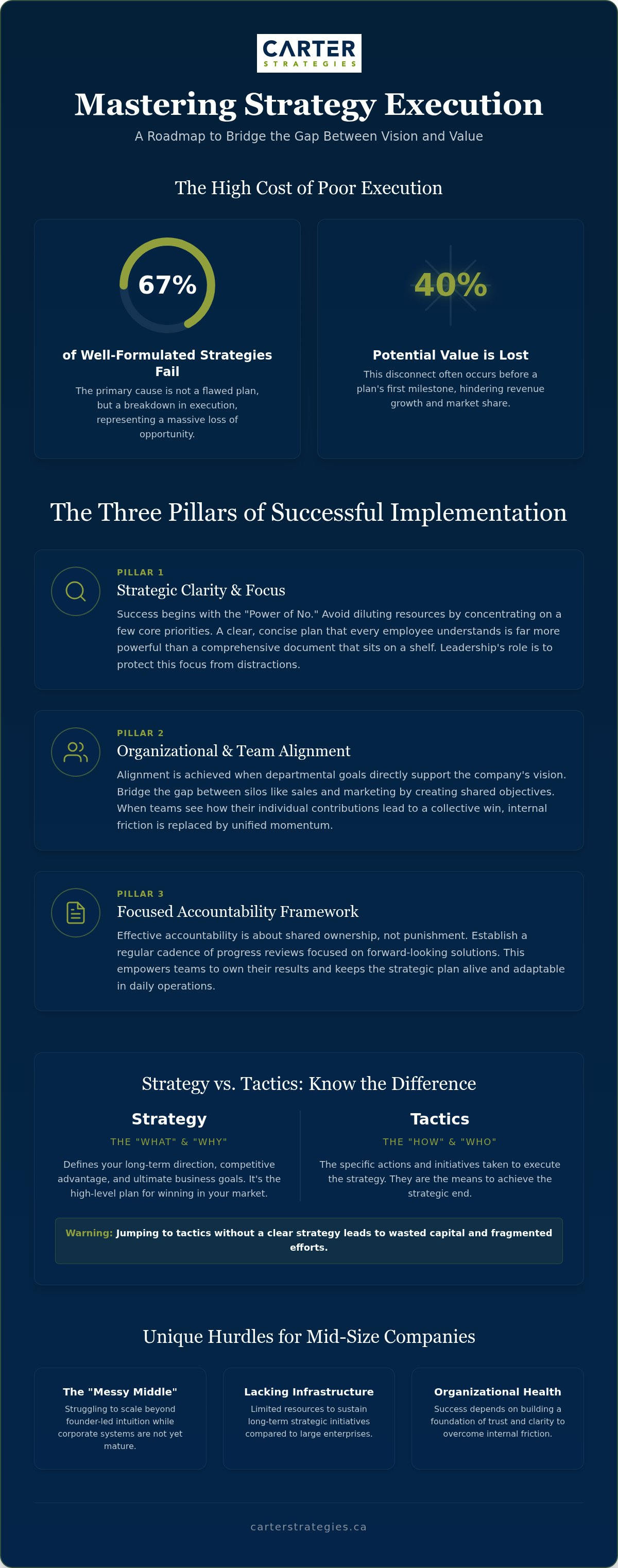
Research shows that 67 percent of well-formulated strategies are unsuccessful because of poor execution. This disconnect frequently results in a 40 percent loss of potential value before a plan even reaches its first milestone. For many mid-size leaders, strategy execution feels like a constant battle against organizational friction. Vision often evaporates the moment it hits the front lines. You've likely felt the frustration of a brilliant roadmap becoming shelfware while your team remains bogged down in daily firefighting.
It's exhausting to realize that despite having a solid plan, your revenue growth remains inconsistent and your team's priorities aren't aligned. You know that a plan is only as good as the people who believe in it and the systems that support them. This article will show you how to bridge the gap between executive planning and daily operations to realize your company's full growth potential. We'll explore a pragmatic roadmap for implementation that builds high team accountability and ensures your strategic vision translates into measurable market share.
Key Takeaways
- Transform your vision into reality by mastering strategy execution, a systematic process that prioritizes organizational health over simple metric tracking.
- Recognize the unique hurdles mid-size companies face when moving from founder-led intuition to a more structured, strategy-led growth model.
- Build a foundation for success by focusing on the three essential pillars: strategic clarity, team alignment, and consistent accountability.
- Bridge the gap between high-level planning and daily operations by cascading clear objectives to every level of the organization.
- Explore how fractional CMO and CRO services provide the executive-level oversight needed to maintain momentum and accelerate implementation.
Defining Strategy Execution in the Canadian Mid-Market
Strategy execution is the systematic process of turning a high-level vision into operational reality. It's the engine that converts abstract goals into tangible results. While many leaders treat planning as a one-time event, true execution is a continuous discipline. It requires moving beyond "shelfware" strategies, those beautifully bound binders that gather dust on a shelf, and adopting living frameworks that guide daily decisions. When execution is integrated into the culture, the plan becomes a roadmap for every employee rather than a secret held by the board.
Mid-size companies face unique hurdles in this area. Unlike startups that pivot on a dime or large enterprises with massive resources, mid-market firms often lack the infrastructure to sustain long-term initiatives. They frequently struggle with the "messy middle" of growth, where founder-led intuition no longer scales but corporate systems haven't yet matured. Success here depends on organizational health. Without a foundation of trust and clarity, even the most sophisticated strategy execution will stall under the weight of internal friction.
The Difference Between Strategy and Tactics
A common mistake is conflating strategy with tactics. Strategy defines the "what" and "why" of your business direction. Execution identifies the "how" and "who." Jumping straight into tactical marketing execution without a strategic foundation often leads to wasted capital and fragmented efforts. You might see busy teams and high activity, but without alignment, that energy doesn't move the needle toward your actual goals. The Execution Gap is the distance between leadership intent and employee action.
Why Execution is the Real Competitive Advantage
Ideas are cheap. Most companies in your industry have similar goals and access to the same market data. The winners are those who can organize their teams to deliver consistently. Research indicates that 67 percent of well-formulated strategies fail due to poor strategy execution. This makes the ability to implement a rare and powerful competitive advantage. Consistent execution creates long-term revenue stability because it removes the guesswork from growth and allows you to capitalize on market opportunities faster than your peers.
A successful outcome begins with how you frame the plan. Effective Business Strategy Development sets the stage by ensuring your goals are realistic and your team is ready for the transition. When you prioritize implementation as much as formulation, you turn your strategy into a living part of your company's DNA. This alignment ensures that every dollar spent and every hour worked contributes directly to your ultimate vision for growth.
The Three Pillars of Successful Strategy Implementation
Successful strategy execution relies on more than just a well-crafted document. It requires a stable foundation built on three concurrent pillars: Strategic Clarity, Team Alignment, and Focused Accountability. For mid-market leaders, the challenge lies in constructing these pillars without overwhelming a team that is already operating at capacity. This transition requires a distinct shift in leadership. While planning demands visionary thinking, implementation requires a pragmatic, people-centric approach that prioritizes organizational health over mere data tracking.
Pillar 1: Strategic Clarity and Focus
Clarity begins with the "Power of No." Many companies fail because they attempt to pursue too many initiatives at once, diluting their resources and confusing their staff. A 50-page strategic plan is often less effective than a single page that outlines three core priorities every employee can recite. The CEO's primary responsibility throughout the fiscal year is to act as a filter. By protecting these priorities from the "shiny object syndrome" that often plagues growth-oriented firms, leadership ensures the team remains focused on what truly drives value.
Pillar 2: Organizational and Team Alignment
Alignment occurs when every department's specific goals directly support the broader business strategy. In many mid-size firms, friction between sales and marketing teams acts as a significant barrier to progress. Marketing may focus on lead volume while sales prioritizes deal size, leaving the actual strategy unsupported. Bridging the gap between vision and execution requires unifying these silos through shared objectives. When teams understand how their daily work contributes to the collective win, internal friction decreases and implementation speed increases.
Pillar 3: The Accountability Framework
Effective accountability is not punitive; it is an exercise in shared ownership. Instead of using performance indicators as a tool for micromanagement, use them to empower your team to own their results. Establishing a regular cadence, such as weekly progress reviews or monthly strategic check-ins, keeps the momentum alive. These sessions should focus on forward-looking solutions rather than historical post-mortems. If your leadership team needs a steady hand to guide this transition, exploring Fractional CMO and CRO services can provide the necessary oversight to maintain this accountability without adding permanent overhead.
Why Most Strategic Plans Fail to Realize Their Potential
Strategic failure is rarely the result of a poor idea. Instead, it stems from the inability to translate that idea into a repeatable operational process. In many Canadian mid-market firms, the primary obstacle is the "whirlwind" of daily operations. When the pressure of immediate client demands meets a complex long-term plan, the daily tasks almost always win. This tension is particularly acute during the transition from founder-led to strategy-led growth. Founders often rely on intuition and personal drive, but as a company scales, those traits must be replaced by a robust framework for strategy execution.
Ambiguity acts as the silent killer of implementation. When plans use subjective qualifiers like "improving customer experience" or "enhancing brand value" without defining the specific metrics for success, employees are left guessing. This lack of clarity creates a Marketing Leadership Gap. Many mid-size companies employ talented tactical doers who can manage social media or run ads, but they lack a strategic architect who can connect those actions to the overarching business goals. Without this bridge, tactical efforts remain disconnected from the company's financial objectives.
The Complexity Trap
A plan with 20 priorities is actually a plan with zero priorities. Over-complexity is a common pitfall where leadership teams attempt to solve every organizational issue simultaneously. This approach dilutes focus and exhausts the team. To succeed, you must simplify strategic language so it resonates with employees on the front lines. Pragmatic simplicity is a necessity. If a staff member cannot explain how their work supports a core priority in two sentences, the plan is too complex to execute. Research indicates that in 86 percent of companies, most employees cannot name their company's strategy, highlighting a massive failure in communication and focus.
The Human Element: Ignoring Buy-In
Strategies imposed from the top down without collaborative input often fail because they ignore the human element of change. Execution requires more than just compliance; it requires ownership. When employees feel that a strategy is "done to them" rather than "developed with them," internal resistance builds. This friction is often invisible until projects begin to stall. Successful leaders mitigate this by involving key stakeholders early in the process. By fostering a sense of shared accountability, you ensure that the people responsible for the work actually believe in the path forward. A plan is only as strong as the team's commitment to realize it.
Five Steps to Synchronize Your Team with Your Strategy
Strategy execution requires a shift from abstract vision to a synchronized operational rhythm. It's about ensuring every part of the machine moves in harmony toward the same destination. To achieve this, mid-market leaders must move beyond the planning phase and focus on the practical synchronization of their people and resources. Follow these five pragmatic steps to bridge the gap between your boardroom and your front lines.
- Commit to a limited number of strategic priorities: Avoid the temptation to fix everything at once.
- Cascade objectives: Translate executive goals into individual daily tasks.
- Establish a Cadence of Accountability: Maintain momentum through structured, brief check-ins.
- Align resources: Ensure your budget and talent are actually assigned to your new priorities.
- Measure lead indicators: Focus on the activities that predict future success.
Cascading Objectives for Maximum Impact
Alignment fails when departments operate in silos. Synchronization occurs through the process of translation. A high-level revenue goal must be translated into specific marketing priorities and daily sales activities. When this cascade is clear, every team member can answer a critical question: "How does my daily work impact our strategy?" Siloed departments often focus on their own functional metrics, but synchronized teams focus on the collective win. This clarity ensures that effort isn't just activity; it's progress. It requires leadership to communicate not just the goal, but the specific role each person plays in reaching it.
Identifying Lead vs. Lag Indicators
Most leaders focus on lag indicators like revenue and profit. While these numbers tell you the score, they represent the past. Lead indicators, such as the number of qualified leads generated or the rate of customer engagement, allow you to influence the game while it's still being played. For a mid-market revenue strategy, a lag indicator is your quarterly sales total. A lead indicator is the volume of high-value consultations booked this week. By tracking the activities that predict success, you can adjust your tactics before the quarter ends. This proactive approach allows you to realize growth potential by fixing issues in real time.
Aligning resources is often the most difficult hurdle. It requires the courage to stop funding legacy projects that no longer serve the strategy. If your talent and budget remain tied to old habits, your new plan will starve. Similarly, a cadence of accountability transforms the strategy from a document into a habit. These are brief, structured check-ins focused exclusively on the progress of strategic initiatives. If your current leadership team is stretched thin, Fractional CMO and CRO services can provide the expertise needed to manage this synchronization and drive measurable growth.
Leveraging Fractional Leadership to Accelerate Execution
Mid-size companies often reach a plateau where their existing leadership team is stretched too thin to manage both daily operations and long-term growth. They have the talent to maintain current performance but lack the executive capacity to drive a significant transition. This is where fractional CMO and CRO services provide the strategic architect your organization likely lacks. A fractional leader doesn't just offer advice; they act as a bridge that connects high-level vision to the daily activities of your team. This model allows you to access battle-tested expertise without the long-term overhead of a full-time executive hire. It's a pragmatic solution for businesses that need to stabilize their strategy execution while maintaining a lean operational structure.
A fractional leader acts as a Strategic Guide, ensuring that the team remains focused on the priorities established during the planning phase. They bring an outside perspective that is often immune to internal politics, allowing them to identify and resolve friction points that full-time staff might overlook. Carter Strategies partners with businesses that need this level of high-level oversight to scale without overwhelming their current teams. We provide the steady hand needed to turn a plan from a static document into an energetic, forward-looking operational framework.
When to Hire a Fractional CMO or CRO
Identifying the right time for fractional support is critical for maintaining momentum. Common triggers include stagnant revenue growth, persistent silos between sales and marketing, or a strategic plan that simply isn't translating into daily action. If your leadership team spends more time firefighting than focusing on growth, you likely have a leadership gap. A fractional executive bridges this gap by translating high-level planning into tactical priorities that your team can actually deliver. For a deeper look at how this role functions within your organization, consult The Fractional CMO Guide for Canadian Mid-Market Leaders.
The ROI of Strategic Alignment
The long-term value of fractional leadership lies in the creation of a repeatable, scalable growth engine. Having a seasoned expert in the trenches with your team ensures that your business strategy development efforts actually lead to organizational success. This isn't about temporary fixes; it's about building the internal capacity for sustained performance. When your team is aligned and your priorities are clear, the cost of the fractional engagement is quickly offset by increased efficiency and market share. If you're ready to bridge the gap between your vision and your results, we invite you to contact Carter Strategies to discuss aligning your team for growth.
Turning Your Strategic Vision into Operational Reality
Strategy is a commitment to your company's future, but strategy execution is the daily work that makes that future possible. Success requires moving beyond static documents to build a culture of shared accountability and organizational health. By simplifying your priorities and cascading them through every level of your team, you eliminate the friction that stalls most mid-market growth plans. This transition from founder-led intuition to a strategy-led framework is the most significant hurdle your business will face as it scales. It's time to realize your full growth potential by putting people at the centre of your implementation process.
You don't have to navigate this transition alone. As a seasoned authority in mid-market growth, Carter Strategies provides the specialized fractional CMO and CRO expertise needed to keep your team aligned and focused on high-value priorities. We help you bridge the gap between high-level planning and boots-on-the-ground action to ensure your vision translates into measurable revenue and market share. Ready to turn your plan into results? Discover how Carter Strategies bridges the gap between vision and execution.
Your growth potential is within reach. With the right alignment and a steady hand to guide the process, your strategic plan will become the engine that drives your company forward.
Frequently Asked Questions
What is the difference between strategy formulation and strategy execution?
Strategy formulation involves identifying your market position and long-term goals. It's the "what" and "why" of your business direction. Strategy execution is the systematic process of turning those high-level plans into daily operational reality. While formulation happens in the boardroom, execution happens on the front lines. Success requires a bridge between these two phases to ensure that leadership's intent actually translates into employee action and measurable growth.
Why do most strategic plans fail to get implemented?
Most plans fail because they are too complex or lack internal buy-in. When a company attempts to juggle 20 priorities at once, it effectively has zero. Additionally, the daily whirlwind of operations often consumes the energy required for long-term change. Without a structured framework to maintain focus, strategic initiatives are pushed aside by immediate client demands. Research suggests that 67 percent of well-formulated strategies fail due to these internal execution hurdles.
How long does it typically take to see results from a new strategy execution framework?
You can often see shifts in team alignment and clarity within the first 30 to 60 days. However, measurable growth in revenue or market share typically takes six to twelve months of consistent strategy execution. The timeline depends on the complexity of your market and your team's ability to adopt new habits. Quick wins in operational efficiency usually appear first, followed by the long-term financial results as your new systems mature and scale.
What are the most important performance indicators for strategy execution?
Focus on lead indicators rather than just lag indicators. Lag indicators, like quarterly revenue or profit margins, tell you the final score but don't help you influence the game. Lead indicators are predictive activities, such as the number of qualified sales meetings or specific project milestones reached. By tracking these active metrics, your leadership team can identify potential roadblocks early and adjust tactics before they impact your year-end financial results.
How can a mid-size company align its employees with a new company strategy?
Alignment starts with simplifying your strategic language so it resonates with every staff member. You must move beyond corporate jargon to explain how each person's daily work contributes to the company's top three priorities. Cascading objectives from the executive level down to individual contributors creates a sense of shared ownership. When employees understand the "why" behind the strategy, they are more likely to stay focused on the "how" during their daily tasks.
Is a fractional CMO or CRO responsible for executing the strategy or just designing it?
A fractional leader is responsible for both designing the roadmap and overseeing its implementation. Unlike a traditional consultant who might deliver a report and leave, a fractional CMO or CRO acts as a strategic guide within your team. They bridge the gap between high-level planning and tactical delivery. Their role is to ensure that your marketing and revenue strategies stay aligned with your growth goals while coaching your internal team to maintain momentum.
How do we maintain strategic focus when daily operational fires occur?
Establishing a "Cadence of Accountability" is the best way to protect your strategic priorities. This involves brief, structured weekly check-ins that focus exclusively on strategic progress, not daily operations. By separating these conversations, you ensure that long-term goals don't get buried by immediate crises. It also requires the "Power of No," where leadership actively chooses to pause or decline projects that don't support the core strategic vision.
What role does leadership alignment play in successful execution?
Leadership alignment is the essential prerequisite for any successful implementation. If the executive team isn't unified on the company's top priorities, that confusion will cascade through the entire organization. Every department's goals must support the same overarching strategy to prevent internal silos and wasted resources. A unified leadership team provides the stabilizing force necessary to guide the company through complex transitions and ensure that everyone is moving in the same direction.


