

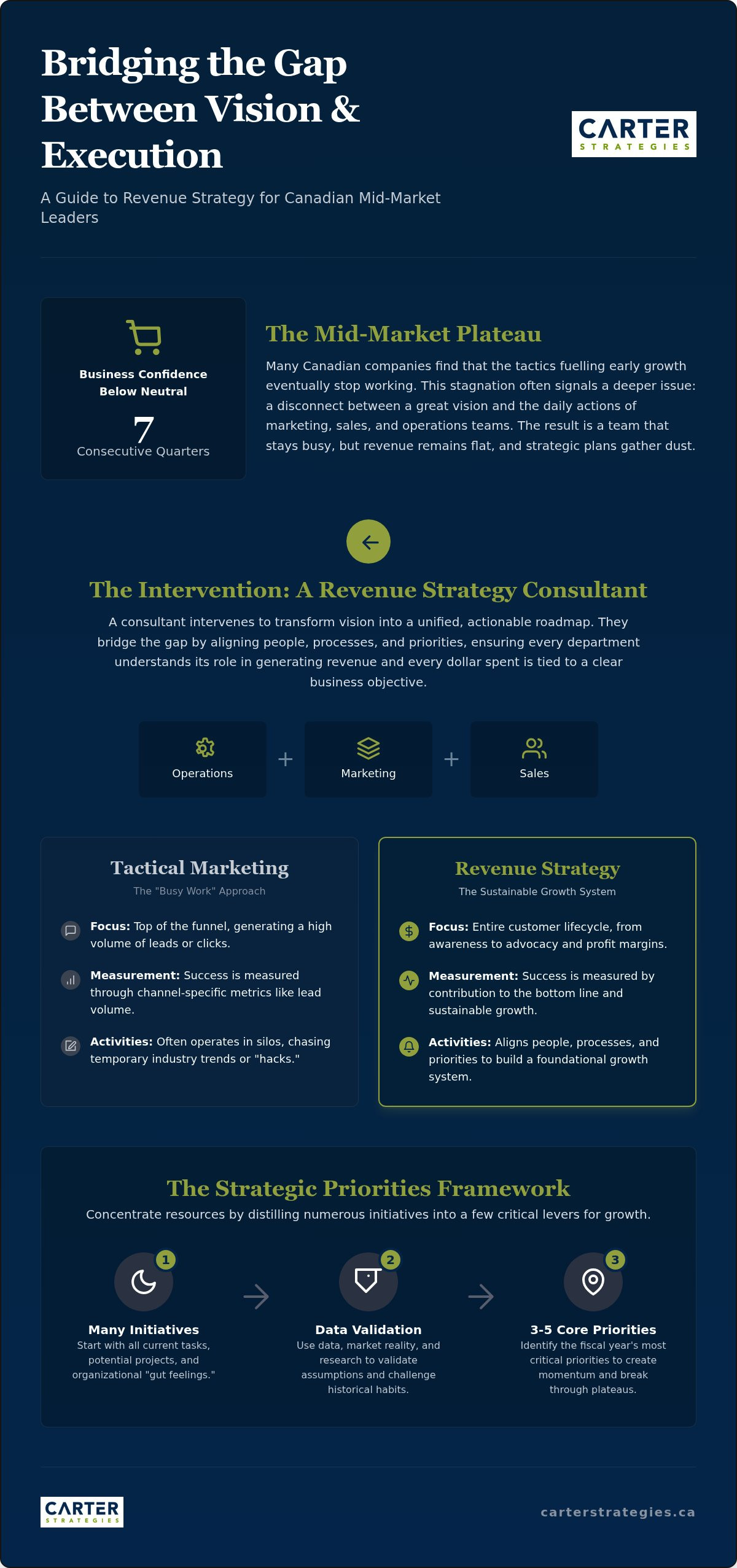
Most strategic plans fail not because the vision is flawed, but because the organization lacks the alignment required to realize it. You likely feel the frustration of watching a growth plan go unused while your marketing and sales teams move in different directions. It is difficult to lead a team that stays busy but remains unfocused on the priorities that contribute to the bottom line. You aren't alone; business confidence in Canada has remained below neutral for seven consecutive quarters as leaders manage economic uncertainty. This is where a revenue strategy consultant intervenes, transforming a vision into a unified, actionable roadmap that your entire executive team supports.
We explore how to bridge the gap between planning and execution by fostering organizational health and leadership alignment. You will discover a methodology for sustainable growth that moves beyond temporary tactical changes to create a stable business. We discuss how to organize your resources to ensure your 2026 goals are implemented through your people. This guide provides the clarity needed to turn a static document into a practical system for revenue growth.
Key Takeaways
- Learn how a revenue strategy consultant unifies marketing, sales, and operations to identify growth opportunities that purely tactical approaches often overlook.
- Master a framework for narrowing your focus to the three to five core priorities that drive sustainable revenue rather than chasing temporary hacks.
- Identify the internal friction that causes strategic plans to fail and learn how to bridge the gap between high-level vision and boots-on-the-ground execution.
- Discover how the fractional CMO and CRO model provides mid-market leaders with executive-level strategic leadership in a pragmatic, cost-effective way.
- Recognize the difference between career academics and battle-tested practitioners to ensure your consultant can navigate the unique scaling challenges of a Canadian mid-size company.
What is a Revenue Strategy Consultant and Why Does Your Organization Need One?
Mid-market companies in Canada often reach a point where the tactics that fueled early growth stop working. This plateau signals that the organization has outgrown its current structure. As firms approach the $20 million revenue mark, a threshold where Innovation, Science and Economic Development Canada notes a shift in financial performance needs, a revenue strategy consultant identifies growth opportunities by aligning the functions of marketing, sales, and operations. Unlike a tactical agency that focuses on a single channel, this role focuses on the "why" and "how" of growth. They ensure that every dollar spent ties to a clear business objective.
This approach is grounded in the principles of Strategic Management, focusing on the formulation and implementation of major goals. The consultant acts as the link between a CEO's vision and the team's daily execution. Without this link, ideas stall because the people on the ground lack the roadmap or the resources to realize them. It is about creating a unified front where every department understands its role in the larger system of generating income.
The Difference Between Tactical Marketing and Revenue Strategy
Tactical marketing focuses on the top of the funnel, measuring success through lead volume or clicks. Revenue strategy takes a broader view, examining the entire customer lifecycle and the resulting profit margins. It is a shift in perspective. Before you commit to any marketing spend, business strategy development must take place to prevent wasted resources. Revenue strategy is the alignment of people, processes, and priorities. It builds a foundation that supports sustainable growth rather than chasing temporary industry trends.
When Mid-Market Leaders Should Seek Strategic Advisory
If your team is busy but revenue remains flat, you have likely hit a strategic ceiling. This stagnation often manifests as marketing activities that lack coordination and do not contribute to a cohesive growth framework. You might see marketing generating leads that sales cannot close. A revenue strategy consultant helps you cut through this noise to prioritize the initiatives that drive the most impact. They bring the clarity needed to stop distractions, ensuring your organization moves forward with collective purpose and a clear centre of focus.
The Strategic Priorities Framework: How Consultants Organize Growth
Strategic focus requires the ability to stop tasks that do not contribute to long-term health. For mid-market leaders, the primary barrier to growth is the dilution of resources across too many initiatives. A revenue strategy consultant introduces a framework to identify the top three to five priorities for the fiscal year. This concentration of effort ensures that your best people don't stretch themselves thin across twenty different tasks that yield marginal results. By aligning organizational resources behind a few critical levers, you create the momentum necessary to break through revenue plateaus.
Consultants use data to validate assumptions before any capital is deployed. Instead of relying on gut feel or historical habits, they set performance indicators based on market reality. This approach transforms vague ambitions into a concrete roadmap that the entire executive team supports. If you want to refine your path forward, engaging in growth strategies and planning provides the external perspective needed to separate genuine opportunities from distractions. It acts as a stabilizing force capable of bringing order to complex transitions.
Identifying Your Top Strategic Priorities
The process of distilling complex business challenges into clear goals requires a shift in mindset. "More revenue" is a result, not a strategy. A true strategy defines how you will win in your specific market. This involves choosing customer segments to prioritize and internal processes to optimize. Every choice grounds the growth plan in research to ensure it survives contact with reality. This evidence-based methodology prevents the organization from chasing uncoordinated activities that don't contribute to the bottom line.
Aligning Teams with Company Strategy
Strategy fails when the team doesn't understand their role in the bigger picture. Successful Strategy Execution depends on every department seeing the connection between their daily tasks and the company's fiscal goals. A revenue strategy consultant facilitates workshops that move beyond simple communication to build shared accountability. These sessions allow teams to voice concerns and contribute to the solution, which increases internal buy-in. You can learn more about this process in our guide on Bridging the Gap Between Vision and Execution. When a team is aligned, they work on the right things with a sense of collective purpose.
Why Strategic Plans Fail: Bridging the Strategy-Execution Gap
Strategic plans often become "shelf-ware" because they lack a connection to the daily reality of the workforce. You've seen the beautiful slide decks that take weeks to prepare only to be forgotten once the quarterly meeting ends. This isn't a failure of intelligence; it's a failure of implementation. A revenue strategy consultant looks beyond the spreadsheets to identify the specific internal friction points slowing your progress. They understand that a plan is only as good as the people who believe in it. Moving from a cold financial exercise to a model of employee ownership is the only way to ensure growth lasts.
Execution requires more than just a list of goals. It demands a fundamental shift in how the organization operates. When leadership focuses solely on metrics without considering the human element, the plan loses its momentum. A seasoned consultant acts as a stabilizing force, bringing order to the transition by ensuring that the "why" behind the strategy is as clear as the "what." This creates a environment where progress is measured not just by financial gains, but by the health and alignment of the entire team.
Overcoming Common Barriers to Growth
Siloed departments act as the primary anchor for mid-market companies. When sales and marketing operate with different definitions of success, the organization wastes energy on internal friction instead of market expansion. Another common pitfall is the "shiny object" syndrome. Leaders often chase new tactics because they feel productive, even if those actions don't align with the roadmap. Understanding the 5 Common Reasons Why Strategic Plans Fail helps you anticipate these hurdles before they derail your 2026 goals. A disciplined approach ensures that every team member stays focused on the agreed-upon priorities.
Securing Employee Buy-in for New Strategies
The human element is the most critical part of any revenue strategy. Employees won't support a plan they don't understand or feel a part of. To bridge the execution gap, you must communicate the strategy in a way that shows every person their specific impact on the bottom line. This isn't about top-down mandates; it's about fostering a culture of shared accountability. When people see how their work contributes to the company's health, they move from being passive participants to active owners of the results. A revenue strategy consultant facilitates this transition by translating high-level goals into the practitioner's vocabulary used on the front lines. This alignment creates a steady rhythm of progress that doesn't rely on constant executive intervention.
Evaluating a Revenue Strategy Consultant: A Framework for Canadian Leaders
Choosing the right advisor is a high-stakes decision that determines whether your growth plan succeeds or stalls. You don't need a career academic who relies on theoretical models; you need a practitioner who has navigated the specific plateaus of a mid-market company. A revenue strategy consultant must demonstrate the ability to speak the language of the executive suite while remaining accessible to the front-line team. This dual-fluency ensures that the strategy doesn't just look good on paper but actually resonates with the people responsible for its daily execution.
Assess their methodology carefully to ensure it isn't a generic template disguised as a custom solution. Every mid-size firm faces unique scaling challenges, from resource constraints to cultural shifts. A seasoned advisor brings empathy to the table, recognizing the internal friction and pressure your team feels when asked to pivot. They should act as a stabilizing force, providing a grounded, results-oriented approach that emphasizes shared accountability rather than just delivering a static report.
The "Peer-to-Peer" Consulting Model
Mid-market CEOs often find themselves caught between small-scale tactical agencies and large-scale management firms. The most effective partner is one who operates on a peer-to-peer level, acting as a strategic guide rather than a cold vendor. This model relies on seasoned authority to navigate complex organizational transitions. You can spot the difference by looking at their focus. A strategic partner prioritizes organizational health and long-term alignment, whereas a tactical vendor will quickly pivot to selling low-level execution services. True strategy is about the architecture of growth, not just the tools used to achieve it.
Key Questions to Ask During the Discovery Process
To find a consultant who truly understands your needs, move beyond the sales pitch and ask direct, pragmatic questions about implementation. Focus on how they handle the human element of corporate growth. Consider asking the following:
- How do you ensure our team actually follows through on the plan after the initial workshops?
- What is your specific approach to aligning marketing and sales under a single, unified revenue goal?
- Can you show us how you've helped other mid-size firms scale their operations without overwhelming their existing staff?
The best solutions are uncovered through collaboration rather than imposed from the top down. If you're ready to move beyond tactical hacks and build a sustainable roadmap, exploring business strategy development with a battle-tested partner can provide the clarity you need to scale effectively.
The Fractional CMO and CRO: A Pragmatic Solution for Growth
Mid-market leaders often find themselves in a difficult position. They need high-level expertise to scale, but hiring a full-time executive can be a heavy financial burden. The fractional model offers a pragmatic solution. A revenue strategy consultant acting as a fractional CMO or CRO focuses on building the strategic architecture your business needs. This isn't about managing daily social media posts; it's about ensuring your revenue engine is built to last. This role acts as a bridge, ensuring that the vision you've created actually reaches the internal team responsible for execution. For a deeper look at this model, read The Fractional CMO Guide for Canadian Mid-Market Leaders.
When to Choose Fractional Leadership Over a Full-Time Hire
Companies generating between $10 million and $100 million in revenue often face unique scaling challenges. At this stage, the cost of a full-time CMO in Canada typically ranges from $260,000 to $355,000 CAD when you include benefits and recruiting fees. For many mid-market firms, this is a significant overhead that might be better allocated toward growth initiatives. Leveraging a fractional CRO allows you to align your entire revenue engine without the long-term commitment of a full-time salary. It's a strategic choice that prioritizes organizational health. You can explore how this fits into your broader roadmap by reviewing our resource on Growth Strategy and Planning for mid-size businesses.
Accelerating Results with a Strategic Guide
A strategic guide brings order to complex organizational transitions. Implementation speed increases when you have a battle-tested expert leading the charge. They've seen what works. They've seen what fails. They don't need a year to learn the ropes; they start identifying friction points on day one. A revenue strategy consultant ensures that your team stays focused on the priorities that matter most. Strategy is a collaborative journey, not a top-down mandate. It requires a leader who values internal buy-in as much as financial metrics. By choosing a fractional partner, you gain an advisor who acts as a peer to your executive team, ensuring that your 2026 growth plans become a reality through collective effort.
Scaling Your Vision for 2026 and Beyond
Success in the Canadian mid-market requires more than just a well-documented growth plan; it demands a unified team capable of bringing that plan to life. We've explored how identifying three to five core strategic priorities prevents the dilution of resources and ensures your organization moves with collective purpose. By focusing on organizational health and bridging the gap between high-level vision and daily execution, you create a foundation for sustainable revenue that doesn't rely on tactical hacks. A revenue strategy consultant acts as the essential connective tissue in this process, providing the seasoned authority needed to navigate complex transitions while ensuring internal buy-in at every level.
The fractional leadership model offers a pragmatic path for firms to access executive-level expertise without the burden of full-time overhead. It's about finding a battle-tested partner who understands the unique scaling challenges faced by mid-size Canadian companies. If you're ready to move beyond static documents and foster a culture of shared accountability, we invite you to connect with Carter Strategies to align your team and accelerate your growth. Our results-oriented approach focuses on the human element of corporate growth, ensuring your strategy is as strong as the people who execute it. You've built a great business; now let's build the engine to scale it.
Frequently Asked Questions
What is the difference between a business consultant and a revenue strategy consultant?
General business consultants often focus on broad operational efficiencies or financial restructuring. In contrast, a revenue strategy consultant specializes specifically in the intersection of marketing, sales, and operations to drive growth. They build the connective tissue between a CEO's vision and the actual revenue engine. While a generalist might look at overhead costs, this specialist focuses on organizational health and the strategic priorities that directly impact the bottom line.
How long does a typical revenue strategy engagement last?
The duration of an engagement depends on the current state of your organization and the complexity of your growth goals. Typically, the process begins with a deep discovery phase to identify friction points, followed by the development of a strategic roadmap. Many mid-market leaders then transition into a fractional leadership arrangement to ensure the plan is executed effectively. This collaborative approach allows for a flexible timeline that adjusts as your team gains momentum and hits key milestones.
Does a revenue strategy consultant help with the actual marketing execution?
No, a revenue strategy consultant focuses on high-level planning and strategic priorities rather than tactical marketing execution. They don't manage social media accounts, write daily blog posts, or run PPC campaigns. Instead, they provide the strategic architecture and leadership required to ensure your internal team stays focused on the right goals. This distinction ensures the consultant remains a neutral guide focused on long-term organizational health rather than billable execution hours.
How do you measure the ROI of hiring a revenue strategy consultant?
ROI is measured through leadership alignment, the speed of implementation, and the achievement of specific strategic priorities. You'll see a return when your executive team stops working in silos and begins moving toward a unified growth goal. Success is evident when your roadmap moves off the shelf and into the daily habits of your team. These outcomes reflect a shift from busy work to high-impact activities that drive a measurable return on investment.
Can a revenue strategy consultant help if our sales and marketing teams are currently siloed?
Yes, breaking down silos is a core part of the consultant's role. They facilitate workshops and create shared accountability frameworks that align both departments under a single revenue goal. By establishing a unified definition of success, the consultant ensures that marketing generates the specific leads sales can close. This process removes the internal friction that often stalls growth in mid-size companies, allowing for a more energetic and forward-looking organization.
What industries do revenue strategy consultants typically work with?
These consultants work with a wide range of industries across Canada, particularly those in the mid-market sector. This includes business services, technology, and manufacturing firms that have reached a growth plateau. The methodology is less about the specific sector and more about the organizational dynamics of companies scaling between $10 million and $100 million in revenue. The focus remains on bridging the gap between high-level planning and the practicalities of leadership.


