


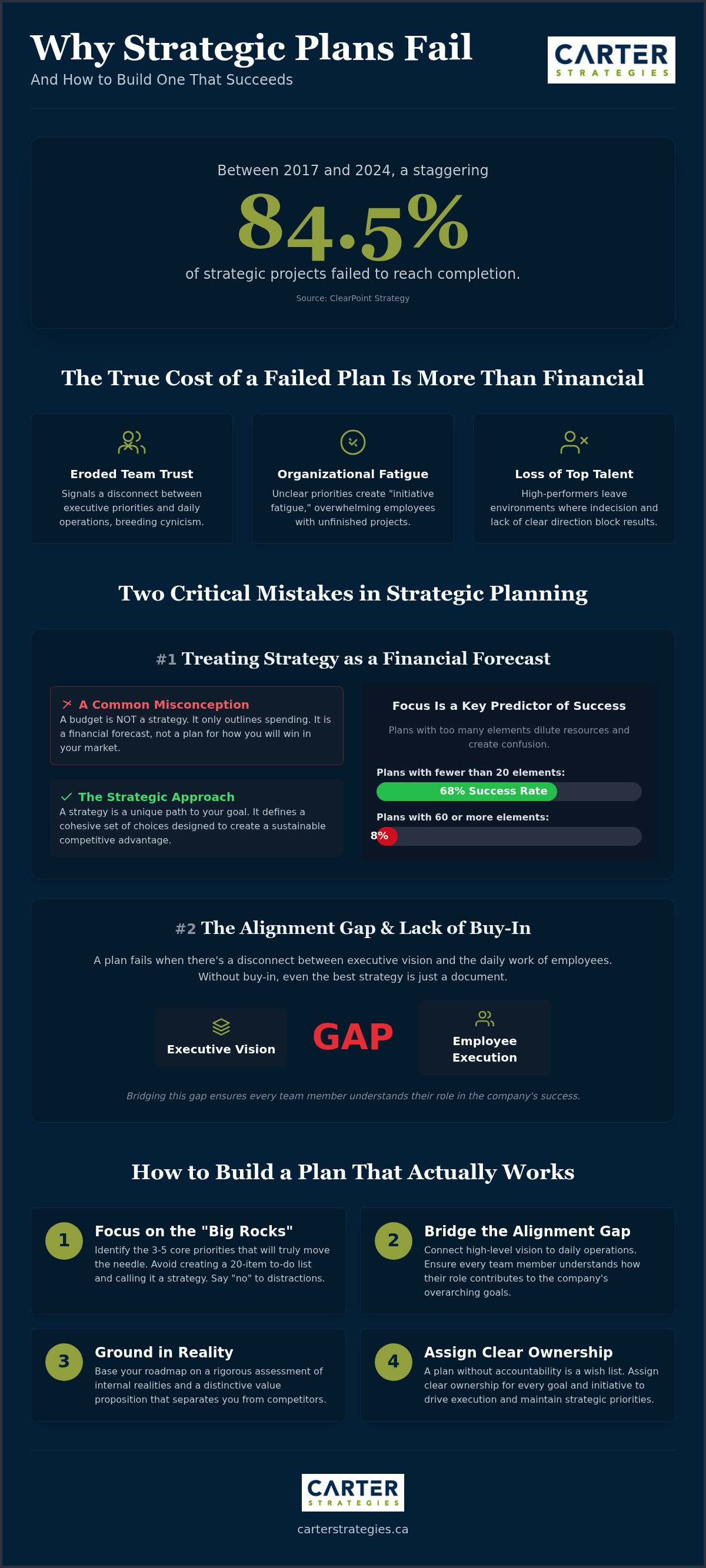
Did you know that 84.5% of strategic projects failed to reach completion between 2017 and 2024, according to research from ClearPoint Strategy? It's a staggering figure that reflects a reality many mid-market leaders know all too well. When you encounter the common strategic planning mistakes to avoid, you often find that valuable time and resources vanish into a document your team doesn't use. It's frustrating to spend weeks refining a vision only to find that six months later, the plan has stalled because of a lack of buy-in or operational alignment.
We understand that the gap between high-level strategy and daily execution is where most growth dies. This guide provides a clear path to building a plan that actually works. You'll discover how to strip away unnecessary complexity, assign clear ownership to every goal, and organize a roadmap that your team will feel motivated to follow. By focusing on organizational health and practical alignment, you can realize measurable, long-term progress instead of watching another plan gather dust.
Key Takeaways
- Understand how failed plans damage team morale and organizational trust far beyond the initial financial investment.
- Learn why confusing a budget with a strategy is one of the most common strategic planning mistakes to avoid if you want to drive real growth.
- Discover how to bridge the gap between executive vision and daily operations to ensure every team member understands their role in the company's success.
- Build a roadmap grounded in a rigorous assessment of internal realities and a distinctive value proposition that separates your brand from competitors.
- Identify the leadership gaps that prevent execution and see how fractional expertise can provide the focus needed to maintain strategic priorities.
The High Cost of Strategic Planning Failure in Mid-Market Companies
A failed strategic plan costs far more than the initial consulting fees or the hours spent in a boardroom. For mid-market leaders, the true damage lies in the erosion of team trust and the loss of organizational momentum. When a plan becomes a "dust-gathering" document, it sends a clear signal to your staff that executive priorities are disconnected from daily operations. This disconnect is one of the most significant common strategic planning mistakes to avoid if you want to maintain a high-performing culture. Mid-market leaders often find that identifying these common strategic planning mistakes to avoid is the first step toward reclaiming their team's focus.
To understand why these efforts stall, we should first clarify What is Strategic Planning? at its core. It is a living framework designed to guide decision-making, not a static annual event. Mid-size companies are uniquely vulnerable when strategy and execution drift apart. They lack the massive capital of enterprise firms to absorb long-term inefficiency, yet they are too large to pivot on a whim like a startup. When the vision fails to translate into action, the company doesn't just stand still; it actively loses ground to more agile competitors.
The Hidden Drain on Organizational Momentum
Unclear priorities create "initiative fatigue," where employees feel overwhelmed by a rotating door of new projects that never reach completion. This exhaustion occurs when leadership fails to define what the company will not do. Misaligned resources between marketing and sales departments further compound this issue, leading to wasted spend and missed revenue targets. When leaders hesitate or change course without a clear strategic anchor, it creates a culture of cynicism. High-performing talent rarely stays in an environment where indecision blocks their ability to achieve meaningful results.
Why Traditional Planning Models Often Fail Mid-Size Firms
Many traditional models are too academic for the pragmatic needs of a mid-market leader. These frameworks often prioritize complex data sets over human alignment, leaving teams confused about how to execute. A frequent error is jumping into tactical marketing execution before the business strategy is set. Without a foundational roadmap, even the most creative marketing campaigns will fail to drive sustainable growth. For a deeper look at how to structure this process, see our guide on Business Strategy Development: A Guide for Canadian Mid-Market Leaders. Successful planning requires a shift from "big-firm" theory to a practitioner's focus on implementation and shared accountability.
Mistake #1: Treating Strategy as a Financial Forecasting Exercise
Many executives mistakenly believe that their annual budget is their strategy. It's a dangerous assumption. A budget outlines what you'll spend; a strategy defines how you'll win. This confusion is among the most common strategic planning mistakes to avoid because it replaces critical thinking with simple arithmetic. When leaders simply add 10% to last year’s targets without changing their approach, they aren't strategizing. They are forecasting. As explored in The Big Lie of Strategic Planning, these spreadsheet-based plans often fail because they ignore the human element of choice and the reality of market competition. Strategy requires making hard decisions about what your company will not do, ensuring that your limited resources focus on the areas with the highest potential for impact.
The Difference Between Goals and Strategy
A goal is your destination, such as reaching a specific revenue milestone. Strategy is the unique path you choose to get there. Specifically, strategy is a cohesive set of choices designed to create a sustainable competitive advantage. Instead of a broad goal like "increase revenue," a strategic approach identifies how you will dominate a specific market segment. This distinction helps your team move beyond abstract numbers to understand the specific actions required to beat the competition. When you define the path clearly, you realize that the numbers are merely a result of your strategic choices, not the strategy itself.
Focusing on Strategic Priorities Over Operational Tasks
One of the biggest risks in mid-market planning is creating a 20-item to-do list and calling it a strategy. This approach leads to resource dilution and team burnout. You must identify the three "big rocks" that will truly move the needle this year. Focusing on these core priorities ensures that your daily operations align with your long-term vision. Plans that include 60 or more elements succeed just 8% of the time, whereas those with fewer than 20 elements have a 68% success rate. To help your team maintain this focus, you can implement a Strategic Priorities Framework. If you find your team struggling to separate daily fires from long-term growth, our business strategy development services can help you organize your efforts around the priorities that drive real value.
Mistake #2: The Alignment Gap and the Lack of Employee Buy-In
A strategic plan is only as effective as the people who believe in it. Many mid-market leaders treat strategy as a private executive exercise, delivering the final product to the rest of the organization as a finished set of instructions. This "top-down" approach almost always meets "bottom-up" resistance. When front-line staff don't see their daily reality reflected in the vision, they view the plan as a distraction from their "real" work rather than a roadmap for success. This disconnect is one of the most common strategic planning mistakes to avoid because it creates a culture of compliance rather than one of commitment.
The human element of corporate growth requires bridging the empathy gap between the boardroom and the front line. Executives often live in a future state, focusing on long-term targets, while staff are grounded in the immediate challenges of the present. According to 2025 data from ClearPoint Strategy, 74% of strategic goals lack a designated owner. This absence of accountability stems directly from a lack of buy-in. If your team doesn't understand the "why" behind the strategy, they won't take ownership of the "how." Connecting individual roles to the high-level corporate vision isn't a soft skill; it's a survival requirement for mid-size firms.
Bridging the Gap Between the Boardroom and the Front Line
Effective communication requires translating executive goals into a language that resonates with every level of the organization. Instead of presenting abstract financial metrics, explain how the new strategy solves specific operational friction. Shared accountability only happens when every employee can see the direct line between their daily tasks and the company's long-term priorities. You can learn more about this process in our guide on Bridging the Gap Between Vision and Execution. When you foster this connection, the strategy becomes a living framework that guides decision-making at every desk.
Securing Ownership Through Collaborative Planning
Involving mid-level managers early in the process ensures the plan is grounded in reality. These leaders provide the "practitioner's voice," highlighting potential execution hurdles that might be invisible from the executive suite. To ensure every department head realizes their role in the new strategy, use this simple alignment checklist:
- Define Ownership: Assign one specific individual to every strategic goal to increase the chance of completion.
- Resource Audit: Confirm that each department has the time and budget to execute their assigned priorities.
- KPI Alignment: Ensure that departmental performance metrics support, rather than contradict, the new strategic direction.
- Feedback Loops: Establish a monthly rhythm for managers to report progress and flag obstacles without fear of reprisal.
By shifting from a top-down mandate to a collaborative model, you transform your plan from a static document into an energetic engine for growth. This inclusive approach is the best way to handle the common strategic planning mistakes to avoid that typically derail mid-market initiatives.
How to Build a Strategic Roadmap That Actually Works
Building a roadmap that your team actually executes requires a shift from idealism to pragmatism. To move past the common strategic planning mistakes to avoid, you must treat your plan as a living document that guides every resource allocation decision. A successful roadmap synchronizes your marketing and revenue strategies, ensuring that your growth engine isn't working in silos. This alignment transforms the strategy from a high-level concept into a clear, actionable path that every department can follow.
Step 1: The Situation Assessment
Cutting corners on data gathering is a recipe for building a plan on false assumptions. A rigorous assessment must include both internal operational realities and external market shifts. You need an "outside-in" perspective to challenge the internal biases that often cloud executive judgment. Before setting new growth targets, evaluate key metrics such as customer acquisition costs, churn rates, and market share. Grounding your plan in evidence is vital. Research shows that 82% of business failures are linked to cash flow problems (Revenue Memo, 2026). If you don't understand your current financial and operational position, your roadmap will lead you in the wrong direction.
Step 2: Defining Your Strategic Focus
The most effective leaders understand the "Power of No." True strategy is about narrowing your focus to the few impactful levers that will truly move the needle. Instead of a sprawling list of objectives, organize your priorities so the whole team understands what comes first. You can find more detail on this in our guide on Growth Strategy and Planning for mid-size businesses. When you limit your focus, you increase the likelihood of success. Research indicates that plans with fewer than 20 elements have a 68% success rate, compared to just 8% for plans with 60 or more items (ClearPoint Strategy, 2026).
Placing accountability at the centre of your process is the final step in creating a functional roadmap. Align your people, time, and budget directly with your priorities to ensure execution. Establish a regular rhythm of review, perhaps monthly or quarterly, to adjust the plan as market conditions change. If your leadership team is struggling to maintain this focus while managing daily operations, our growth strategies and planning services provide the external perspective and accountability needed to keep your roadmap on track. By connecting your high-level vision to a disciplined execution rhythm, you ensure that your strategic goals become operational realities.
Mistake #3: Neglecting the Leadership Gap in Execution
Mid-market companies frequently struggle with a significant capacity problem. While the executive team possesses the vision, they often lack the specialized leadership required to drive complex implementation across departments. This oversight is one of the most common strategic planning mistakes to avoid because it assumes that a team already working at full capacity can suddenly absorb a new, high-stakes workload. Without a dedicated leader to champion the strategy, the plan inevitably slides down the priority list as daily operational fires take precedence.
Research indicates that more than 70% of strategic growth plans fail due to breakdowns in execution rather than flawed ideas (Strategy Ladders, 2025). This failure typically happens because there is no one at the helm with the specific experience to navigate organizational transitions. A "Fractional CMO" or "Fractional CRO" provides a pragmatic solution by bringing seasoned authority to your leadership table. This model allows you to access high-level expertise and a battle-tested perspective without the full-time overhead of a permanent executive hire.
The Role of Fractional Leadership in Strategic Growth
A fractional leader acts as a strategic guide who bridges the gap between high-level planning and tactical execution. They provide an objective, third-party perspective that challenges internal assumptions and keeps the team focused on the priorities identified in your roadmap. This practitioner’s approach ensures that your marketing and revenue strategies aren't just concepts but active drivers of growth. To understand how this model supports your organization, see The Fractional CMO Guide for Canadian Mid-Market Leaders. By embedding this expertise within your team, you realize a more integrated approach to growth that balances financial metrics with human alignment.
Maintaining Momentum After the Planning Session Ends
The "excitement of the retreat" rarely survives the first week back in the office. To maintain momentum, you must transition from the initial high-level vision to the discipline of the daily grind. Strategy is a marathon, not a sprint. It requires a persistent rhythm of accountability that prevents the plan from gathering dust on a shelf. Consider these steps to keep your priorities at the centre of your leadership culture:
- Schedule monthly strategy reviews that focus on measurable progress toward long-term goals rather than just status updates.
- Empower project owners to flag obstacles early, ensuring that leadership can provide the resources needed to clear the path.
- Keep strategic priorities as a standing item on every leadership meeting agenda to reinforce their importance to the entire team.
By filling the leadership gap with fractional expertise, you ensure that your plan receives the consistent attention it deserves. This proactive approach prevents your growth strategy from becoming another casualty of organizational inertia.
Moving Beyond the Static Plan to Real-World Results
Building a successful growth engine requires more than a polished document. It demands a shift from financial forecasting to making hard strategic choices and fostering deep organizational alignment. By identifying the common strategic planning mistakes to avoid, you can bridge the gap between high-level vision and the daily execution that drives revenue. Your plan is only as strong as the people who believe in it and the leaders who have the capacity to guide the transition. Mid-market companies often find that external, battle-tested expertise is the missing link in their growth journey.
Whether you need a disciplined roadmap or high-level revenue guidance, specialized advisory provides the focus your team needs to stay on track. Strategy is a marathon. Ready to build a strategy that actually drives growth? Contact Carter Strategies today. Our fractional CMO and CRO services offer pragmatic, battle-tested strategic advisory tailored specifically for Canadian mid-market growth. You have the vision; now it's time to build the alignment and accountability required to realize your long-term goals.
Frequently Asked Questions
What are the most common reasons strategic plans fail in mid-size companies?
Breakdowns in execution and a lack of clear ownership are the primary reasons these projects fail. Research indicates that 84.5% of strategic projects didn't reach completion between 2017 and 2024. This happens when leaders treat the plan as a static document rather than a living framework. Without assigning specific individuals to every goal, you invite the "phantom owner" phenomenon where no updates occur for months.
How often should a Canadian mid-market company revisit its strategic plan?
Revisit your strategic plan at least quarterly to monitor progress and adjust for market shifts. While a deep situation assessment should happen annually, successful firms treat planning as a continuous process rather than a one-time retreat. This regular rhythm prevents your roadmap from becoming obsolete. It ensures that your team remains aligned with current priorities as internal and external realities evolve throughout the fiscal year.
What is the difference between a business strategy and a marketing plan?
Business strategy defines how your company creates a competitive advantage, while a marketing plan outlines the tactical steps to communicate that value. Strategy involves making hard choices about which markets to enter and which to avoid. A marketing plan follows this lead, selecting specific channels to reach those targets. Confusing the two is one of the common strategic planning mistakes to avoid when aiming for growth.
How can I get my employees to actually care about our strategic priorities?
Connect individual daily tasks to the high-level corporate vision to show employees why their work matters. Staff members care about priorities when they understand how their specific role contributes to the company's success. Use collaborative planning sessions to involve mid-level managers early in the process. This approach builds shared accountability and ensures that the plan reflects the practitioner's reality on the front line rather than just executive theory.
Does a mid-size company really need a strategic consultant?
A strategic consultant provides the objective, third-party perspective necessary to challenge internal biases and identify operational blind spots. Mid-market leaders often face internal friction that makes it difficult to see execution gaps clearly. A consultant acts as a strategic guide, bringing battle-tested experience from other corporate environments. They help organize priorities and ensure that your limited resources focus on the initiatives that will actually move the needle.
What is a fractional CMO, and how do they help with strategy execution?
A fractional CMO is a seasoned marketing executive who provides high-level revenue leadership on a part-time basis. They help with strategy execution by bridging the gap between your growth vision and tactical marketing efforts. This role ensures that your marketing strategy remains aligned with your overall business goals. It provides the specialized leadership needed to maintain momentum without the full-time overhead of a permanent, senior executive hire.
How do we know if our strategic plan is too tactical?
Your plan is too tactical if it resembles a long to-do list rather than a set of strategic choices. Tactical plans focus on what you are doing today, while strategic plans focus on how you will win in the market. If you have 60 or more elements in your plan, you are likely bogged down in operational details. Strategy requires the power of "no" to narrow your focus significantly.
What should be included in a strategic roadmap for growth?
A strategic roadmap must include a rigorous situation assessment, a distinctive value proposition, and clear resource alignment. It should define your core strategic priorities and assign specific owners to every project. This document acts as a tool for team alignment, ensuring that everyone understands the direction. Including a regular review rhythm is another way to handle common strategic planning mistakes to avoid during the implementation phase.


